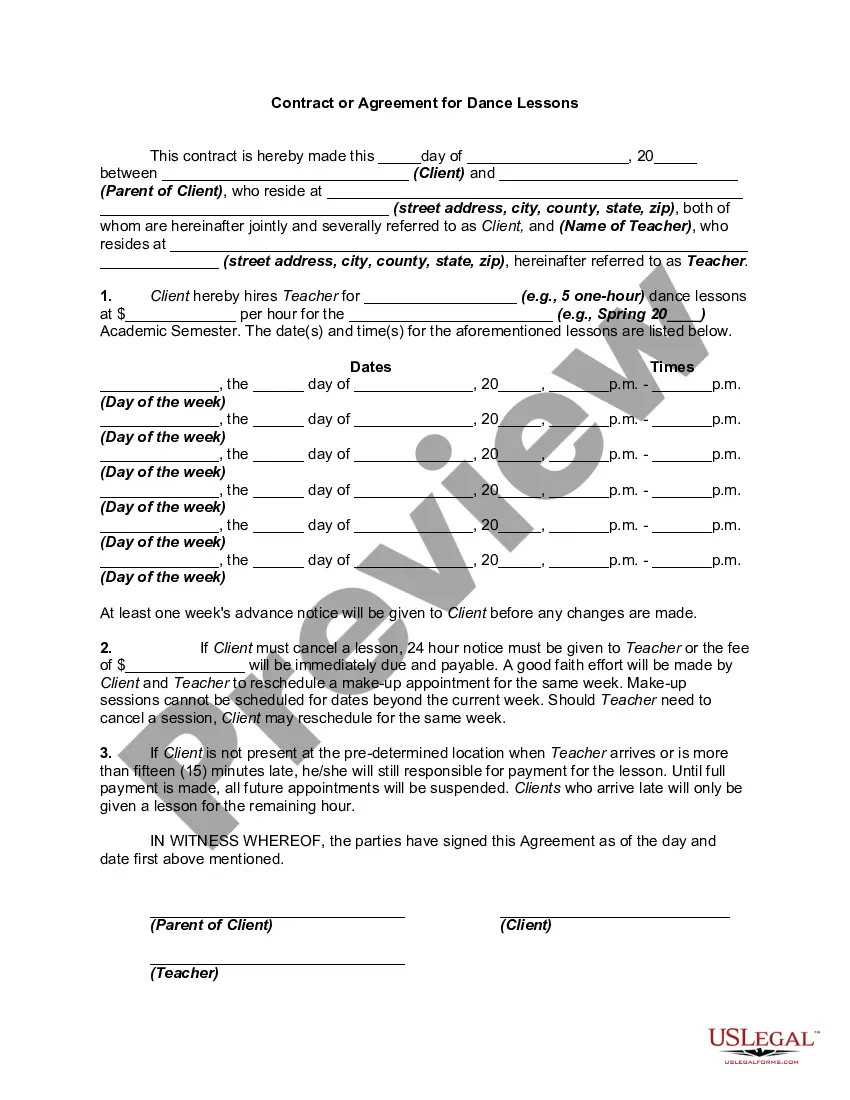
Contract or Agreement for Dance Lessons
Understanding this form
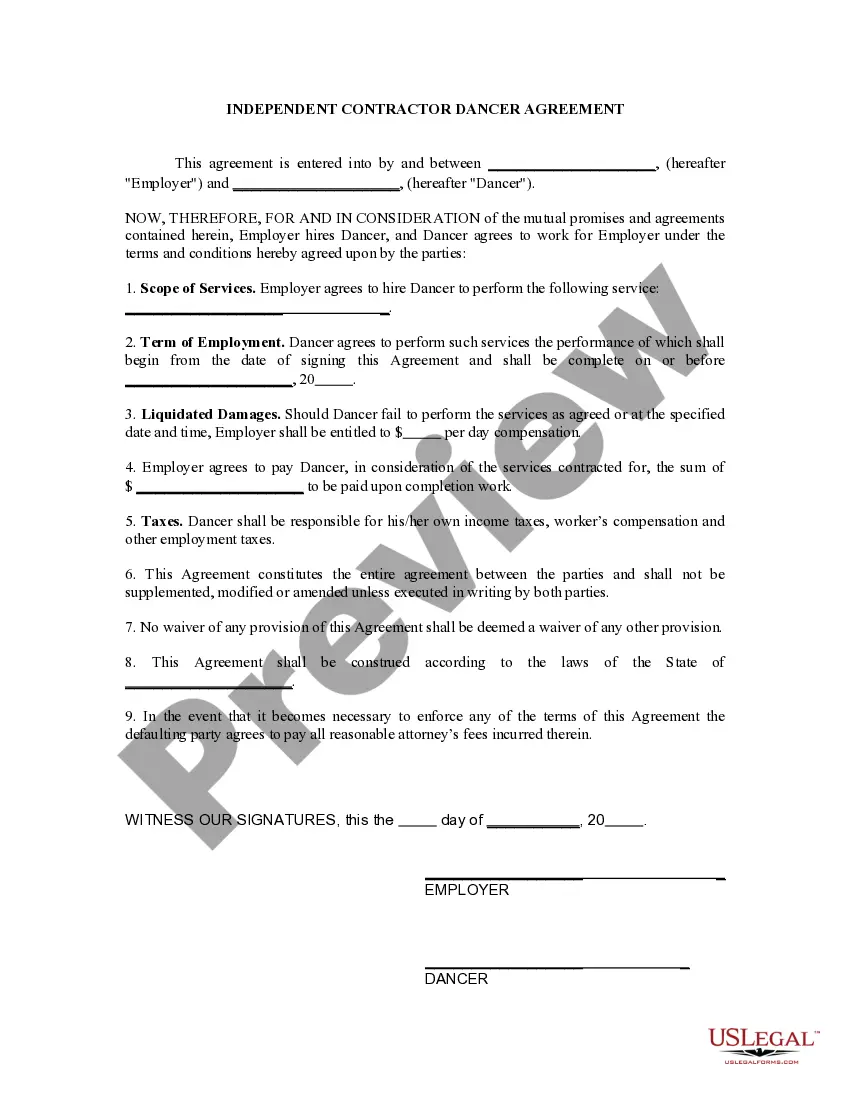
The Contract or Agreement for Dance Lessons is a legal document that outlines the terms of dance instruction provided by a teacher to a student. This contract specifies details such as the number of lessons, scheduling, payment terms, and cancellation policies. It is designed to protect both the client and the teacher by clearly defining their responsibilities, making it distinct from other agreements like informal handshake deals or general service contracts.
What’s included in this form
- Parties involved: Identifies the client (student and parent) and the dance teacher.
- Lesson details: Specifies the number of dance lessons, duration, and rates.
- Schedule: Includes dates and times for scheduled lessons.
- Cancellation policy: Outlines notice periods for cancellations and fees for missed lessons.
- Location: States where the lessons will take place.
Common use cases
This form should be used when a parent or student wishes to formally engage a teacher for dance lessons over a defined period. It is useful when lessons are intended to occur repeatedly, such as weekly or bi-weekly sessions, and helps manage expectations and obligations of both parties in a clear manner.
Who this form is for
- Parents seeking structured dance instruction for their children.
- Individuals interested in taking dance lessons and wanting to formalize the arrangement with a teacher.
- Dance teachers who require a formal agreement with their students or clients.
Instructions for completing this form
- Identify the parties: Fill in the names of the client (student and parent) and the teacher.
- Specify lesson details: Enter the number of lessons and the rate per hour.
- List the schedule: Provide specific dates and times for each dance lesson.
- Outline the cancellation policy: State the notice period required for cancellations and any associated fees.
- Obtain signatures: Ensure that both parties sign the document to validate the agreement.
Does this document require notarization?
Notarization is generally not required for this form. However, certain states or situations might demand it. You can complete notarization online through US Legal Forms, powered by Notarize, using a verified video call available anytime.
Get your form ready online
Our built-in tools help you complete, sign, share, and store your documents in one place.
Make edits, fill in missing information, and update formatting in US Legal Forms—just like you would in MS Word.
Download a copy, print it, send it by email, or mail it via USPS—whatever works best for your next step.
Sign and collect signatures with our SignNow integration. Send to multiple recipients, set reminders, and more. Go Premium to unlock E-Sign.
If this form requires notarization, complete it online through a secure video call—no need to meet a notary in person or wait for an appointment.
We protect your documents and personal data by following strict security and privacy standards.

Make edits, fill in missing information, and update formatting in US Legal Forms—just like you would in MS Word.

Download a copy, print it, send it by email, or mail it via USPS—whatever works best for your next step.

Sign and collect signatures with our SignNow integration. Send to multiple recipients, set reminders, and more. Go Premium to unlock E-Sign.

If this form requires notarization, complete it online through a secure video call—no need to meet a notary in person or wait for an appointment.

We protect your documents and personal data by following strict security and privacy standards.
Typical mistakes to avoid
- Failing to specify lesson dates and times clearly, leading to misunderstandings.
- Not including the cancellation fee, which can lead to disputes if a lesson is missed.
- Neglecting to gather all parties' signatures to make the agreement legally binding.
Why complete this form online
- Convenience of downloading and completing the form from anywhere.
- Editability allows for easy customization to fit specific client-teacher arrangements.
- Reliability of having a professionally drafted document that meets legal standards.
Looking for another form?




Form popularity
FAQ
The general rule is that an individual is an independent contractor if the payer has the right to control or direct only the result of the work and not what will be done and how it will be done. The earnings of a person who is working as an independent contractor are subject to Self-Employment Tax.
For years, it was common for music stores and vibrant music lesson programs to have teachers classified as independent contractors. Friedman and Jobe commented that more stores are flipping their music teachers from independent contractors to employees due to tougher regulations.
Classes still need to be paid for regardless of whether or not your child was in attendance. In fairness to all dancers, classes still need to be paid for if you go on holidays.
Look for Community Classes. First, check with your community. Talk to the Studio Manager. Create Your Own Studio. Search for Discounts and Coupons. Volunteer or Barter. Learn Dance at Any Budget.
In most cases of studio owners I've encountered, your teachers are considered employees, not independent contractors. However, the business of dance studios is a very diverse group when it comes to schedules and employee structures.
$50 - $85 /hr. The average cost for dance lessons is $60 per hour. Hiring a dance instructor to teach you to play the dance, you will likely spend between $50 and $85 on each lesson. The price of dance lessons can vary greatly by region (and even by zip code).
Private Dance Lessons Even though they are expensive, private lessons are worth it. It offers a great way to learn techniques because the teacher has more time to further go into details. For those who are looking to perform or compete, private lessons are the best choice.
Cost Commitment as a Hobby As far as costs for ballet or dance classes as a hobby is concerned, expect to pay somewhere around $60 to $150 per month for tuition, depending on the number of classes your child takes each week and the region you live in.
Teachers are independent contractors only if (a) you do not control or direct how they teach their classes, (b) if teaching yoga is outside of your yoga business, and (c) the teacher has an independent business that is the same as they work they do for you.