Terms and Conditions
Overview of this form
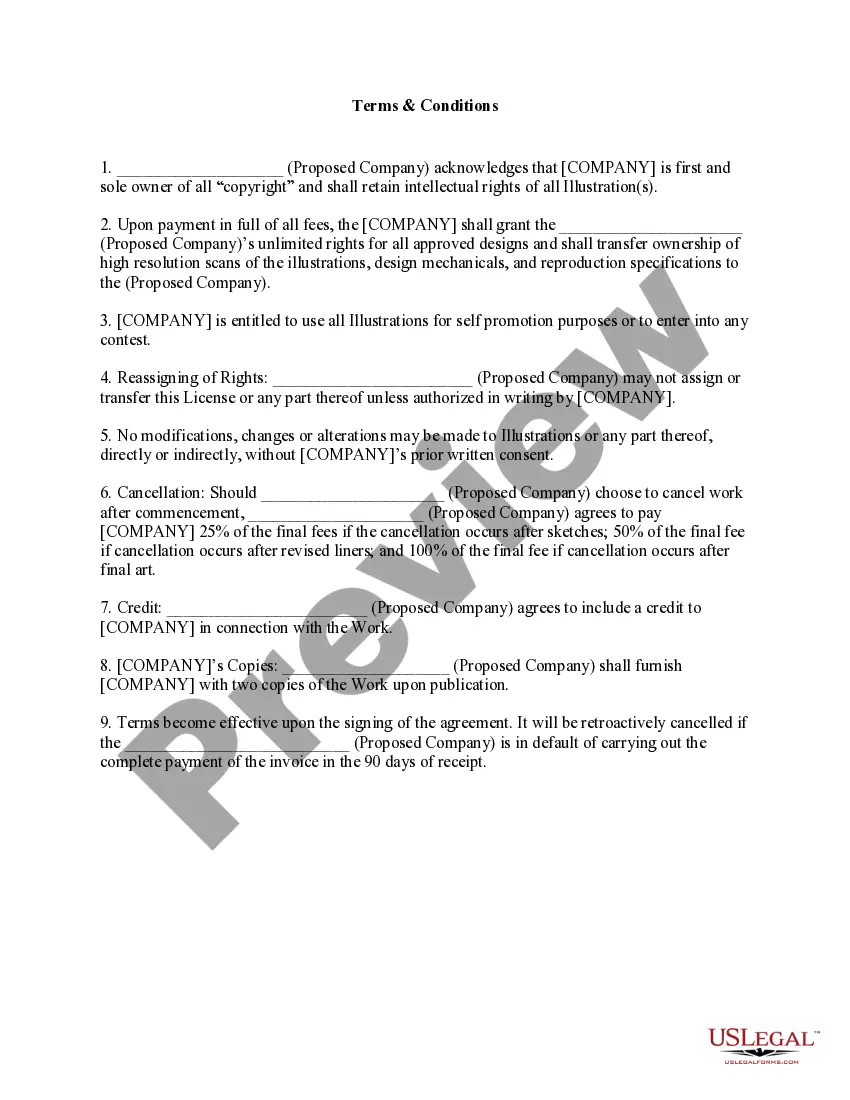
The Terms and Conditions form is a legal document that outlines the agreement between a company and its client regarding the use of creative illustrations and designs. This form serves to protect the copyright and intellectual property rights of the originating company while delineating the rights granted to the client for the approved designs. It is essential for establishing clear expectations and obligations, which makes it distinct from other legal agreements, such as contracts or service agreements.
Main sections of this form
- Copyright ownership and intellectual rights retention
- Transfer of rights upon full payment
- Restrictions on modifying illustrations without consent
- Cancellation fees depending on project stage
- Credit attribution requirements for the originating company
- Effective date of terms and conditions
When to use this document
This form is appropriate to use when a business engages a creative company to design illustrations or other visual content. It should be implemented before any design work begins to ensure both parties are clear on ownership rights, usage permissions, and cancellation policies. Utilizing this form helps prevent potential disputes that may arise regarding the use and modification of creative works.
Intended users of this form
This form is suitable for:
- Businesses and organizations commissioning custom illustrations or designs
- Freelance designers and creative agencies providing design services
- Legal representatives handling contracts for creative services
Instructions for completing this form
- Identify the parties involved: Enter the names of the company and client in the designated fields.
- Specify terms of payment: Clearly outline payment amounts and any conditions that might affect payment.
- Define usage rights: Fill in the specifics regarding the rights granted to the client for using the illustrations.
- Include cancellation policies: Clearly state the fees associated with cancellation at different project stages.
- Sign and date the form: Both parties must sign to make the agreement legally binding and enforceable.
Does this form need to be notarized?
This form does not typically require notarization unless specified by local law. However, it's recommended to check the specific legal requirements in your jurisdiction to ensure its validity.
Get your form ready online
Our built-in tools help you complete, sign, share, and store your documents in one place.
Make edits, fill in missing information, and update formatting in US Legal Forms—just like you would in MS Word.
Download a copy, print it, send it by email, or mail it via USPS—whatever works best for your next step.
Sign and collect signatures with our SignNow integration. Send to multiple recipients, set reminders, and more. Go Premium to unlock E-Sign.
If this form requires notarization, complete it online through a secure video call—no need to meet a notary in person or wait for an appointment.
We protect your documents and personal data by following strict security and privacy standards.

Make edits, fill in missing information, and update formatting in US Legal Forms—just like you would in MS Word.

Download a copy, print it, send it by email, or mail it via USPS—whatever works best for your next step.

Sign and collect signatures with our SignNow integration. Send to multiple recipients, set reminders, and more. Go Premium to unlock E-Sign.

If this form requires notarization, complete it online through a secure video call—no need to meet a notary in person or wait for an appointment.

We protect your documents and personal data by following strict security and privacy standards.
Common mistakes to avoid
- Failing to specify payment details, leading to confusion over fees.
- Not including all parties involved, which may complicate enforceability.
- Overlooking the cancellation policy, causing disagreements if the project does not proceed as planned.
- Not getting proper signatures, rendering the form ineffective.
Advantages of online completion
- Convenient access from anywhere, allowing for quick edits and updates as needed.
- Templates are designed by licensed attorneys, ensuring compliance with legal standards.
- Easy to download and save for future reference, safeguarding your legal documents.
Looking for another form?
Form popularity
FAQ
A Terms and Conditions agreement is where you let the public know the terms, rules and guidelines for using your website or mobile app. They include topics such as acceptable use, restricted behavior and limitations of liability.
When the user accepts the terms ? i.e. checking a box or clicking a button to indicate acceptance ? the Terms and Conditions become a legally binding contract. However, proper presentation and acceptance methods are key to enforceability.
For you to legally enforce your website, application, or business's rules of use, users must first agree to your terms and conditions. Terms and conditions, also known as terms of service or terms of use, are a legal agreement between you and your users that outlines the rules of use for your website, app, or business.
The difference between a Terms & Conditions agreement and EULA agreement is how they address license of use. While the End-User License Agreement (EULA) establishes the right for users to use your software and establishes rules for that use, the Terms & Conditions agreement (T&C) is more extensive.
Terms and conditions refer to the contractual rights and obligations of a party to any contract. They refer to the broader concept of guidelines that parties must follow in an agreement. Your business can create them for any formalized business agreement.
The reality is that there is no legal difference between terms and conditions, terms of service, and terms of use. They are all different names for the same agreement. You can choose which title you want to use for the contract that outlines your relationship with your website's users.
?Terms and Conditions? is the document governing the contractual relationship between the provider of a service and its user. On the web, this document is often also called ?Terms of Service? (ToS), ?Terms of Use?, EULA (?End-User License Agreement?), ?General Conditions? or ?Legal Notes?.