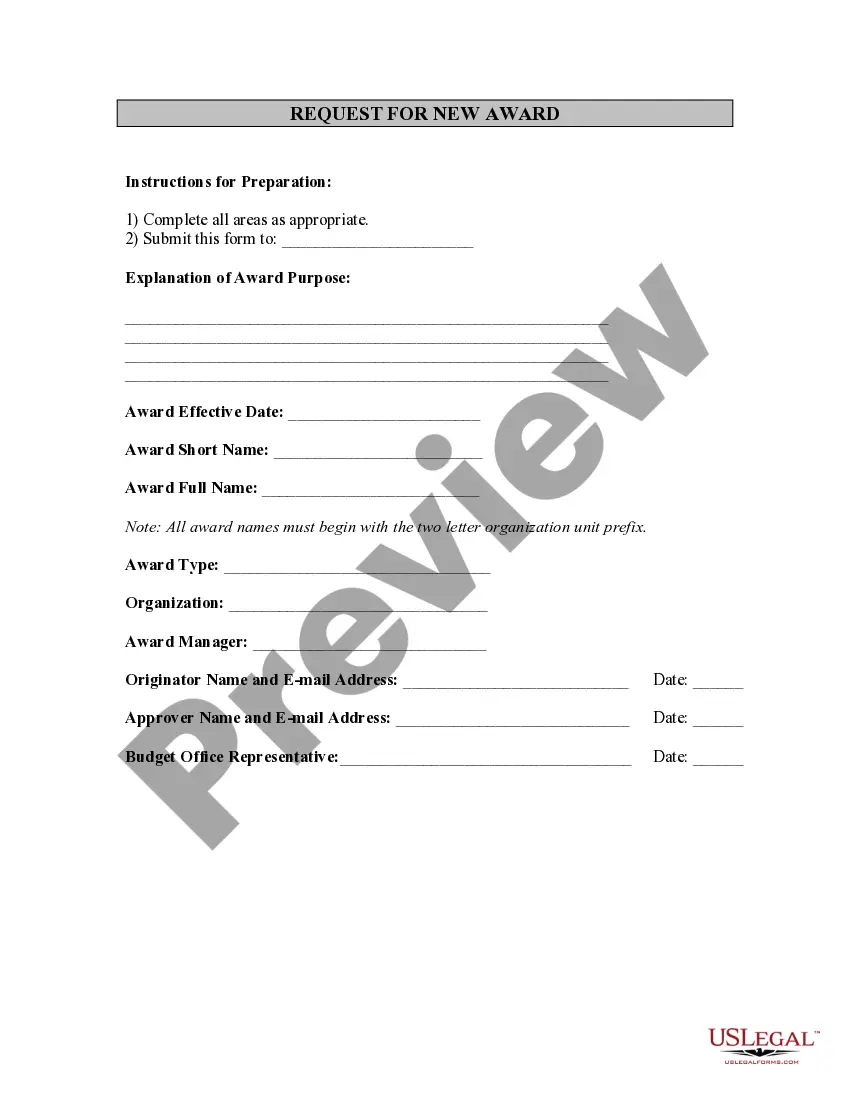
Texas Request for New Award
Description
Get your form ready online
Our built-in tools help you complete, sign, share, and store your documents in one place.
Make edits, fill in missing information, and update formatting in US Legal Forms—just like you would in MS Word.
Download a copy, print it, send it by email, or mail it via USPS—whatever works best for your next step.
Sign and collect signatures with our SignNow integration. Send to multiple recipients, set reminders, and more. Go Premium to unlock E-Sign.
If this form requires notarization, complete it online through a secure video call—no need to meet a notary in person or wait for an appointment.
We protect your documents and personal data by following strict security and privacy standards.

Make edits, fill in missing information, and update formatting in US Legal Forms—just like you would in MS Word.

Download a copy, print it, send it by email, or mail it via USPS—whatever works best for your next step.

Sign and collect signatures with our SignNow integration. Send to multiple recipients, set reminders, and more. Go Premium to unlock E-Sign.

If this form requires notarization, complete it online through a secure video call—no need to meet a notary in person or wait for an appointment.

We protect your documents and personal data by following strict security and privacy standards.
Looking for another form?







How to fill out Request For New Award?
You can invest numerous hours online looking for the approved document template that meets the state and federal requirements you need.
US Legal Forms offers thousands of legal forms that are evaluated by professionals.
It is easy to download or print the Texas Request for New Award from the services.
If available, use the Review button to look through the document template as well.
- If you possess a US Legal Forms account, you can Log In and click the Acquire button.
- Then, you can complete, modify, print, or sign the Texas Request for New Award.
- Each legal document template you purchase is yours indefinitely.
- To obtain an additional copy of any purchased form, please visit the My documents tab and click the corresponding button.
- If you are using the US Legal Forms website for the first time, follow the straightforward instructions below.
- First, ensure you have selected the correct document template for the county/town of your choice.
- Read the form information to confirm you have chosen the appropriate form.
Form popularity
FAQ
Correcting Mistakes Check the wages we show for you on your Statement of Wages and Potential Benefit Amounts and call a TWC Tele-Center at 800-939-6631 immediately if there are mistakes such as: Incorrect Social Security Number.
April 1, 2020 Updated: April 1, 2020 6 p.m. The Texas Workforce Commission said it will now backdate unemployment claims to the date that workers were laid off, in an apparent revision to its previous position.
In Texas, you will be denied unemployment benefits if you leave your job voluntarily and without a compelling reason. You refused a suitable job when offered one. One condition of receiving benefits is that you must continue to look for work and only rely on benefits as a short-term relief.
In situations involving the first three disqualification categories, the disqualification remains in effect until the claimant returns to work for at least six weeks and/or earns at least six times his or her weekly benefit amount.
If an employer does not respond at all and the employee receives benefits, the employer receives a Notice of Maximum Potential Chargeback. Employers must then decide if they wish to challenge the decision to award unemployment benefits to the former employee.
If you are not given the option to request backdated benefits, you'll need to call the TWC, request a callback or email the agency requesting backdated payments starting with the date you lost your job. Email: ui.ombudsmen@twc.state.tx.us. Provide the exact date you lost your job.
If you are requesting benefits, TWC will apply each eligible weekly benefit payment toward repaying your overpayment until it is repaid. NOTE: As of , TWC will use only 50 percent of a claimant's weekly benefit amount (WBA) to repay their overpayment, unless otherwise required by law.
Claim ChangesVisit Ask EDD to request to backdate your claim if you think it has the wrong start date. Select Unemployment Insurance Benefits, then Claim Questions, then Backdate the Effective Date of my UI Claim Due to COVID-19. In your UI Online account, select Contact Us to request a change.
After you have been unemployed for eight weeks, you must be willing to accept a suitable job that pays at least 75 percent of your normal wage. If you do not apply for suitable work, accept suitable work, or return to your regular self-employment work, TWC may disqualify you for benefits.
You may be eligible for benefits if you were fired for reasons other than misconduct. Examples of misconduct that could make you ineligible include violation of company policy, violation of law, neglect or mismanagement of your position, or failure to perform your work adequately if you are capable of doing so.