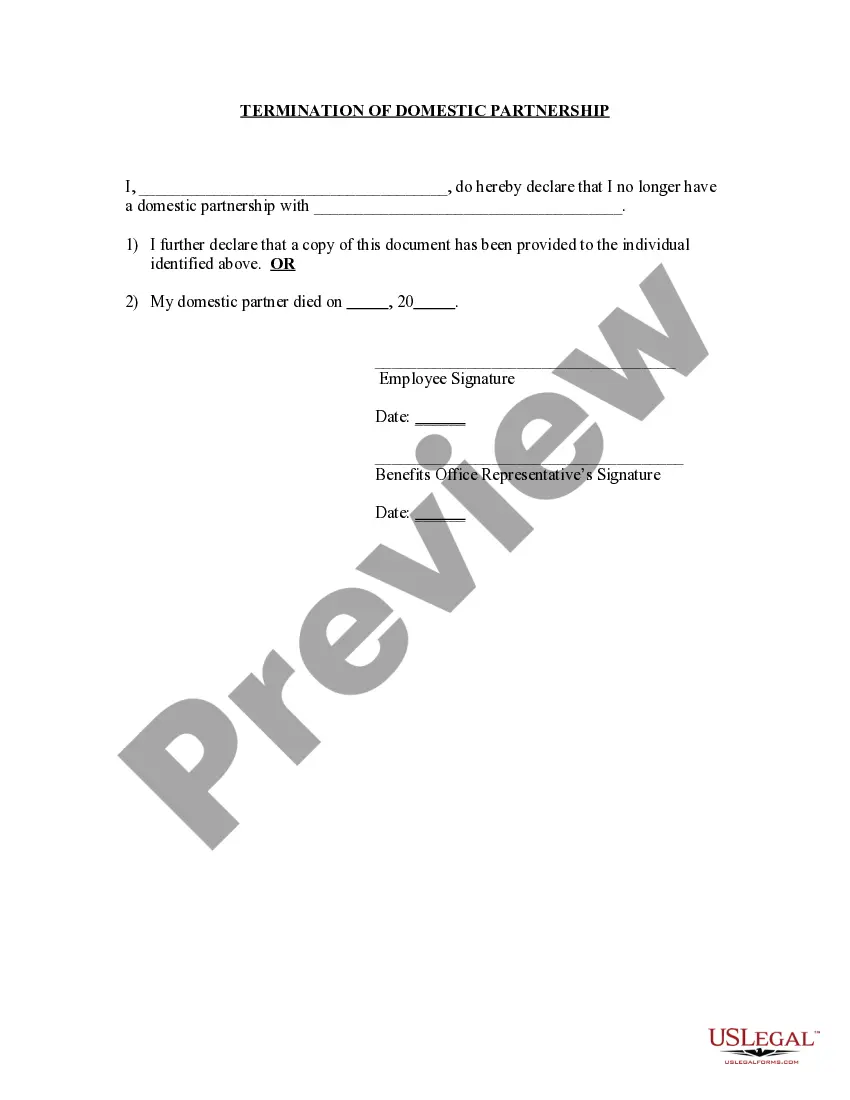
Texas Termination of Domestic Partnership
Description
Get your form ready online
Our built-in tools help you complete, sign, share, and store your documents in one place.
Make edits, fill in missing information, and update formatting in US Legal Forms—just like you would in MS Word.
Download a copy, print it, send it by email, or mail it via USPS—whatever works best for your next step.
Sign and collect signatures with our SignNow integration. Send to multiple recipients, set reminders, and more. Go Premium to unlock E-Sign.
If this form requires notarization, complete it online through a secure video call—no need to meet a notary in person or wait for an appointment.
We protect your documents and personal data by following strict security and privacy standards.

Make edits, fill in missing information, and update formatting in US Legal Forms—just like you would in MS Word.

Download a copy, print it, send it by email, or mail it via USPS—whatever works best for your next step.

Sign and collect signatures with our SignNow integration. Send to multiple recipients, set reminders, and more. Go Premium to unlock E-Sign.

If this form requires notarization, complete it online through a secure video call—no need to meet a notary in person or wait for an appointment.

We protect your documents and personal data by following strict security and privacy standards.
Looking for another form?


How to fill out Termination Of Domestic Partnership?
If you intend to summarize, obtain, or create valid document templates, utilize US Legal Forms, the largest selection of legitimate forms available online.
Take advantage of the site's simple and user-friendly search to find the documents you need. Various templates for business and personal purposes are organized by categories and states, or keywords.
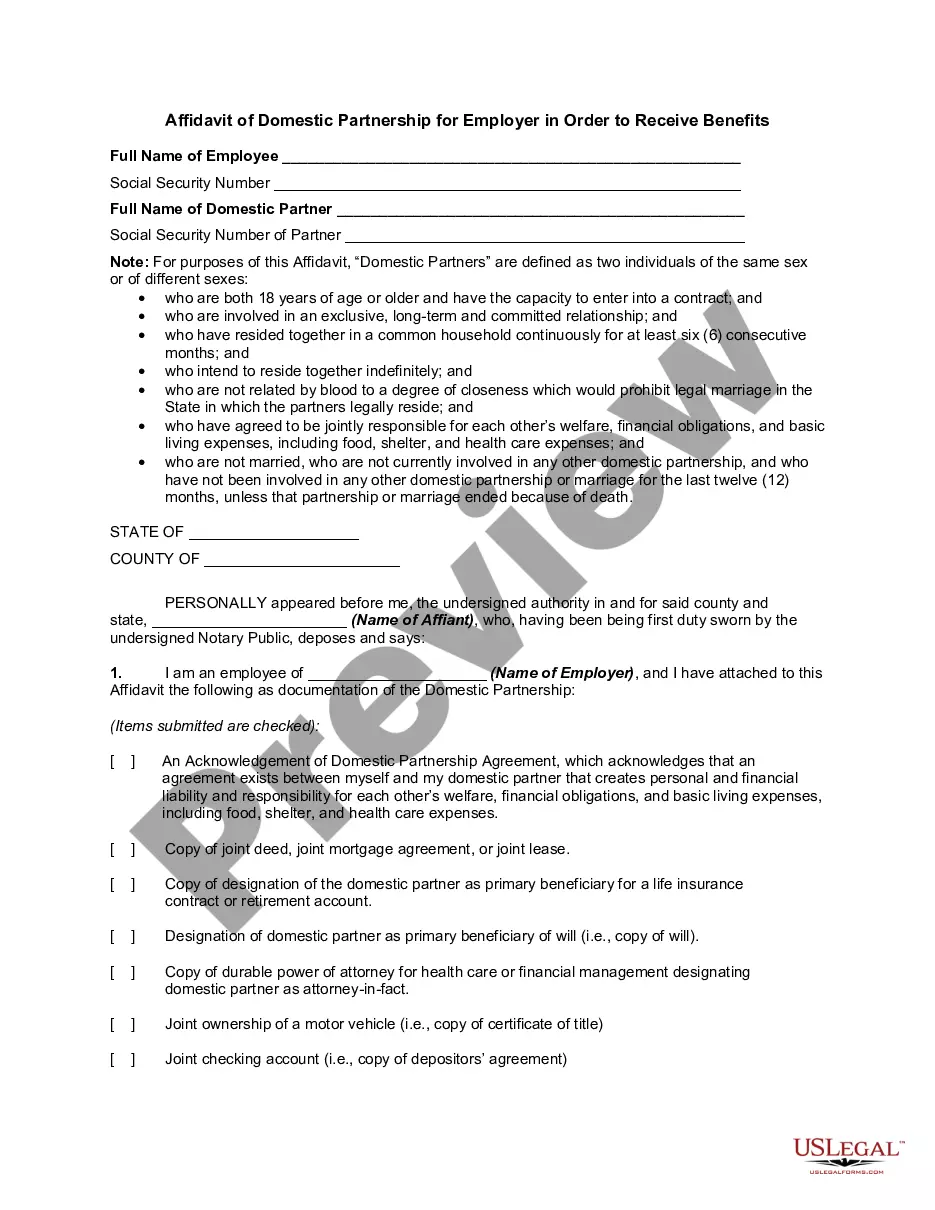
Utilize US Legal Forms to acquire the Texas Termination of Domestic Partnership with just a few clicks.
Every legal document template you purchase is yours permanently. You will have access to every form you downloaded in your account. Click on the My documents section and select a form to print or download again.
Compete and acquire, and print the Texas Termination of Domestic Partnership with US Legal Forms. There are millions of professional and state-specific forms available for your business or personal needs.
- If you are already a US Legal Forms user, Log In to your account and click the Obtain button to find the Texas Termination of Domestic Partnership.
- You can also access forms you previously downloaded in the My documents section of your account.
- If you are using US Legal Forms for the first time, follow the instructions below.
- Step 1. Ensure you have selected the form for the correct city/state.
- Step 2. Use the Review option to browse the form's details. Don't forget to read the description.
- Step 3. If you are not satisfied with the form, use the Search area at the top of the screen to find other variations of the legal form template.
- Step 4. Once you have located the form you need, click on the Obtain now button. Choose the payment plan you prefer and enter your information to register for an account.
- Step 5. Complete the transaction. You can use your credit card or PayPal account to finalize the purchase.
- Step 6. Select the format of the legal form and download it to your device.
- Step 7. Fill out, edit, and print or sign the Texas Termination of Domestic Partnership.
Form popularity
FAQ
Your attorney can walk you through the process and make sure you comply with all legal requirements.Read Your Partnership Agreement.Formally Dissolve Your Partnership.Dividing Assets and Liabilities.Notify Customers, Creditors, and Suppliers.
People who are already married or in a domestic partnership with someone else (people who are in a domestic partnership with each other can later get married without dissolving the partnership)
To start a court process, you must complete and file a Petition for Dissolution of Domestic Partnership, a Petition for Dissolution of Domestic Partnership and Marriage, a Petition for Judgment of Nullity of Domestic Partnership, or a Petition for Legal Separation of Domestic Partners with a California Superior Court.
Domestic partnership is an arrangement wherein two individuals of any gender can live together without officially getting married and still enjoy some of the benefits that are available for married couples.
A domestic partnership agreement is a legal agreement but it is not a marriage, a common-law marriage, or a civil union. Texas does not currently recognize any of these unions.
Everything But Marriage Equal treatment means that domestic partners share responsibility for each other's debts, children and child support and must go through the same divorce processes as married couples.
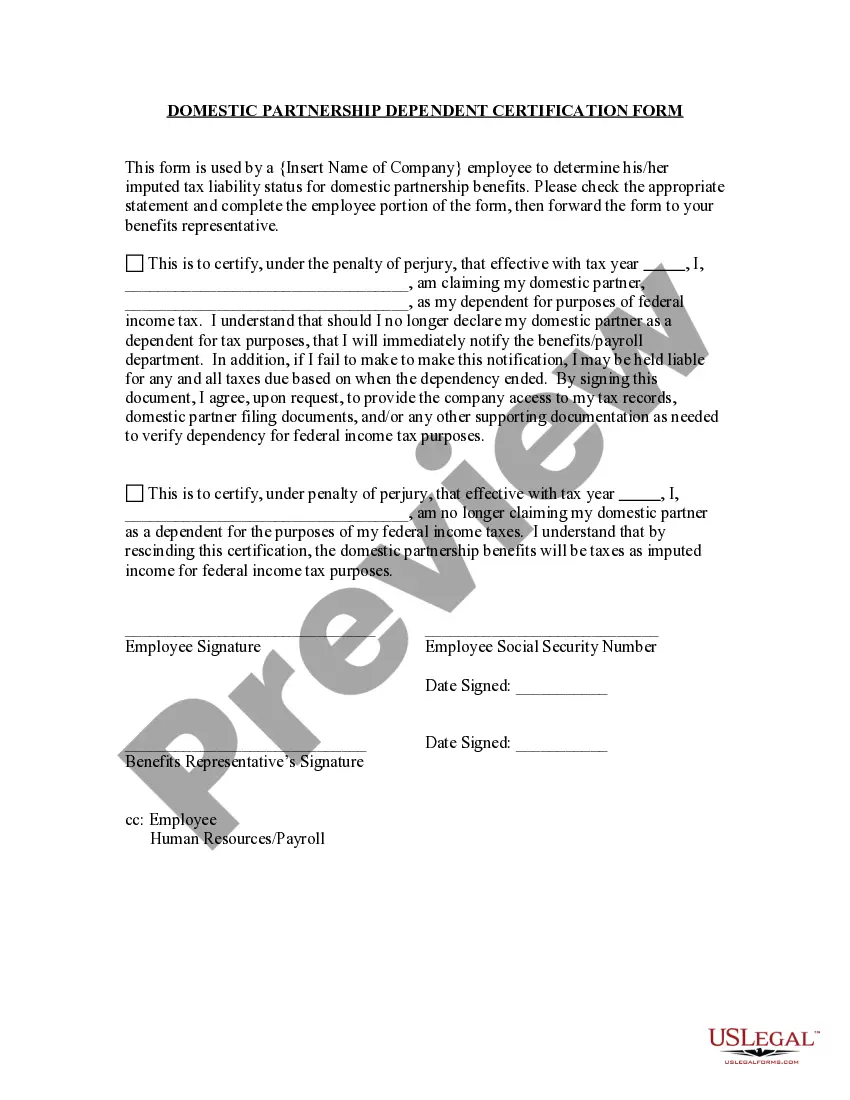
One major change that was not enforced before the new law is that domestic partners are now financially responsible for each other's debts, both during and after the partnership.
A Petition for Dissolution of Domestic Partnership and Marriage is a formal request by one partner/spouse to a California Superior Court to dissolve both the domestic partnership and the marriage in a single proceeding. A judgment issued by the court in this case will end both the domestic partnership and the marriage.
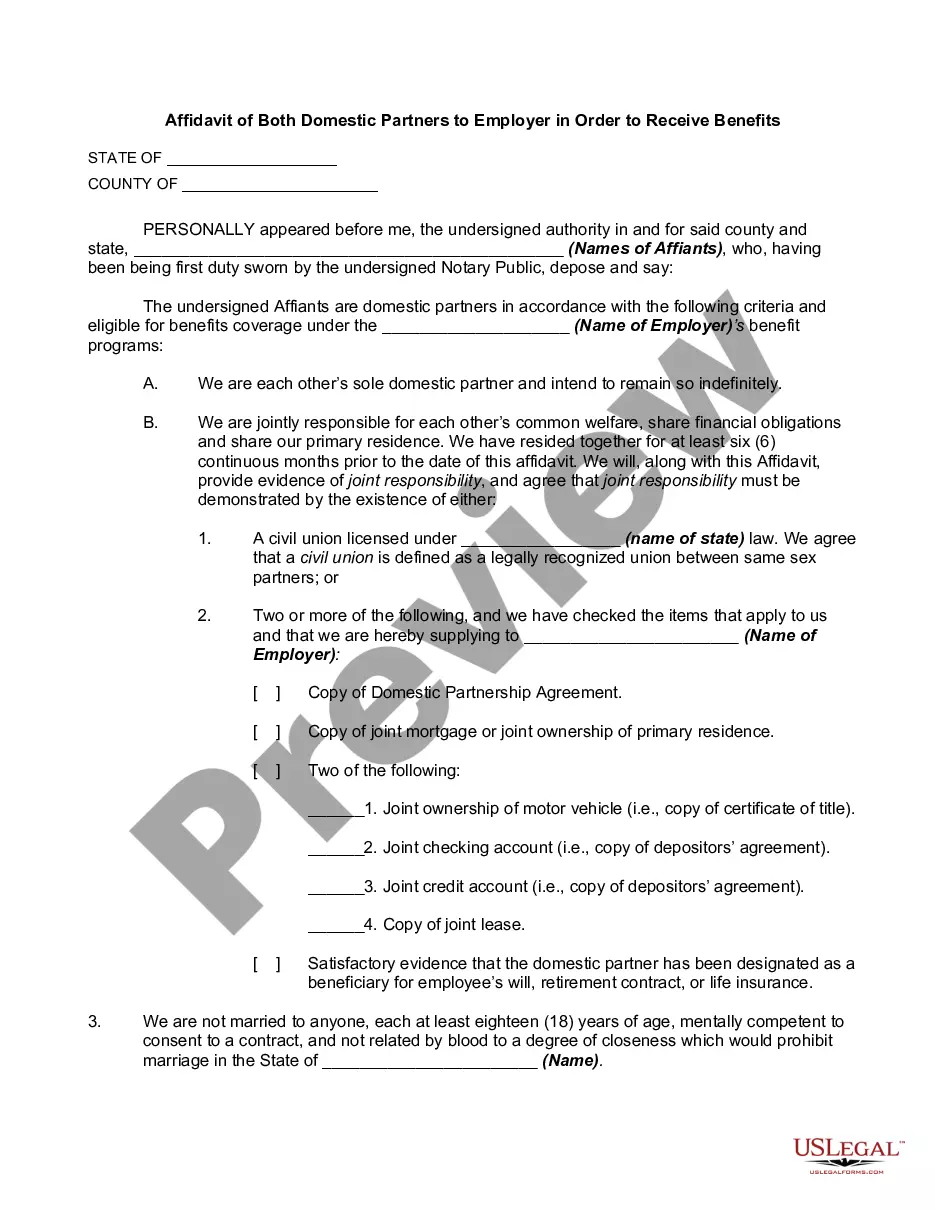
A domestic partnership is a legal relationship between two individuals who live together and share a common domestic life, but are not married (to each other or to anyone else). People in domestic partnerships receive benefits that guarantee right of survivorship, hospital visitation, and others.