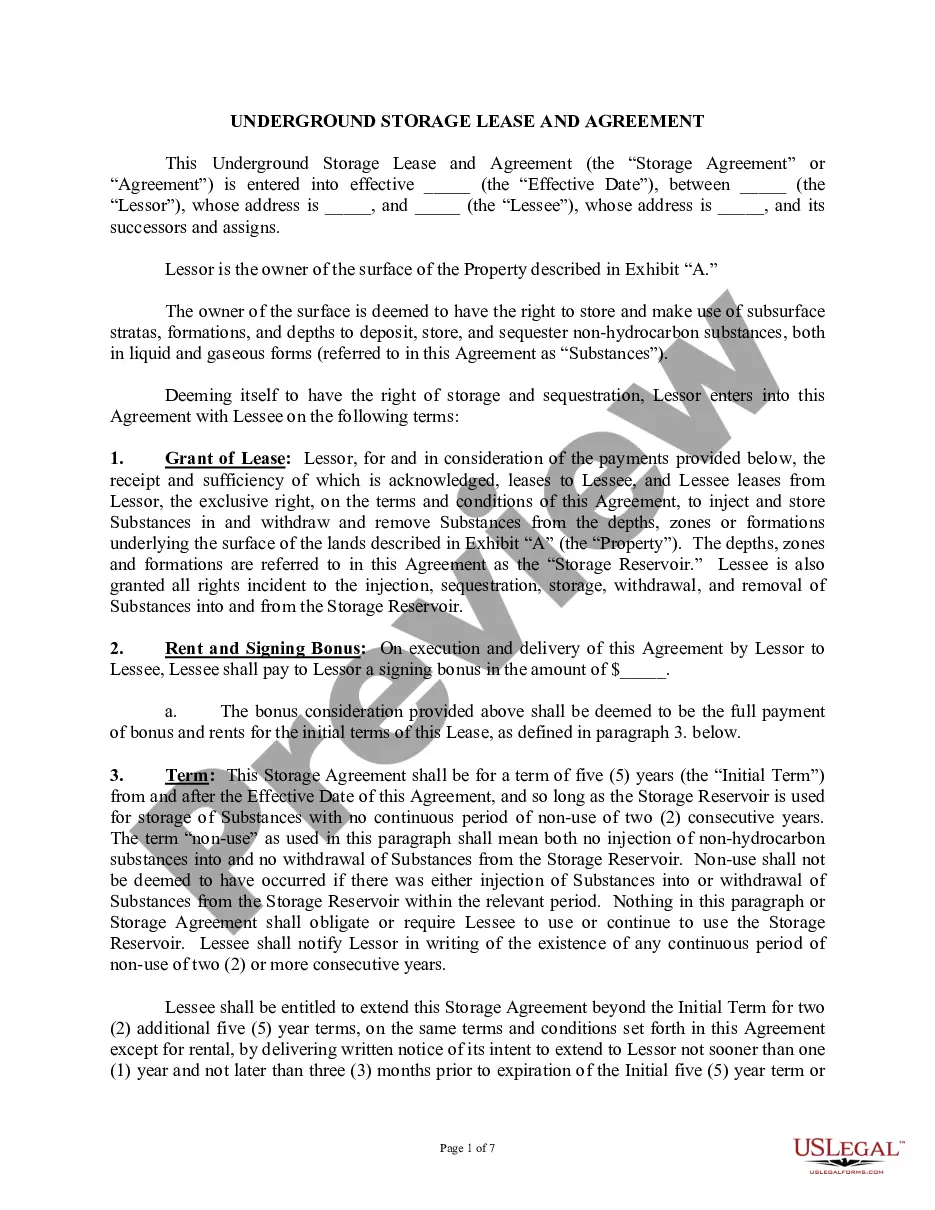
Texas Sharecropping Contract or Agreement
Description
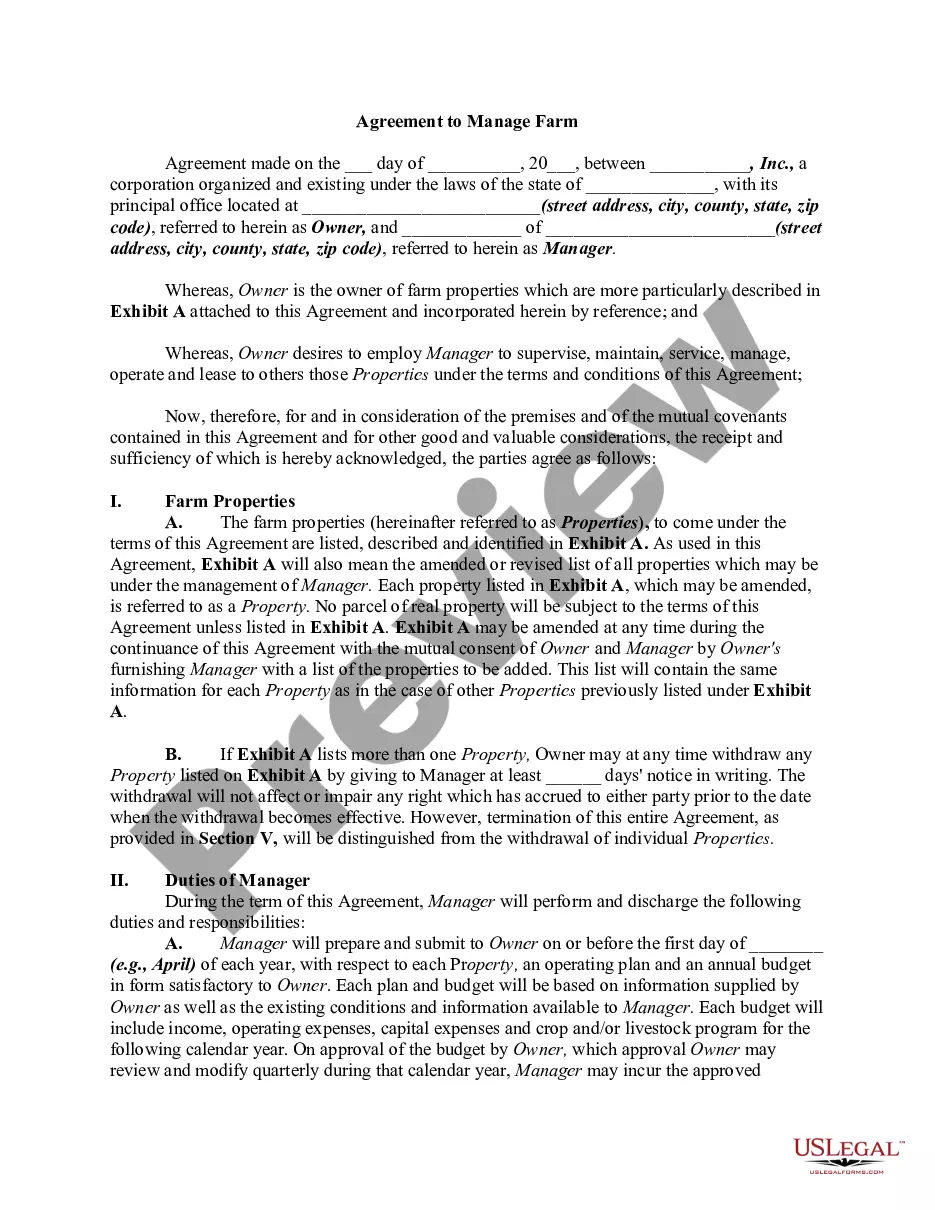
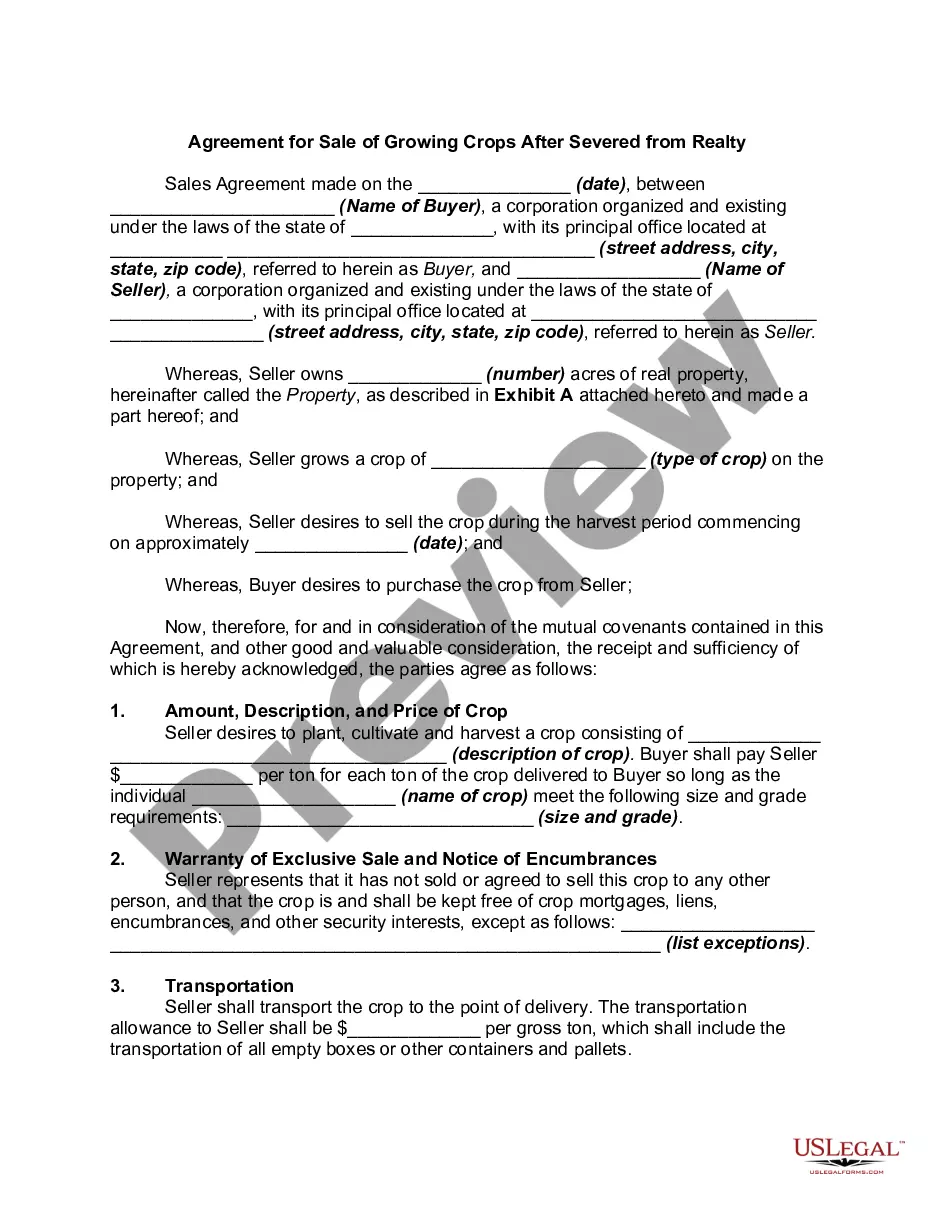
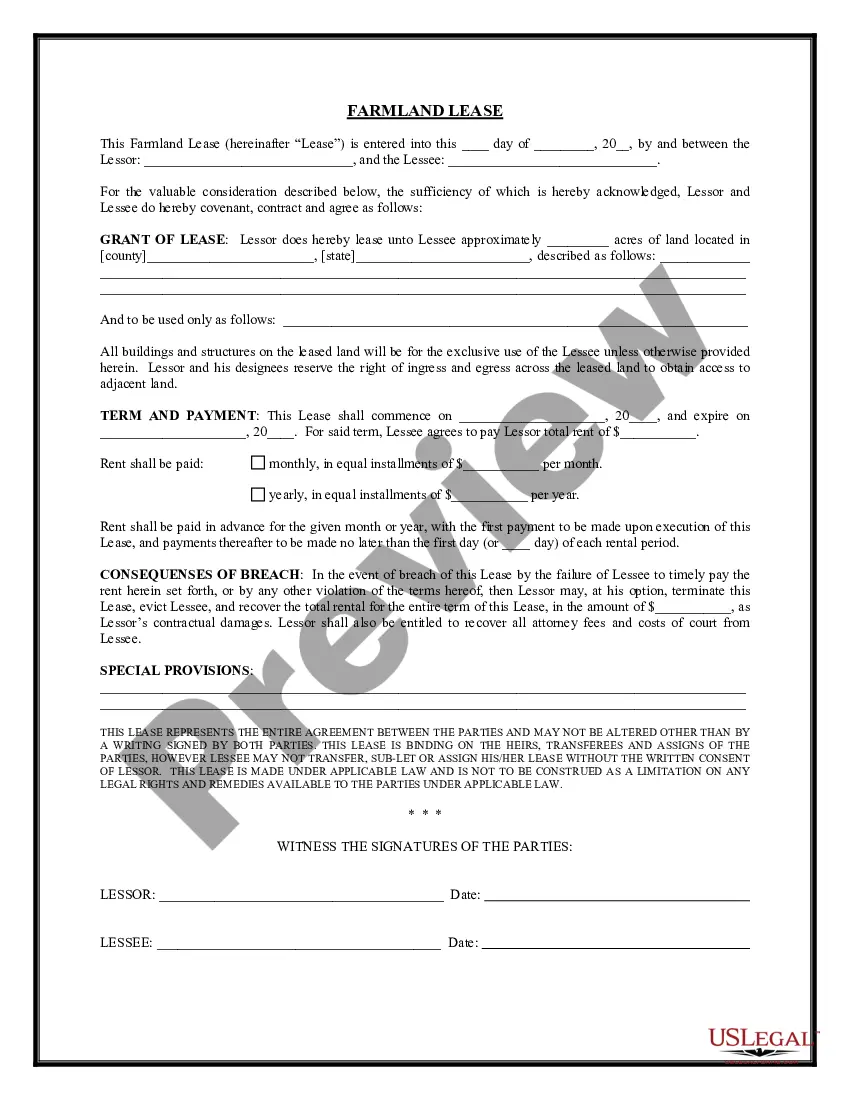
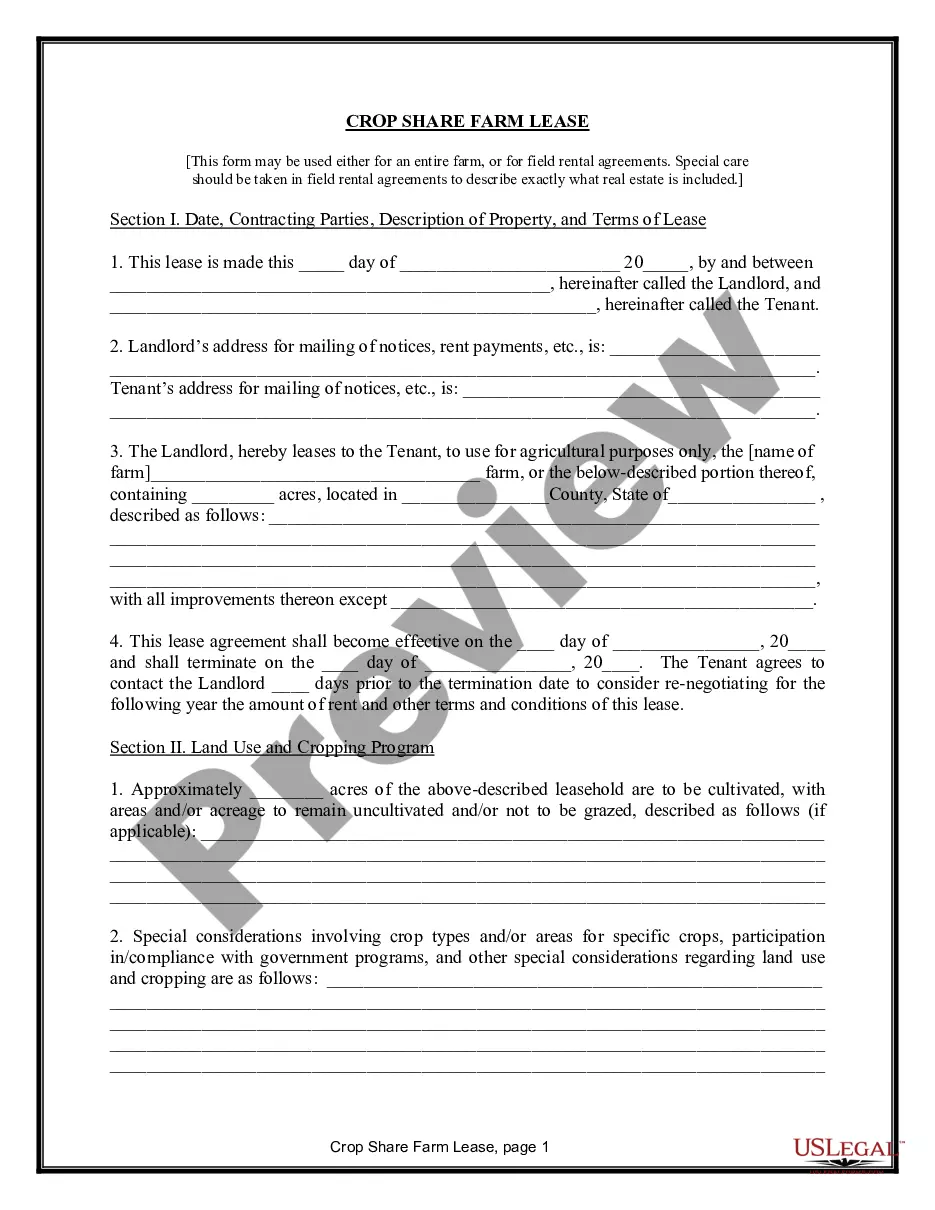
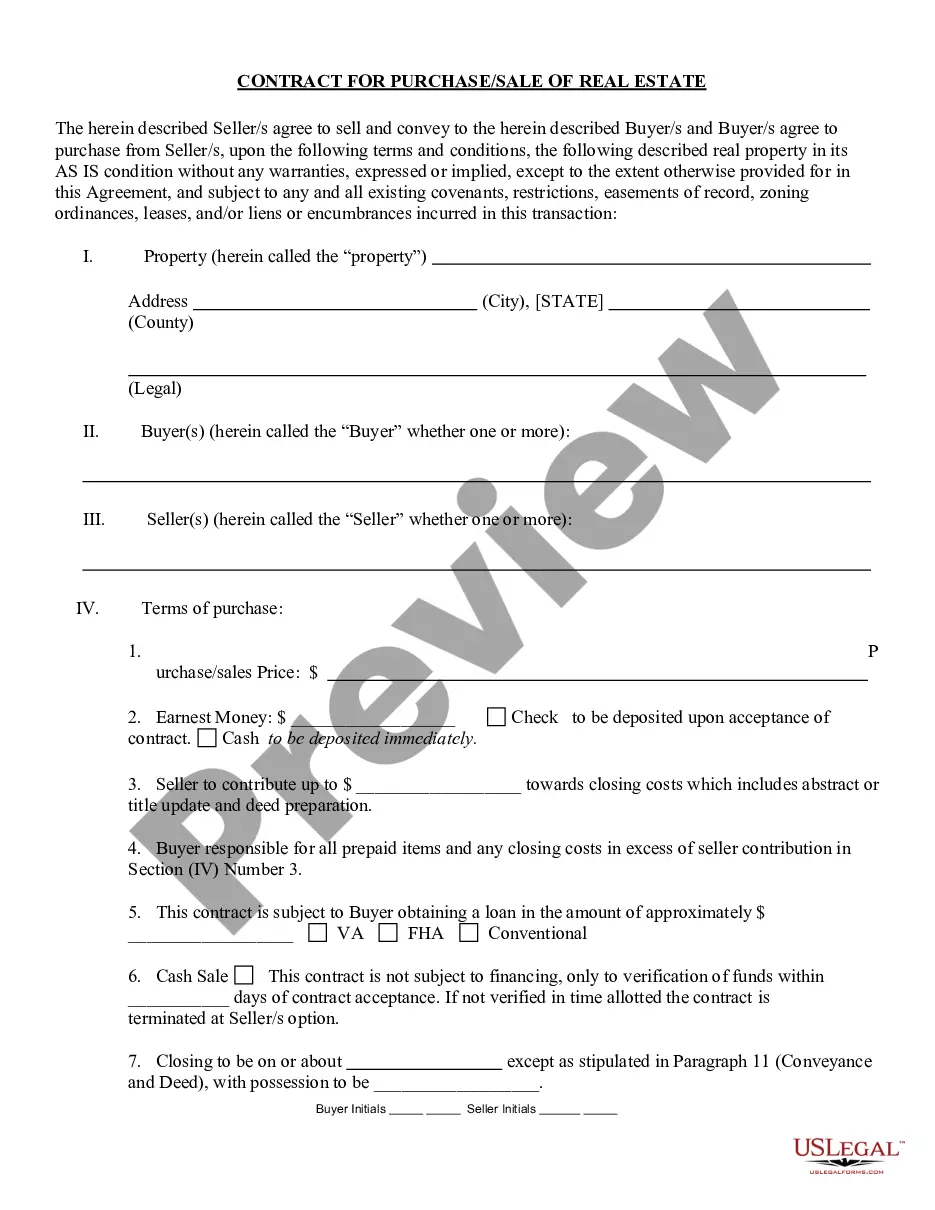
Get your form ready online
Our built-in tools help you complete, sign, share, and store your documents in one place.
Make edits, fill in missing information, and update formatting in US Legal Forms—just like you would in MS Word.
Download a copy, print it, send it by email, or mail it via USPS—whatever works best for your next step.
Sign and collect signatures with our SignNow integration. Send to multiple recipients, set reminders, and more. Go Premium to unlock E-Sign.
If this form requires notarization, complete it online through a secure video call—no need to meet a notary in person or wait for an appointment.
We protect your documents and personal data by following strict security and privacy standards.
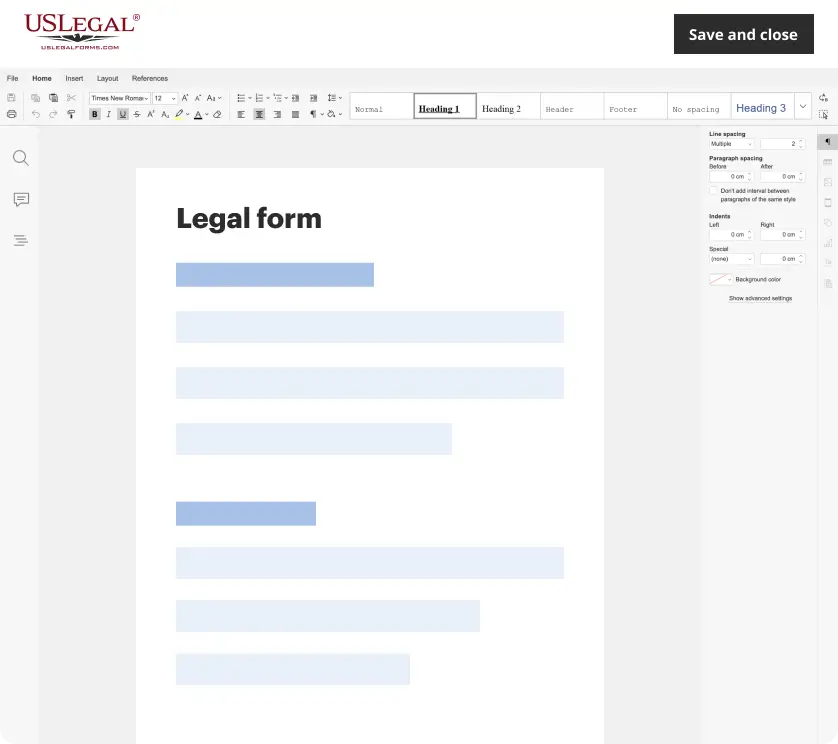
Make edits, fill in missing information, and update formatting in US Legal Forms—just like you would in MS Word.
Download a copy, print it, send it by email, or mail it via USPS—whatever works best for your next step.
Sign and collect signatures with our SignNow integration. Send to multiple recipients, set reminders, and more. Go Premium to unlock E-Sign.

If this form requires notarization, complete it online through a secure video call—no need to meet a notary in person or wait for an appointment.
We protect your documents and personal data by following strict security and privacy standards.
Looking for another form?







How to fill out Sharecropping Contract Or Agreement?
You may spend numerous hours online attempting to locate the sanctioned document template that meets the state and federal requirements you require.
US Legal Forms offers thousands of legal forms that are reviewed by experts.
You can download or print the Texas Sharecropping Contract or Agreement from the service.
In order to find another version of the form, use the Search field to locate the template that meets your preferences and requirements.
- If you already have an account with US Legal Forms, you can Log In and select the Download option.
- After that, you can complete, modify, print, or sign the Texas Sharecropping Contract or Agreement.
- Each legal document template you obtain is yours indefinitely.
- To get another copy of any purchased form, visit the My documents tab and select the relevant option.
- If you are using the US Legal Forms website for the first time, follow the simple instructions below.
- First, ensure you have selected the correct document template for the county/city of your choice. Check the form description to confirm you have chosen the correct form.
Form popularity
FAQ
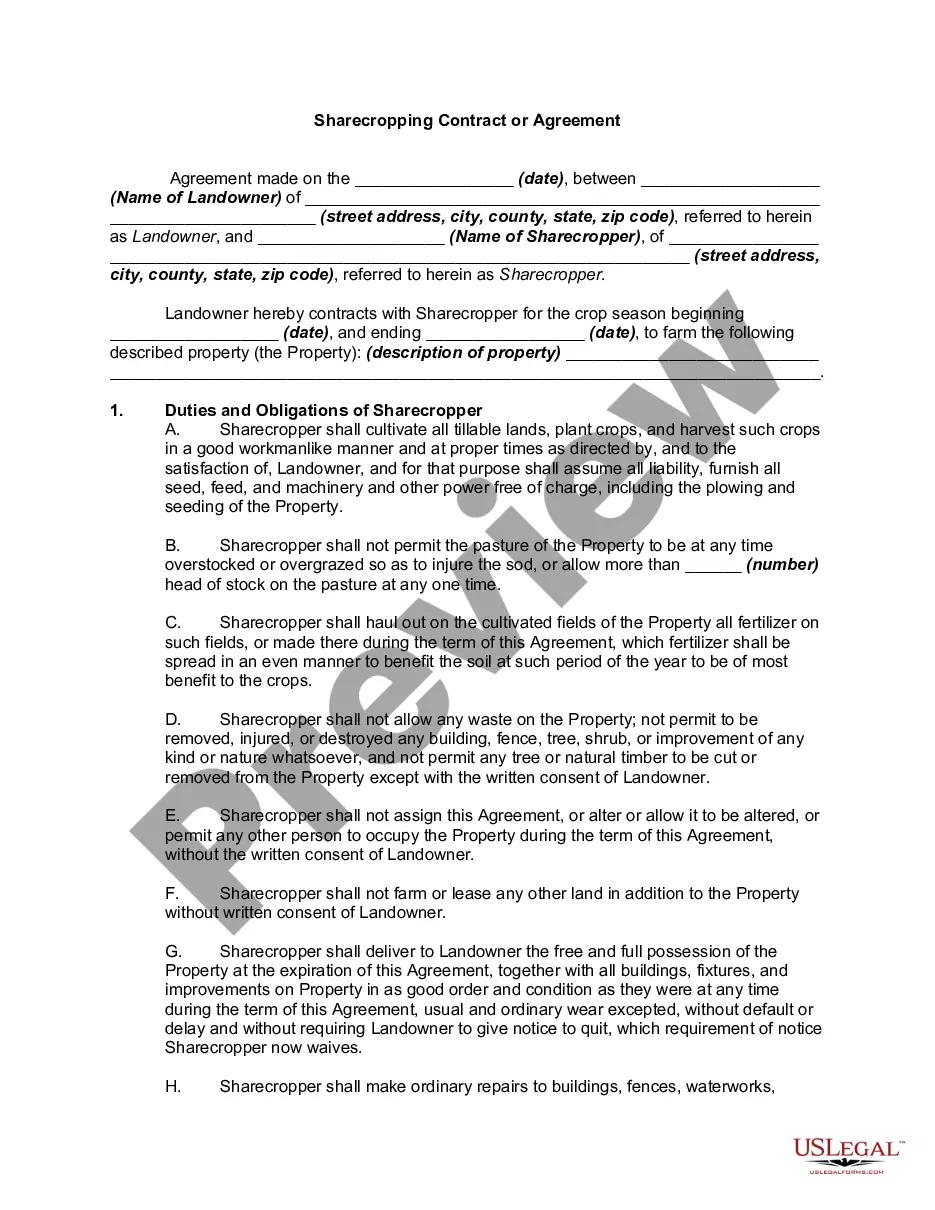
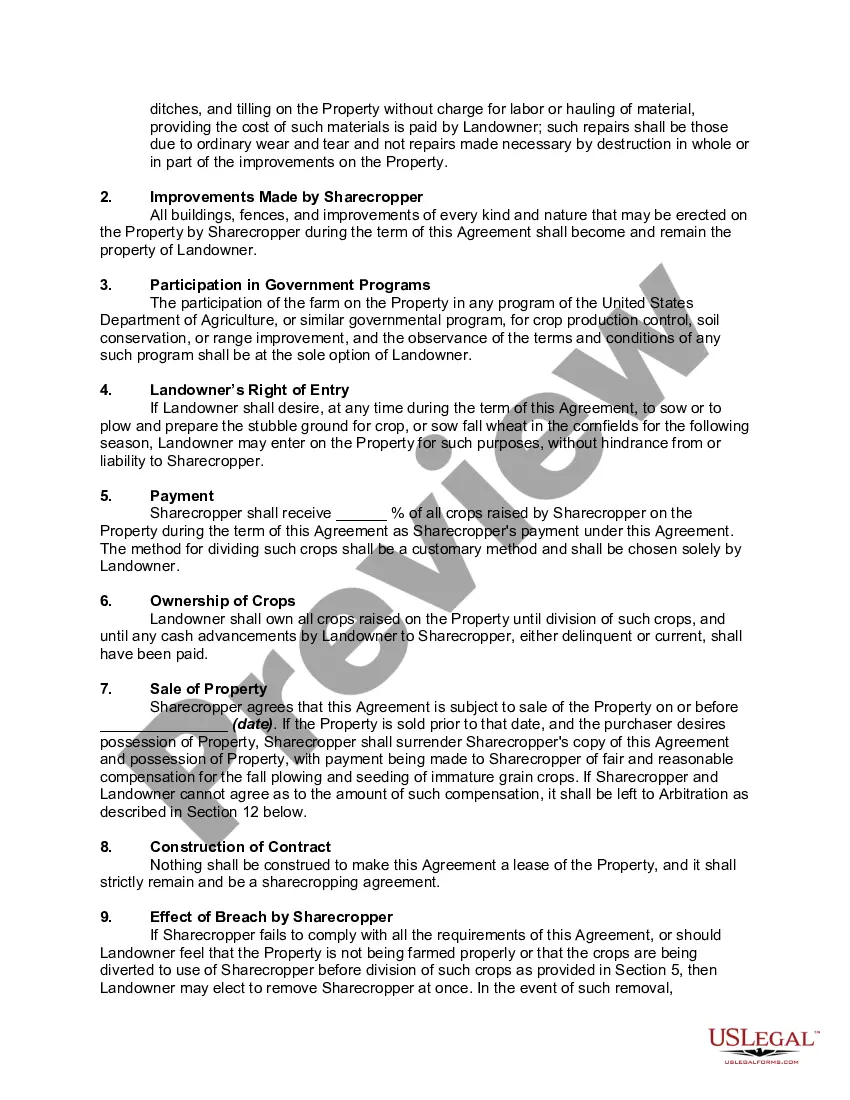
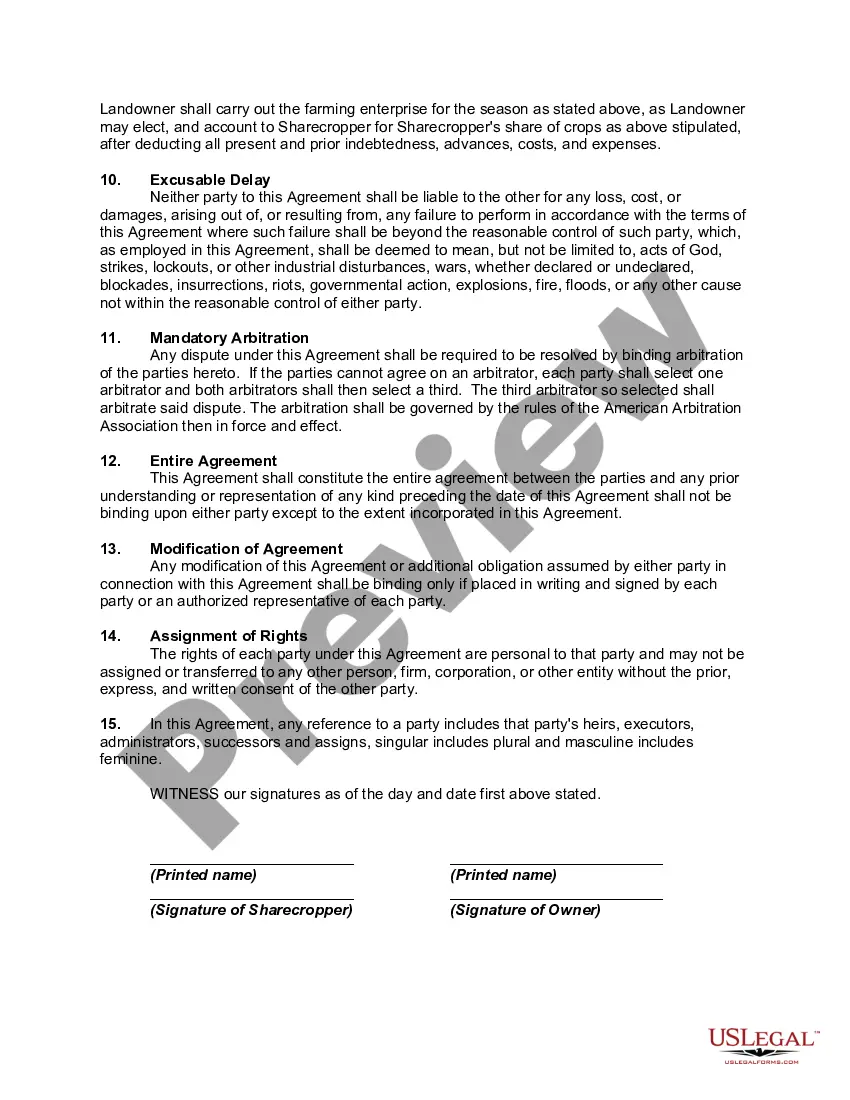
A sharecropping contract is a legal document that establishes the terms of the relationship between a landowner and a sharecropper, especially in Texas. This contract outlines responsibilities, profit-sharing, and other key elements of the farming arrangement. A well-structured Texas Sharecropping Contract or Agreement protects the rights of both parties and ensures clear expectations. To create or review such a contract, visit US Legal Forms for expert assistance.
In a typical Texas Sharecropping Contract or Agreement, the landowner generally provides land, tools, and possibly seeds, while the sharecropper contributes labor. Profits from the harvested crops are then divided according to the agreed percentages outlined in the contract. This division can vary, so both parties should negotiate terms that reflect their contributions. US Legal Forms can help draft a contract that clearly defines these expectations.
Determining if the Texas Sharecropping Contract or Agreement is fair requires evaluating the terms involved. A well-structured contract will detail the obligations and rights of both the landowner and sharecropper. Fairness is achieved through equitable profit-sharing and clear responsibilities. If you need help drafting or reviewing a contract, consider using US Legal Forms for reliable resources and support.
In historical contexts, the Texas Sharecropping Contract or Agreement addressed the relationship between landowners and sharecroppers. Typically, it outlined the crop-sharing arrangements, specifying what percentage of the harvest each party would receive. It also defined responsibilities for maintaining the land and crop production. Understanding these components can help both parties create a more favorable agreement today.
Sharecropping can be seen as fair or unfair based on the specific conditions outlined in the Texas Sharecropping Contract or Agreement. The power dynamics between landowners and sharecroppers can influence perceptions of fairness. It's important to look at how resources, profits, and risks are shared in the agreement. Consulting with US Legal Forms can help ensure you establish a balanced and equitable contract.
The fairness of a Texas Sharecropping Contract or Agreement often depends on the terms set within the contract. Both the landowner and sharecropper should arrive at an agreement that reflects their respective interests. Clear communication and mutual understanding are essential for promoting fairness in this arrangement. If you are unsure about the terms, US Legal Forms can assist in clarifying and structuring a fair contract.
Share tenancy farming is a system where a farmer rents land and pays rent in the form of a share of the crop produced. This arrangement allows for farmer participation in decisions about cultivation, unlike sharecropping, where oversight is heavier from the landowner. Utilizing a Texas Sharecropping Contract or Agreement for share tenancy can clarify roles and expectations, leading to a more productive relationship between landowners and farmers.
Sharecropping and share tenancy emerged as solutions during post-Civil War America, largely due to economic necessity. These systems provided opportunities for landless individuals to cultivate land without needing upfront capital for land ownership. In the context of Texas, a Texas Sharecropping Contract or Agreement can still serve as a valuable resource for those looking to engage in agricultural endeavors, fostering growth and collaboration.
Sharecropping and share tenancy involve different arrangements for land use. In sharecropping, a landowner provides land, and the sharecropper cultivates it, typically giving a portion of the crop to the owner. Conversely, share tenancy generally involves a tenant who pays rent in the form of a fixed share of the harvest while maintaining more control over their farming decisions. Understanding the nuances of these agreements is essential when considering a Texas Sharecropping Contract or Agreement.
The primary purpose of a Texas Sharecropping Contract or Agreement was to establish a working relationship between landowners and laborers. These contracts aimed to facilitate agricultural production by allowing sharecroppers to farm land in exchange for part of the crop yield. Essentially, they were designed to benefit landowners while providing a livelihood for laborers, albeit with significant limitations.