Texas Certificate of Trust for Testamentary Trust
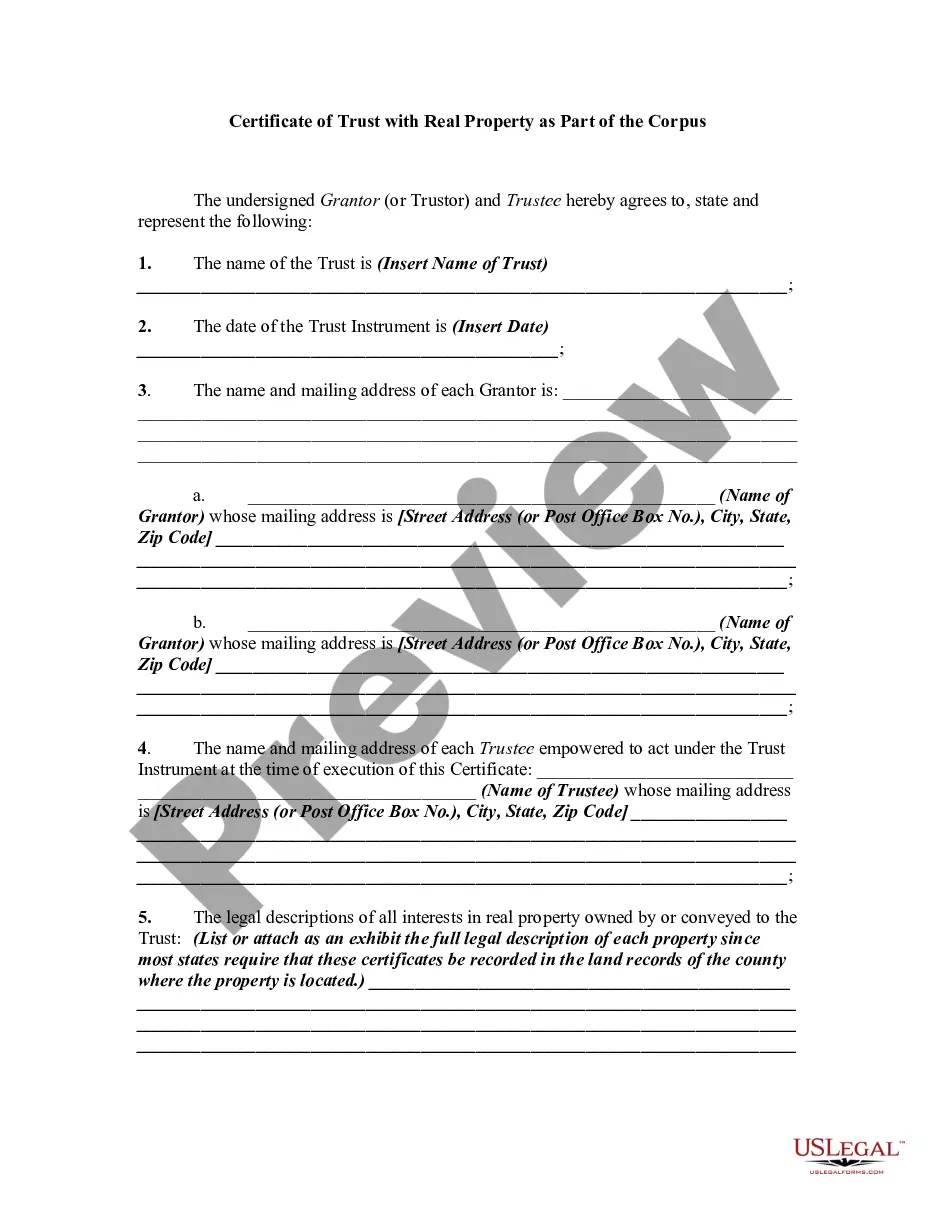
Description

Get your form ready online
Our built-in tools help you complete, sign, share, and store your documents in one place.
Make edits, fill in missing information, and update formatting in US Legal Forms—just like you would in MS Word.
Download a copy, print it, send it by email, or mail it via USPS—whatever works best for your next step.
Sign and collect signatures with our SignNow integration. Send to multiple recipients, set reminders, and more. Go Premium to unlock E-Sign.
If this form requires notarization, complete it online through a secure video call—no need to meet a notary in person or wait for an appointment.
We protect your documents and personal data by following strict security and privacy standards.

Make edits, fill in missing information, and update formatting in US Legal Forms—just like you would in MS Word.

Download a copy, print it, send it by email, or mail it via USPS—whatever works best for your next step.

Sign and collect signatures with our SignNow integration. Send to multiple recipients, set reminders, and more. Go Premium to unlock E-Sign.

If this form requires notarization, complete it online through a secure video call—no need to meet a notary in person or wait for an appointment.

We protect your documents and personal data by following strict security and privacy standards.
Looking for another form?
How to fill out Certificate Of Trust For Testamentary Trust?
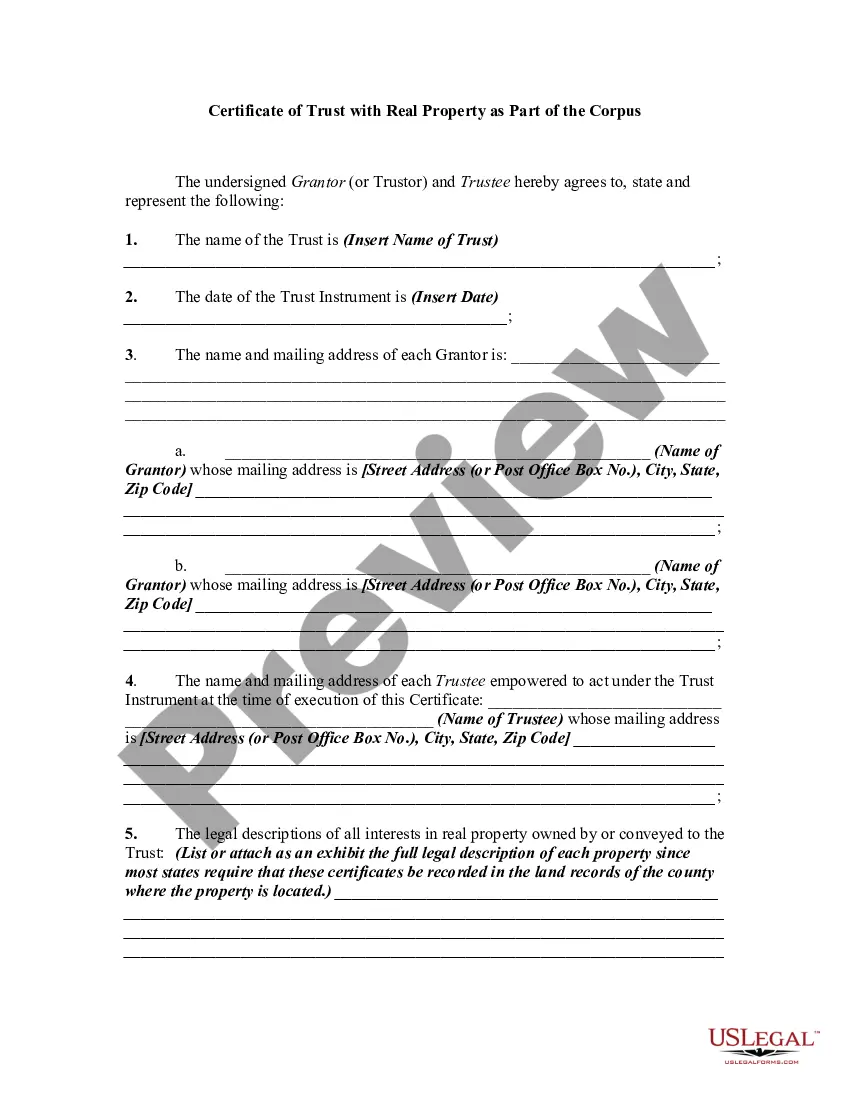
US Legal Forms - one of the largest collections of legal documents in the USA - offers a diverse selection of legal templates that you can download or print. By utilizing the site, you can access thousands of forms for business and personal purposes, organized by categories, states, or keywords. You can find the most recent forms such as the Texas Certificate of Trust for Testamentary Trust in just a few minutes.
If you have a monthly subscription, Log In and obtain the Texas Certificate of Trust for Testamentary Trust from the US Legal Forms library. The Download option will be available on every form you view. You have access to all previously acquired forms in the My documents section of your account.
If you are using US Legal Forms for the first time, here are some simple steps to get you started: Ensure you have selected the correct form for your city/area. Click the Preview option to review the form’s details. Check the form summary to confirm that you have chosen the right template. If the form does not meet your needs, utilize the Search box at the top of the screen to find one that does. If you are satisfied with the form, confirm your selection by clicking the Buy now button. Then, choose the payment plan you prefer and provide your credentials to sign up for an account. Complete the payment. Use a credit card or PayPal account to finalize the transaction. Select the format and download the form to your device. Make edits. Fill out, modify, print, and sign the downloaded Texas Certificate of Trust for Testamentary Trust. Every template you add to your account has no expiration date and is yours indefinitely. Therefore, if you wish to download or print another copy, simply go to the My documents section and click on the form you need.
- Access the Texas Certificate of Trust for Testamentary Trust with US Legal Forms, the most extensive library of legal templates.
- Utilize thousands of professional and state-specific templates that cater to your business or personal requirements and preferences.
Form popularity
FAQ
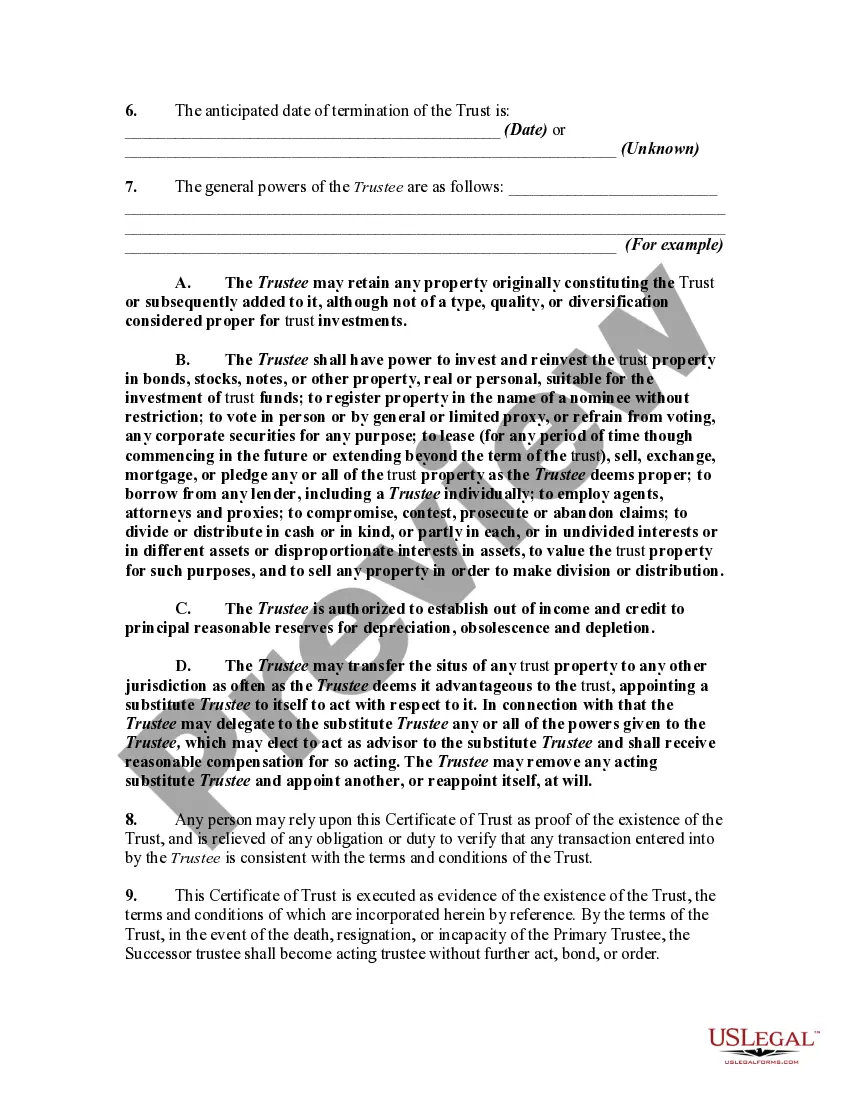
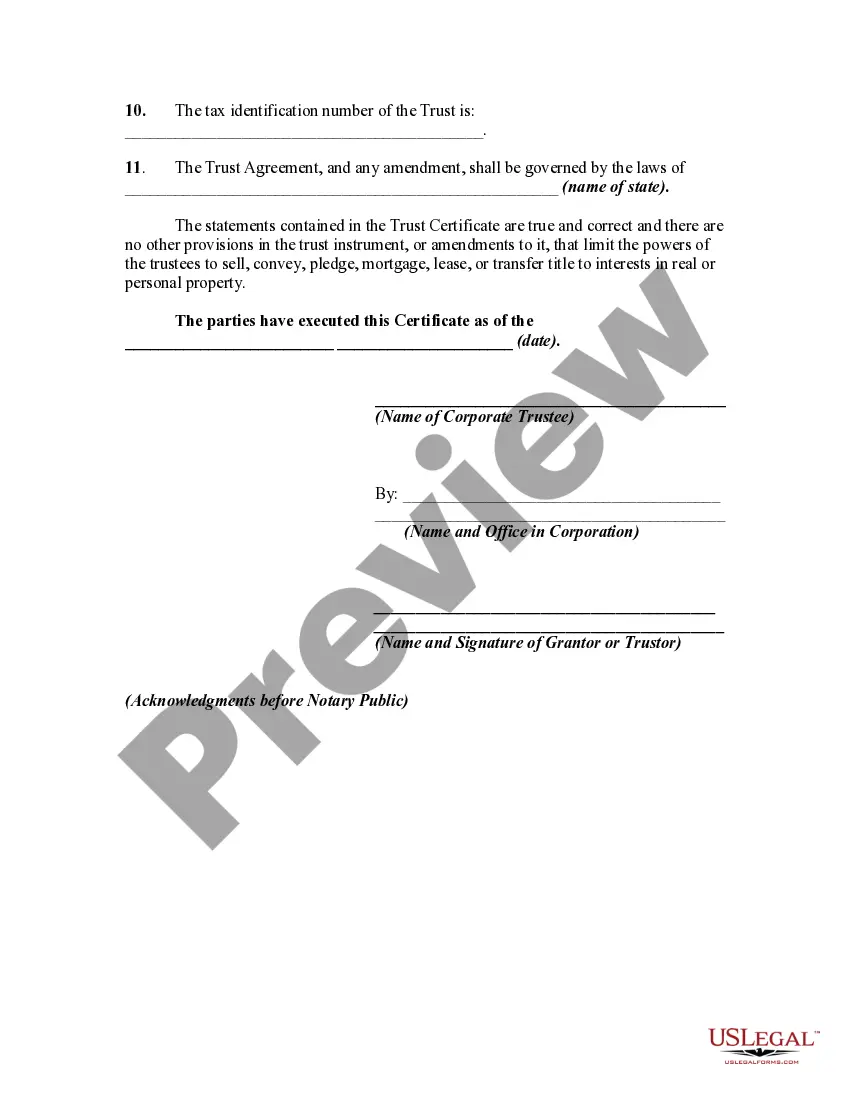
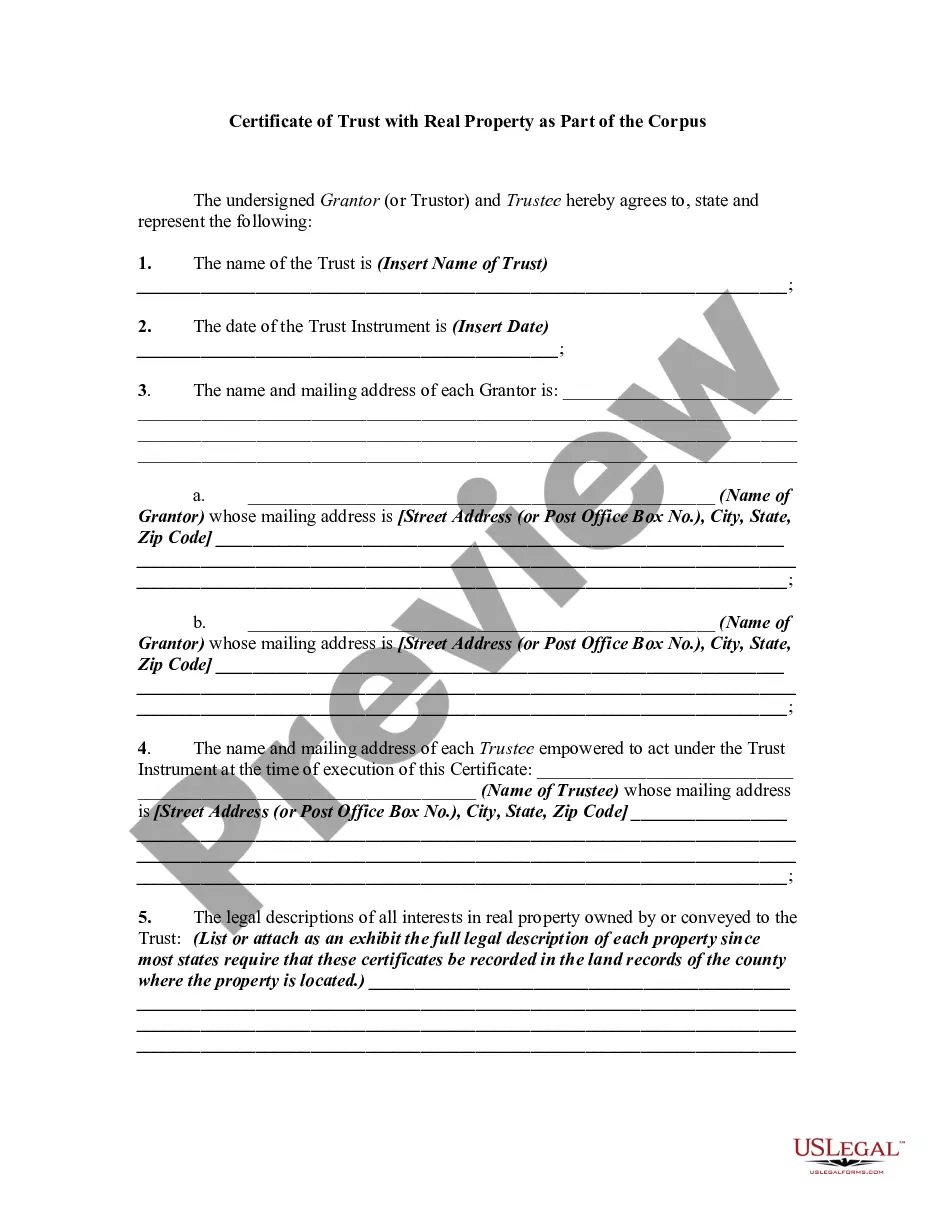
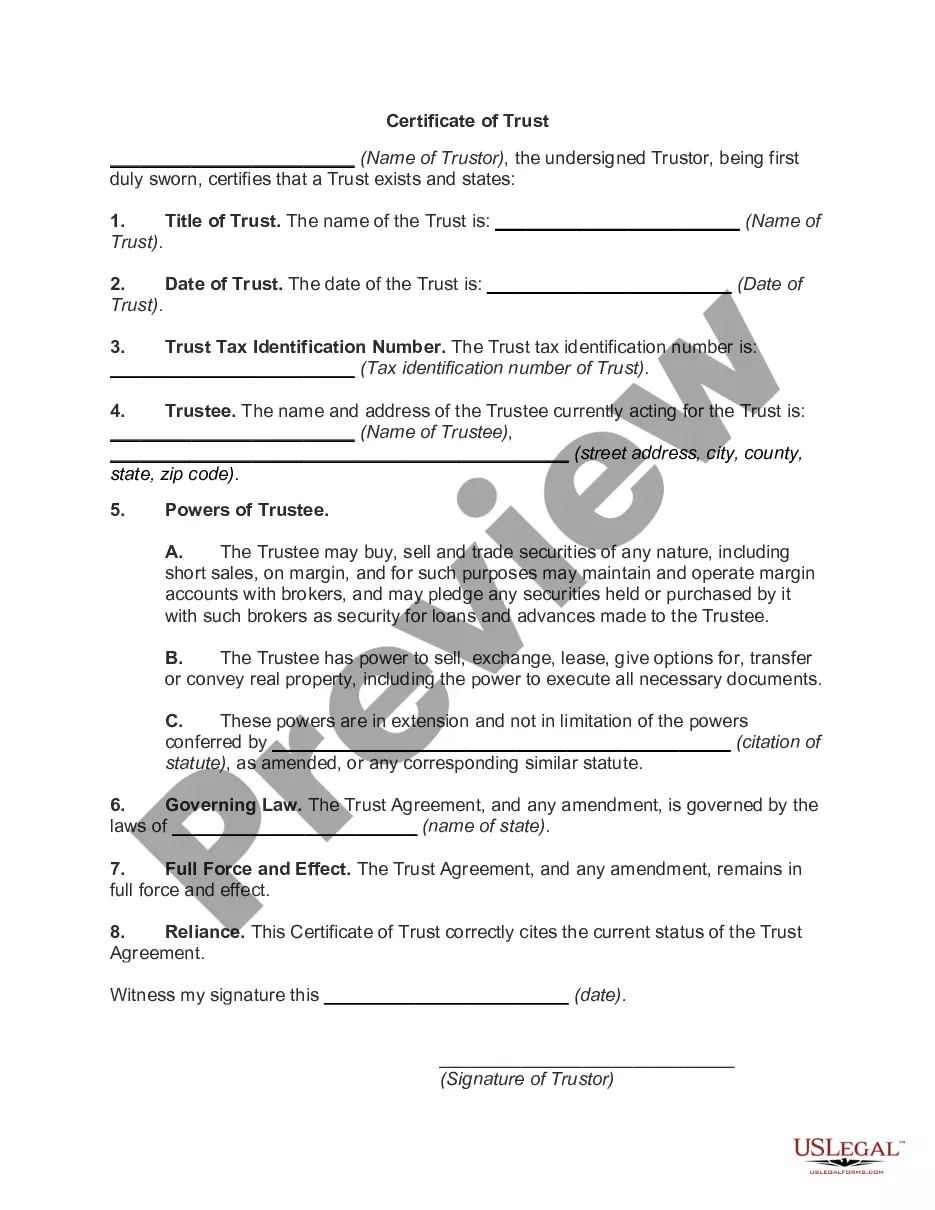
A certification of trust provides information regarding the settlor of the trust, the acting trustee, and the power and authority of the trustee to manage and invest trust property or to act with respect to a specific transaction.
A copy of any trust must be given to all beneficiaries named in the document within 60 days of approval from the probate court.
How to Set up a Testamentary Trust? Testamentary Trusts must be set up within a Last Will and Testament, so they can be created following one's death. Once you have begun the estate planning process, you will need to designate a trustee and beneficiary.
Unlike a corporation, which is required to file a certificate of formation with the Secretary of State, there is no such requirement for a trust. Rather, the trust remains a private document.
The trust agreement is the parent document that details anything and everything regarding the trust, including its agreements. Meanwhile, the certificate of trust is used in tandem to keep nonessential information confidential.
First of all, there must be assets. Secondly, there must be a person who has created the trust, often referred to as the grantor or the trustor. Another person must be named in order for the trust to be legally effective. This person is called the trustee and this individual manages, holds, and distributes the assets.
(b) A certification of trust may be signed or otherwise authenticated by any trustee. (c) A certification of trust must state that the trust has not been revoked, modified, or amended in any manner that would cause the representations contained in the certification to be incorrect.
How to Get a Copy of a Trust Make a written demand for a copy of the Trust and its amendments, if any; Wait 60 days; and. If you do not receive a copy of the Trust within 60 days of making your written demand, file a petition with the probate court.