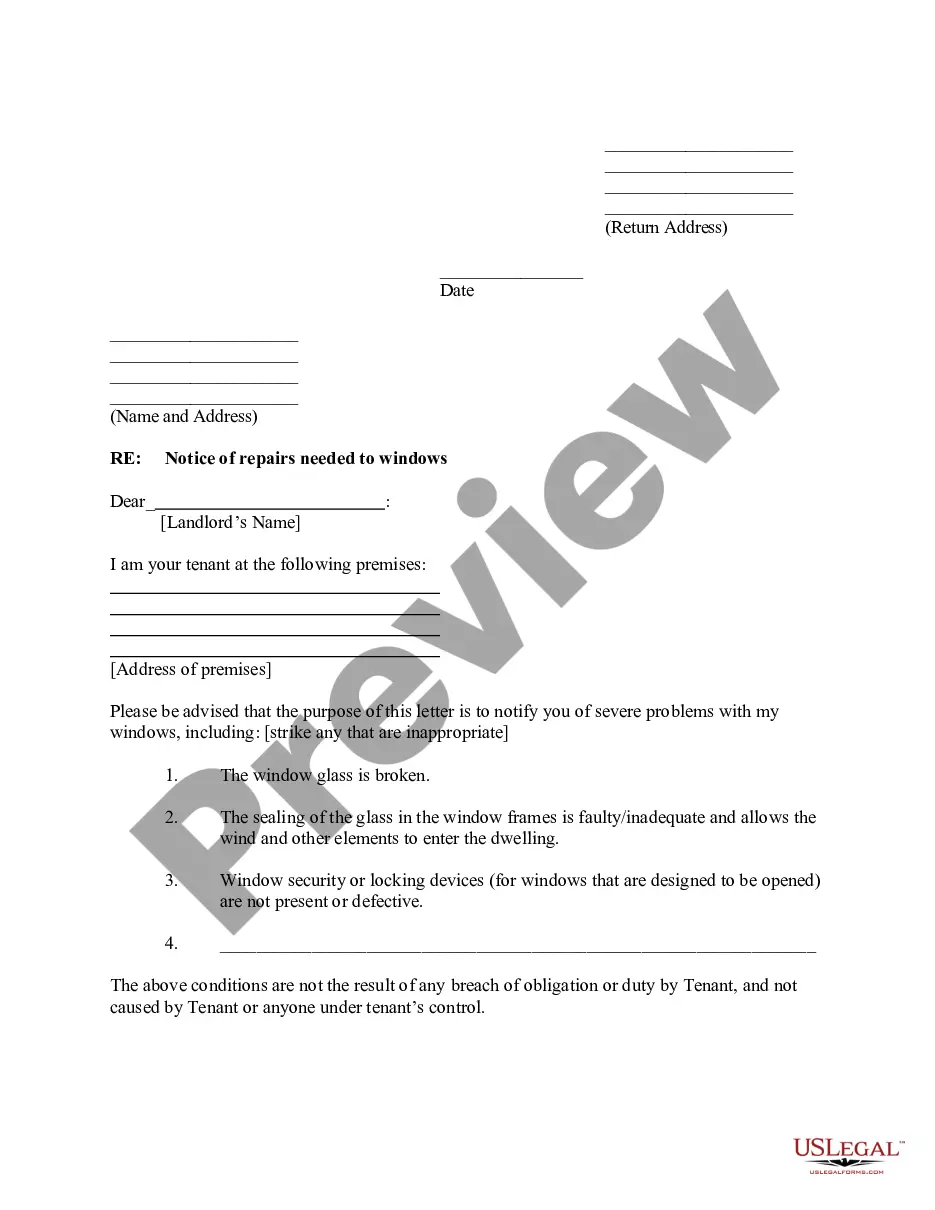
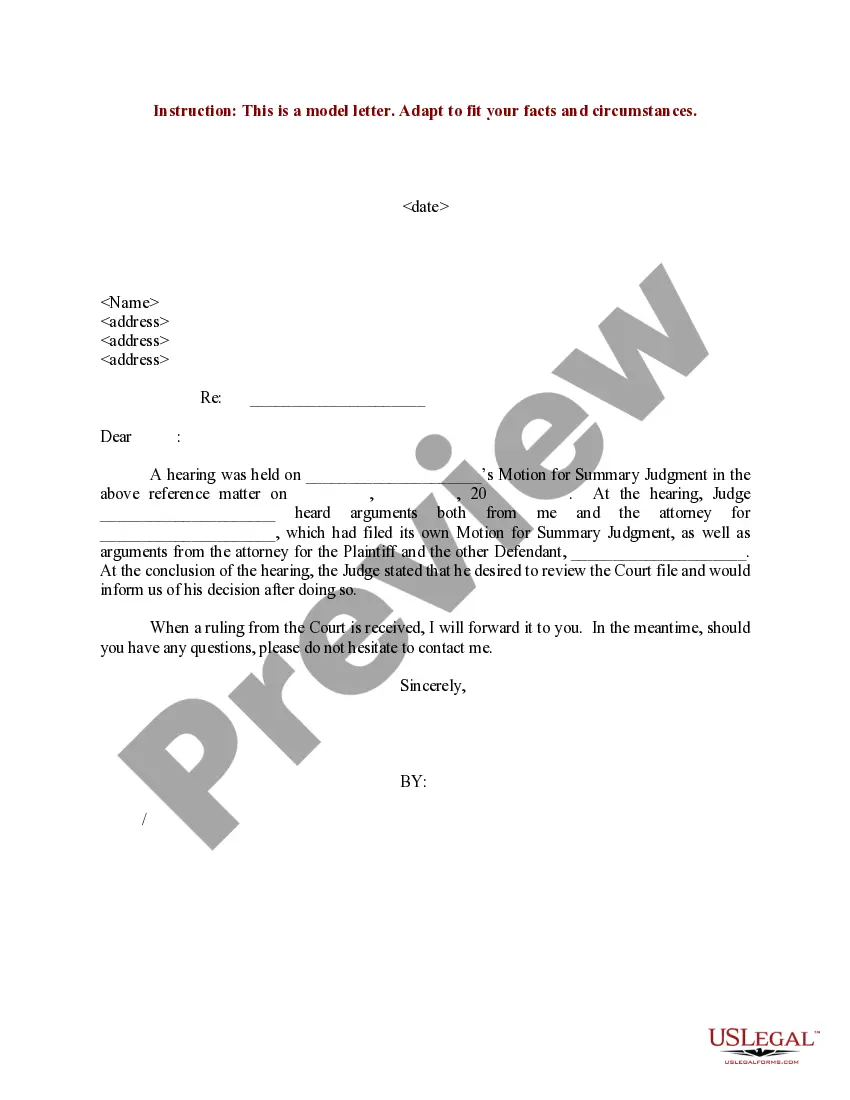
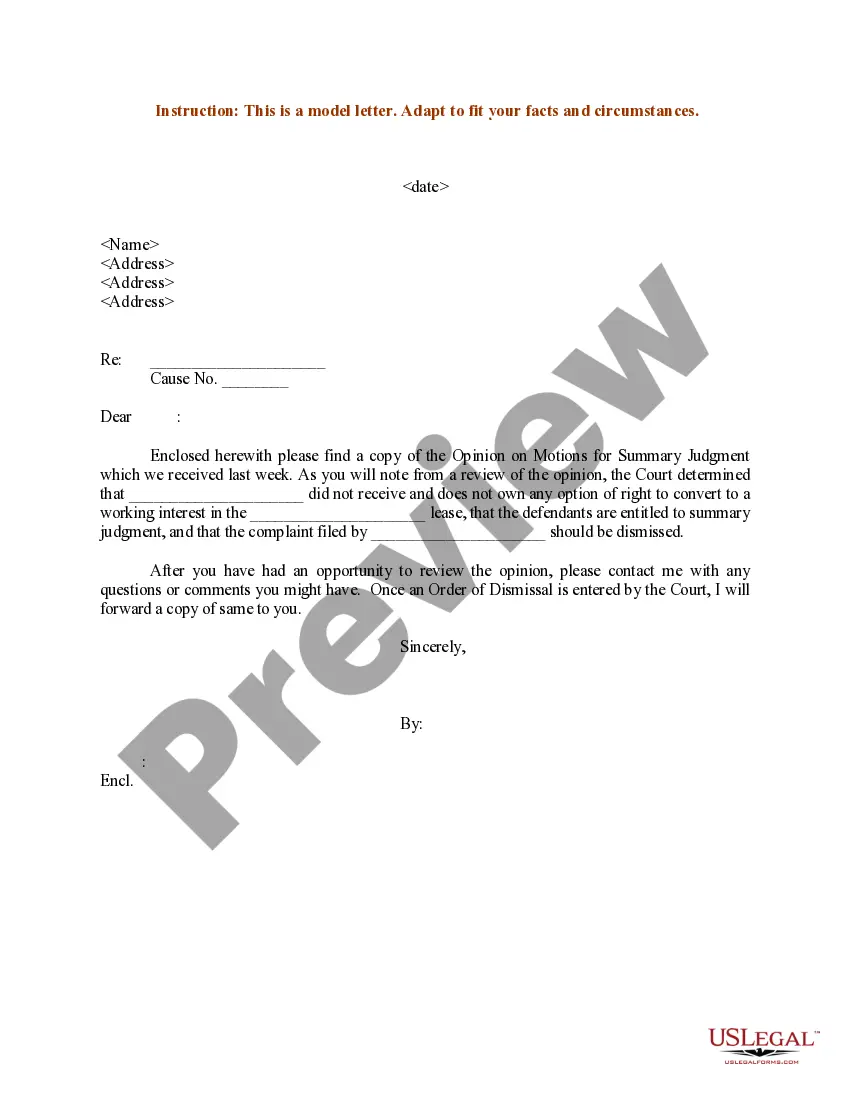
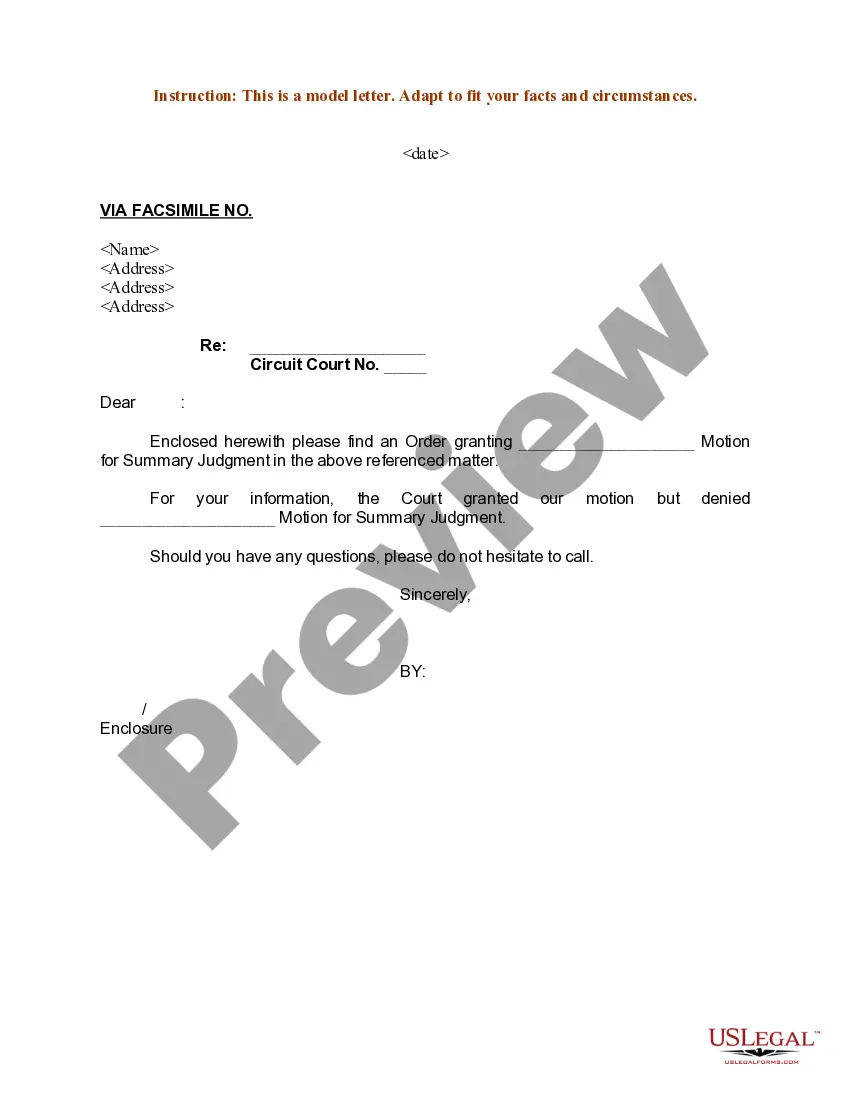
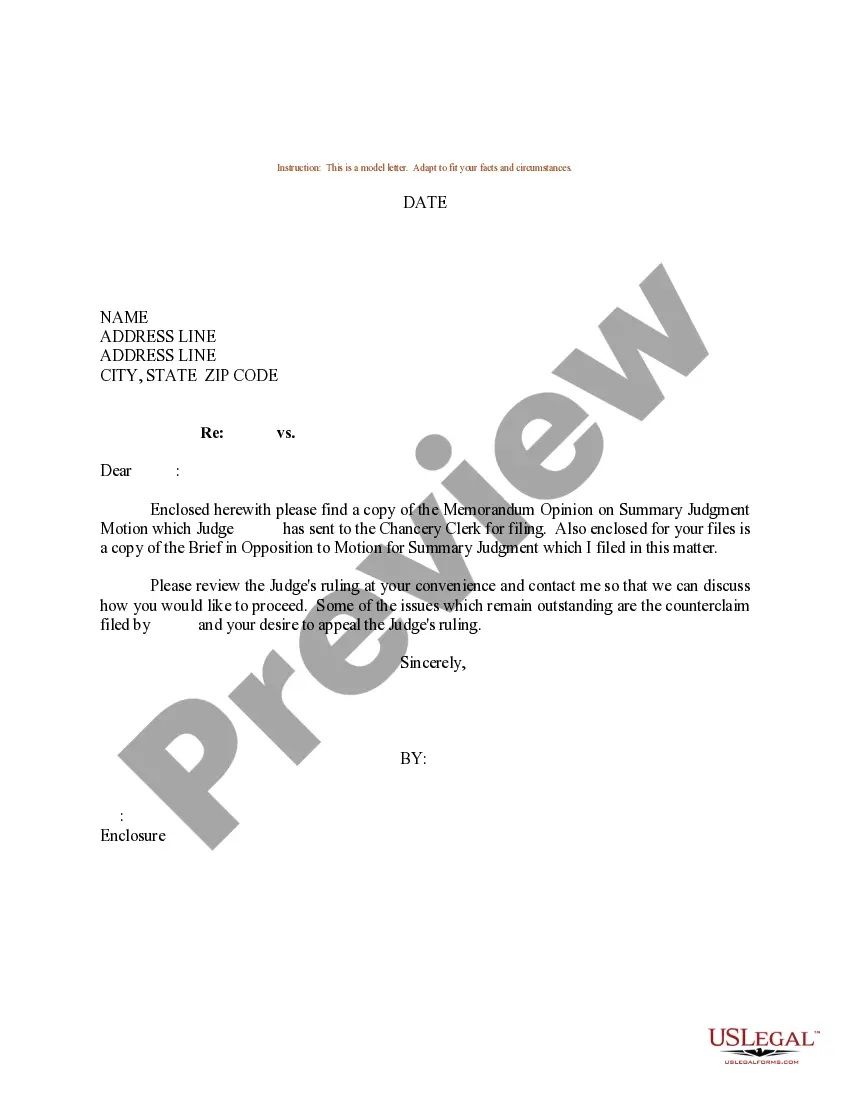
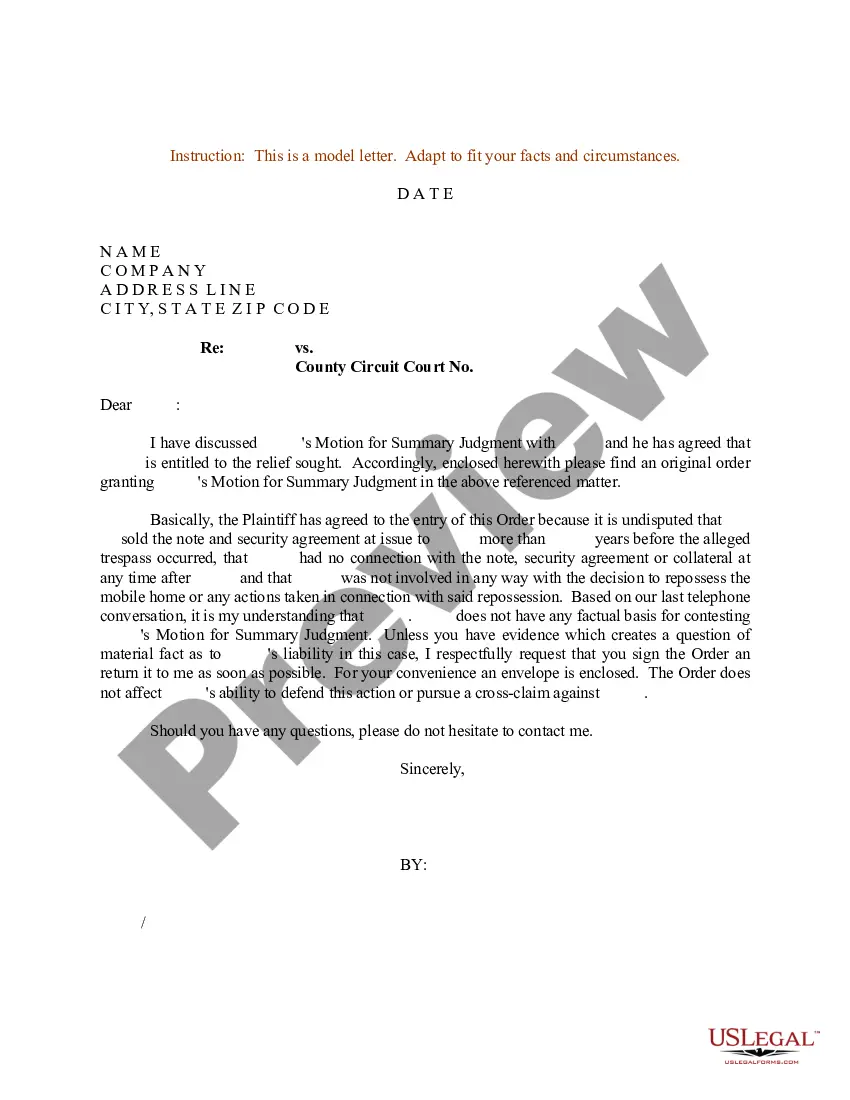
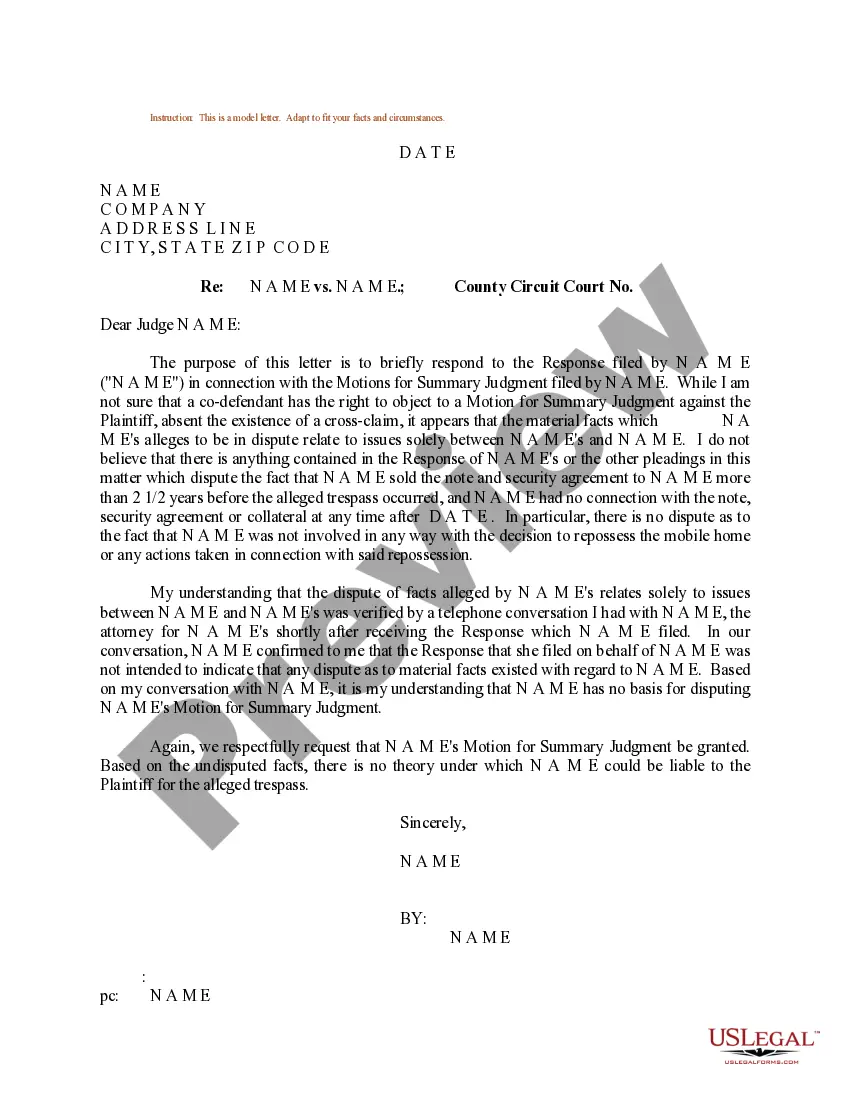
This form is a sample letter in Word format covering the subject matter of the title of the form.
Texas Sample Letter to Client concerning Hearing on Motion of Summary Judgment
Category:
State:
Multi-State
Control #:
US-0007LTR
Format:
Word;
Rich Text
Instant download
Description
Get your form ready online
Our built-in tools help you complete, sign, share, and store your documents in one place.
Built-in online Word editor
Make edits, fill in missing information, and update formatting in US Legal Forms—just like you would in MS Word.
Export easily
Download a copy, print it, send it by email, or mail it via USPS—whatever works best for your next step.
E-sign your document
Sign and collect signatures with our SignNow integration. Send to multiple recipients, set reminders, and more. Go Premium to unlock E-Sign.
Notarize online 24/7
If this form requires notarization, complete it online through a secure video call—no need to meet a notary in person or wait for an appointment.
Store your document securely
We protect your documents and personal data by following strict security and privacy standards.

Make edits, fill in missing information, and update formatting in US Legal Forms—just like you would in MS Word.

Download a copy, print it, send it by email, or mail it via USPS—whatever works best for your next step.

Sign and collect signatures with our SignNow integration. Send to multiple recipients, set reminders, and more. Go Premium to unlock E-Sign.

If this form requires notarization, complete it online through a secure video call—no need to meet a notary in person or wait for an appointment.

We protect your documents and personal data by following strict security and privacy standards.
Looking for another form?

How to fill out Sample Letter To Client Concerning Hearing On Motion Of Summary Judgment?
It is feasible to invest hours online looking for the legal document template that meets the federal and state criteria you require. US Legal Forms offers thousands of legal forms that are examined by experts.
It is easy to download or print the Texas Sample Letter to Client regarding Hearing on Motion of Summary Judgment from the service. If you already possess a US Legal Forms account, you can Log In and then click the Obtain button. After that, you can complete, modify, print, or sign the Texas Sample Letter to Client regarding Hearing on Motion of Summary Judgment.
Each legal document template you purchase is yours to keep indefinitely. To acquire another copy of the obtained form, visit the My documents tab and then click the corresponding button. If you are using the US Legal Forms site for the first time, follow the simple instructions below: First, ensure that you have chosen the correct document template for the county/town of your choice. Review the form description to confirm you have selected the right template. If available, use the Preview button to view the document template simultaneously.
Avoid altering or removing any HTML tags. Only synonymize plain text outside of the HTML tags.
- If you want to find another version of your form, use the Search section to locate the template that meets your needs and requirements.
- Once you have found the template you desire, click Buy now to proceed.
- Select the pricing plan you want, enter your credentials, and register for an account on US Legal Forms.
- Complete the transaction. You can use your credit card or PayPal account to pay for the legal form.
- Choose the format of your document and download it to your device.
- Make adjustments to your document if necessary. You can complete, modify, and sign and print the Texas Sample Letter to Client regarding Hearing on Motion of Summary Judgment.
- Obtain and print thousands of document templates using the US Legal Forms site, which offers the largest selection of legal forms. Utilize professional and state-specific templates to address your business or personal needs.
Form popularity
FAQ
To write a motion for summary judgment sample, begin with a title and introduction outlining the purpose of the motion. Include sections detailing the undisputed facts, legal arguments, and your request for judgment. Using a Texas Sample Letter to Client concerning Hearing on Motion of Summary Judgment can provide a helpful framework to ensure you cover all necessary elements.
An example of summary judgment occurs when one party argues that there is no genuine dispute over the material facts of a case, such as a breach of contract claim. If the evidence clearly supports one side, the court may grant summary judgment in favor of that party, effectively resolving the case without a trial. A Texas Sample Letter to Client concerning Hearing on Motion of Summary Judgment can illustrate how to present this in a legal context.
In Texas, you must provide at least 21 days' notice before a hearing on a motion for summary judgment. This ensures that all parties have adequate time to prepare their responses and arguments. It's essential to follow this timeline closely, and a Texas Sample Letter to Client concerning Hearing on Motion of Summary Judgment can help you format your notice correctly.
To write a good motion for summary judgment, start by clearly stating the issue and the relief you seek. Then, present a concise argument, supported by evidence and applicable law. Make sure to format your motion professionally, and consider using a Texas Sample Letter to Client concerning Hearing on Motion of Summary Judgment for templates and guidance.
A motion for summary judgment typically includes a statement of the case, a summary of undisputed facts, and legal arguments supporting the request for judgment. You should also attach evidence, such as affidavits and exhibits, to substantiate your claims. Utilizing a Texas Sample Letter to Client concerning Hearing on Motion of Summary Judgment can guide you in organizing these components.
In your response to the motion for summary judgment, you need to clearly outline your arguments against the motion, supported by evidence. Include affidavits, documents, and relevant facts that demonstrate why the motion should not be granted. Additionally, a Texas Sample Letter to Client concerning Hearing on Motion of Summary Judgment can help structure your response effectively.
Summary judgment is awarded if the undisputed facts and the law make it clear that it would be impossible for one party to prevail if the matter were to proceed to trial. The court must consider all designated evidence in the light most favorable to the party opposing the summary judgment motion.
Under Rule 56, in order to succeed in a motion for summary judgment, a movant must show 1) that there is no genuine dispute as to any material fact, and 2) that the movant is entitled to judgment as a matter of law. "Material fact" refers to any facts that could allow a fact-finder to decide against the movant.
Although the law is clear that only admissible evidence may be considered on summary judgment, that does not mean that the material must be presented in a form that would be admissible at trial. Affidavits and declarations are the classic examples.
The first step in appealing a summary judgment is determining whether the order is a final judgment that can be appealed. Generally, Texas appellate courts may review only final judgments, and there can be only one final judgment in any case. See Colquitt v. Brazoria County, 324 S.W.