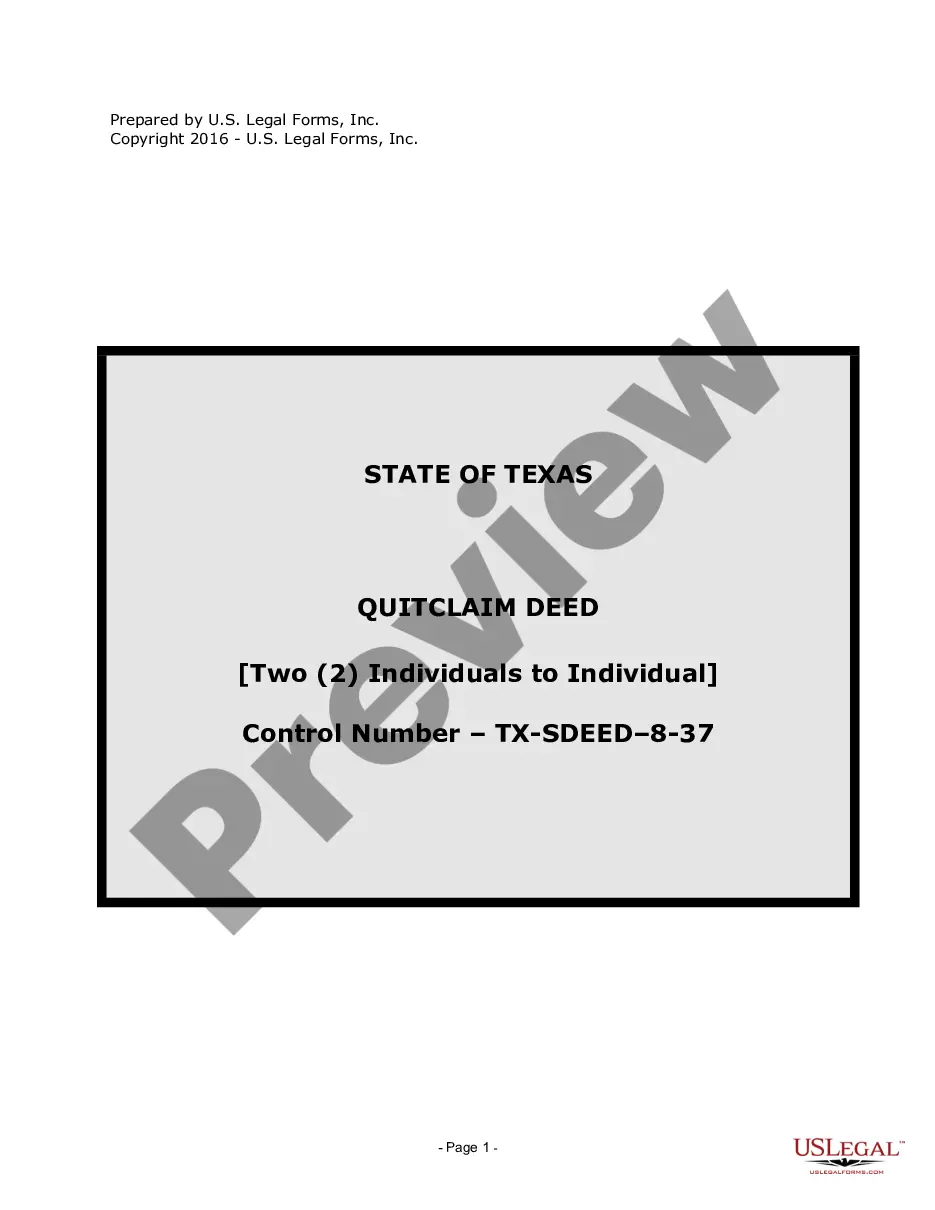
Texas Quitclaim Deed for Two Individuals to Individual
About this form
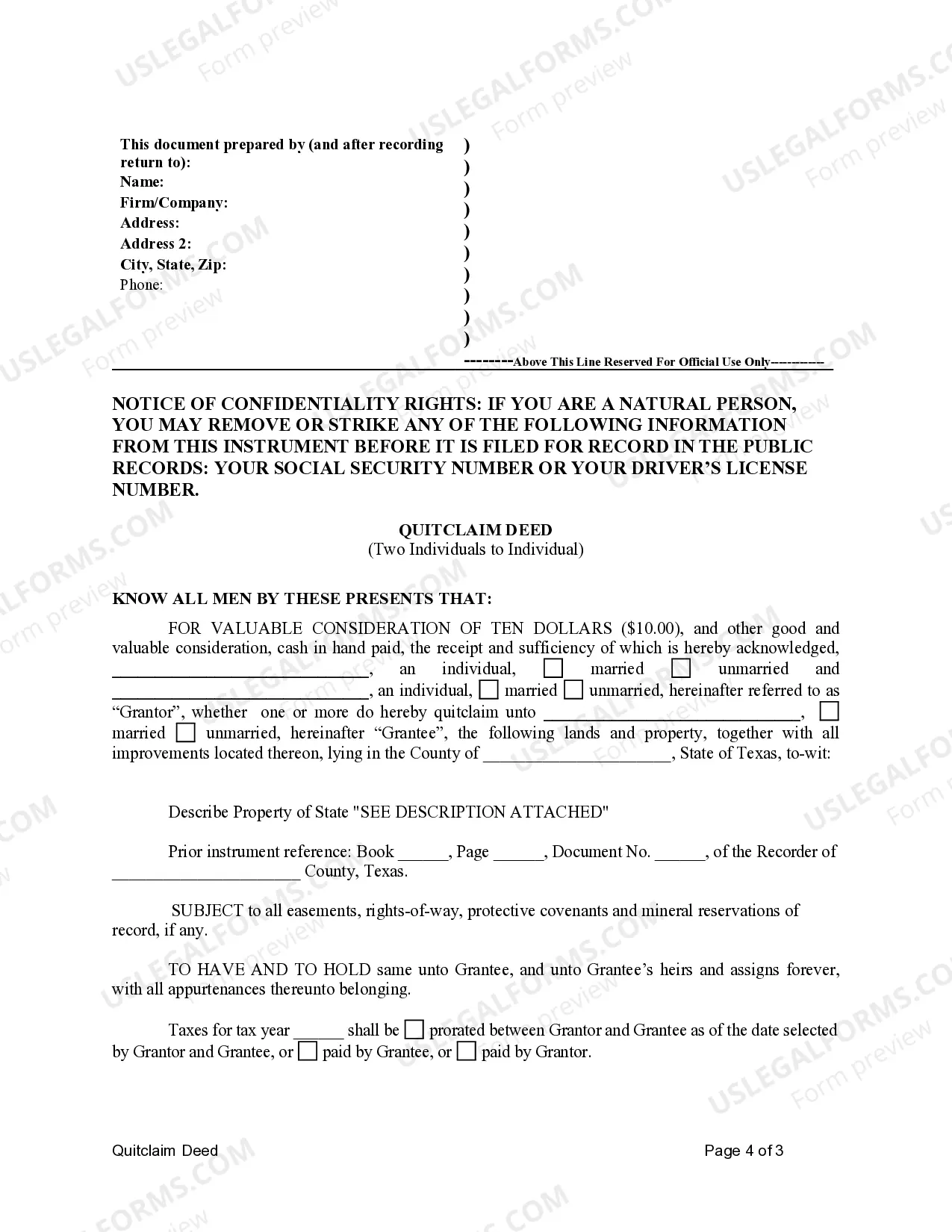
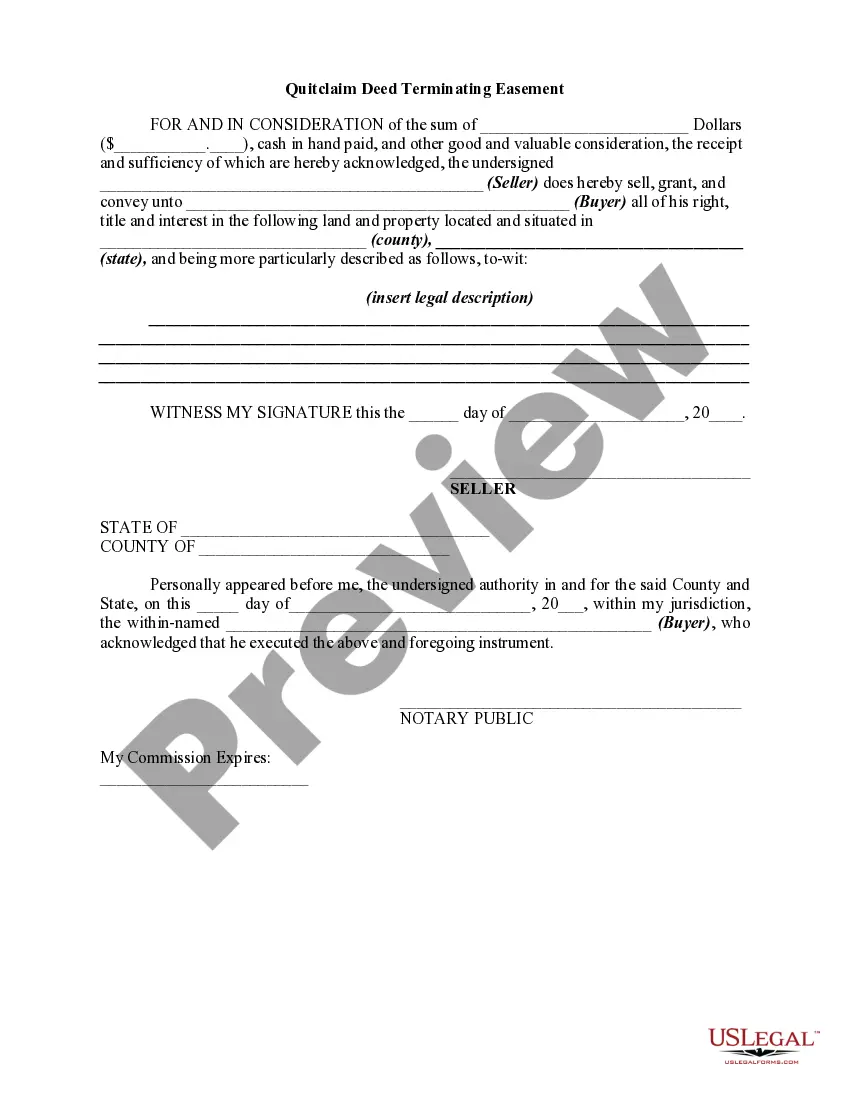
The Quitclaim Deed for Two Individuals to Individual is a legal document used to transfer property ownership from two individuals (grantors) to a single individual (grantee). Unlike other deed types, a quitclaim deed does not guarantee that the grantors hold clear title to the property. It simply conveys whatever interest may exist, making it particularly useful in situations where ownership is being transferred informally, such as family transactions or divorce settlements.
Key components of this form
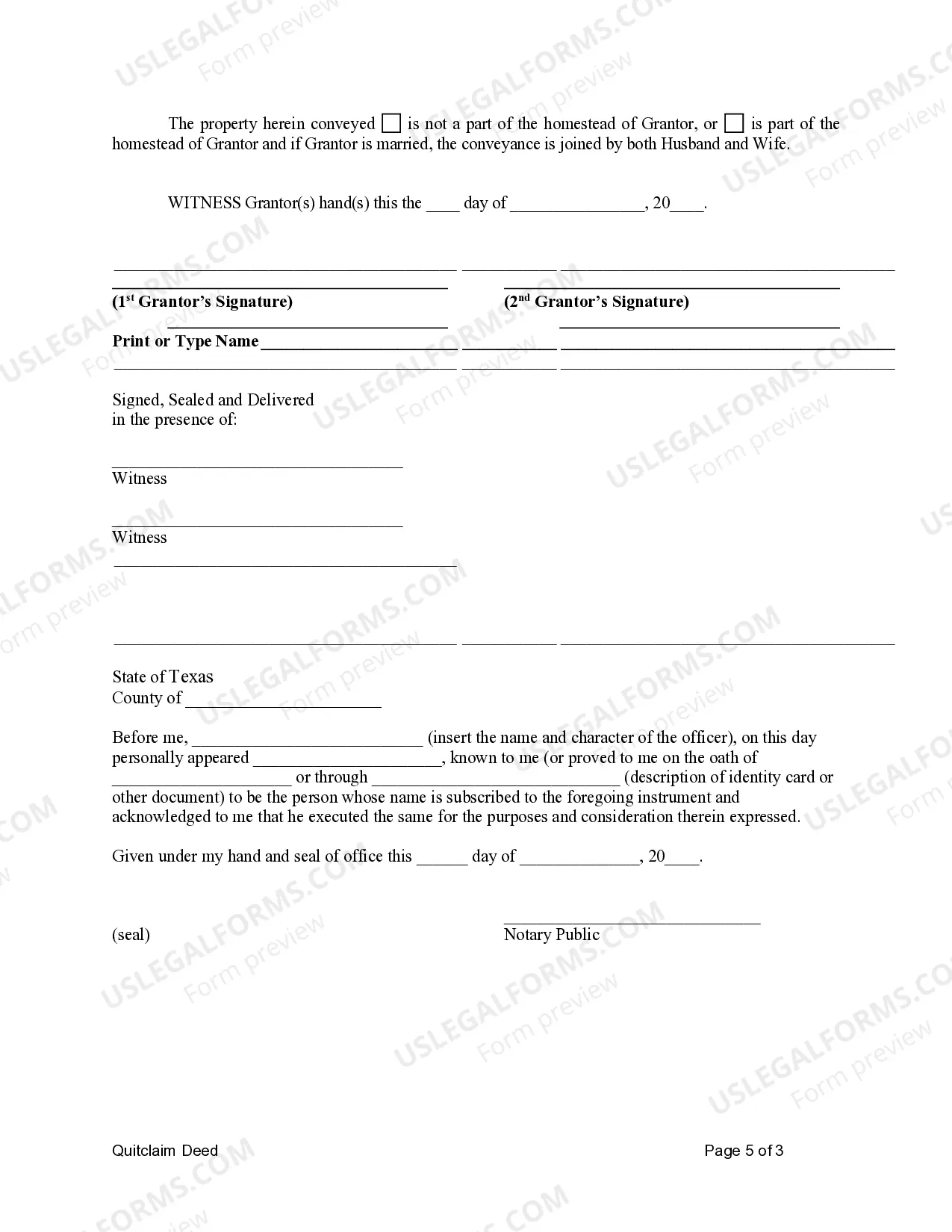
- Identification of the grantors (two individuals) and grantee (one individual)
- Property description, including legal description and location
- Consideration provided for the property (usually a nominal amount)
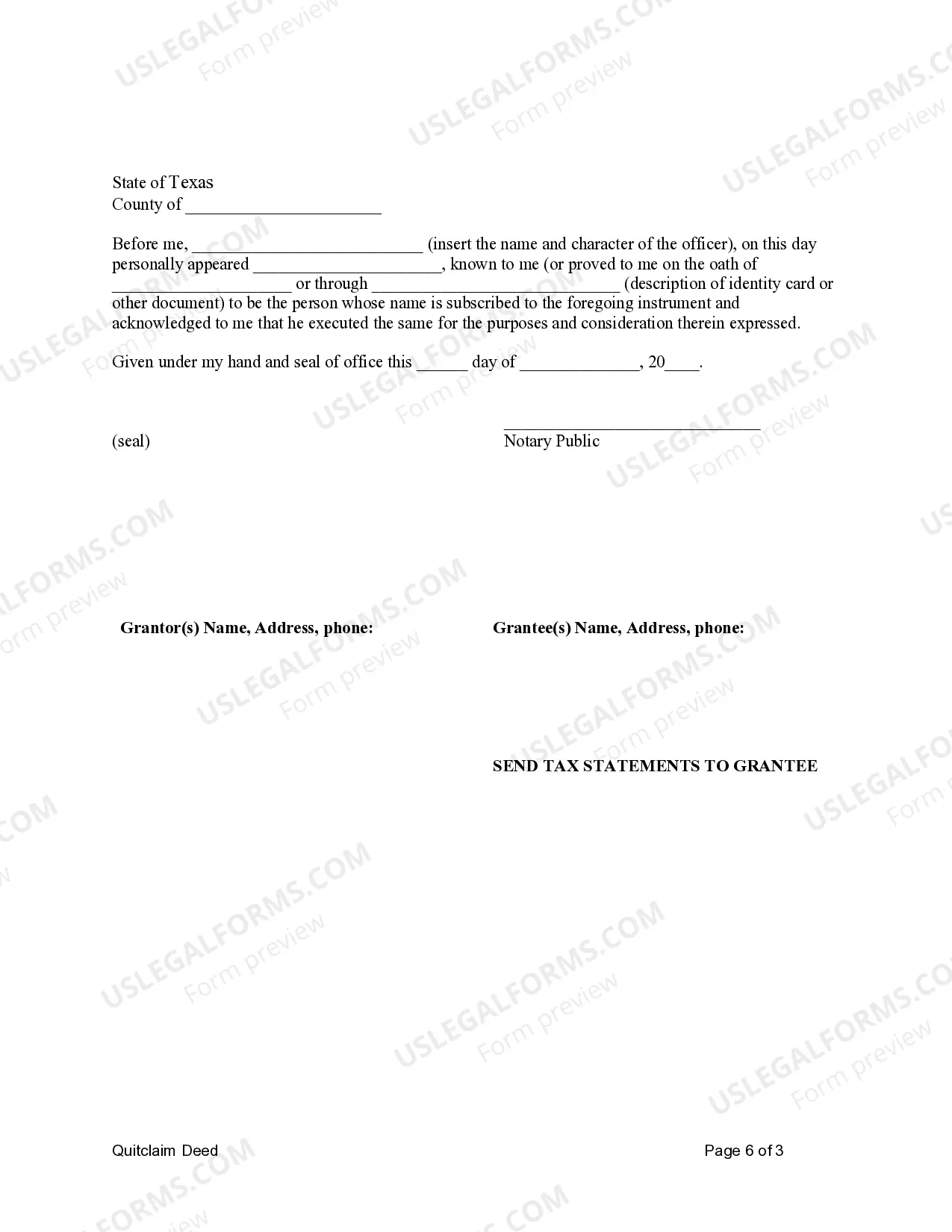
- Signature lines for grantors and acknowledgment by a notary public
- Provisions regarding taxes and use of the property



Common use cases
This form is commonly used in situations where two individuals wish to transfer property to one person, such as when parents give a property to their child or when co-owners of real estate decide to transfer their interest to one party. It is also useful in resolving ownership disputes or during marital separations.
Who should use this form
This form is intended for:
- Individuals transferring ownership of real estate among family members
- Co-owners of property who wish to consolidate ownership
- Anyone involved in legal agreements relating to property transfer without warranties
How to complete this form
- Identify the names and marital status of the two grantors.
- Enter the name of the grantee along with their marital status.
- Provide a detailed description of the property being transferred.
- State the nominal consideration (typically ten dollars) received for the property.
- Sign the deed in front of a notary public to validate the transfer.
Notarization guidance
This form needs to be notarized to ensure legal validity. US Legal Forms provides secure online notarization powered by Notarize, allowing you to complete the process through a verified video call, available anytime.
Get your form ready online
Our built-in tools help you complete, sign, share, and store your documents in one place.
Make edits, fill in missing information, and update formatting in US Legal Forms—just like you would in MS Word.
Download a copy, print it, send it by email, or mail it via USPS—whatever works best for your next step.
Sign and collect signatures with our SignNow integration. Send to multiple recipients, set reminders, and more. Go Premium to unlock E-Sign.
If this form requires notarization, complete it online through a secure video call—no need to meet a notary in person or wait for an appointment.
We protect your documents and personal data by following strict security and privacy standards.

Make edits, fill in missing information, and update formatting in US Legal Forms—just like you would in MS Word.

Download a copy, print it, send it by email, or mail it via USPS—whatever works best for your next step.

Sign and collect signatures with our SignNow integration. Send to multiple recipients, set reminders, and more. Go Premium to unlock E-Sign.

If this form requires notarization, complete it online through a secure video call—no need to meet a notary in person or wait for an appointment.

We protect your documents and personal data by following strict security and privacy standards.
Common mistakes to avoid
- Neglecting to accurately describe the property being conveyed.
- Forgetting to have the deed notarized, which could affect its validity.
- Failing to consider potential tax implications on the transfer.
Advantages of online completion
- Convenience of filling out the form from home without the need for physical trips to a lawyer's office.
- Editability allows users to customize the form to their specific situation before printing.
- Access to a reliable template created by licensed attorneys, ensuring compliance with legal standards.
What to keep in mind
- The Quitclaim Deed allows two individuals to transfer property rights to one individual.
- Proper completion and notarization are essential for the deed's validity.
- This form is particularly useful for family transfers or simplifying property ownership disputes.
Looking for another form?
Form popularity
FAQ
Laws Section 13.002. Recording This form must be filed at the Recorder's Office in the County Clerk's Office. Signing (Section 11.002(c)) The Grantor(s) has the choice of authorizing this form in the presence of Two (2) Witnesses or a Notary Public.
It does not convey muniment of title. Instead, unlike a warranty deed, which conveys property, a quitclaim deed only conveys whatever interest the grantor has at the time of the transfer.Despite all of this, quitclaim deeds are still a valid, if unreliable, means of transferring title to real property in Texas.
A person who signs a quitclaim deed to transfer property they do not own results in no title at all being transferred since there is no actual ownership interest. The quitclaim deed only transfers the type of title you own.
Yes, you can use a Quitclaim Deed to transfer a gift of property to someone. You must still include consideration when filing your Quitclaim Deed with the County Recorder's Office to show that title has been transferred, so you would use $10.00 as the consideration for the property.
Rates vary by state and law office but typically fall in the range of $200 to $400 per hour. Title companies routinely prepare quitclaim deeds in many states.
The drawback, quite simply, is that quitclaim deeds offer the grantee/recipient no protection or guarantees whatsoever about the property or their ownership of it. Maybe the grantor did not own the property at all, or maybe they only had partial ownership.
If you own your own home, you are free to gift or sell an interest in the real property to someone else.You'll need to transfer an interest by writing up another deed with the person's name on it. In California, you can use either a grant deed, a quitclaim deed or an interspousal deed, depending on your circumstances.
Once you sign a quitclaim deed and it has been filed and recorded with the County Clerks Office, the title has been officially transferred and cannot be easily reversed. In order to reverse this type of transfer, it would require your spouse to cooperate and assist in adding your name back to the title.
Quitclaim deeds are most often used to transfer property between family members. Examples include when an owner gets married and wants to add a spouse's name to the title or deed, or when the owners get divorced and one spouse's name is removed from the title or deed.