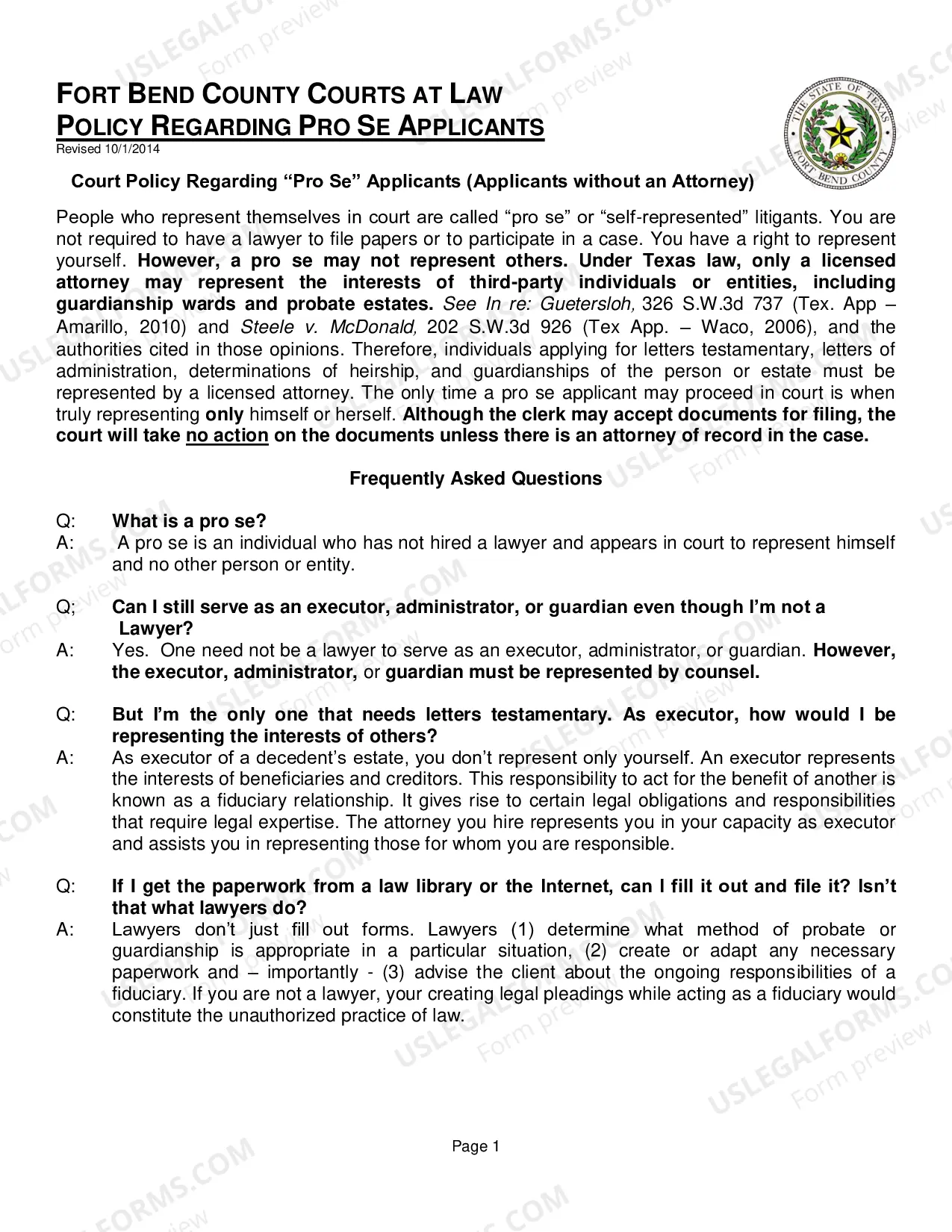
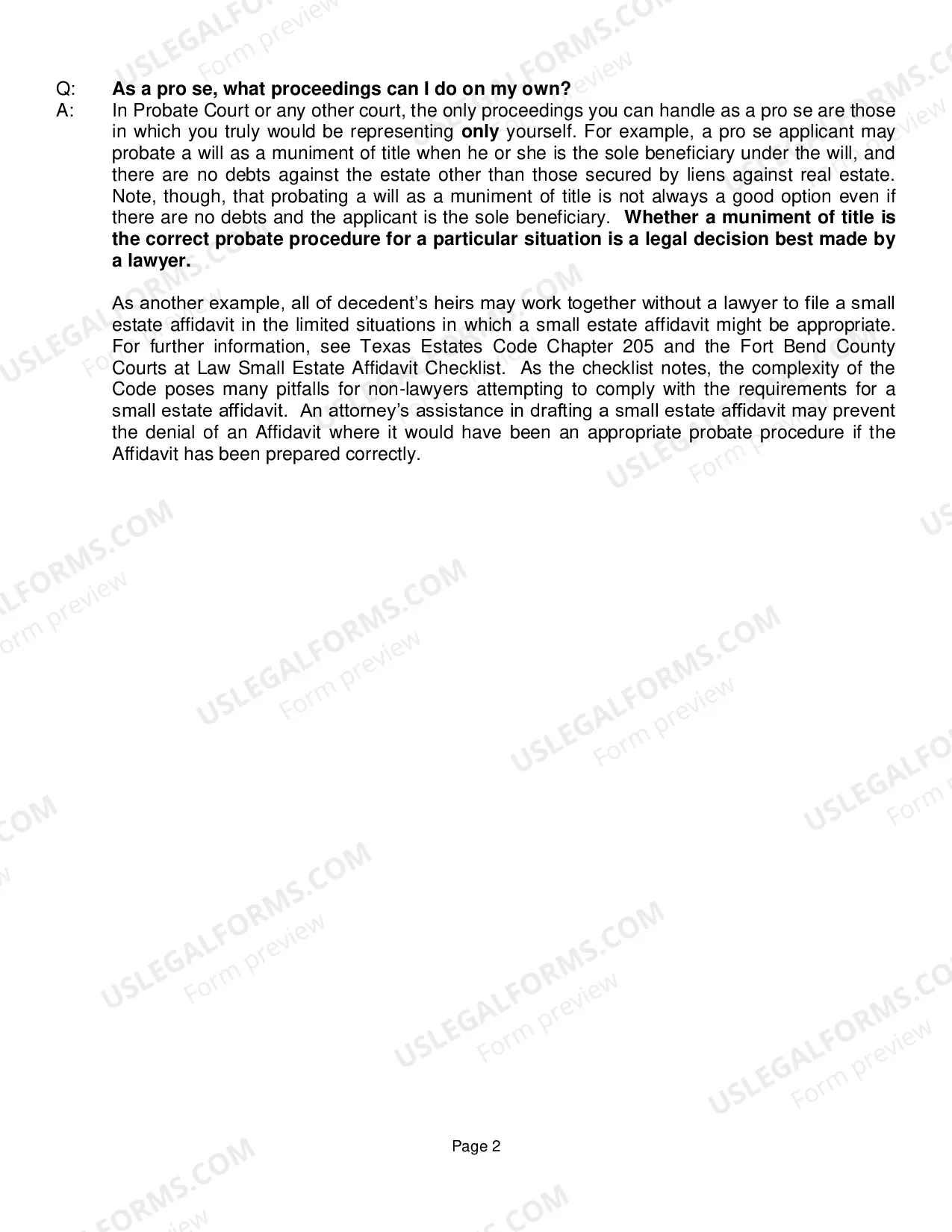
Texas Court Policy Regarding Pro Se Applicants is a set of guidelines used by courts in Texas to ensure that self-represented individuals (Pro Se applicants) have access to fair and equal justice in the state's court system. This policy applies to all trial and appellate courts throughout Texas, including the Texas Supreme Court, the Texas Court of Criminal Appeals, and all state and county courts. The policy is intended to ensure that Pro Se applicants receive the same level of procedural due process as represented litigants, regardless of their legal knowledge and experience. The policy includes the following provisions: 1. All courts must provide Pro Se applicants with forms, instructions, and other resources necessary to participate in court proceedings, as well as access to court staff for assistance. 2. Courts must ensure that any orders or decisions issued in Pro Se cases are explained in plain language and that the applicant is provided with copies. 3. The court must take all reasonable steps to ensure that the Pro Se applicant understands the legal process and any consequences of the proceedings. 4. Courts must provide Pro Se applicants with reasonable accommodations and procedural safeguards, including allowing more time for filings and hearings. 5. Courts should not require Pro Se applicants to use language or terminology that is unfamiliar to them. 6. Courts should not require Pro Se applicants to provide legal representation or advice to another party. 7. Courts must provide Pro Se applicants with access to the court's library, research materials, and other resources. 8. Courts must provide Pro Se applicants with notice of deadlines and other important information in a timely manner. 9. Courts must provide Pro Se applicants with access to court-appointed counsel if they are unable to afford an attorney.
Texas Court Policy Regarding Pro Se Applicants
Description
Get your form ready online
Our built-in tools help you complete, sign, share, and store your documents in one place.
Make edits, fill in missing information, and update formatting in US Legal Forms—just like you would in MS Word.
Download a copy, print it, send it by email, or mail it via USPS—whatever works best for your next step.
Sign and collect signatures with our SignNow integration. Send to multiple recipients, set reminders, and more. Go Premium to unlock E-Sign.
If this form requires notarization, complete it online through a secure video call—no need to meet a notary in person or wait for an appointment.
We protect your documents and personal data by following strict security and privacy standards.

Make edits, fill in missing information, and update formatting in US Legal Forms—just like you would in MS Word.

Download a copy, print it, send it by email, or mail it via USPS—whatever works best for your next step.

Sign and collect signatures with our SignNow integration. Send to multiple recipients, set reminders, and more. Go Premium to unlock E-Sign.

If this form requires notarization, complete it online through a secure video call—no need to meet a notary in person or wait for an appointment.

We protect your documents and personal data by following strict security and privacy standards.
Looking for another form?
How to fill out Texas Court Policy Regarding Pro Se Applicants?
US Legal Forms is the most easy and profitable way to find suitable legal templates. It’s the most extensive web-based library of business and individual legal documentation drafted and checked by legal professionals. Here, you can find printable and fillable templates that comply with federal and local laws - just like your Texas Court Policy Regarding Pro Se Applicants.
Getting your template takes just a few simple steps. Users that already have an account with a valid subscription only need to log in to the web service and download the form on their device. Later, they can find it in their profile in the My Forms tab.
And here’s how you can obtain a professionally drafted Texas Court Policy Regarding Pro Se Applicants if you are using US Legal Forms for the first time:
- Read the form description or preview the document to make certain you’ve found the one meeting your requirements, or find another one using the search tab above.
- Click Buy now when you’re sure of its compatibility with all the requirements, and choose the subscription plan you like most.
- Create an account with our service, sign in, and purchase your subscription using PayPal or you credit card.
- Decide on the preferred file format for your Texas Court Policy Regarding Pro Se Applicants and save it on your device with the appropriate button.
After you save a template, you can reaccess it whenever you want - simply find it in your profile, re-download it for printing and manual fill-out or import it to an online editor to fill it out and sign more effectively.
Benefit from US Legal Forms, your trustworthy assistant in obtaining the corresponding formal paperwork. Try it out!
Form popularity
FAQ
(a) Contempt. Failure by any person without adequate excuse to obey a subpoena served upon that person may be deemed a contempt of the court from which the subpoena is issued or a district court in the county in which the subpoena is served, and may be punished by fine or confinement, or both.
Generally, only an attorney licensed in the State of Texas may represent a third person or entity in a judicial proceeding in the State of Texas.
You simply file the affidavit with the county clerk of the counties where the decedent owned property or resided at the time of death. The affidavit must be notarized and signed by two disinterested people (i.e., persons that have no financial interest in the decedent's estate).
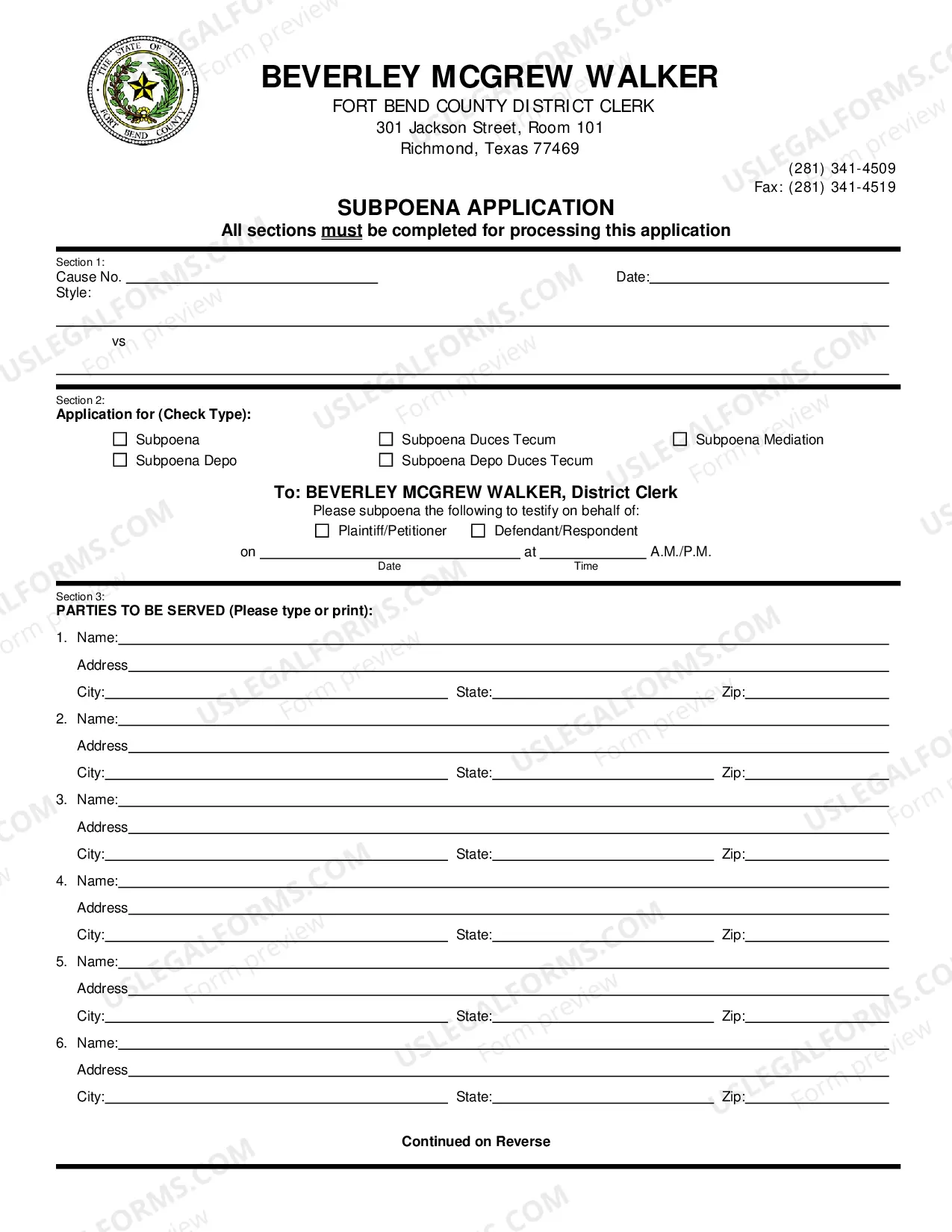
A subpoena may be issued by the clerk of the justice court or an attorney authorized to practice in the State of Texas, as an officer of the court.
Types of Property Exempt from Probate The asset is held in joint tenancy, such as a home where two people's names are on the deed; Community property with the right of survivorship; Payable-on-death bank accounts; Proceeds and benefits that are payable via a life insurance policy; and. Payments from a survivor annuity.
The Texas Rules of Civil Procedure Rule 176.7 and 192.6 provide that the subpoenaed party may try to defeat the subpoena based on the grounds that it requests information which is unduly burdensome or expensive, harassing, annoying, invasive or a protected right, or is privileged.
Can I subpoena someone on my own, as a self-represented litigant? No. Unless you are an attorney or officer of the court, you cannot subpoena someone on your own. You will need the court's permission.
176.5 Service. (a) Manner of service. A subpoena may be served at any place within the State of Texas by any sheriff or constable of the State of Texas, or any person who is not a party and is 18 years of age or older.