Texas Expedited Foreclosure Forms
Overview of this form
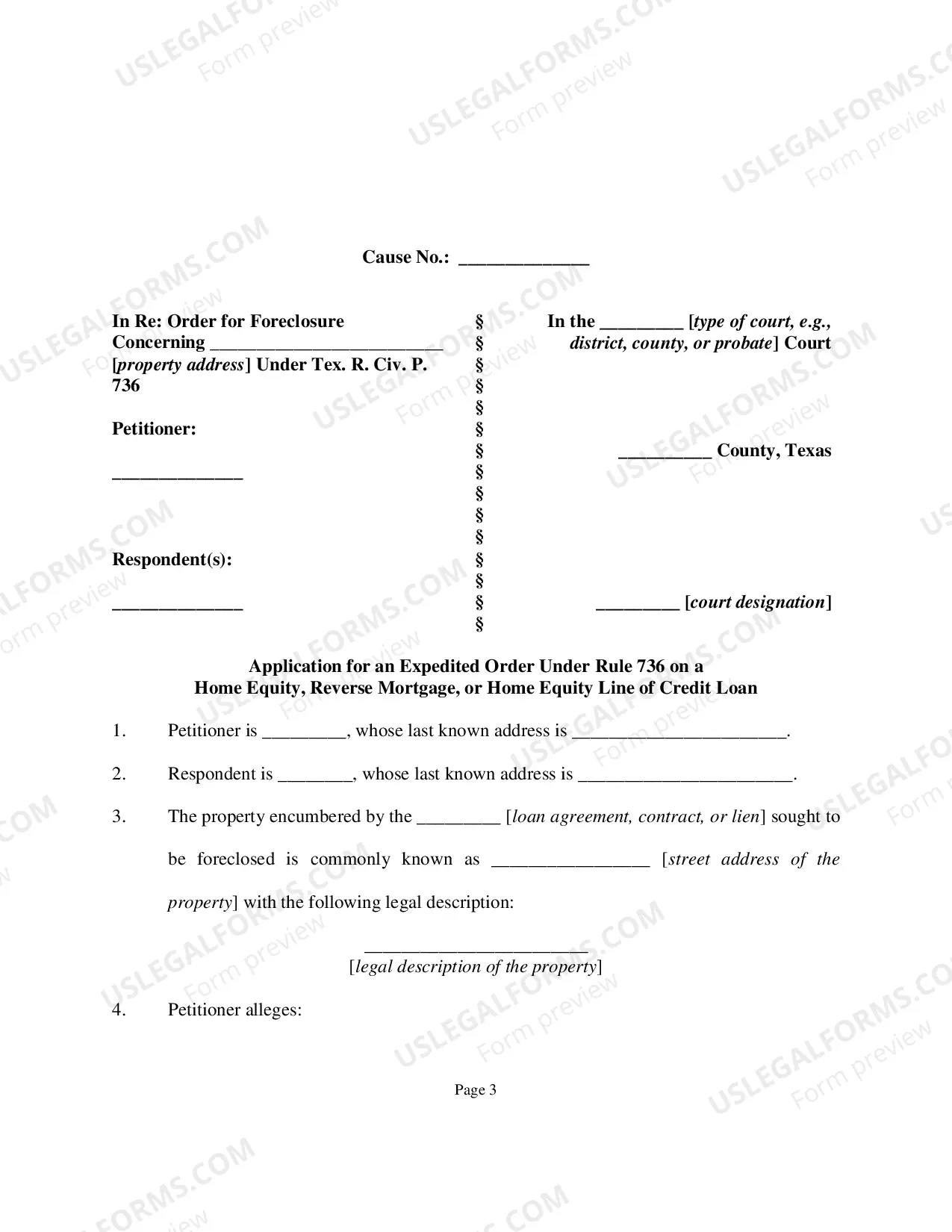
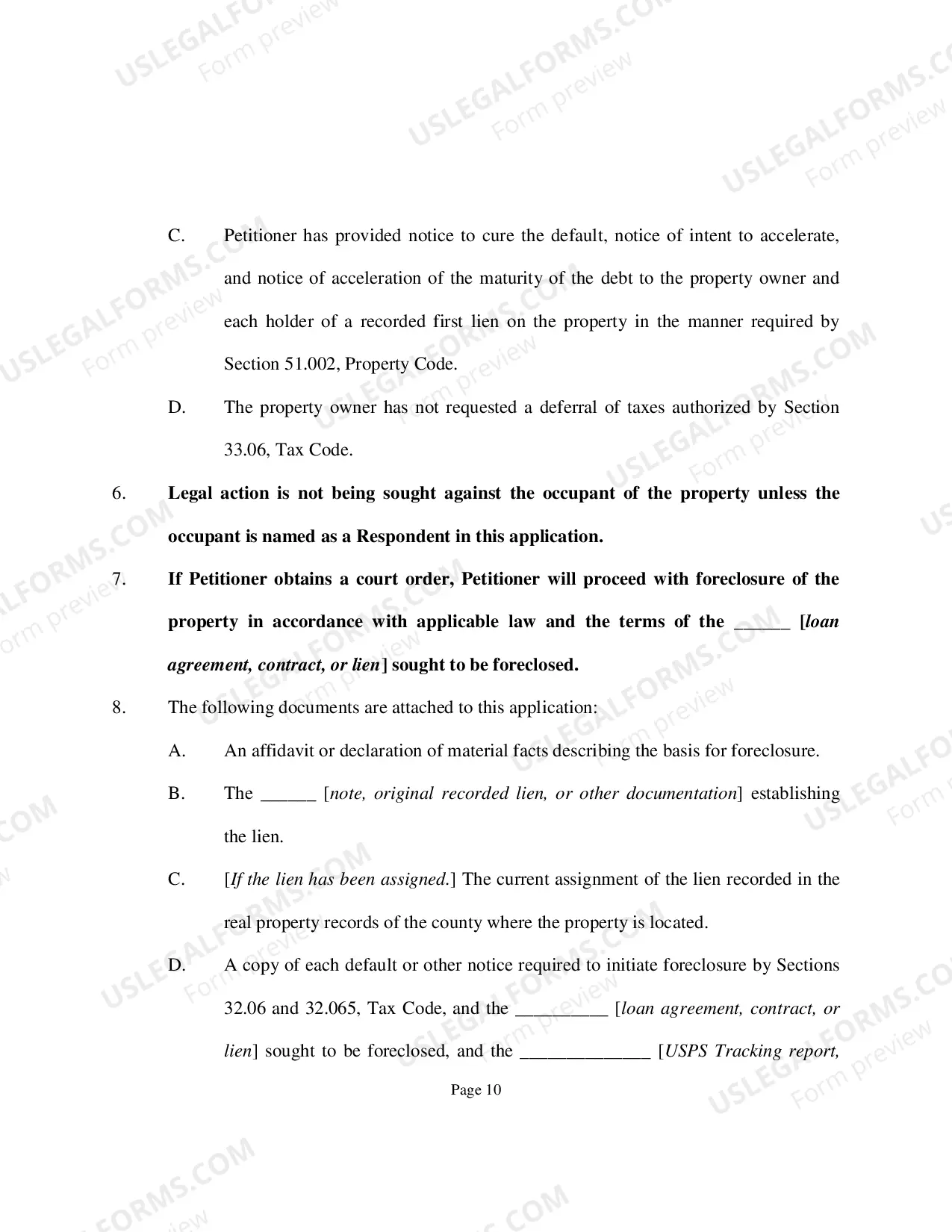
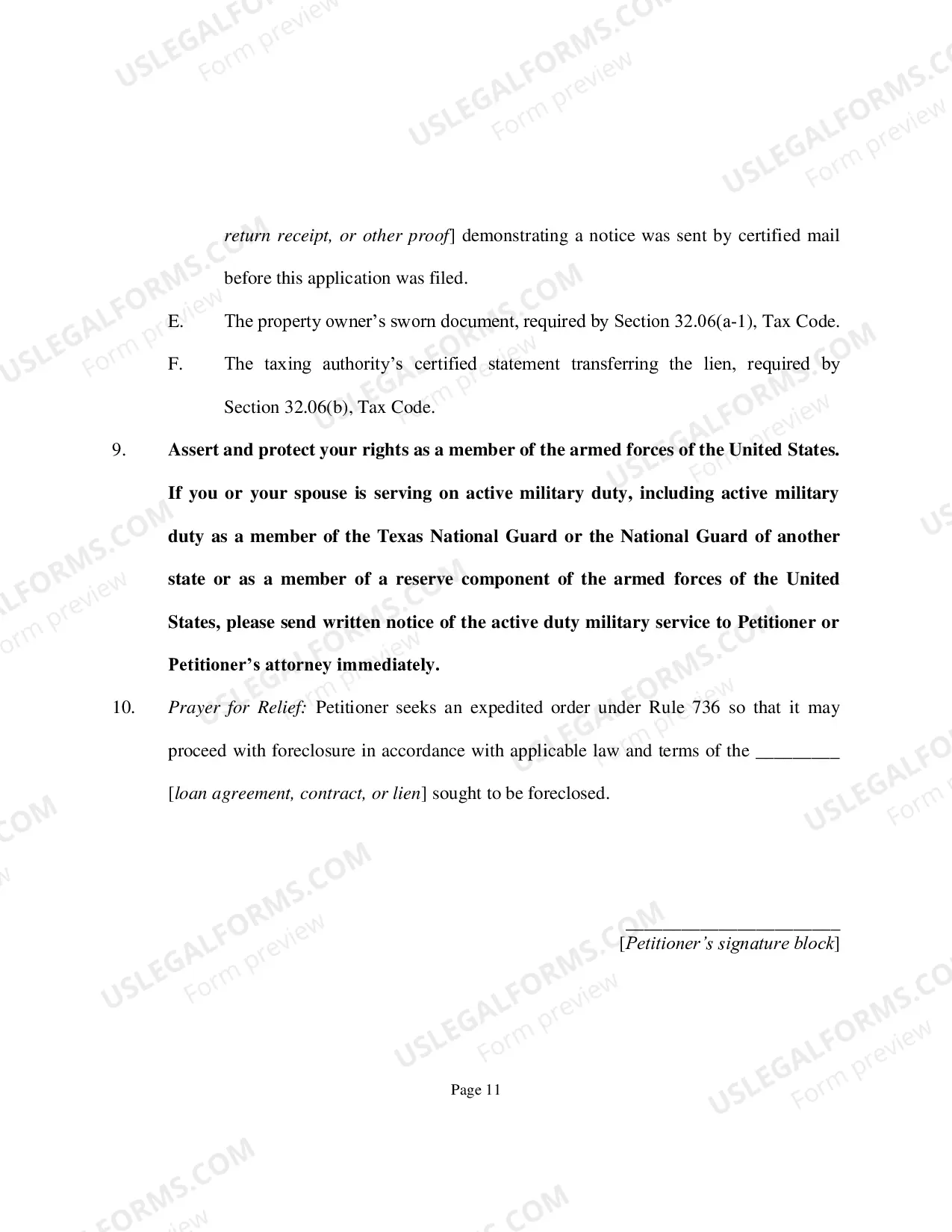
The Expedited Foreclosure Forms are legal documents used in Texas to quickly initiate foreclosure proceedings under Rule 736 of the Texas Rules of Civil Procedure. These forms allow a lender or lienholder to apply for a court order to foreclose on a property due to default on a loan or payment obligation. Unlike standard foreclosure processes, this expedited procedure is designed to resolve cases more swiftly, ensuring timely action for lenders while protecting the rights of borrowers.
Main sections of this form
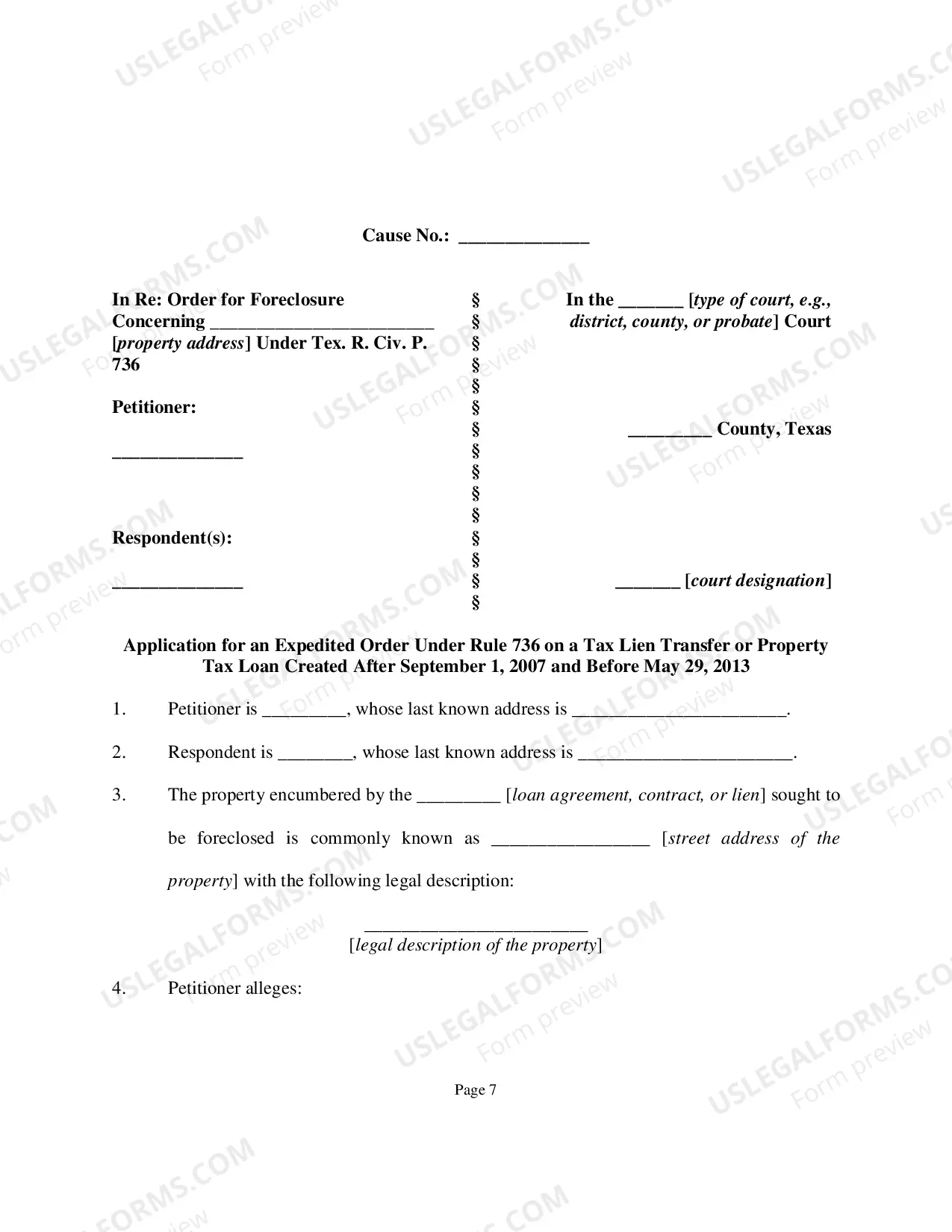
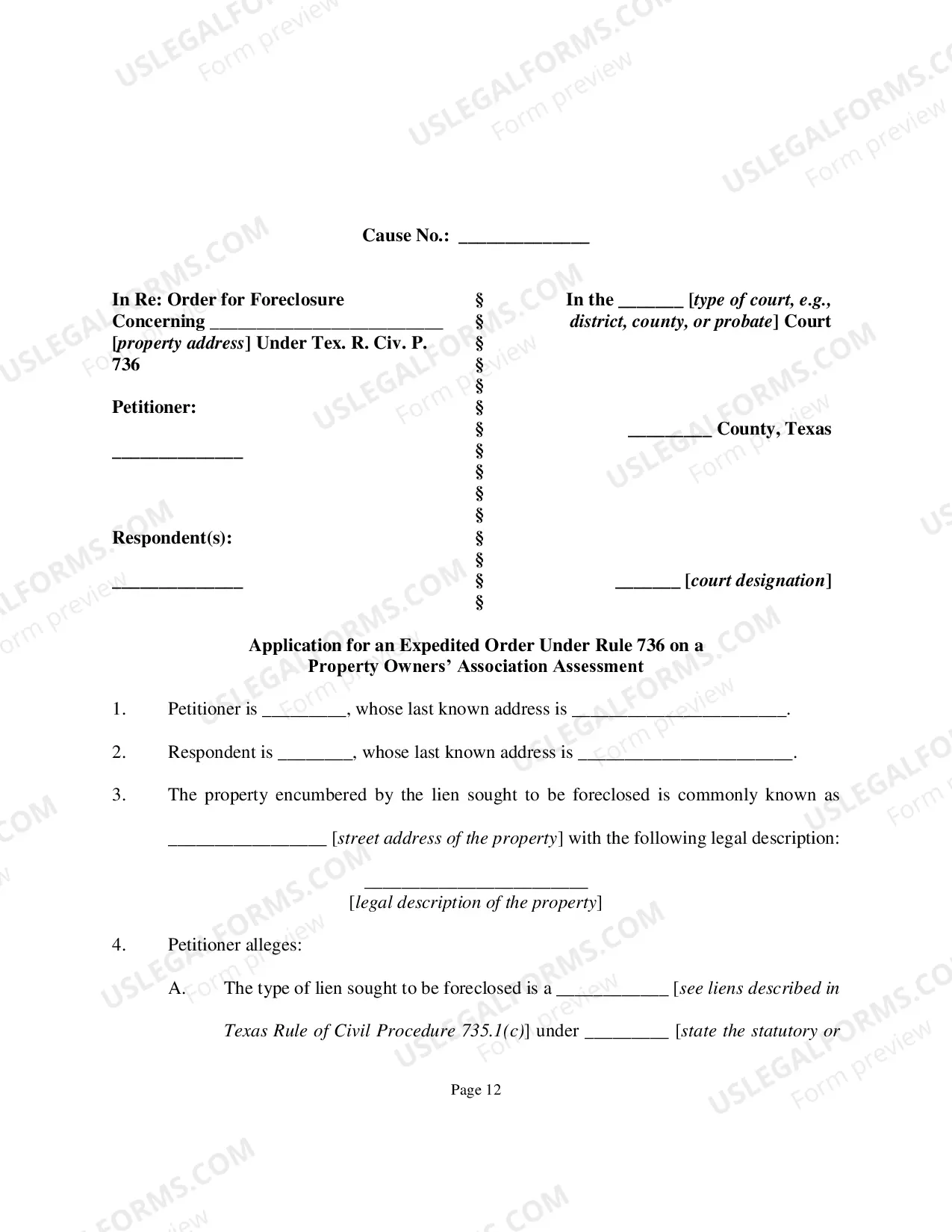
- Cause Number: The unique identifier for the court case.
- Petitioner and Respondent Information: Names and addresses of the involved parties.
- Property Details: Common and legal descriptions of the property in question.
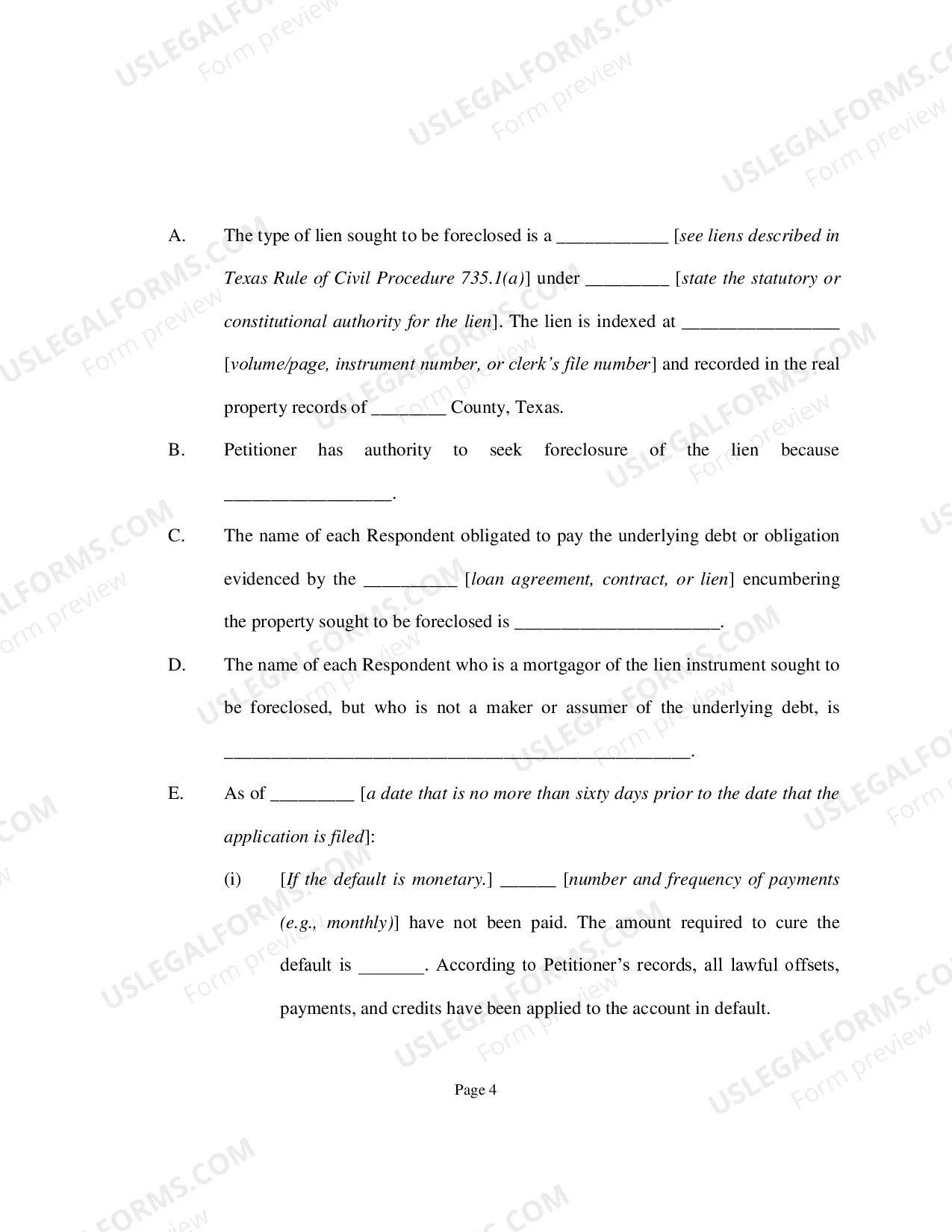
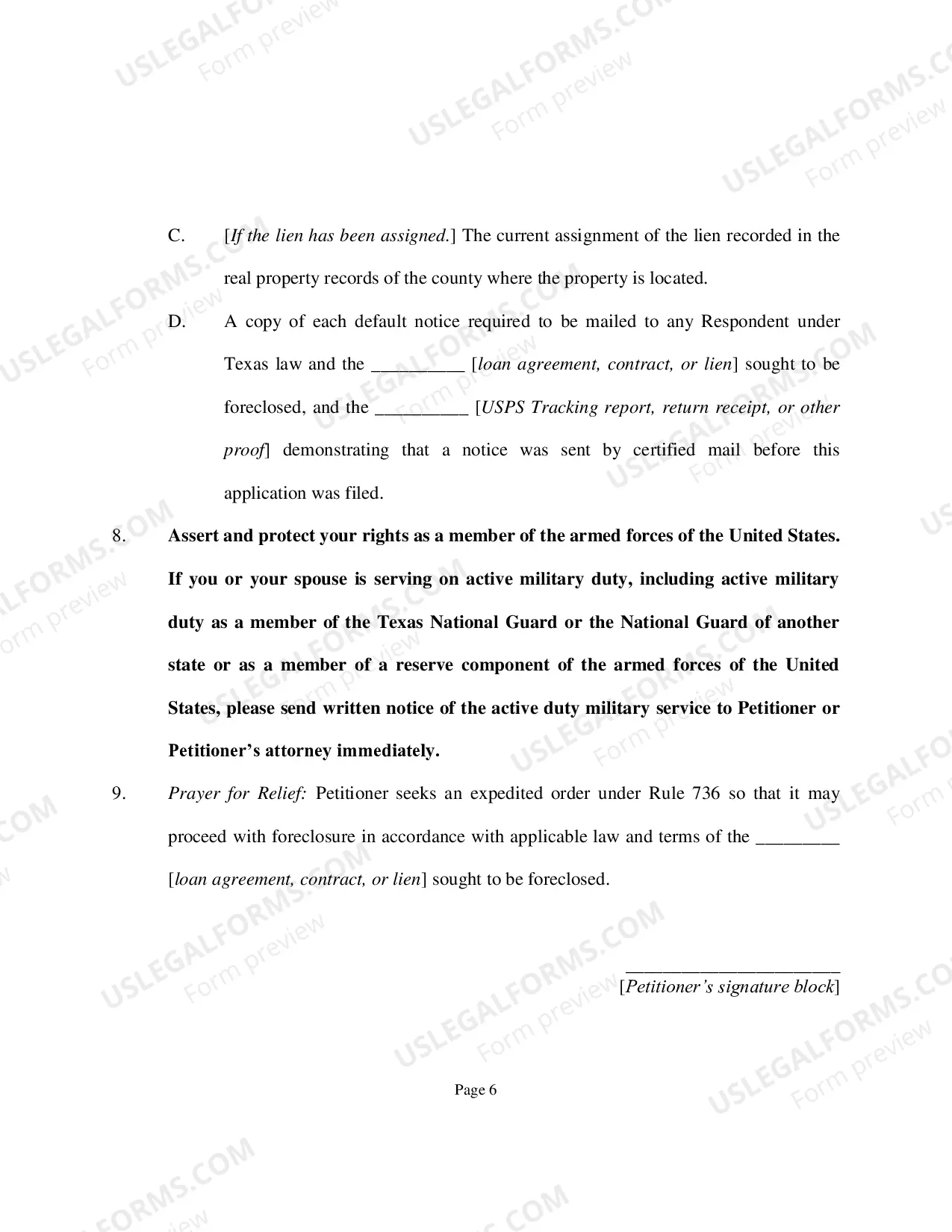
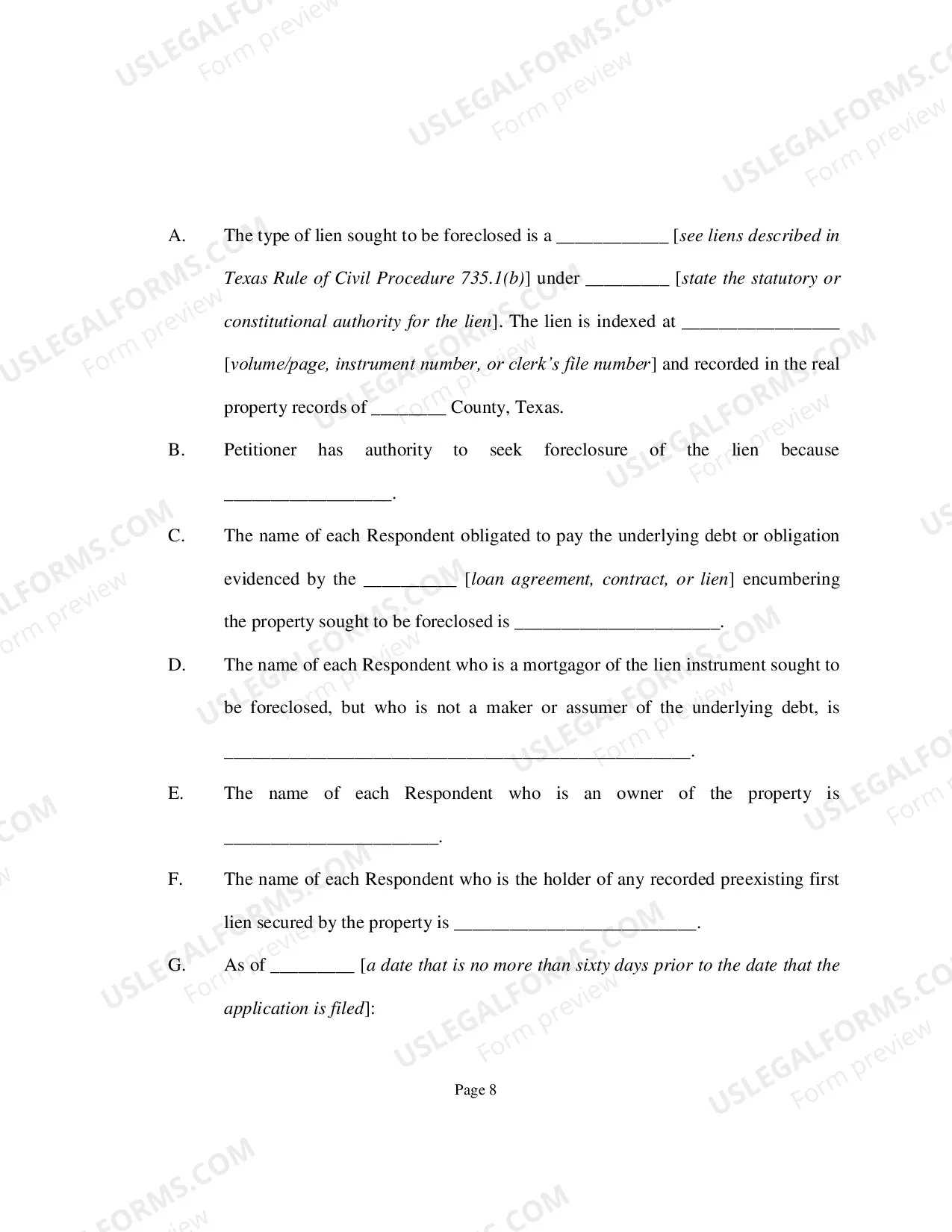
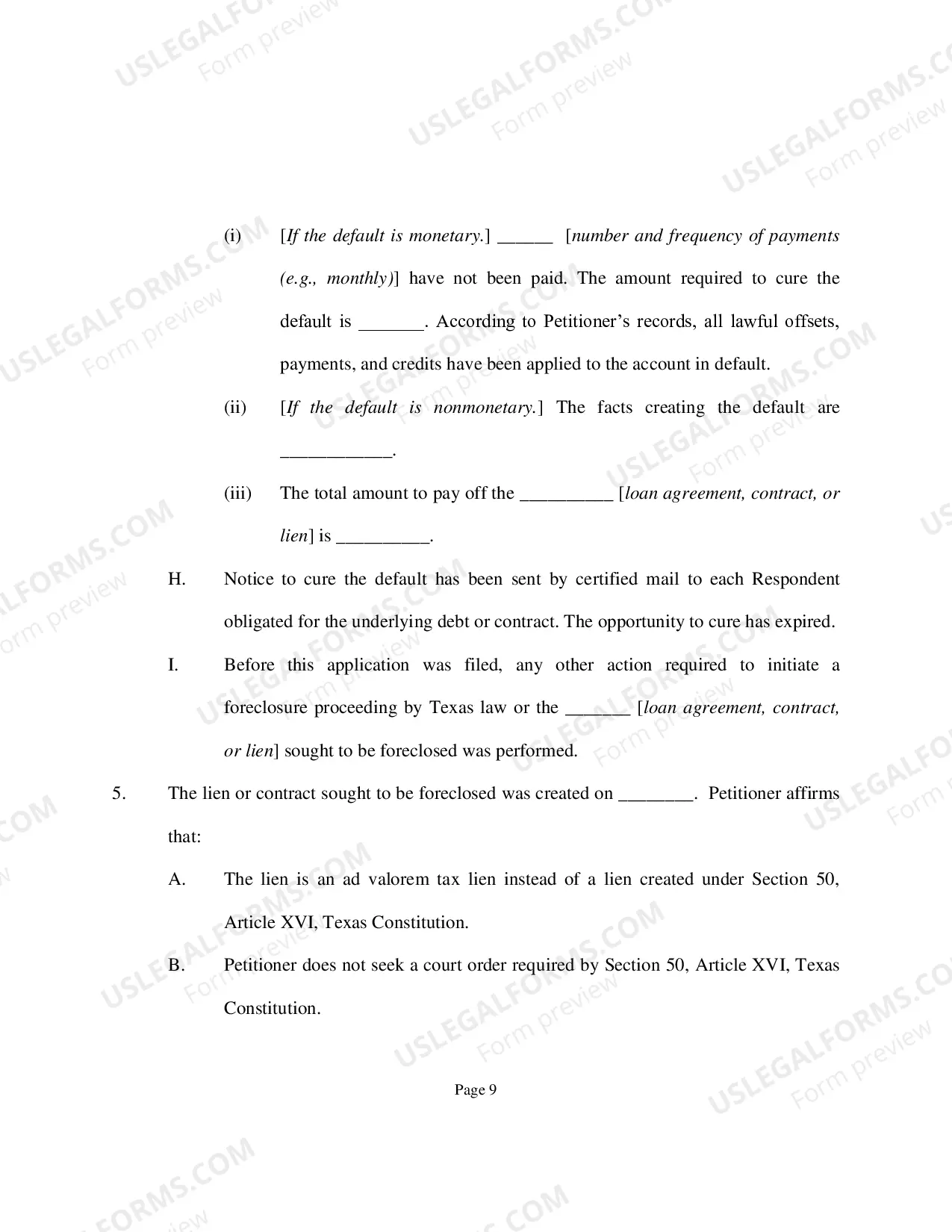
- Allegations of Default: Specific details regarding the nature of the default, including unpaid amounts and other relevant facts.
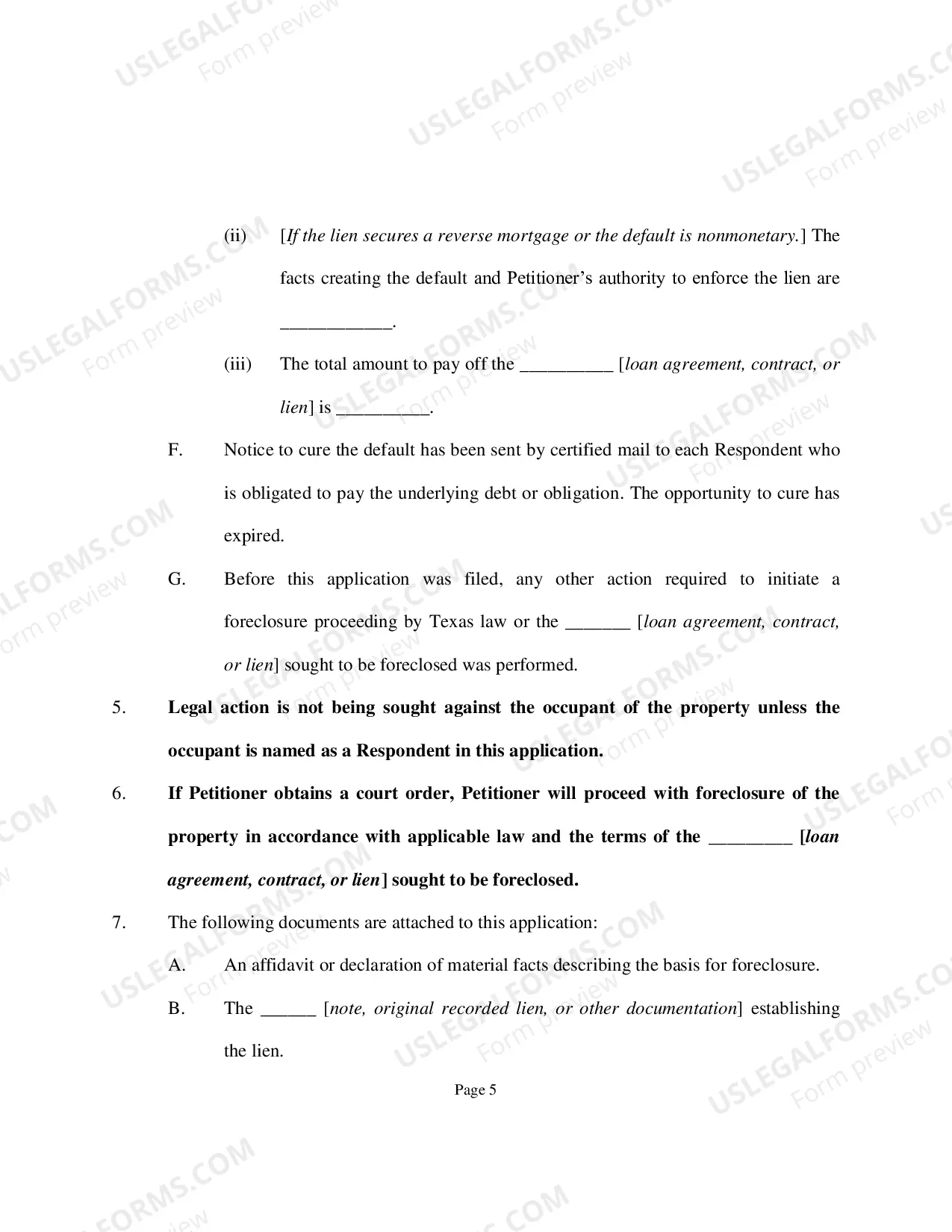
- Notice Requirements: Confirmation that necessary notifications of default were sent to the respondents.
- Supporting Documents: Required attachments such as affidavits and lien details.

Situations where this form applies
This form should be used when a lender or lienholder believes that a borrower has defaulted on a loan secured by real estate, including home equity loans or property tax loans. It is particularly relevant when the lender seeks a rapid resolution to initiate foreclosure proceedings to recover owed amounts. Scenarios may include a home equity loan where the borrower has missed multiple payments or when assessment fees for a property owners' association have not been fulfilled.
Who should use this form
- Lenders or financial institutions holding a lien on a property.
- Property owners involved in disputes regarding unpaid taxes or assessments.
- Homeowners facing foreclosure proceedings due to loan defaults.
- Legal representatives of the aforementioned parties.
How to prepare this document
- Identify the parties involved by filling out the petitioner's and respondent's full names and addresses.
- Specify the property details, including its common address and legal description.
- Clearly state the type of lien and the nature of the default.
- Ensure necessary notifications of default have been sent to the respondent and note their delivery status.
- Gather and attach all supporting documentation, such as affidavits and records of the underlying loan or lien.
Notarization guidance
Yes, this form must be notarized to be legally valid. US Legal Forms offers integrated online notarization that is available 24/7 through secure video calls, ensuring the process is efficient and accessible without the need to travel.
Get your form ready online
Our built-in tools help you complete, sign, share, and store your documents in one place.
Make edits, fill in missing information, and update formatting in US Legal Forms—just like you would in MS Word.
Download a copy, print it, send it by email, or mail it via USPS—whatever works best for your next step.
Sign and collect signatures with our SignNow integration. Send to multiple recipients, set reminders, and more. Go Premium to unlock E-Sign.
If this form requires notarization, complete it online through a secure video call—no need to meet a notary in person or wait for an appointment.
We protect your documents and personal data by following strict security and privacy standards.

Make edits, fill in missing information, and update formatting in US Legal Forms—just like you would in MS Word.

Download a copy, print it, send it by email, or mail it via USPS—whatever works best for your next step.

Sign and collect signatures with our SignNow integration. Send to multiple recipients, set reminders, and more. Go Premium to unlock E-Sign.

If this form requires notarization, complete it online through a secure video call—no need to meet a notary in person or wait for an appointment.

We protect your documents and personal data by following strict security and privacy standards.
Common mistakes
- Failing to include all required supporting documents, which could lead to delays.
- Incomplete or inaccurate descriptions of the property which may lead to jurisdictional issues.
- Not providing proper notice to respondents or not documenting the notice's delivery adequately.
- Missing signatures or not notarizing the required affidavits or declarations.
Advantages of online completion
- Access to professionally drafted legal forms that comply with Texas laws.
- The ability to easily edit and customize forms to meet specific needs.
- Instant availability for download and printing, eliminating waiting times.
- Convenient access to integrated online notarization services for documents that require it.
Looking for another form?

Form popularity
FAQ
Yes. In Texas most loans are non-judicial which means the bank does not have to take a foreclosure to court to be approved. The best way to stop and delay a lender from taking your property is to file a lawsuit and get a restraining order.
By law, lenders and servicers are required to send a written notice allowing you 20 days to ?cure? (pay in full the amount owed) to bring the defaulted loan current. Some loans increase this period to 30 days (most FHA, VA and home equity loans).
However, under Rules 735 and 736 of the Texas Rules of Civil Procedure, certain lienholders can apply for what is known as an "expedited foreclosure" (also referred to as a quasi-judicial foreclosure) which, if granted, allows the process to move forward similar to a non-judicial foreclosure.
In Texas, the foreclosing lender has to give two notices of the foreclosure: a notice of default and a notice of sale. Notice of Default and Intent to Accelerate. The servicer must mail you a Notice of Default and Intent to Accelerate. ("Accelerate" means to demand that the entire balance of the loan be repaid).
Texas has two distinct foreclosure processes, judicial and non-judicial. Non-Judicial Foreclosure.Judicial Foreclosure.Step 1: Notice of Default and Intent to Accelerate.Step 2: Notice of Sale.Step 3: The Foreclosure Sale.
The foreclosure process in Texas is a relatively quick process, usually around 6 months. Though foreclosure action can be taken after the first missed payment, most lenders include a grace period for late payments. After 10-15 days, the lender will usually charge a late fee.
In Texas, the general rule is that the deadline to foreclose on the lien claim is one year from the last date the claimant could have filed a lien.
The most common foreclosure process in Texas is non-judicial foreclosure, which means the lender can foreclose without going to court so long as the deed of trust contains a power of sale clause. Non-judicial foreclosure is most common with purchase money loans as well as rate-and-term refinances.