Texas Relative Caretaker Legal Documents Package
Understanding this form package
The Texas Relative Caretaker Legal Documents Package is a comprehensive collection of forms and guides designed to assist relatives in taking custody and care of children. It provides crucial information regarding state laws related to child placement with relatives, ensuring that families understand their rights and responsibilities. This package offers a significant savings of over 50% compared to purchasing the individual guides or forms separately.
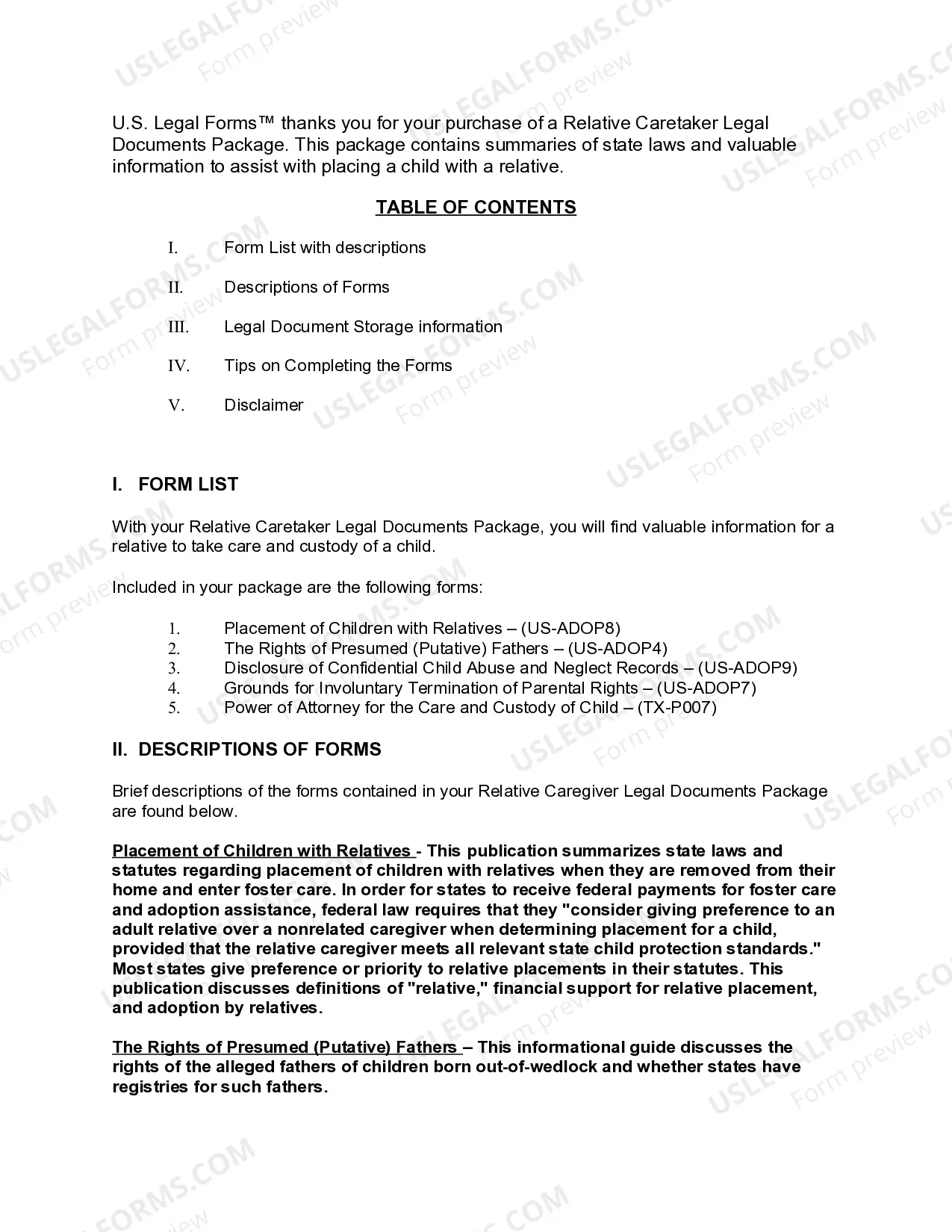
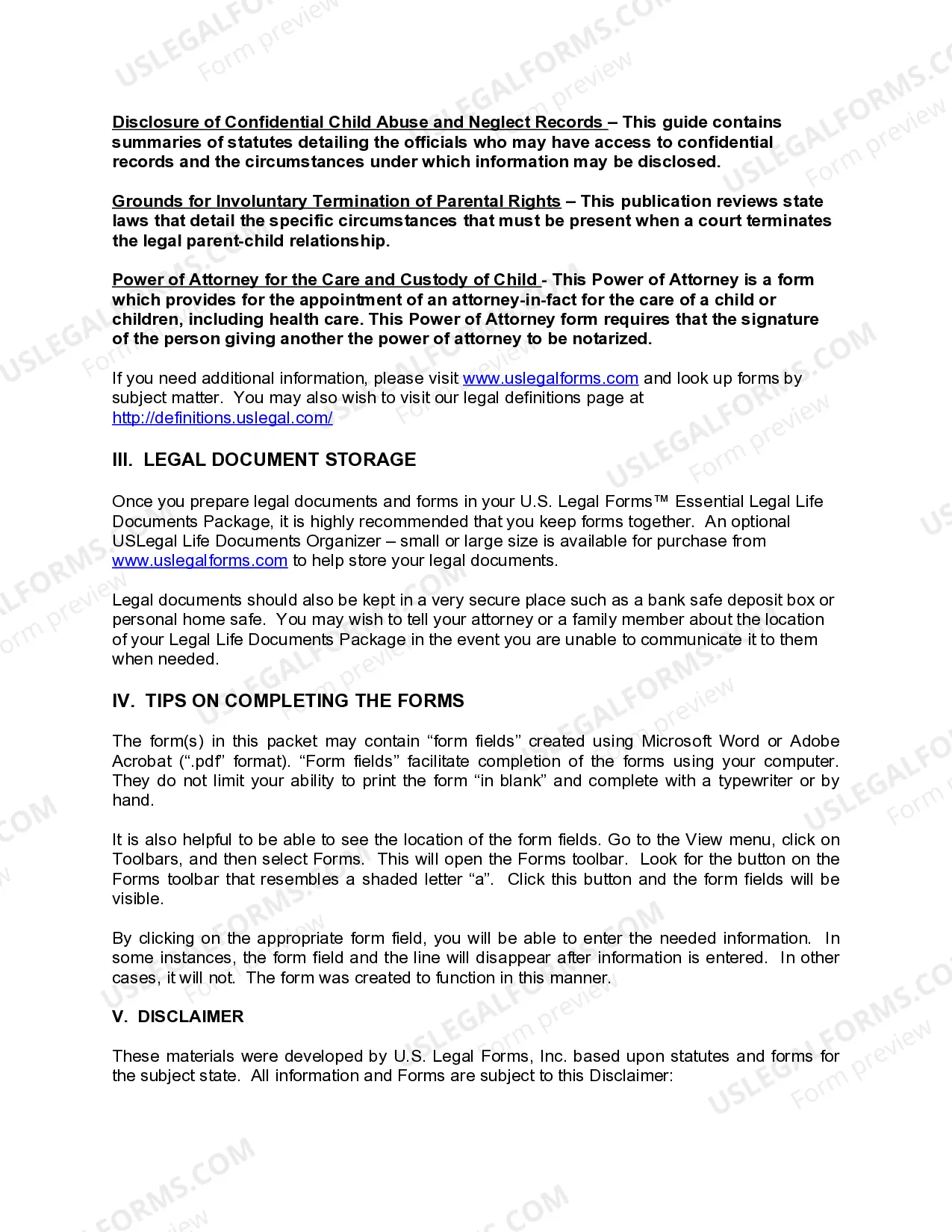
Documents contained in this package


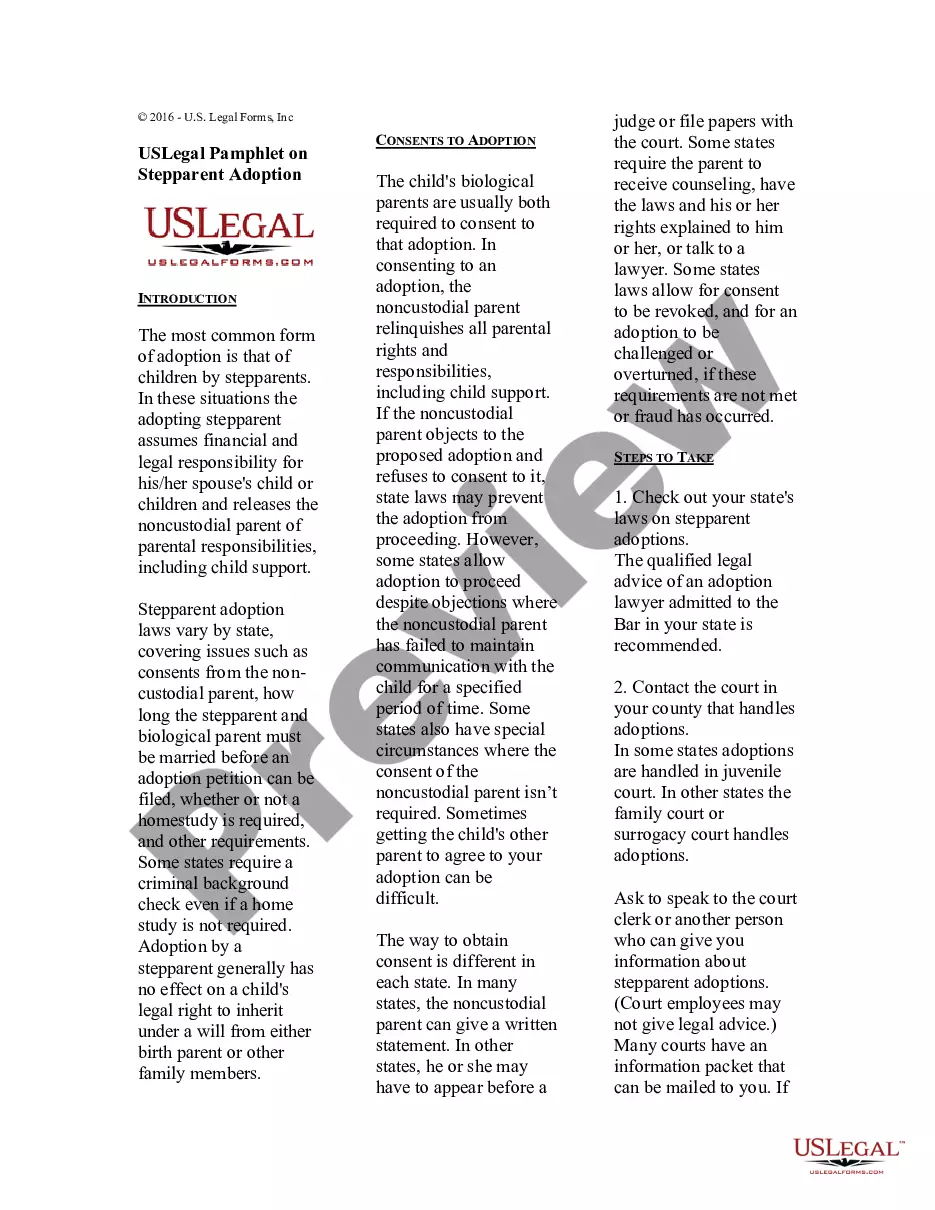
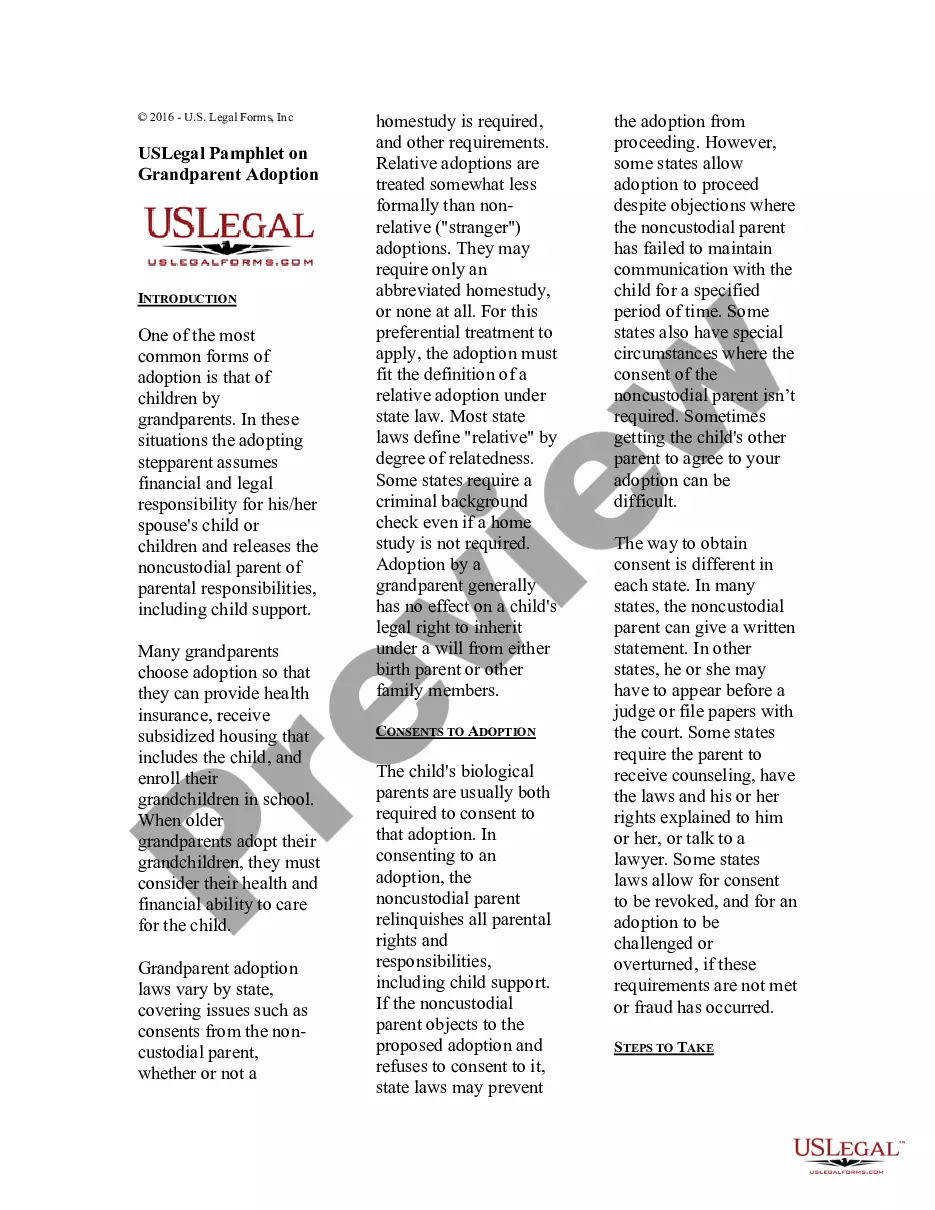
Situations where these forms applies
This package is beneficial in various scenarios, including:
- When a child needs to be placed with a relative due to removal from their home.
- When relatives are considering adopting a child from foster care.
- When a presumed father wants to understand his rights regarding a child born out-of-wedlock.
- When a family member needs access to confidential child abuse records for safety reasons.
- When seeking to terminate parental rights under specific legal circumstances.
Intended users of this form package
- Relatives seeking to care for or adopt a child.
- Presumed or putative fathers of children born out-of-wedlock.
- Guardians and caretakers involved in legal custody discussions.
- Legal representatives helping families navigate child placement laws.
Steps to complete these forms
- Review the included forms and guides to understand your legal standing.
- Fill out the Power of Attorney for the Care and Custody of Child accurately with relevant details.
- Ensure you meet the state standards for relative placements as outlined in the guides.
- Complete any additional forms based on your specific situation as described in the information sheets.
- Store your completed forms securely and share their location with a trusted individual.
Do forms in this package need to be notarized?
Yes, forms in this package must be notarized to be legally valid. The Power of Attorney for the Care and Custody of Child specifically requires notarization. US Legal Forms offers integrated online notarization services, available 24/7 through secure video calls, ensuring legal equivalence without the need for travel.
Get your form ready online
Our built-in tools help you complete, sign, share, and store your documents in one place.
Make edits, fill in missing information, and update formatting in US Legal Forms—just like you would in MS Word.
Download a copy, print it, send it by email, or mail it via USPS—whatever works best for your next step.
Sign and collect signatures with our SignNow integration. Send to multiple recipients, set reminders, and more. Go Premium to unlock E-Sign.
If this form requires notarization, complete it online through a secure video call—no need to meet a notary in person or wait for an appointment.
We protect your documents and personal data by following strict security and privacy standards.

Make edits, fill in missing information, and update formatting in US Legal Forms—just like you would in MS Word.

Download a copy, print it, send it by email, or mail it via USPS—whatever works best for your next step.

Sign and collect signatures with our SignNow integration. Send to multiple recipients, set reminders, and more. Go Premium to unlock E-Sign.

If this form requires notarization, complete it online through a secure video call—no need to meet a notary in person or wait for an appointment.

We protect your documents and personal data by following strict security and privacy standards.
Common mistakes to avoid
- Failing to understand the definitions of "relative" which are crucial for custody considerations.
- Not notarizing the Power of Attorney form as required by Texas law.
- Overlooking the importance of financial support discussions outlined in the Placement of Children with Relatives guide.
- Neglecting to follow up on the status of custody or adoption cases after submitting forms.
Benefits of using this package online
- Convenience of downloading and accessing documents anytime, anywhere.
- Editability of forms allows for customization based on individual needs.
- Access to clear, attorney-drafted documents ensures reliability for legal use.
Legal use & context
- These documents provide a sound legal basis for relative care arrangements in Texas.
- They help determine the custody rights of family members and clarify the rights of presumed fathers.
- Understanding these forms is essential to ensure compliance with local laws and secure the child's best interests.
Looking for another form?

Form popularity
FAQ
If you're a foster/kinship foster carer, you can get help, training and financial support. This includes an allowance to cover costs, tax relief and help getting a State Pension. Social workers also visit to support you and the foster child.
Unlike fostering, kinship is a type of out-of-home care where the child or young person is with a caregiver with whom they have had a previous relationship.informal, when the caregiver is providing home care as a private arrangement with the family, unrecognised by both the court and jurisdiction.
A relative or NREFM who is caring for a dependent child is eligible to receive a monthly foster care maintenance payment whether the child is federally eligible or ineligible. This payment is currently about $688 to $859 per month, depending on the age of the child.
The process to become an approved foster carer usually takes around 3 to 6 months. This varies depending on your individual circumstances and the type of care you want to provide.
Texas Family Code generally allows the child's parents to make all the decisions related to how the child is raised. This includes deciding who they can and cannot see or where they live. However, aunt and uncle rights do exist to a certain degree. Both may be able to open up a case against the parent(s).
An aboveground, shop fabricated, secondarily contained vessel designed to store flammable and combustible liquids constructed according to Underwriters Laboratories Standard 2085 entitled Protected Aboveground Tanks for Flammable and Combustible Liquids.
Can an Aunt and Uncle Seek Visitation Rights with their Niece/Nephews? The short answer is YES. California law confers discretion on the court to grant reasonable visitation rights to any other person having an interest in the welfare of the any other person.
Guide covers how to use the information your team has collected. By this point, your KPM team will have created detailed documentation of your current kinship care practices, which will position you to proceed with improvements to your child welfare system. All three phases of KPM take approximately eight weeks.
A non-parent caretaker can be: l A guardian. A guardian is a person designated by a court to assume responsibility to care for a child. The guardian has all the powers and responsibilities that would otherwise be held by the parent of the child.