Texas Special Warranty Deed - Individual to LLC
Understanding this form
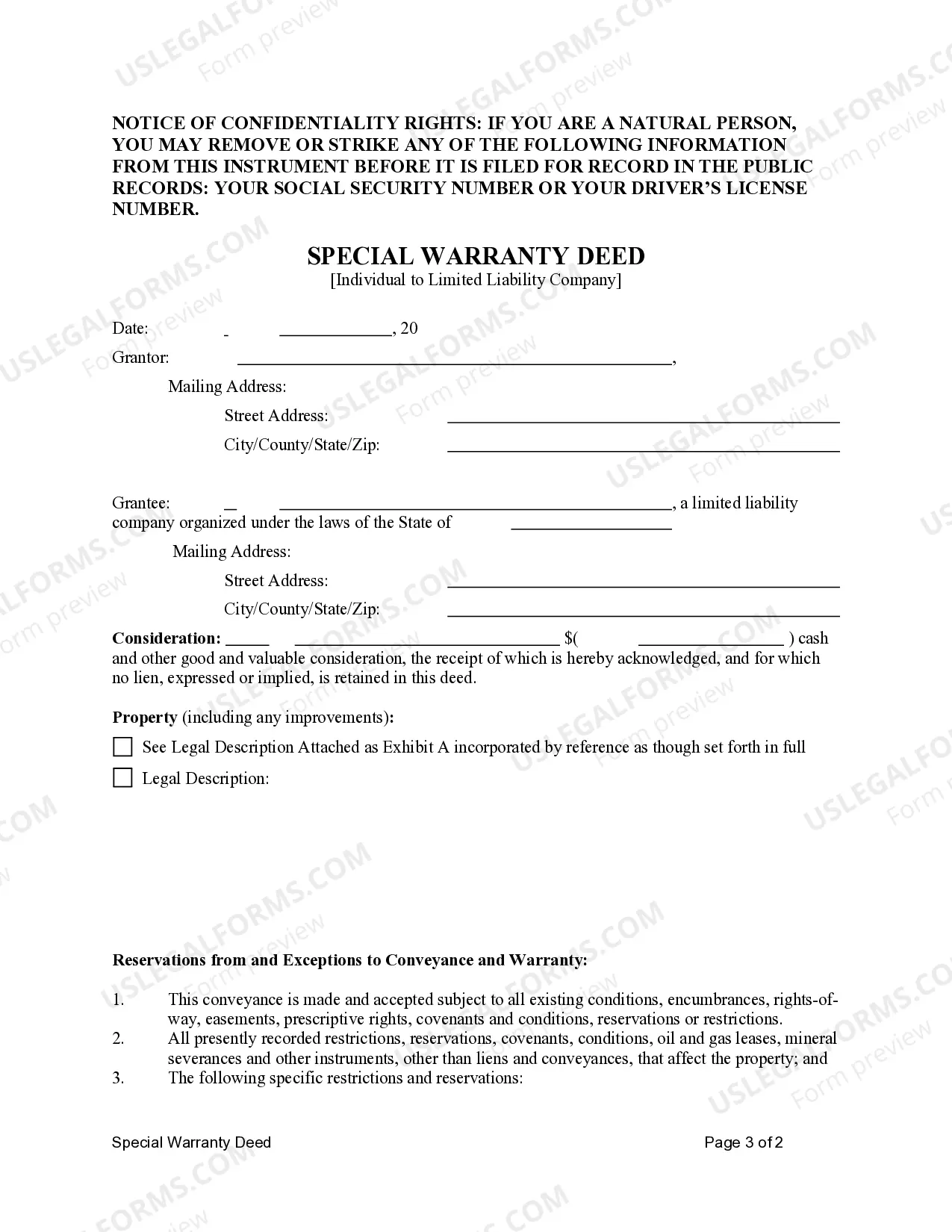
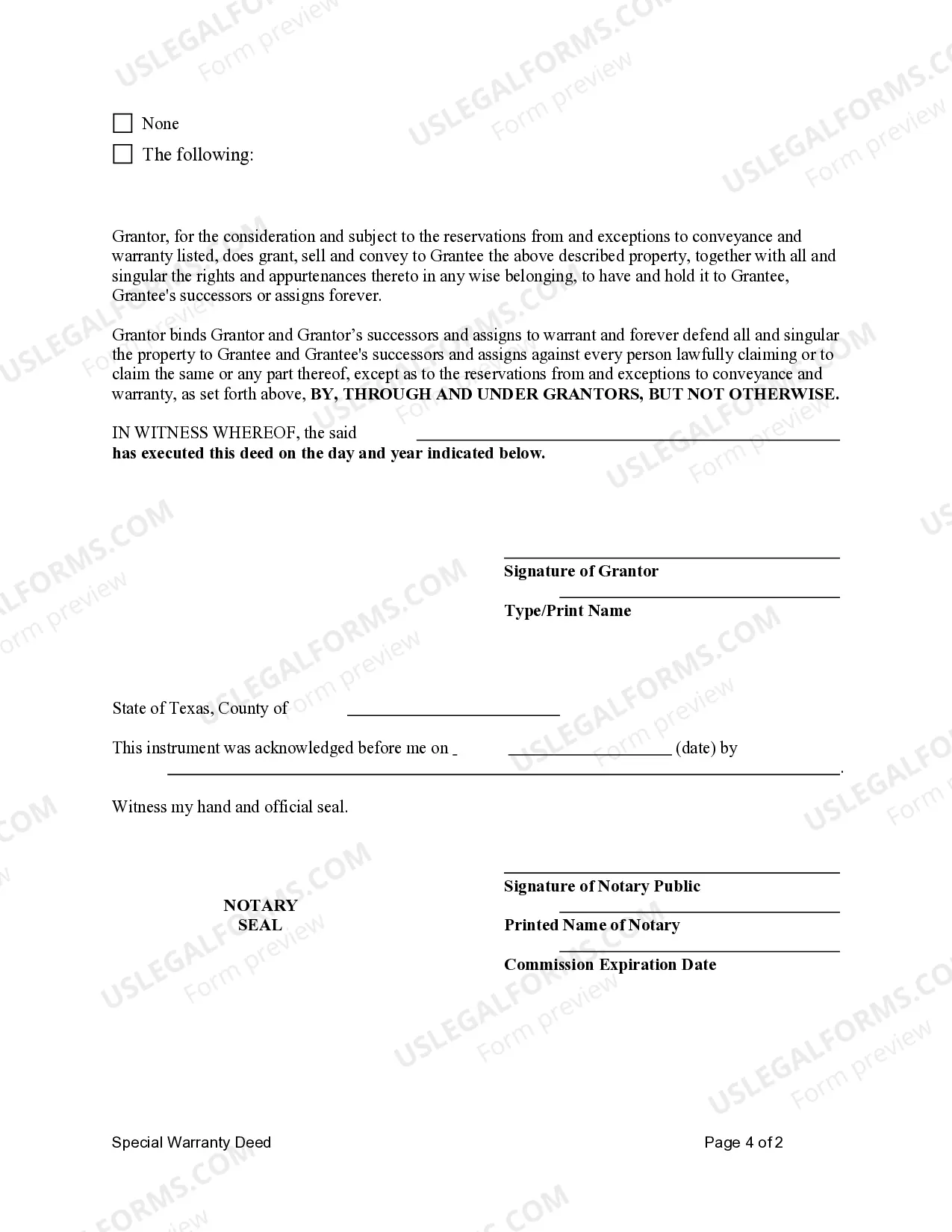
The Special Warranty Deed - Individual to LLC is a legal document used to transfer ownership of real property from an individual (the Grantor) to a limited liability company (the Grantee). This type of deed provides a specific warranty, meaning the Grantor guarantees that the property is free of claims arising from their ownership but does not warrant against claims that existed prior to their ownership. This deed is distinct from other types of deeds, such as general warranty deeds, as it limits the scope of the Grantor's liability for potential claims on the property.
Key components of this form
- Identification of Grantor (individual) and Grantee (LLC).
- Description of the property being transferred.
- Statement of special warranty regarding claims.
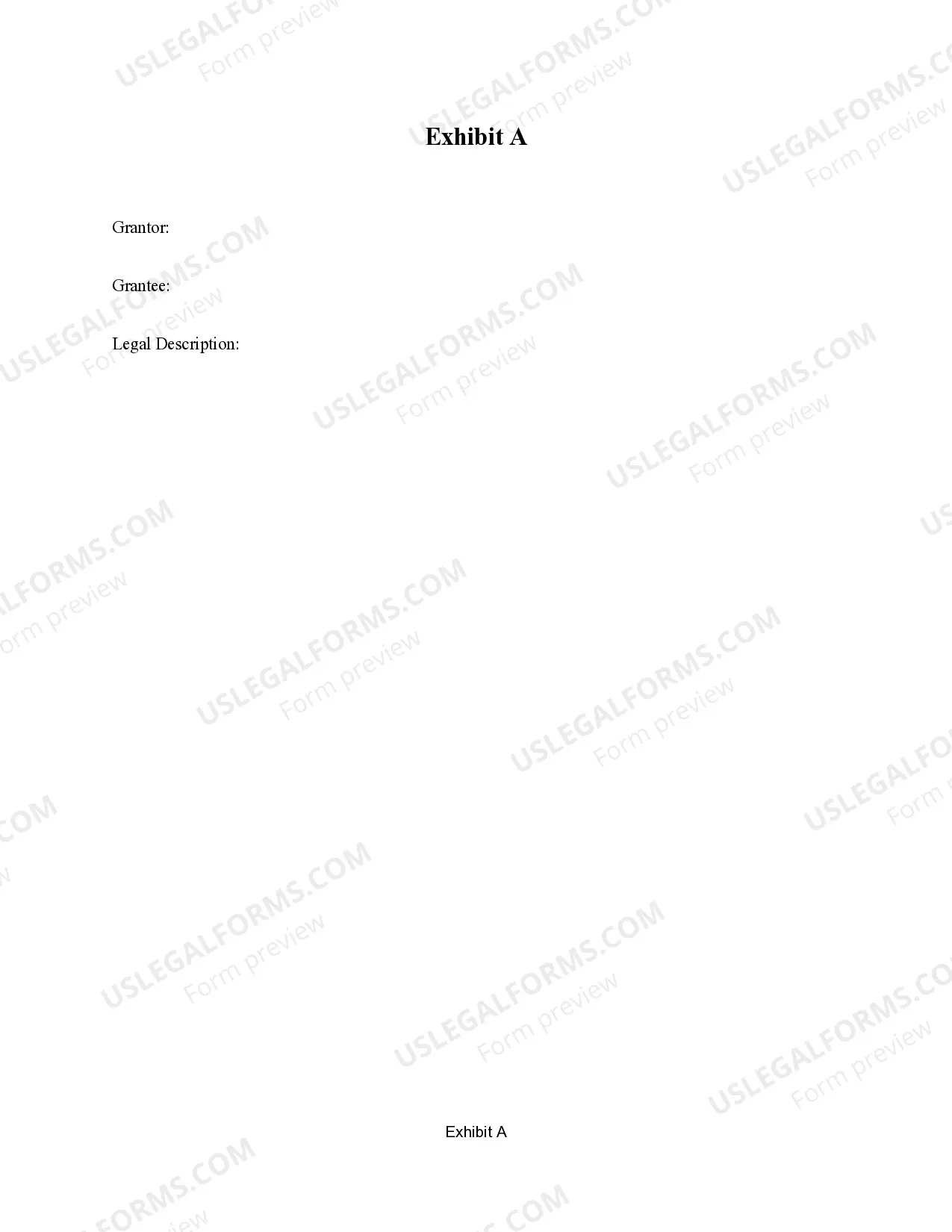
- Legal description of property attached as an exhibit.
- Signature and date fields for execution.



When this form is needed
This form is necessary when an individual wants to convey property to a limited liability company, especially when the individual might want limited liability regarding future claims. It is commonly used in property sales or transfers where the owner is transitioning real estate assets into a business structure while limiting their future liability.
Who should use this form
This form is suitable for:
- Individuals who own real property and wish to transfer it to an LLC.
- Business owners seeking to shield personal assets from claims against the LLC.
- Real estate investors managing their properties through limited liability companies.
How to prepare this document
- Identify the Grantor as the individual transferring the property.
- Identify the Grantee as the LLC receiving the property.
- Provide a detailed description of the property, attaching a legal description as an exhibit.
- Complete the Grantor's warranty clause to outline the extent of the warranty provided.
- Sign and date the deed in the appropriate spaces provided.
Notarization requirements for this form
This form does not typically require notarization unless specified by local law. However, it is recommended to consult with a legal professional to ensure compliance with any specific requirements in your jurisdiction.
Get your form ready online
Our built-in tools help you complete, sign, share, and store your documents in one place.
Make edits, fill in missing information, and update formatting in US Legal Forms—just like you would in MS Word.
Download a copy, print it, send it by email, or mail it via USPS—whatever works best for your next step.
Sign and collect signatures with our SignNow integration. Send to multiple recipients, set reminders, and more. Go Premium to unlock E-Sign.
If this form requires notarization, complete it online through a secure video call—no need to meet a notary in person or wait for an appointment.
We protect your documents and personal data by following strict security and privacy standards.

Make edits, fill in missing information, and update formatting in US Legal Forms—just like you would in MS Word.

Download a copy, print it, send it by email, or mail it via USPS—whatever works best for your next step.

Sign and collect signatures with our SignNow integration. Send to multiple recipients, set reminders, and more. Go Premium to unlock E-Sign.

If this form requires notarization, complete it online through a secure video call—no need to meet a notary in person or wait for an appointment.

We protect your documents and personal data by following strict security and privacy standards.
Common mistakes
- Failing to accurately describe the property, leading to potential disputes.
- Not including the legal description as an exhibit, which is essential.
- Missing signatures or dates, which can render the document invalid.
- Overlooking local laws and requirements that may vary by jurisdiction.
Benefits of using this form online
- Convenience of downloading and completing the form from anywhere.
- Editability allows for easy modification of details as needed.
- Reliability of forms drafted by licensed attorneys ensures compliance with legal standards.
Legal use & context
- This Special Warranty Deed is recognized legally as a binding agreement for property transfer.
- The document protects the Grantee from future claims related to the property that are not the result of the Grantor's actions.
- Failure to use this form may jeopardize the validity of the property transfer or leave the Grantee vulnerable to title disputes.
Key takeaways
- The Special Warranty Deed is a legal tool for transferring property from an individual to an LLC.
- The Grantorâs liability is limited to claims originating under their ownership.
- Careful completion of the form is essential to ensure its validity and legal effectiveness.
Looking for another form?



Form popularity
FAQ
Write the county where the property is located on line provided next to the words "County of" beneath the words "The State of Texas." Write the name and address of the grantor on the lines provided after the words "Know all men by these presents, That I."
Special Warranty Deed TX A Special Warranty Deed is a document that transfers title with both express and implied warranties. However, unlike in a General Warranty Deed, the Grantor only warrants the title from the time the Grantor has owned the property.
Fill out the "grantor" section of the warranty deed. The grantors are the givers, or current owners, of the property. Use the legal name of each grantor and insert current addresses after each grantor's name.
The answer is yes. Parties to a transaction are always free to prepare their own deeds. If you do so, be sure your deed measures up to your state's legal regulations, to help avert any legal challenge to the deed later.
A special warranty deed to real estate offers protection to the buyer through the seller's guarantee that the title has been free and clear of encumbrances during their ownership of the property. It does not guarantee clear title beyond their ownership.
Fill out the "grantor" section of the warranty deed. The grantors are the givers, or current owners, of the property. Use the legal name of each grantor and insert current addresses after each grantor's name.
Special warranties allow the transfer of property title between seller and buyer. The purchase of title insurance can mitigate the risk of prior claims to the special warranty deed.
It will not protect against title issues that arose prior to the time the seller took occupancy. Consequently, it offers less protection to buyers, and more protection to sellers, than a general warranty deed, which is the most common option for selling or buying a property.