Texas General Warranty Deed from Two Individuals to One Individual
About this form
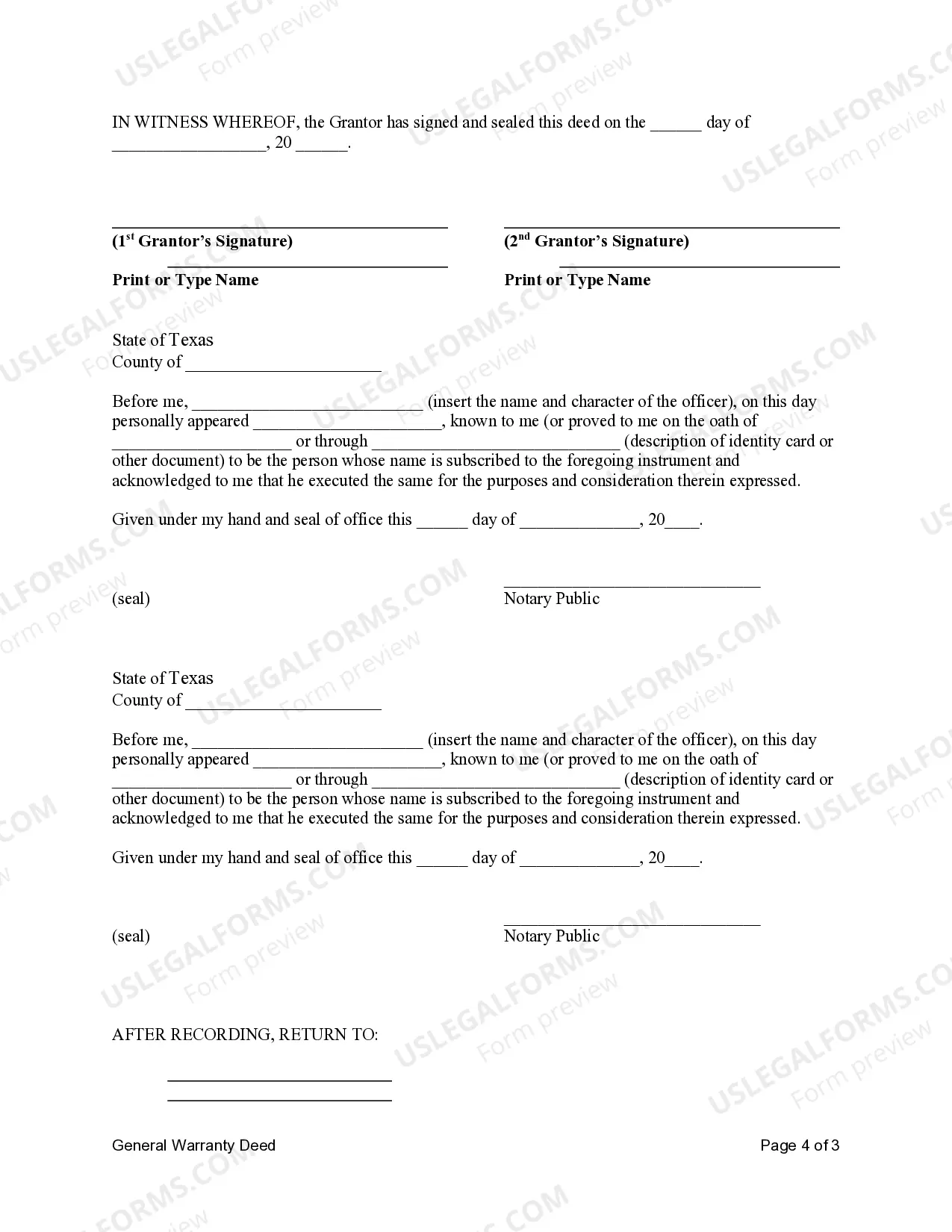
This General Warranty Deed allows two individuals, known as Grantors, to convey property rights to a single individual, the Grantee. This type of deed provides a guarantee that the Grantors hold clear title to the property and will defend the title against any claims. Unlike other deeds, a General Warranty Deed offers the broadest level of protection for the grantee, ensuring that the property is free from any encumbrances created by the Grantors.
Key parts of this document
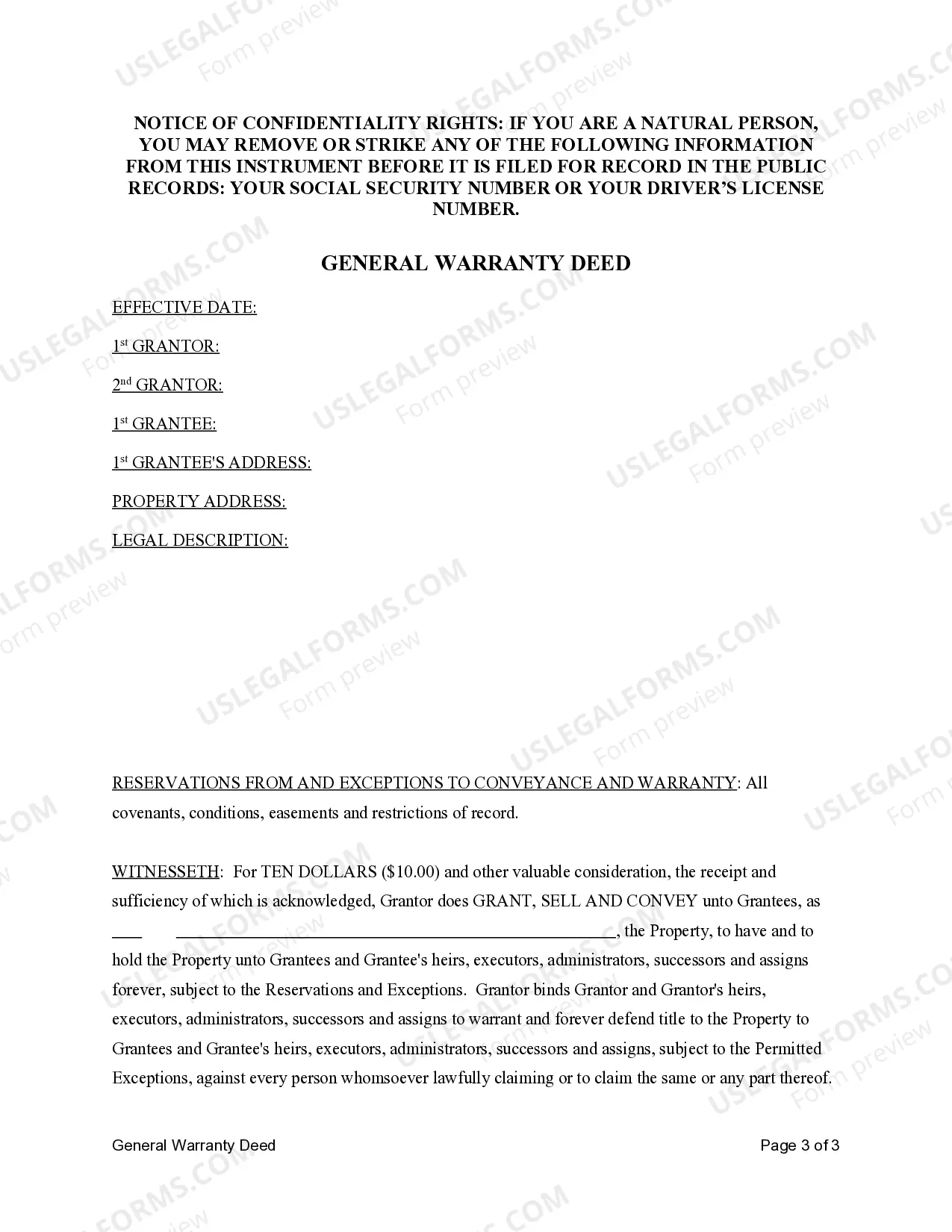
- Grantor and Grantee Information: Includes the names and addresses of the individuals involved.
- Description of the Property: Provides a clear legal description of the property being conveyed.
- Consideration Statement: Indicates the payment or other value exchanged for the property.
- Warranties of Title: Assures the Grantee of the Grantorsâ legal right to transfer the property.
- Signatures: Requires signatures from both Grantors to validate the deed.
- Date of the Transaction: Specifies when the deed is signed and executed.






When to use this document
This General Warranty Deed should be used when two individuals are transferring ownership of property to another single individual. Common scenarios include sales of real estate, gifting property, or formally rearranging ownership interests. It is particularly beneficial when the Grantee requires assurances regarding the title and potential claims against the property.
Intended users of this form
This form is intended for:
- Property owners looking to transfer property to another individual.
- Individuals engaged in a sale or gift of real estate.
- Those needing a legally binding document to ensure protection against title claims.
Completing this form step by step
- Identify the parties: Enter the names and addresses of the Grantors and the Grantee.
- Specify the property: Clearly define the property being conveyed using its legal description.
- State the consideration: Indicate the payment amount or âten dollarsâ for nominal consideration.
- Sign and date: Both Grantors must sign the deed and write the date of execution.
- Consider notarization: If required, have the deed notarized by a licensed notary public.
Is notarization required?
This form does typically require notarization unless specified by local law. Notarization helps verify the identities of the signers and adds credibility to the document, enhancing its legality.
Get your form ready online
Our built-in tools help you complete, sign, share, and store your documents in one place.
Make edits, fill in missing information, and update formatting in US Legal Forms—just like you would in MS Word.
Download a copy, print it, send it by email, or mail it via USPS—whatever works best for your next step.
Sign and collect signatures with our SignNow integration. Send to multiple recipients, set reminders, and more. Go Premium to unlock E-Sign.
If this form requires notarization, complete it online through a secure video call—no need to meet a notary in person or wait for an appointment.
We protect your documents and personal data by following strict security and privacy standards.

Make edits, fill in missing information, and update formatting in US Legal Forms—just like you would in MS Word.

Download a copy, print it, send it by email, or mail it via USPS—whatever works best for your next step.

Sign and collect signatures with our SignNow integration. Send to multiple recipients, set reminders, and more. Go Premium to unlock E-Sign.

If this form requires notarization, complete it online through a secure video call—no need to meet a notary in person or wait for an appointment.

We protect your documents and personal data by following strict security and privacy standards.
Typical mistakes to avoid
- Failing to provide a complete legal description of the property.
- Not including the signature of one or both Grantors.
- Omitting the necessary date of signing.
- Not verifying whether the deed needs notarization based on state laws.
Advantages of online completion
- Convenience: Download the form instantly from any location.
- Editability: Easily complete the form using a computer, ensuring accuracy.
- Accessibility: Available in multiple formats like Word and PDF for flexible use.
Looking for another form?
Form popularity
FAQ
Write the county where the property is located on line provided next to the words "County of" beneath the words "The State of Texas." Write the name and address of the grantor on the lines provided after the words "Know all men by these presents, That I."
In order to make the Warranty Deed legally binding, the Seller needs to sign it front of a notary public. Then signed and notarized deed must be filed at the city or county office for recording property documents. Before filing with this office all previously billed property taxes must be paid in full.
To make the form legally binding, you must sign it in front of a notary public. You must then file your signed and notarized deed with the county office that's in charge of recording property documents. Once the grantee signs the warranty deed, he/she legally has ownership and claim to the property.
In Texas, you can't add your spouse's name to an existing deed, but you can create a new deed by transferring the property from yourself to you and your spouse jointly. You can do this by using either a deed without warranty or a quit claim deed.
The name and address of the seller (called the grantor) The name and address of the buyer (called the grantee) A legal description of the property (found on the previous deed) A statement that the grantor is transferring the property to the grantee.
In Texas, you can't add your spouse's name to an existing deed, but you can create a new deed by transferring the property from yourself to you and your spouse jointly. You can do this by using either a deed without warranty or a quit claim deed.
Retrieve your original deed. Get the appropriate deed form. Draft the deed. Sign the deed before a notary. Record the deed with the county recorder. Obtain the new original deed.
Find the most recent deed to the property. It is best to begin with a copy of the most recent deed to the property (the deed that transferred the property to the current grantor). Create a new deed. Sign and notarize the deed. File the documents in the county land records.
The Texas General Warranty Deed is a form that transfers real estate ownership in the clearest possible manner promising the new owner that there are no title defects such as liens or encumbrances.