Texas Grant Deed - Two Individuals to One Individual
Understanding this form
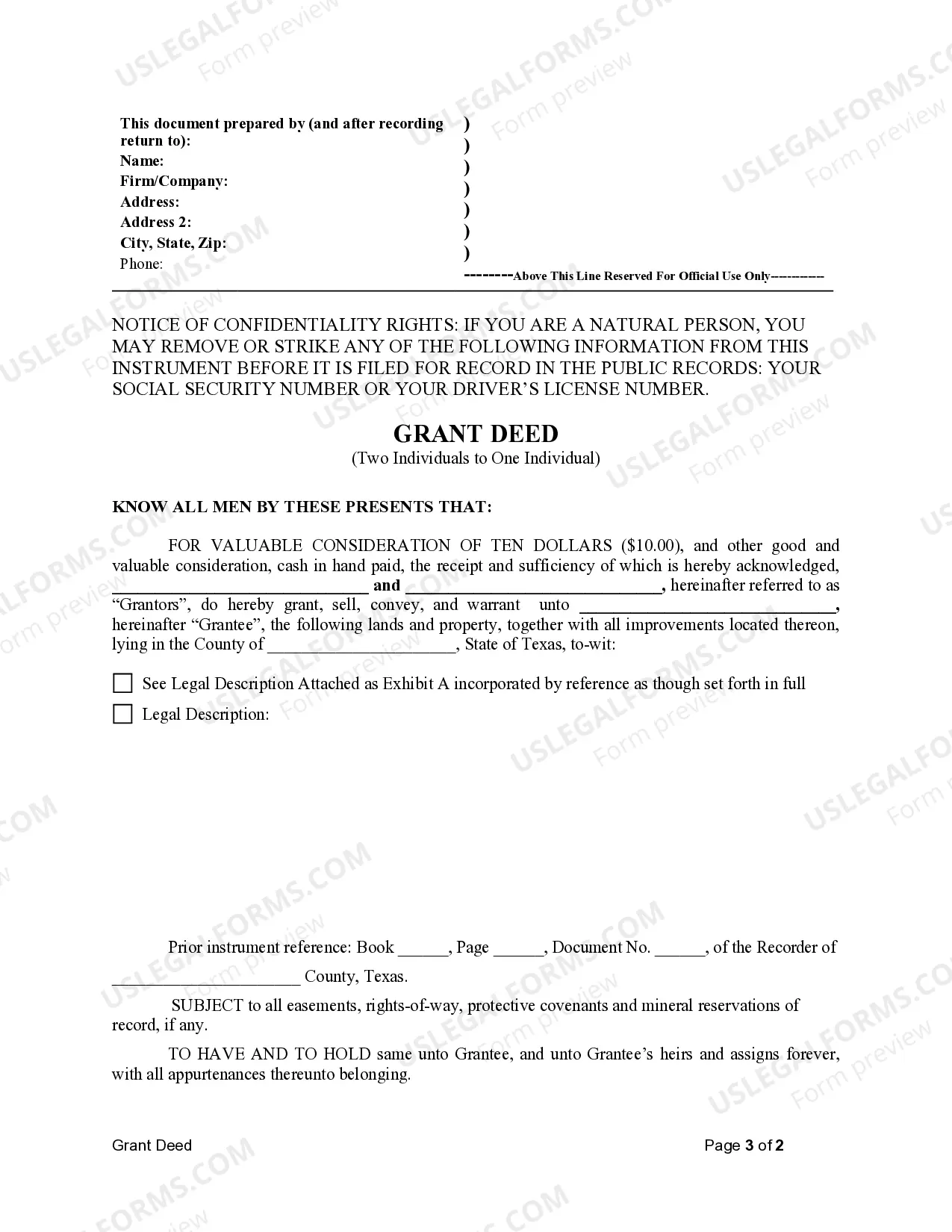
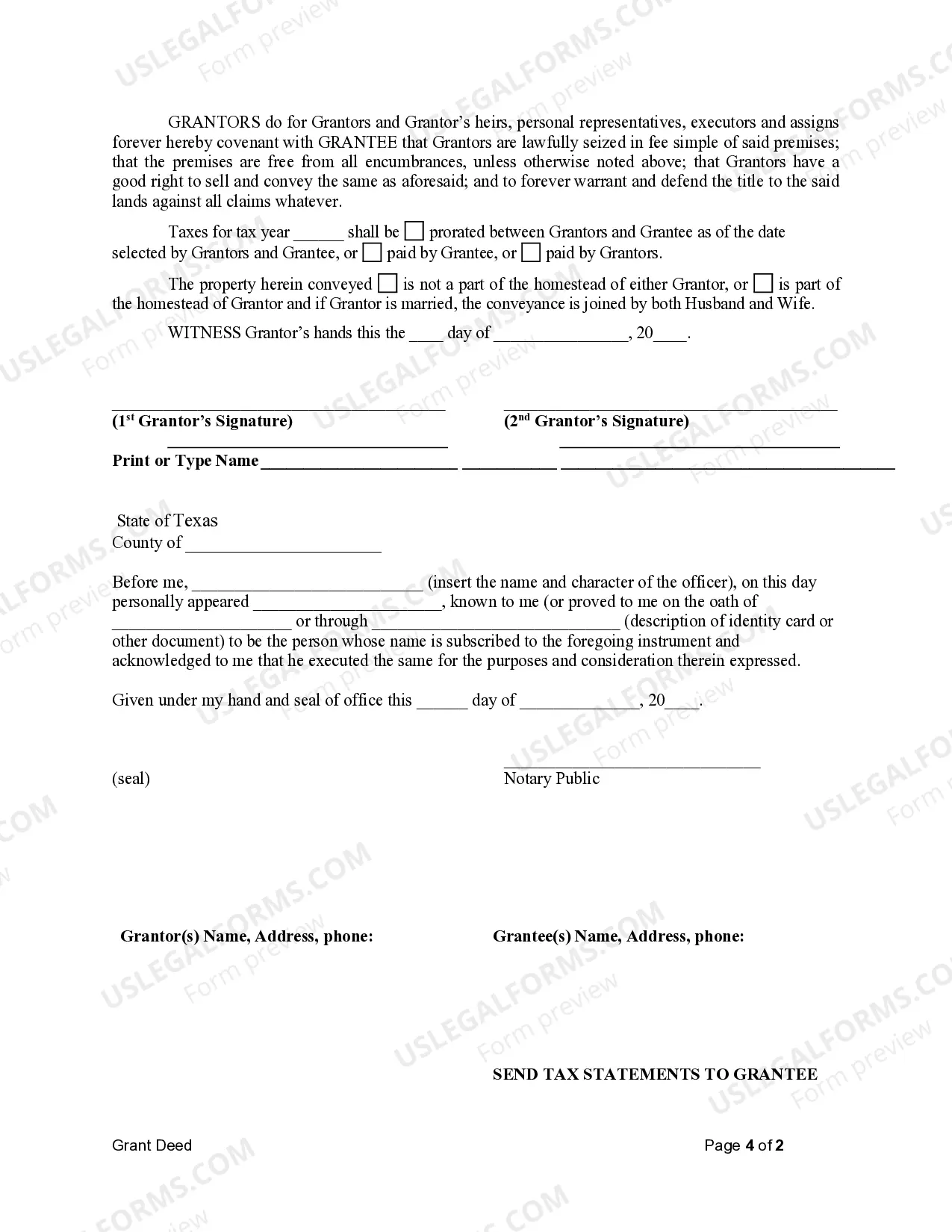
This Grant Deed is a legal document used to transfer property ownership from two individuals, known as grantors, to one individual, known as the grantee. It serves as a General Warranty Deed, ensuring that the grantors guarantee clear ownership of the property being transferred. Unlike other types of deeds, this specific form involves multiple grantors, providing a unique structure for property transactions.
Main sections of this form
- Identification of grantors and grantee with space for names and signatures
- Legal description of property being transferred
- Covenant for warranty of title, ensuring the property is free from encumbrances
- Provisions regarding any outstanding taxes on the property
- Space for notarization and date of execution






When to use this form
This form is typically used when two individuals wish to convey their ownership interest in a property to a single person. This might occur in various situations, such as when co-owners decide to transfer their ownership to a family member or when partners in a business agree to consolidate property ownership under one individual. It is an essential step to ensure that the property title is updated and reflects the correct ownership.
Who should use this form
- Individuals acting as grantors who want to convey property ownership to another individual
- People looking to transfer real estate between family members or partners
- Anyone involved in property transactions requiring clear documentation of ownership transfer
- Those needing a legally compliant document to satisfy state requirements for property deeds
Steps to complete this form
- Identify the parties involved: enter the names of the two grantors and the single grantee.
- Specify the property being conveyed: provide a detailed legal description as outlined in the form.
- Enter the consideration amount: typically a nominal amount like ten dollars, acknowledging the transaction.
- Review any tax-related provisions, ensuring clarity on who will pay outstanding taxes.
- Both grantors must sign and date the form, ensuring all parties are in agreement.
Is notarization required?
This form needs to be notarized to ensure legal validity. US Legal Forms provides secure online notarization powered by Notarize, allowing you to complete the process through a verified video call, available anytime.
Get your form ready online
Our built-in tools help you complete, sign, share, and store your documents in one place.
Make edits, fill in missing information, and update formatting in US Legal Forms—just like you would in MS Word.
Download a copy, print it, send it by email, or mail it via USPS—whatever works best for your next step.
Sign and collect signatures with our SignNow integration. Send to multiple recipients, set reminders, and more. Go Premium to unlock E-Sign.
If this form requires notarization, complete it online through a secure video call—no need to meet a notary in person or wait for an appointment.
We protect your documents and personal data by following strict security and privacy standards.

Make edits, fill in missing information, and update formatting in US Legal Forms—just like you would in MS Word.

Download a copy, print it, send it by email, or mail it via USPS—whatever works best for your next step.

Sign and collect signatures with our SignNow integration. Send to multiple recipients, set reminders, and more. Go Premium to unlock E-Sign.

If this form requires notarization, complete it online through a secure video call—no need to meet a notary in person or wait for an appointment.

We protect your documents and personal data by following strict security and privacy standards.
Mistakes to watch out for
- Failing to include a complete legal description of the property.
- Not signing the form, which invalidates the transfer.
- Leaving out important tax payment arrangements or miscommunicating these duties.
- Using incorrect names or misspellings in the identification of parties.
Why use this form online
- Convenient access and easy download, allowing for quick completion at your convenience.
- Fillable fields enhance accuracy and facilitate data entry.
- Ensures compliance with state requirements, reducing the risk of legal issues.
- Secure storage and retrieval of completed documents for future reference.
Looking for another form?

Form popularity
FAQ
Print a grant deed from an online source. Sign the document in the presence of a notary public. Take the deed to the recorder's office in the county where the property is located.
To add a co-owner, the bank would have to create a new home loan agreement, which must be registered after paying the due stamp duty and registration charges. The bank would also insist on making the co-owner a co-borrower in the home loan applicable.
Grantor's name. Grantee's name and address. Description of grantee (ex: unmarried man, husband and wife, joint tenants) Person who requested grant deed. Address of real estate that is being transferred. Legal description of property (lot number) Original title order number for property.
Yes you can. This is called a transfer of equity but you will need the permission of your lender. If you are not married or in a civil partnership you may wish to consider creating a deed of trust and a living together agreement which we can explain to you.
In most states you can file a disclaimer or deed of disclaimer that says specifically you were placed in title without your knowledge or consent and disclaim the deed.
In Texas, you can't add your spouse's name to an existing deed, but you can create a new deed by transferring the property from yourself to you and your spouse jointly. You can do this by using either a deed without warranty or a quit claim deed.
The deed and any related agreements should be filed in the land records of the county where the property is located. The county clerk will require a recording fee. Recording fees can vary, but usually range from $11.00 to $30.00 for the first page and $4.00 for each additional page.
In all fifty states, a deed must be signed and acknowledged by the grantor. Additional signatures may also be required, such as a grantee's signature, witnesses, a notary public, and the document preparer.
Today's question is is it possible to deed real estate to someone without them knowing it? Strictly speaking, the answer is no. Because it does not meet the acceptance element of a valid deed transfer. Us lawyers must learn to speak in elements because it governs everything that we do.