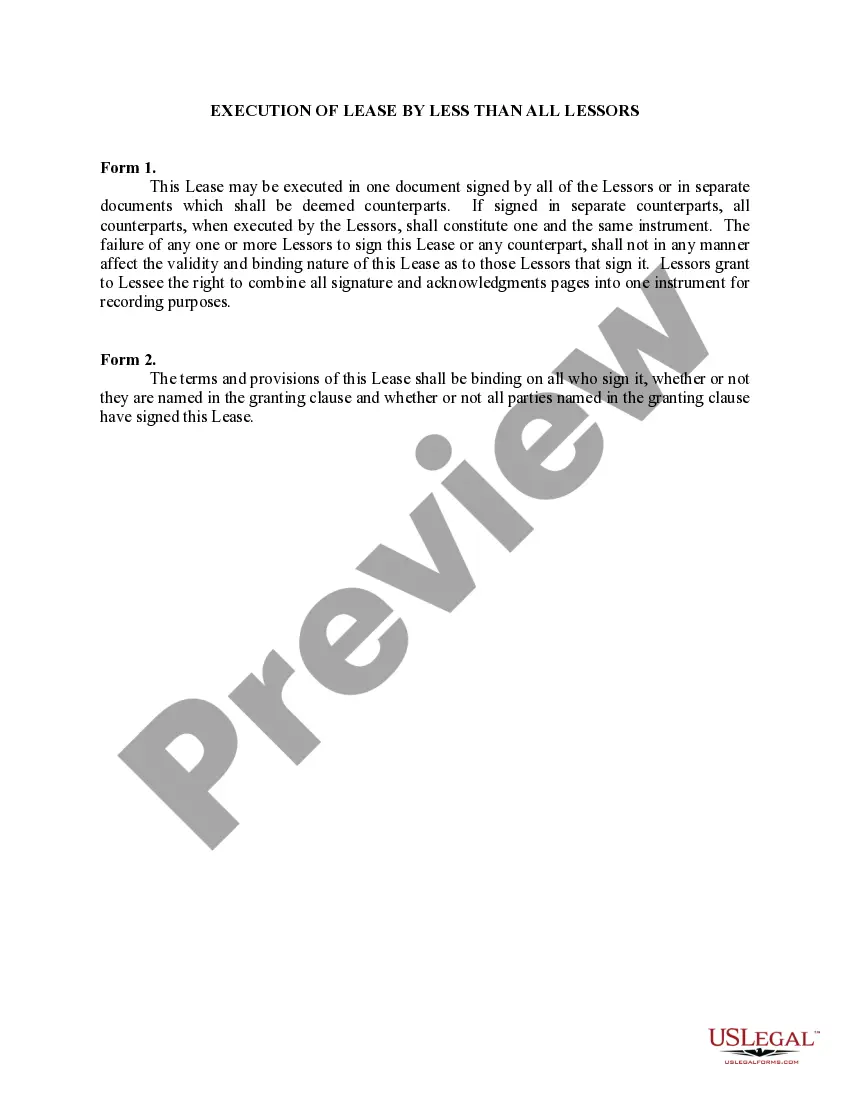
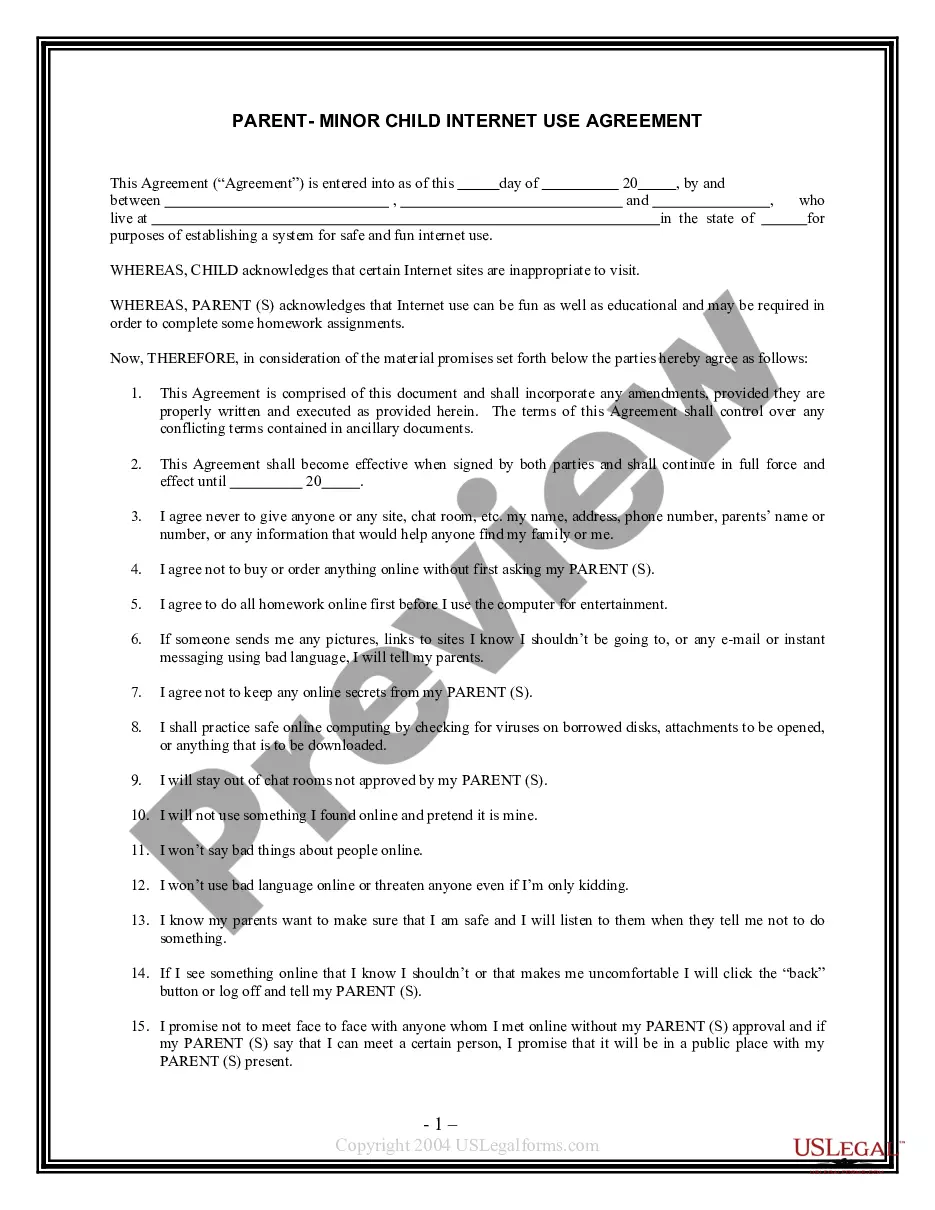
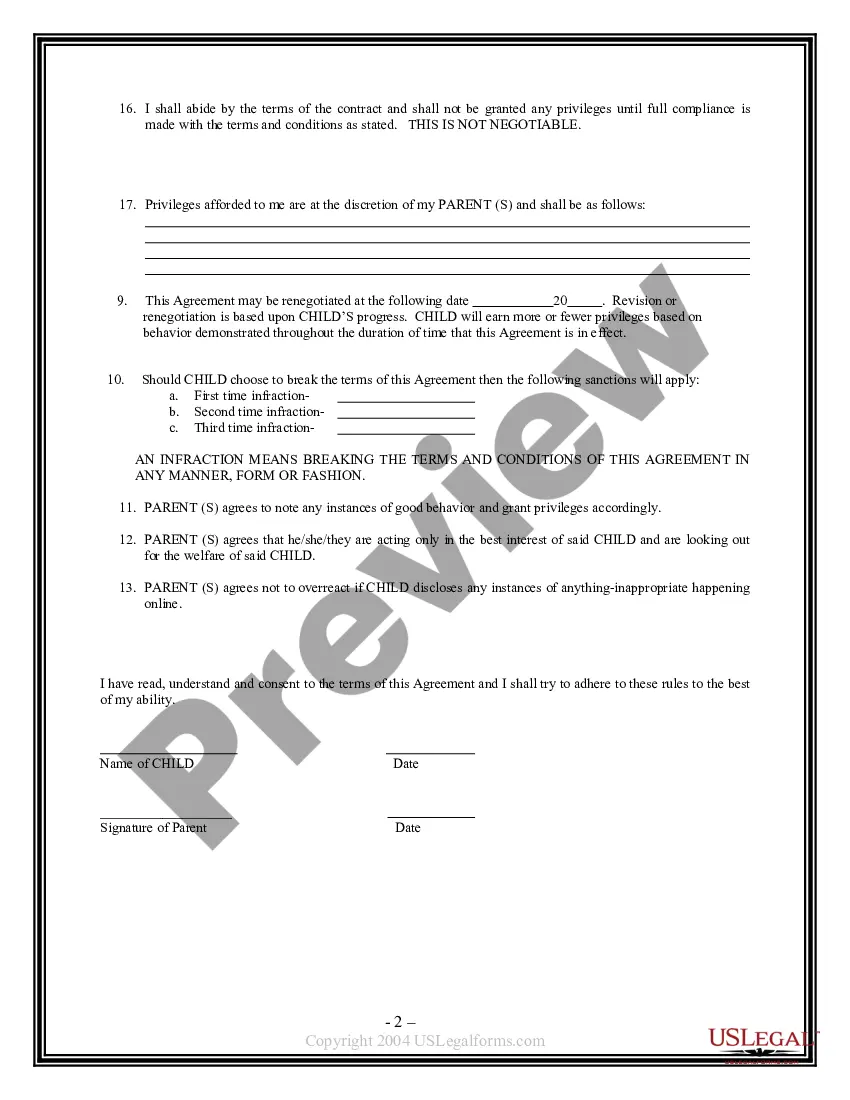
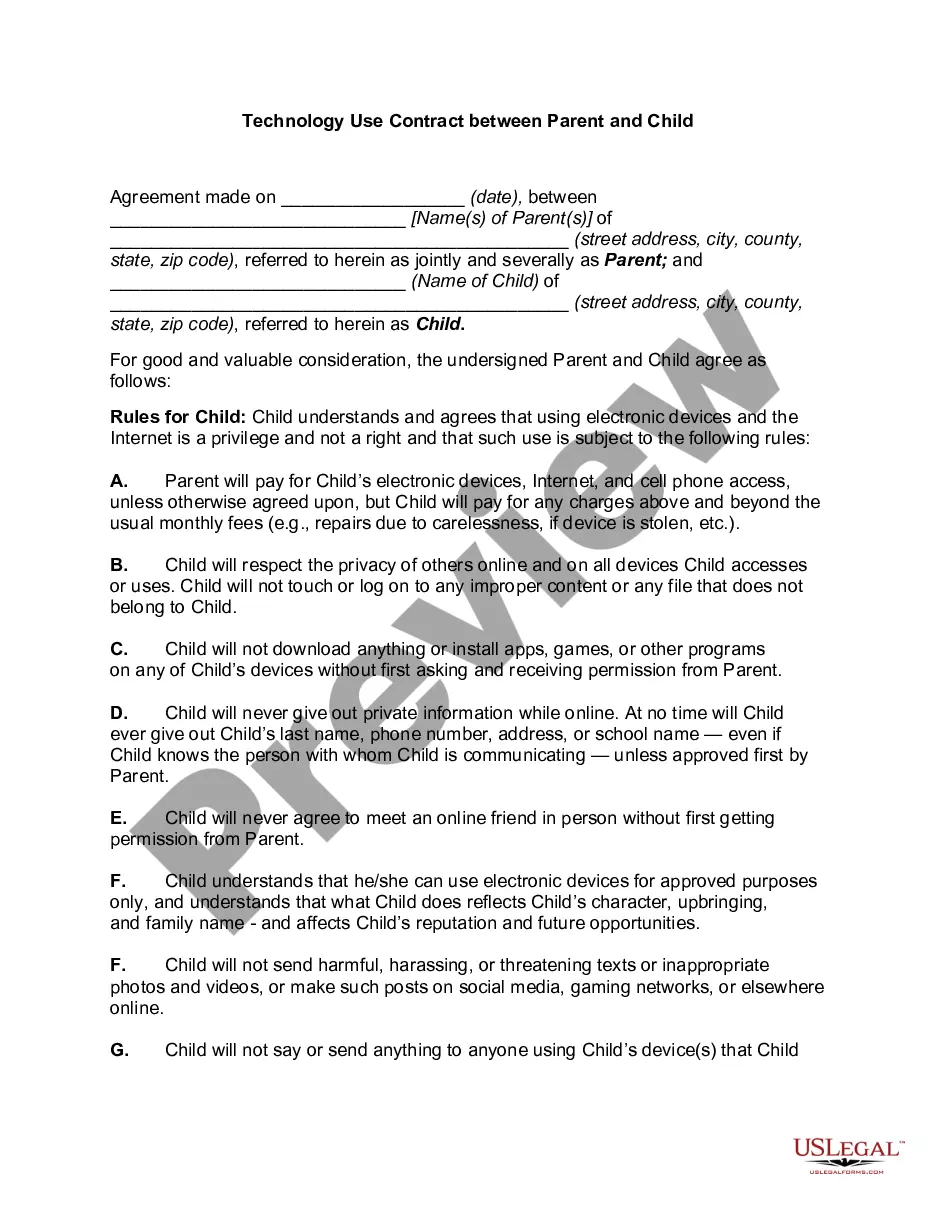
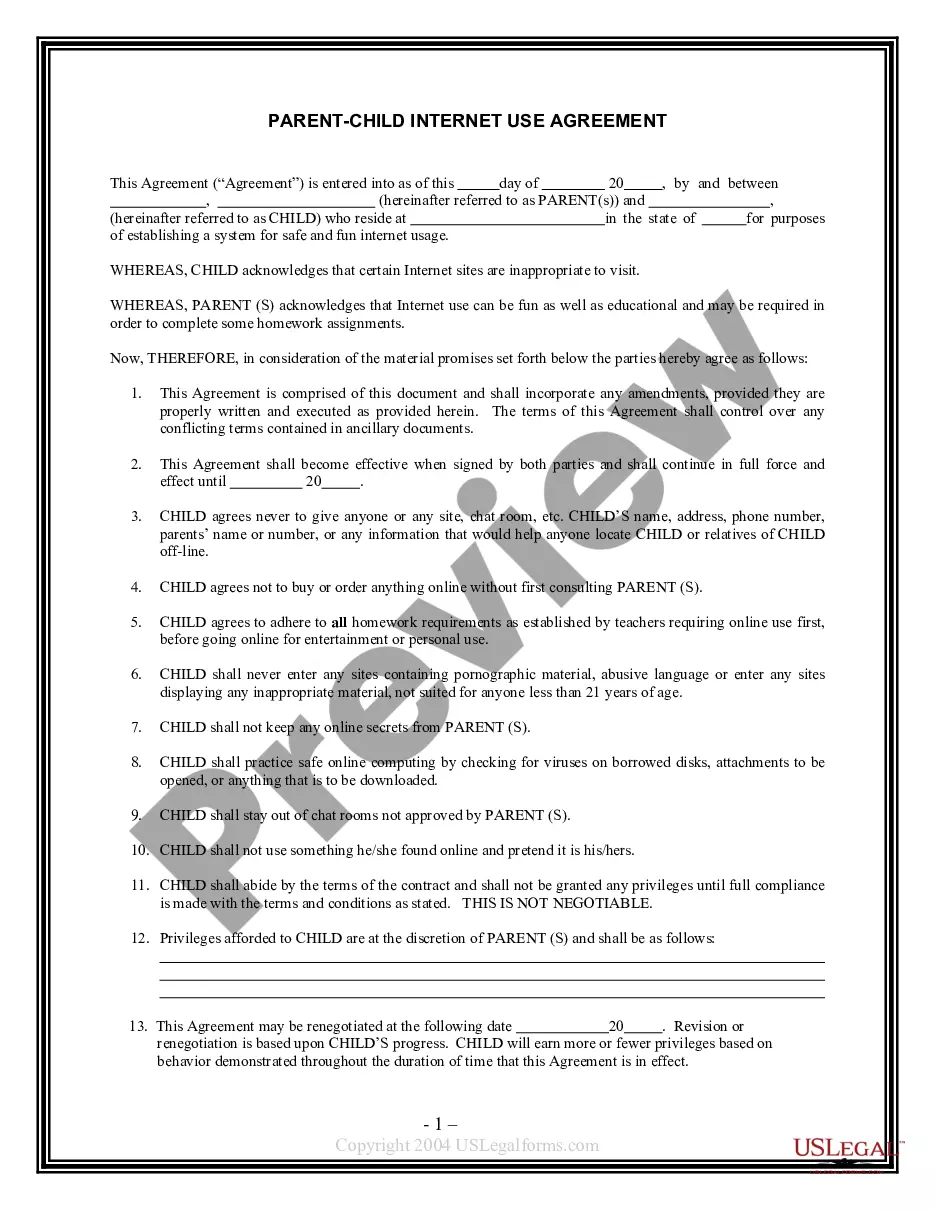
This is a contract between parent(s) and a younger child introducing child to Internet safety by describing what types of sites child should not contact and other general rules for Internet use.
Tennessee Parent - Minor Child Internet Use Agreement
Category:
State:
Multi-State
Control #:
US-PC10
Format:
Word;
Rich Text
Instant download
Description
Free preview
Get your form ready online
Our built-in tools help you complete, sign, share, and store your documents in one place.
Built-in online Word editor
Make edits, fill in missing information, and update formatting in US Legal Forms—just like you would in MS Word.
Export easily
Download a copy, print it, send it by email, or mail it via USPS—whatever works best for your next step.
E-sign your document
Sign and collect signatures with our SignNow integration. Send to multiple recipients, set reminders, and more. Go Premium to unlock E-Sign.
Notarize online 24/7
If this form requires notarization, complete it online through a secure video call—no need to meet a notary in person or wait for an appointment.
Store your document securely
We protect your documents and personal data by following strict security and privacy standards.

Make edits, fill in missing information, and update formatting in US Legal Forms—just like you would in MS Word.

Download a copy, print it, send it by email, or mail it via USPS—whatever works best for your next step.

Sign and collect signatures with our SignNow integration. Send to multiple recipients, set reminders, and more. Go Premium to unlock E-Sign.

If this form requires notarization, complete it online through a secure video call—no need to meet a notary in person or wait for an appointment.

We protect your documents and personal data by following strict security and privacy standards.
Looking for another form?


How to fill out Parent - Minor Child Internet Use Agreement?
US Legal Forms - one of the largest collections of legal documents in the USA - provides a selection of legal form templates that you can purchase or print. By utilizing the website, you can discover thousands of forms for business and personal purposes, organized by categories, states, or keywords.
You can access the latest versions of forms such as the Tennessee Parent - Minor Child Internet Use Agreement within moments. If you have a subscription, Log In and obtain the Tennessee Parent - Minor Child Internet Use Agreement from the US Legal Forms library. The Download button will appear on every form you view. You can access all previously obtained forms in the My documents section of your account.
If you are using US Legal Forms for the first time, here are some simple tips to help you get started: Make sure you have selected the correct form for your city/county. Click the Preview button to review the form's content. Read the form description to ensure that you have chosen the correct form.
Every template you added to your account does not have an expiration date and is yours permanently. Therefore, if you wish to download or print another copy, simply navigate to the My documents section and click on the form you desire.
Access the Tennessee Parent - Minor Child Internet Use Agreement through US Legal Forms, the most extensive library of legal document templates. Utilize thousands of professional and state-specific templates that cater to your business or personal needs and requirements.
- If the form does not meet your needs, utilize the Search field at the top of the screen to find the one that does.
- If you are satisfied with the form, confirm your choice by clicking the Get now button.
- Then, select the payment plan you prefer and provide your details to register for an account.
- Process the transaction. Use your credit card or PayPal account to complete the transaction.
- Choose the format and download the form to your device.
- Make modifications. Fill out, edit, print, and sign the downloaded Tennessee Parent - Minor Child Internet Use Agreement.
Form popularity
FAQ
Erin's Law in Tennessee addresses the prevention of child sexual abuse through education and awareness. The law mandates that schools provide age-appropriate curriculum to teach students about personal boundaries and how to report abuse. A Tennessee Parent - Minor Child Internet Use Agreement can complement this education by setting expectations for online interactions and protecting children from potential online threats. This proactive approach empowers parents and enhances children's safety in both real and virtual environments.
Eli's Law in Tennessee focuses on promoting safe internet usage among minors. This legislation requires schools to educate students and parents about the risks associated with internet use. By implementing a Tennessee Parent - Minor Child Internet Use Agreement, parents can establish clear guidelines for their children's online activities. This agreement helps foster responsible internet behavior while ensuring that children understand the importance of online safety.
Is Tennessee a mother or father state? Neither. Some fathers' rights activists may say it is a mother state because Tennessee does not have an equal parenting time presumption.
Children ages 12 and older in Tennessee can certainly voice their preference, but the ultimate decision lies with the judge on the case. However, a judge may listen to a younger child's preferences as well, providing the child is mature enough, but there is no guarantee the child will get their wish.
In law, there is no fixed age that determines when a child can express a preference as to where they want to live. However, legally, a child cannot decide who they want to live with until they are 16 years old. Once a child reaches the age of 16, they are legally allowed to choose which parent to live with.
The court can restrict or deny a noncustodial parent visitation grounds on the flowing grounds: If the parent has a history of molesting the child. If the court believes that the parent can kidnap the child. If the parent is likely to abuse drugs while taking care of the child.
When can my child decide which parent to live with? Under Tennessee statute, the court shall consider the reasonable preference of the child over the age of 12. The court may choose to hear the preference of a child under the age of 12.
In Tennessee, the child must be at least 12 years old. That would be the legal age at which the child could express a preference of a parent to live with over the other. Children should never be pressured to take sides or choose the more loved (or permissive) parent instead of the other parent (or disciplinarian).
At What Age Can a Child Refuse Visitation in Texas? In Texas, there is no age under 18 that allows for a child to refuse visitation. Visitation is the right of the parent, and it cannot be taken away by the custodial parent or child. The only option would be for the custodial parent to request a modification of orders.
Although a child can never decide issues relating to custody or visitation, Tennessee law requires a court to consider the wishes of a child over the age of 12 when making visitation related decisions.