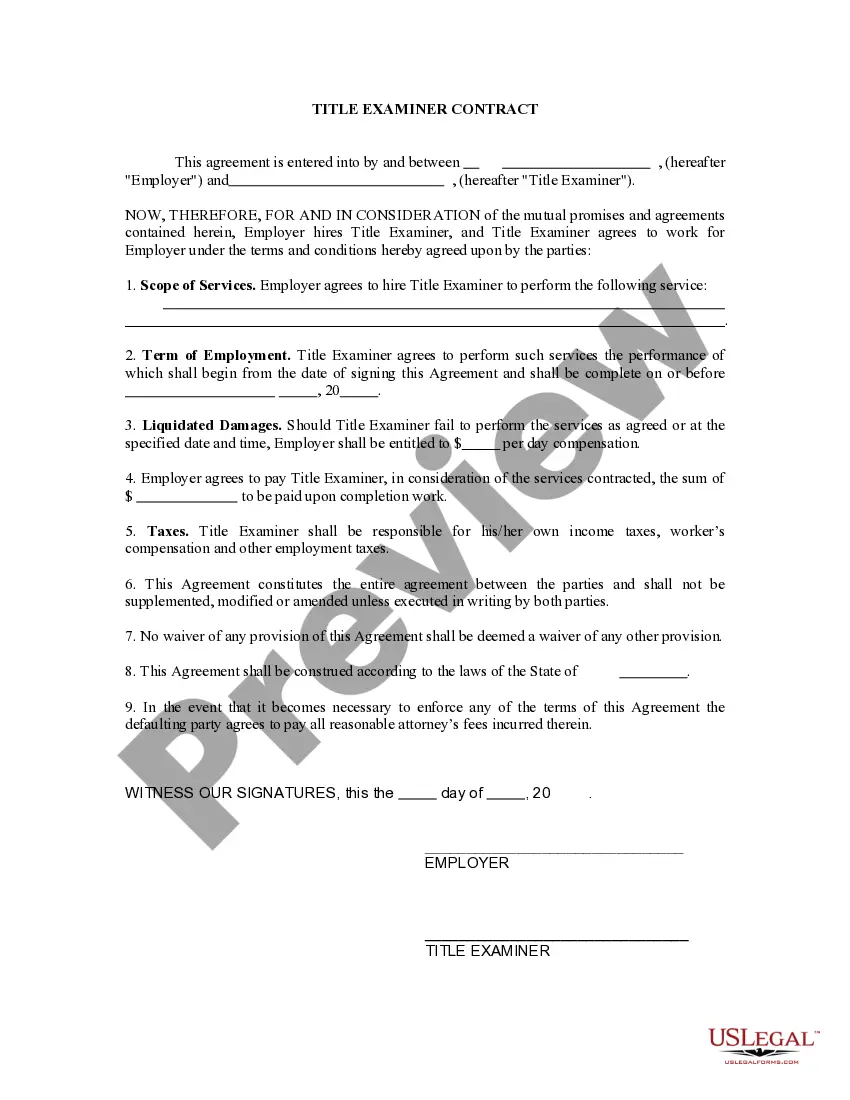
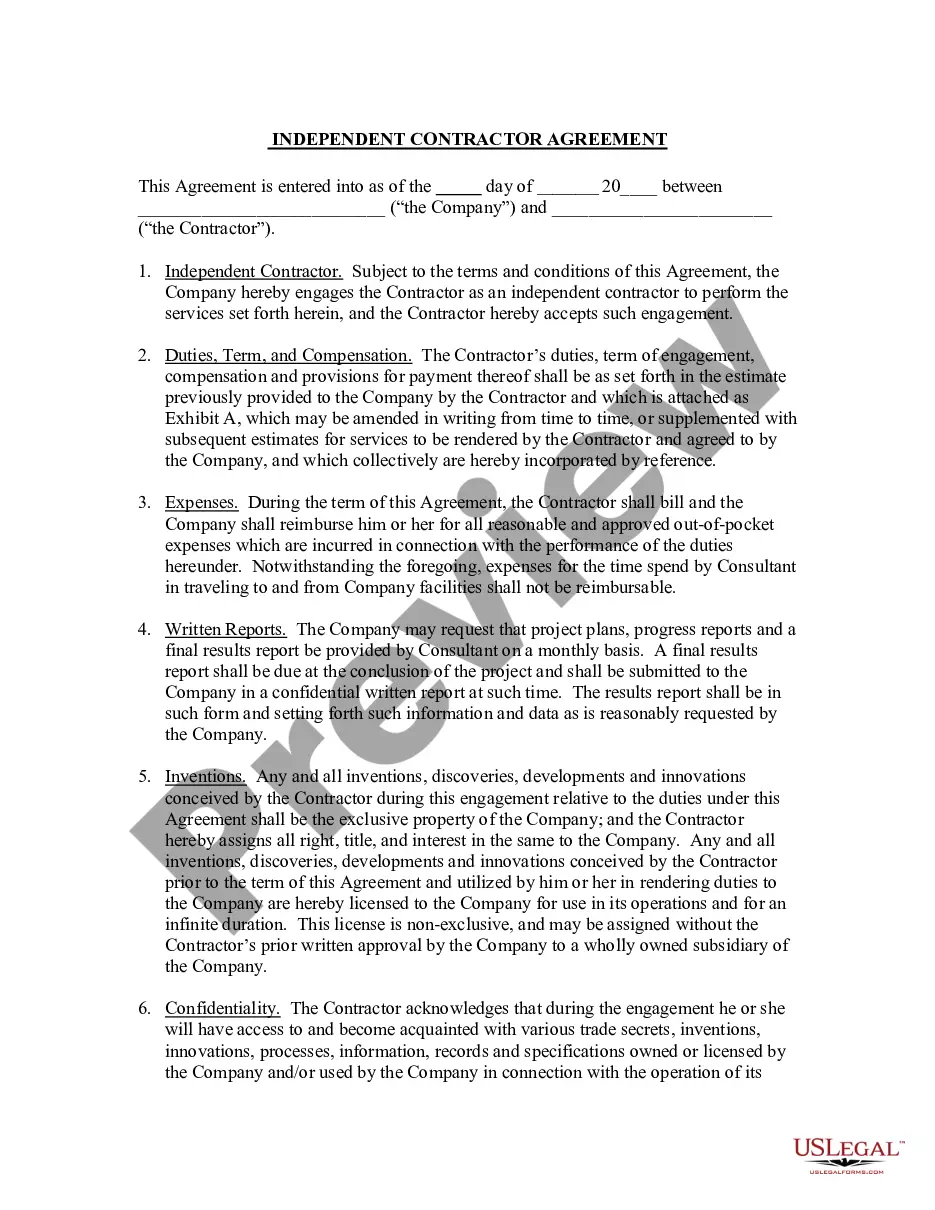
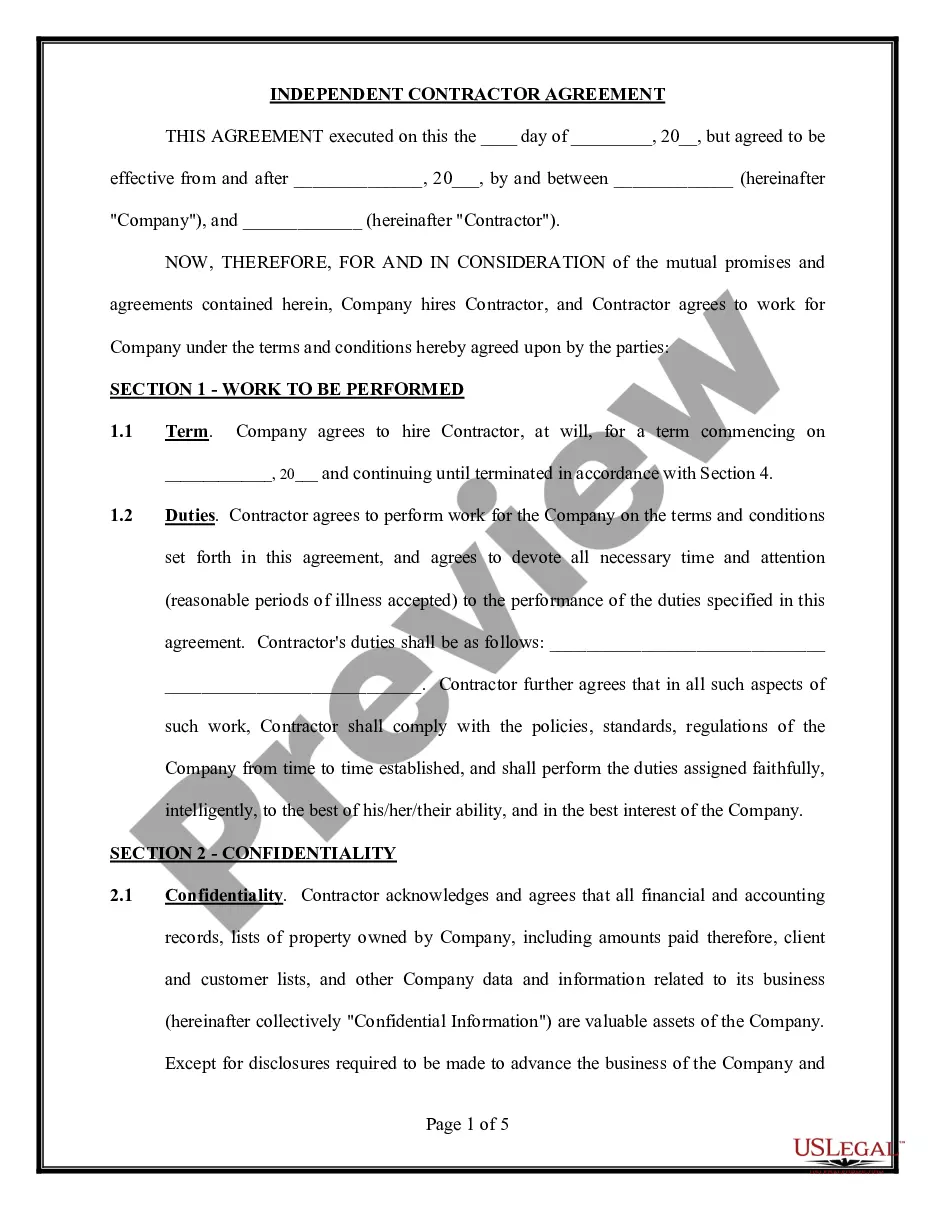
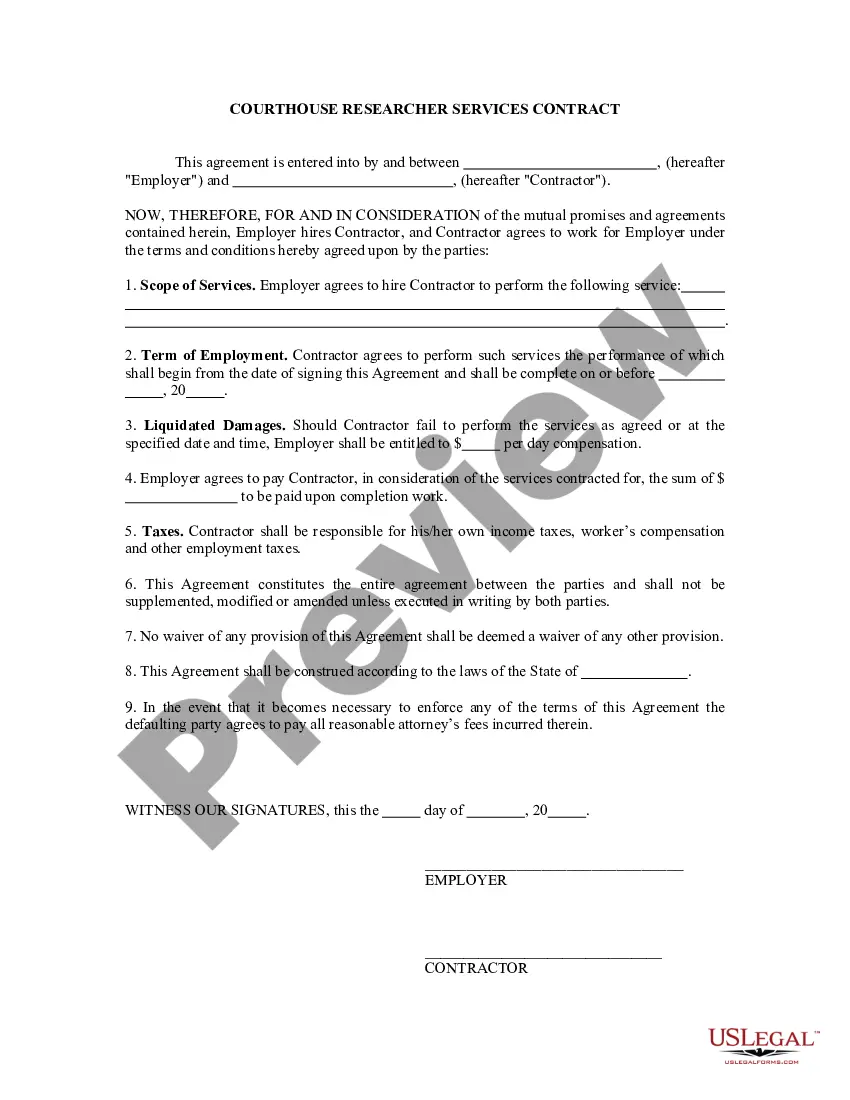
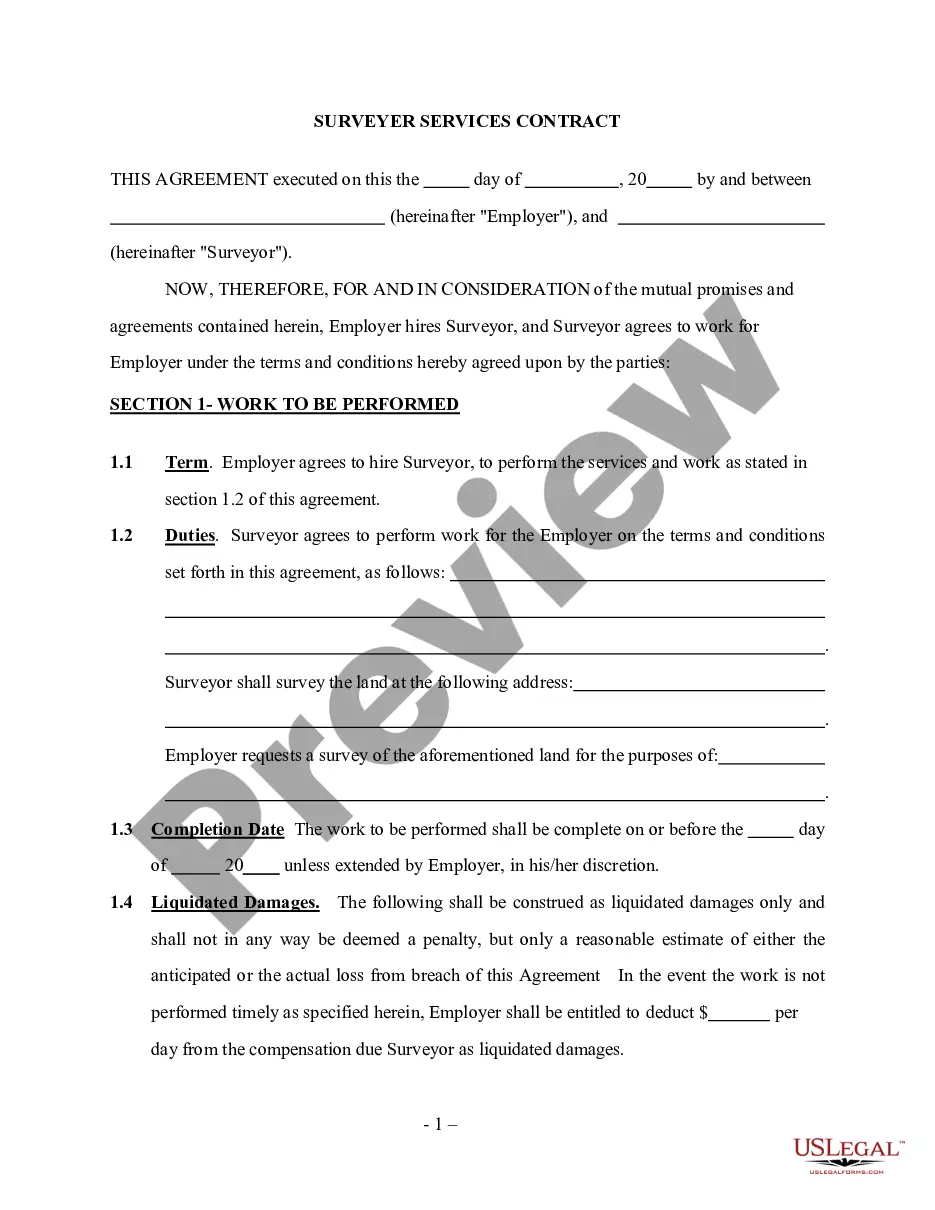
Employer hires a title examiner as an independent contractor to perform title searching services as agreed to in the contract.
Tennessee Self-Employed Title Examiner Contract
State:
Multi-State
Control #:
US-INDC-212
Format:
Word;
Rich Text
Instant download
Description
Get your form ready online
Our built-in tools help you complete, sign, share, and store your documents in one place.
Built-in online Word editor
Make edits, fill in missing information, and update formatting in US Legal Forms—just like you would in MS Word.
Export easily
Download a copy, print it, send it by email, or mail it via USPS—whatever works best for your next step.
E-sign your document
Sign and collect signatures with our SignNow integration. Send to multiple recipients, set reminders, and more. Go Premium to unlock E-Sign.
Notarize online 24/7
If this form requires notarization, complete it online through a secure video call—no need to meet a notary in person or wait for an appointment.
Store your document securely
We protect your documents and personal data by following strict security and privacy standards.

Make edits, fill in missing information, and update formatting in US Legal Forms—just like you would in MS Word.

Download a copy, print it, send it by email, or mail it via USPS—whatever works best for your next step.

Sign and collect signatures with our SignNow integration. Send to multiple recipients, set reminders, and more. Go Premium to unlock E-Sign.

If this form requires notarization, complete it online through a secure video call—no need to meet a notary in person or wait for an appointment.

We protect your documents and personal data by following strict security and privacy standards.
Looking for another form?



How to fill out Self-Employed Title Examiner Contract?
US Legal Forms - one of the largest collections of legal documents in the United States - provides a variety of legal document templates that you can obtain or print. By using the website, you can access thousands of forms for business and personal purposes, organized by categories, states, or keywords. You can find the latest versions of documents like the Tennessee Self-Employed Title Examiner Contract in just a few minutes.
If you already hold a subscription, Log In and obtain the Tennessee Self-Employed Title Examiner Contract from the US Legal Forms library. The Download button will appear on each form you view. You can access all previously downloaded forms in the My documents section of your account.
If you are using US Legal Forms for the first time, here are simple steps to help you get started: Ensure you have selected the correct form for your city/region. Click the Preview button to review the form's details. Check the form summary to confirm you have chosen the right document. If the form does not meet your needs, utilize the Search field at the top of the screen to find one that does. If you are satisfied with the form, confirm your selection by clicking the Buy now button. Next, choose your preferred payment plan and enter your information to register for an account. Process the transaction. Use your Visa or Mastercard or PayPal account to complete the transaction. Select the format and download the form to your device. Edit. Fill out, modify, print, and sign the downloaded Tennessee Self-Employed Title Examiner Contract. Each template you purchased does not have an expiration date and is yours indefinitely. So, if you wish to download or print another copy, simply go to the My documents section and click on the form you need. Access the Tennessee Self-Employed Title Examiner Contract with US Legal Forms, the most extensive library of legal document templates. Utilize a multitude of professional and state-specific templates that meet your business or personal needs and requirements.
Form popularity
FAQ
Legal requirements for independent contractors often vary by state, but generally include compliance with tax regulations and an understanding of the duties outlined in your contract. In Tennessee, having a well-drafted Tennessee Self-Employed Title Examiner Contract can help you meet these legal standards. This contract should include the terms of service, payment agreements, and any applicable laws to protect your business.
To qualify as an independent contractor, you must demonstrate that you control your work, provide your tools, and operate independently from your clients. Additionally, having a Tennessee Self-Employed Title Examiner Contract can help clarify the nature of your relationship with clients. This contract is crucial for establishing your standalone status in the eyes of tax authorities.
In Tennessee, certain types of work allow individuals to operate without a contractor license, especially if they engage in small-scale projects or consulting services. However, contracting work that exceeds specific monetary thresholds typically requires licensing. It's wise to consult the Tennessee licensing board to ensure compliance, especially if you're pursuing a Tennessee Self-Employed Title Examiner Contract.
To become an independent contractor in Tennessee, you should begin by defining your skills and services. Next, register your business if necessary and obtain any required permits or licenses. Finally, consider drafting a Tennessee Self-Employed Title Examiner Contract to clearly outline your services to potential clients.
The basic independent contractor agreement outlines the terms between a client and an independent contractor in Tennessee. This agreement confirms the contractor will perform certain services without being treated as an employee. For those interested in a Tennessee Self-Employed Title Examiner Contract, this document serves as a foundation, detailing payment, scope of work, and deadlines.
Rule 0680 1 13 pertains to the qualifications and regulations surrounding contractors in Tennessee, outlining the necessary guidelines for obtaining a license. This rule also addresses compliance requirements and exemptions for different types of work. Understanding and adhering to this rule is essential for anyone considering services that involve contracting. If you’re looking to operate under a Tennessee Self-Employed Title Examiner Contract, being informed about such regulations can empower your business decisions.
Contracting without a license in Tennessee can lead to fines and legal consequences. Individuals may face penalties up to $1,000 per violation, and it can impede your ability to obtain future contracts. Staying licensed not only protects your business but guides you in maintaining industry standards. If you are interested in freelancing through a Tennessee Self-Employed Title Examiner Contract, make sure you comply with licensing laws.
In Tennessee, individuals can perform work valued at up to $25,000 without needing a contractor license. However, for any larger projects, a valid license is necessary. This regulation emphasizes the importance of compliance to ensure quality and safety in construction work. If you're considering a Tennessee Self-Employed Title Examiner Contract, understanding these regulations can help you navigate your responsibilities.
The salary for Title Examiners in the US can vary based on location, experience, and employment type, ranging from $40,000 to $80,000 annually. Self-employed title examiners might earn different amounts based on their workload and client base. A Tennessee Self-Employed Title Examiner Contract offers the potential for flexible income aligned with your efforts and expertise.
The qualifications for being a Title Examiner often include a high school diploma or equivalent, with many professionals holding a degree in real estate, finance, or a related field. Important skills include attention to detail and a strong understanding of property laws. Working under a Tennessee Self-Employed Title Examiner Contract may also necessitate certain state licenses or certifications.