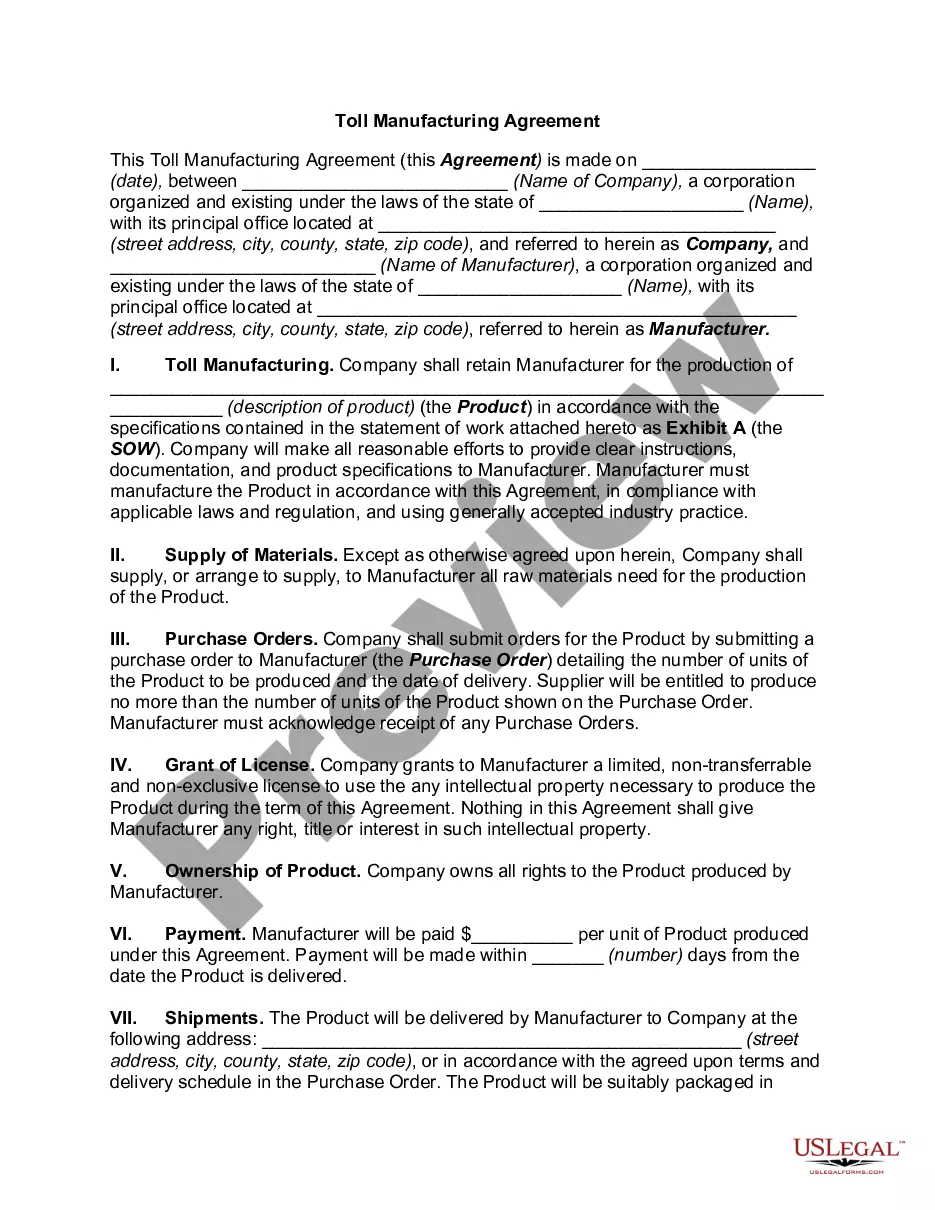
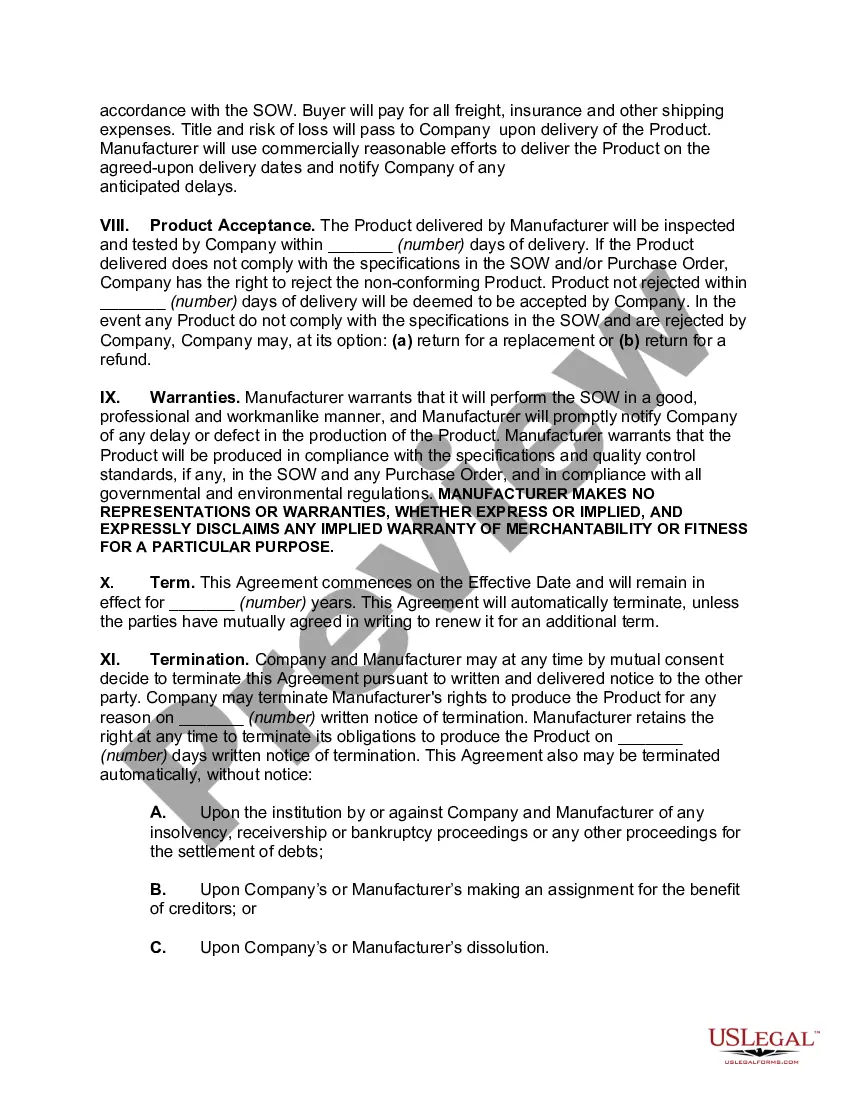
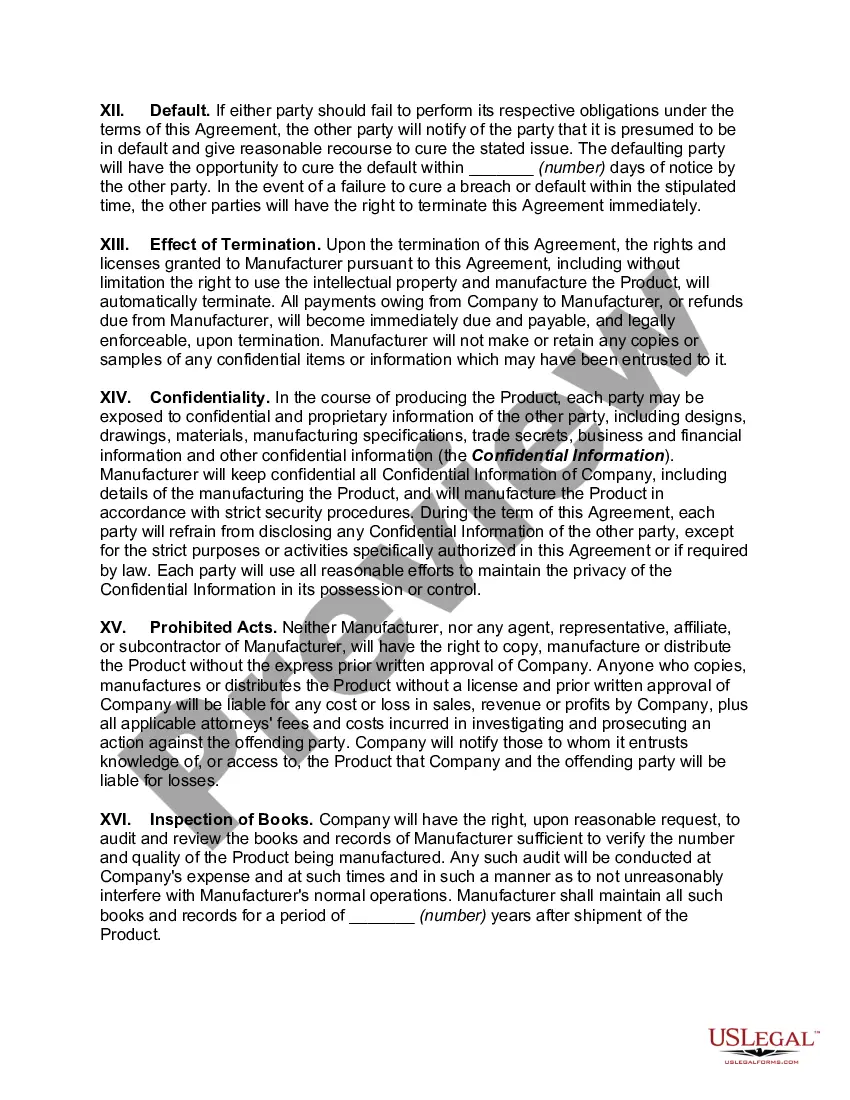
Tennessee Toll Manufacturing Agreement
Description
Get your form ready online
Our built-in tools help you complete, sign, share, and store your documents in one place.
Make edits, fill in missing information, and update formatting in US Legal Forms—just like you would in MS Word.
Download a copy, print it, send it by email, or mail it via USPS—whatever works best for your next step.
Sign and collect signatures with our SignNow integration. Send to multiple recipients, set reminders, and more. Go Premium to unlock E-Sign.
If this form requires notarization, complete it online through a secure video call—no need to meet a notary in person or wait for an appointment.
We protect your documents and personal data by following strict security and privacy standards.

Make edits, fill in missing information, and update formatting in US Legal Forms—just like you would in MS Word.

Download a copy, print it, send it by email, or mail it via USPS—whatever works best for your next step.

Sign and collect signatures with our SignNow integration. Send to multiple recipients, set reminders, and more. Go Premium to unlock E-Sign.

If this form requires notarization, complete it online through a secure video call—no need to meet a notary in person or wait for an appointment.

We protect your documents and personal data by following strict security and privacy standards.
Looking for another form?


How to fill out Toll Manufacturing Agreement?
You can spend hours on the web attempting to discover the authentic document format that satisfies the state and federal requirements you require.
US Legal Forms offers thousands of authentic forms that are reviewed by experts.
You can actually download or print the Tennessee Toll Manufacturing Agreement from your services.
If you wish to find another version of the form, use the Search field to locate the format that meets your needs and requirements.
- If you already have a US Legal Forms account, you can sign in and click the Download button.
- Then, you may complete, modify, print, or sign the Tennessee Toll Manufacturing Agreement.
- Each authentic document format you receive is yours forever.
- To obtain another copy of the purchased form, visit the My documents section and click the appropriate option.
- If you are using the US Legal Forms website for the first time, follow the basic instructions below.
- Firstly, ensure that you have selected the right document format for your county/city of your choice.
- Review the form outline to confirm you have chosen the correct form.
Form popularity
FAQ
Toll manufacturing refers to a business arrangement where one company provides production services for another, using the latter's raw materials. This arrangement allows businesses to reduce overhead costs while benefiting from the expertise of specialized manufacturers. With a Tennessee Toll Manufacturing Agreement, you can outline critical aspects such as timelines, costs, and quality requirements, ensuring a smooth collaboration. This approach is particularly beneficial for companies seeking flexibility in their manufacturing processes.
Toll manufacturing typically focuses on the transformation of raw materials into finished products without the manufacturer taking ownership of the goods. In contrast, contract manufacturing involves the supplier owning the inventory and creating products according to the hiring company’s specifications. A Tennessee Toll Manufacturing Agreement clearly defines these roles and responsibilities, ensuring transparency in operations. Understanding these differences can greatly affect your manufacturing decisions.
A manufacturer generally produces goods using its resources and sells them directly, while a contract manufacturer produces goods on behalf of another entity, following strict guidelines. In a Tennessee Toll Manufacturing Agreement, the focus is more on processing raw materials than managing overall production, which sets it apart from typical manufacturing arrangements. Companies choose contract manufacturers to enhance flexibility and efficiency in their production capabilities.
A toll manufacturing arrangement is a contractual setup where a business engages a toll manufacturer to produce specific products using its raw materials. Under a Tennessee Toll Manufacturing Agreement, responsibilities and fees are clearly outlined, ensuring clarity for both parties. This structure helps businesses streamline operations while ensuring high-quality production.
A tolling manufacturer is a specialized company that provides processing services under a Tennessee Toll Manufacturing Agreement. They have the equipment and expertise to convert raw materials into finished or semi-finished products, while the client retains ownership of those materials. This arrangement allows businesses to leverage manufacturing capabilities without heavy capital investment in equipment.
In a contract manufacturing setup, the contractor takes responsibility for the complete production cycle, whereas a toll manufacturer only processes materials. The Tennessee Toll Manufacturing Agreement emphasizes this distinction by detailing the scope of work and the client's role. Essentially, contract manufacturing may include more comprehensive services than toll manufacturing.
While both toll manufacturing and subcontracting involve outsourcing parts of the production process, they serve different purposes. A toll manufacturing arrangement typically focuses on transforming raw materials into finished products, while subcontracting may involve hiring another company to perform any aspect of the manufacturing process. The Tennessee Toll Manufacturing Agreement ensures that the toll manufacturer follows specific guidelines set by the contracting company.
While a Tennessee Toll Manufacturing Agreement has its advantages, it also comes with limitations. One major concern is the potential loss of control over the production process and quality oversight. Furthermore, relying on external manufacturers may lead to communication challenges, which could impact delivery timelines or product specifications. It’s essential to carefully choose a reputable toll manufacturer to mitigate these risks.
An example of tolling is when a manufacturer contracts another company to produce goods using their raw materials. For instance, a beverage company may use a Tennessee Toll Manufacturing Agreement to have a third party produce their drinks, providing the ingredients while the toll manufacturer handles the bottling and packaging processes. This ensures product consistency while reducing the manufacturer's overhead.
The primary purpose of a Tennessee Toll Manufacturing Agreement is to outsource manufacturing processes to a third party while maintaining control over product specifications. This beneficial arrangement enables companies to increase production efficiency, reduce costs, and expand production capabilities without the need for large investments. Overall, it allows businesses to remain agile and responsive to market demands.