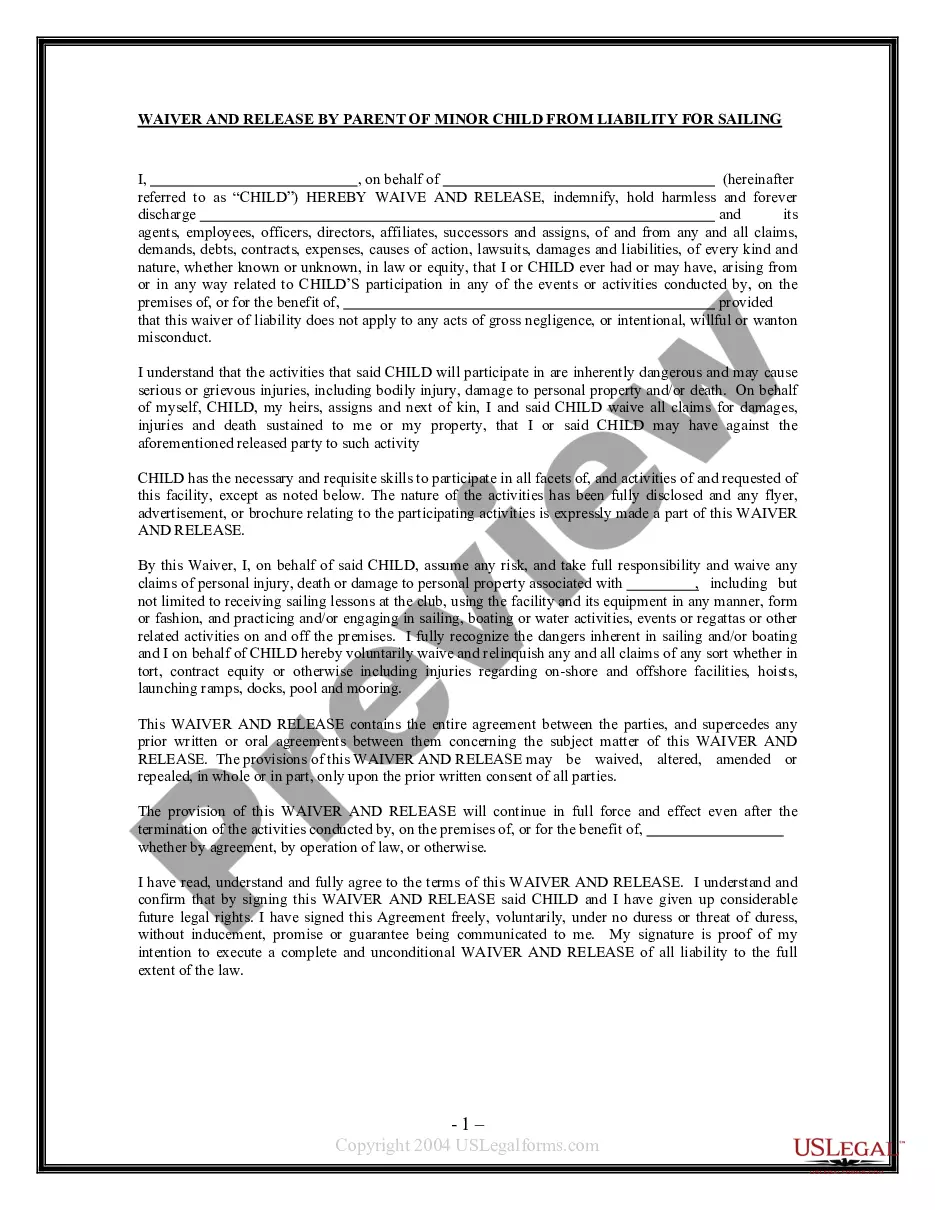
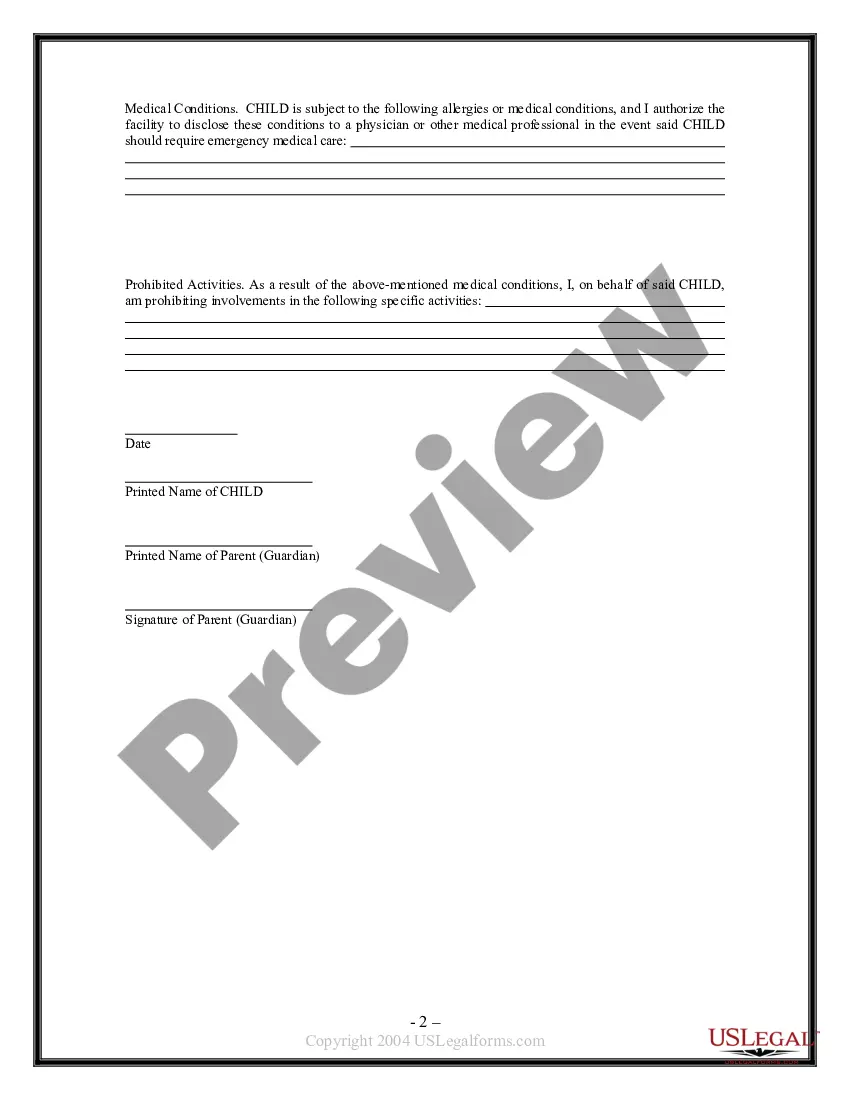
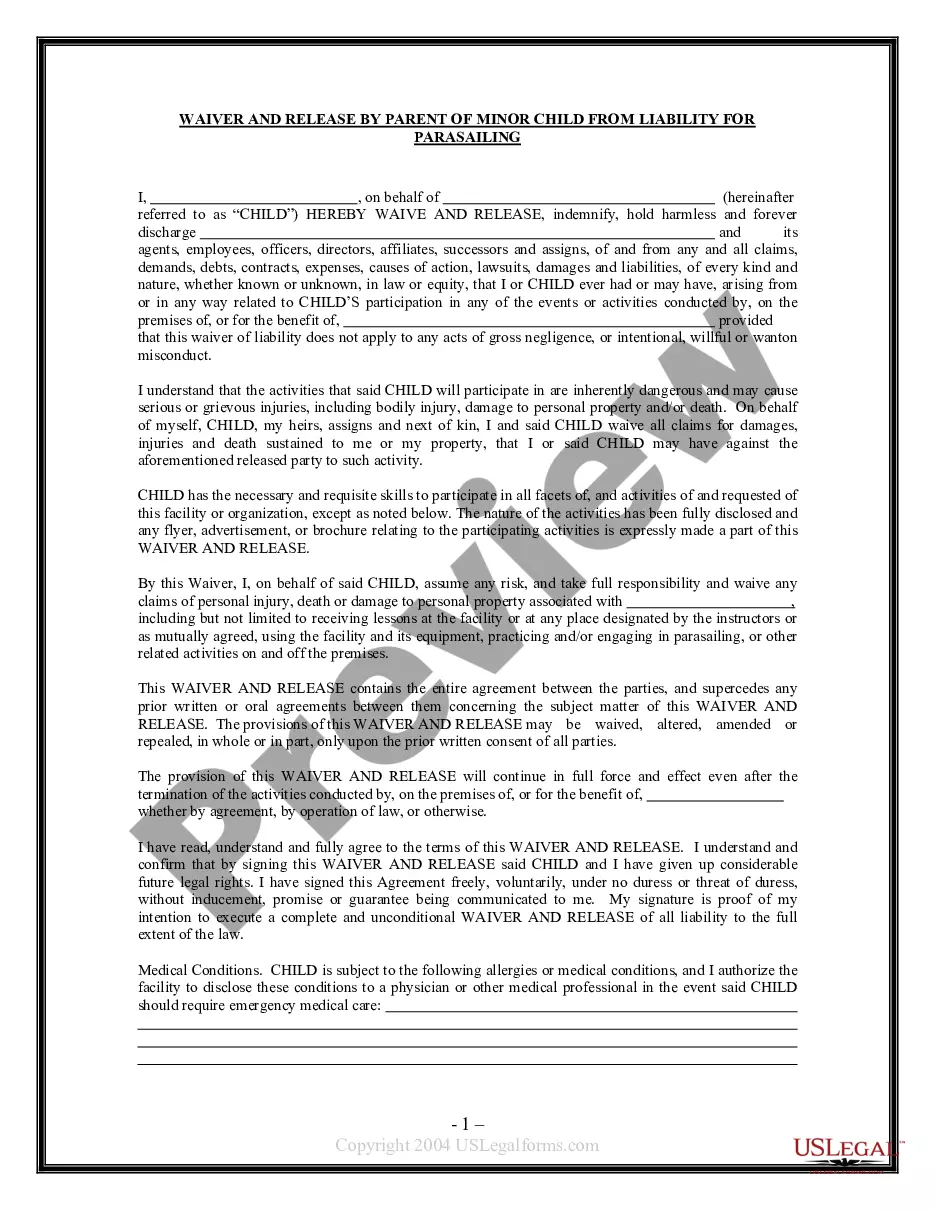
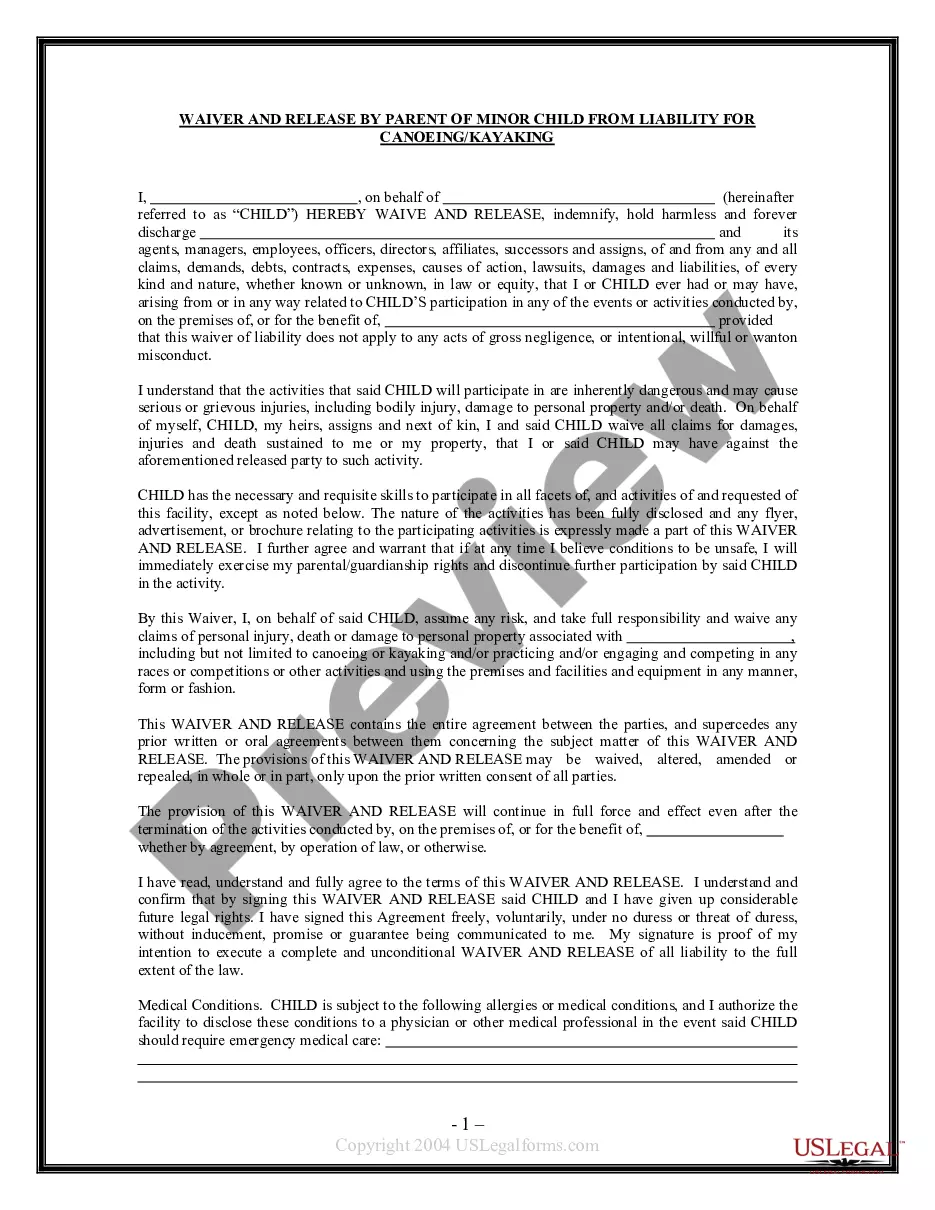
This form allows a parent or guardian to release a sailing facility from liability for injuries which may be incurred by a minor child while on the premises, taking part in activities, etc.
South Dakota Waiver and Release From Liability For Minor Child for Sailing
Category:
State:
Multi-State
Control #:
US-WAV-32M
Format:
Word;
Rich Text
Instant download
Description
Free preview

How to fill out Waiver And Release From Liability For Minor Child For Sailing?
If you need to finalize, acquire, or print legitimate document templates, utilize US Legal Forms, the largest collection of legal forms available online. Take advantage of the site's straightforward and user-friendly search to locate the documents you require. A range of templates for business and personal purposes are organized by categories and states, or keywords.
Use US Legal Forms to find the South Dakota Waiver and Release From Liability For Minor Child for Sailing with just a few clicks. If you are already a US Legal Forms customer, Log In to your account and click on the Obtain button to download the South Dakota Waiver and Release From Liability For Minor Child for Sailing. You can also access forms you previously downloaded in the My documents section of your account.
If you are using US Legal Forms for the first time, follow the steps below: Step 1. Ensure you have selected the form for the correct city/state. Step 2. Use the Review option to review the form's content. Do not forget to read the description. Step 3. If you are not satisfied with the form, use the Search field at the top of the screen to find other types of your legal form template. Step 4. Once you have found the form you need, click on the Get now button. Choose the pricing plan you prefer and enter your details to register for an account. Step 5. Complete the transaction. You can use your credit card or PayPal account to finalize the payment. Step 6. Select the format of your legal form and download it to your device. Step 7. Fill out, edit, and print or sign the South Dakota Waiver and Release From Liability For Minor Child for Sailing.
- Every legal document template you obtain is yours permanently.
- You have access to every form you downloaded in your account.
- Select the My documents section and choose a form to print or download again.
- Be proactive and download, and print the South Dakota Waiver and Release From Liability For Minor Child for Sailing with US Legal Forms.
- There are millions of professional and state-specific forms you can utilize for your business or personal needs.
Form popularity
FAQ
A liability waiver is a legal document that a person who participates in an activity may sign to acknowledge the risks involved in their participation. By doing so, the company attempts to remove legal liability from the business or person responsible for the activity.
Liability waivers are enforceable in California solely to the extent they shift to the customer the risk of ordinary negligence. Under California law, a liability waiver cannot excuse an injury caused by a defendant's gross negligence, recklessness or intentionally wrongful act.
Here is all that pertains writing an effective liability waiver:Get help. Writing a waiver should not be complicated.Use the correct structure.Proper formatting.Include a subject line.Include a caution!Talk about the activity risks.Do not forget an assumption of risk.Hold harmless.More items...?
Under California law, waivers of liability may not prevent people from suing for injuries resulting from gross negligence, recklessness, intentional torts or illegal acts.
Liability waivers are enforceable in California solely to the extent they shift to the customer the risk of ordinary negligence. Under California law, a liability waiver cannot excuse an injury caused by a defendant's gross negligence, recklessness or intentionally wrongful act.
You might think that since you signed a waiver acknowledging the risks of the activity, you have no legal leg to stand on to file a personal injury lawsuit. Waivers can make personal injury lawsuits more complex, but you can still seek damages for injuries that could have and should have been prevented.
As tempting as it may be, you should never write your own liability waiver. Unless you're a fully qualified lawyer with experience in this area, it's likely that you'll omit critical language that puts your business at risk for lawsuits.
The Waiver must be clearly worded and unambiguous in its intent to relieve any and all legal liability, even liability for negligence. The Waiver should be prominent and not hidden in the fine print of a long contract. The Waiver must be signed by the person who it is being used against.
A release of liability, also known as a liability waiver or a hold harmless agreement, is a contract in which one party agrees not to hold another party liable for damages or injury. These contracts are common in fields that involve some risk to property, finances, or health.
The main difference between releases and waivers is the transferring of ownership. When rights are released, they are transferred to another party. When rights are waived, they are gone altogether.
