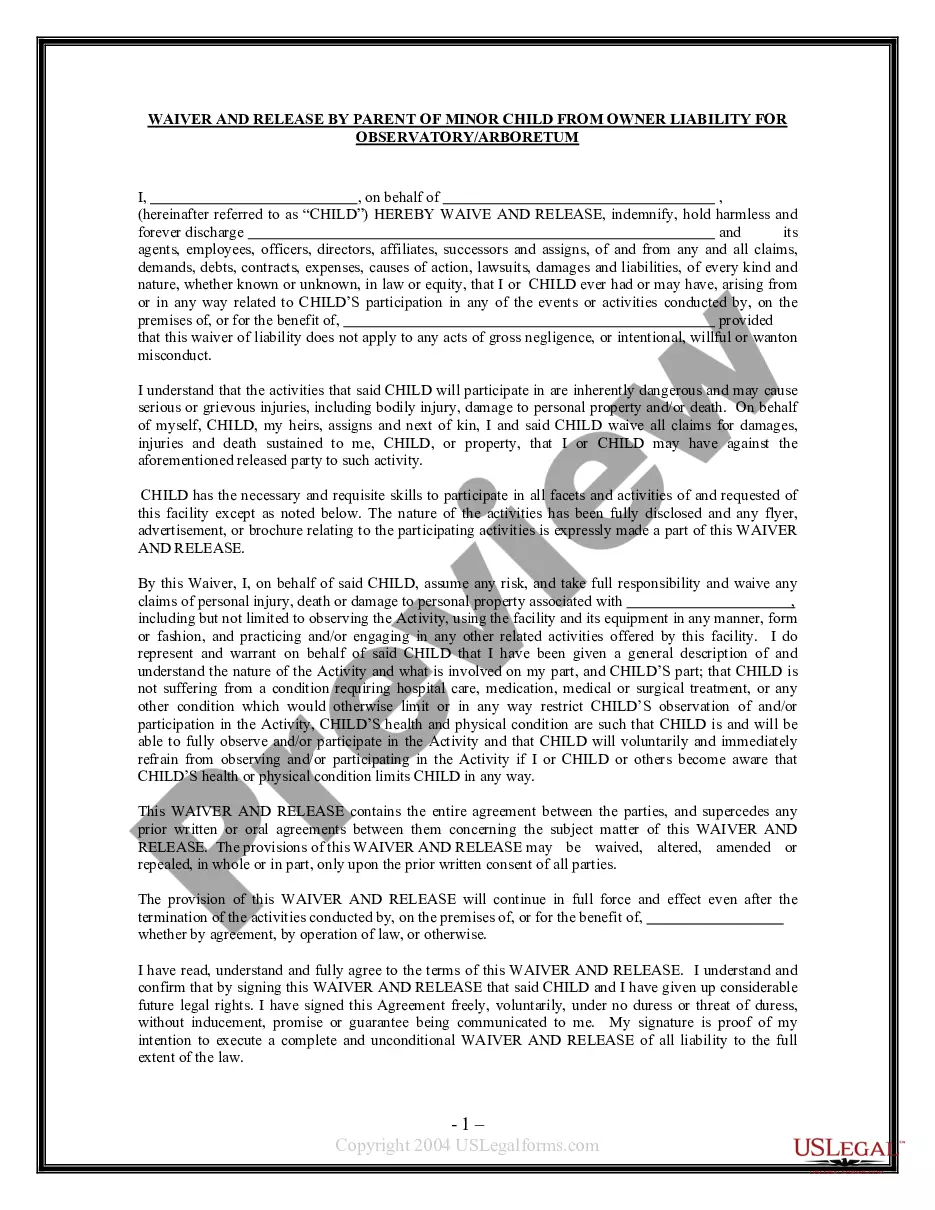
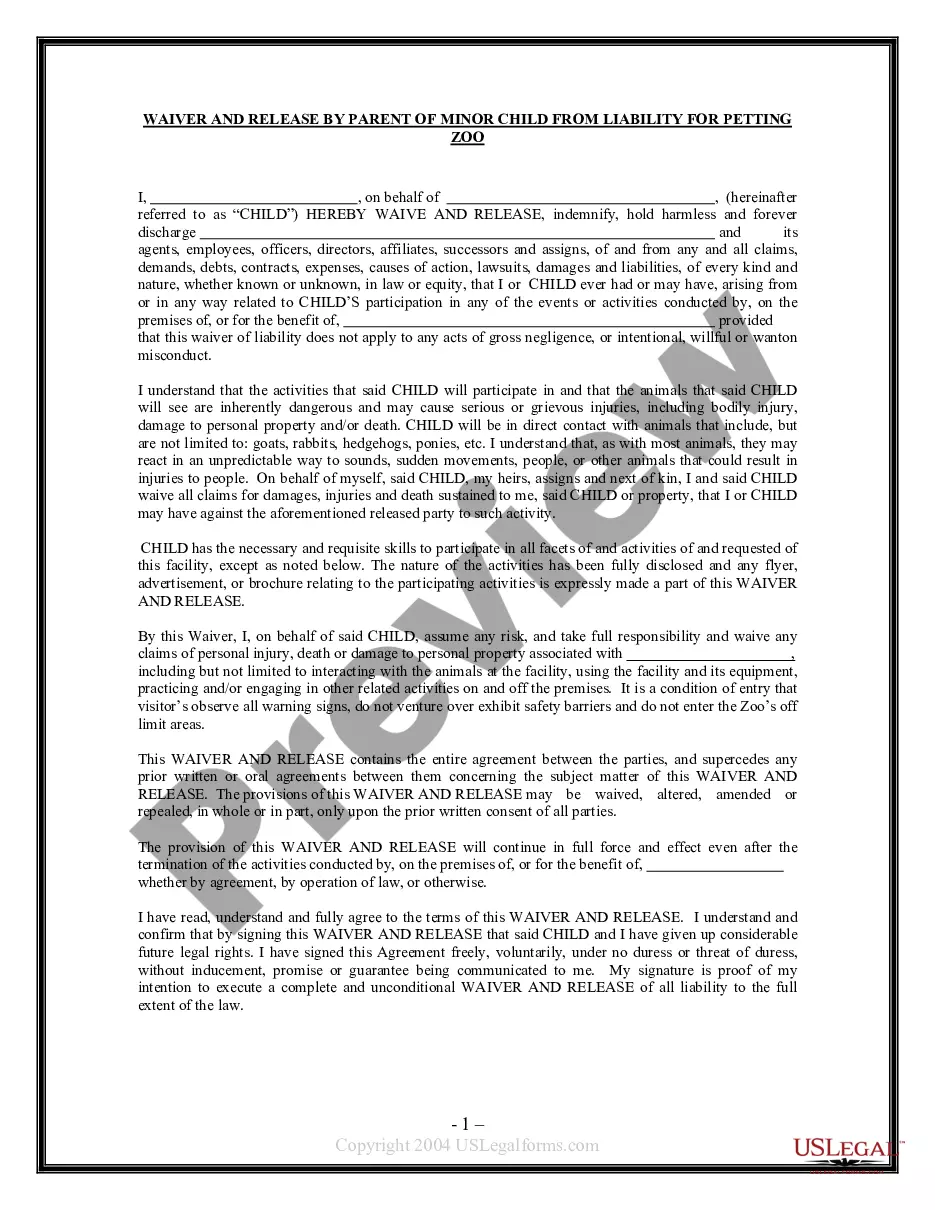
This form allows a parent or guardian to release a zoo facility from liability for injuries which may be incurred by a minor child while on the premises, taking part in activities, etc.
South Dakota Waiver and Release From Liability For Minor Child for Zoo
Category:
State:
Multi-State
Control #:
US-WAV-16M
Format:
Word;
Rich Text
Instant download
Description
Free preview
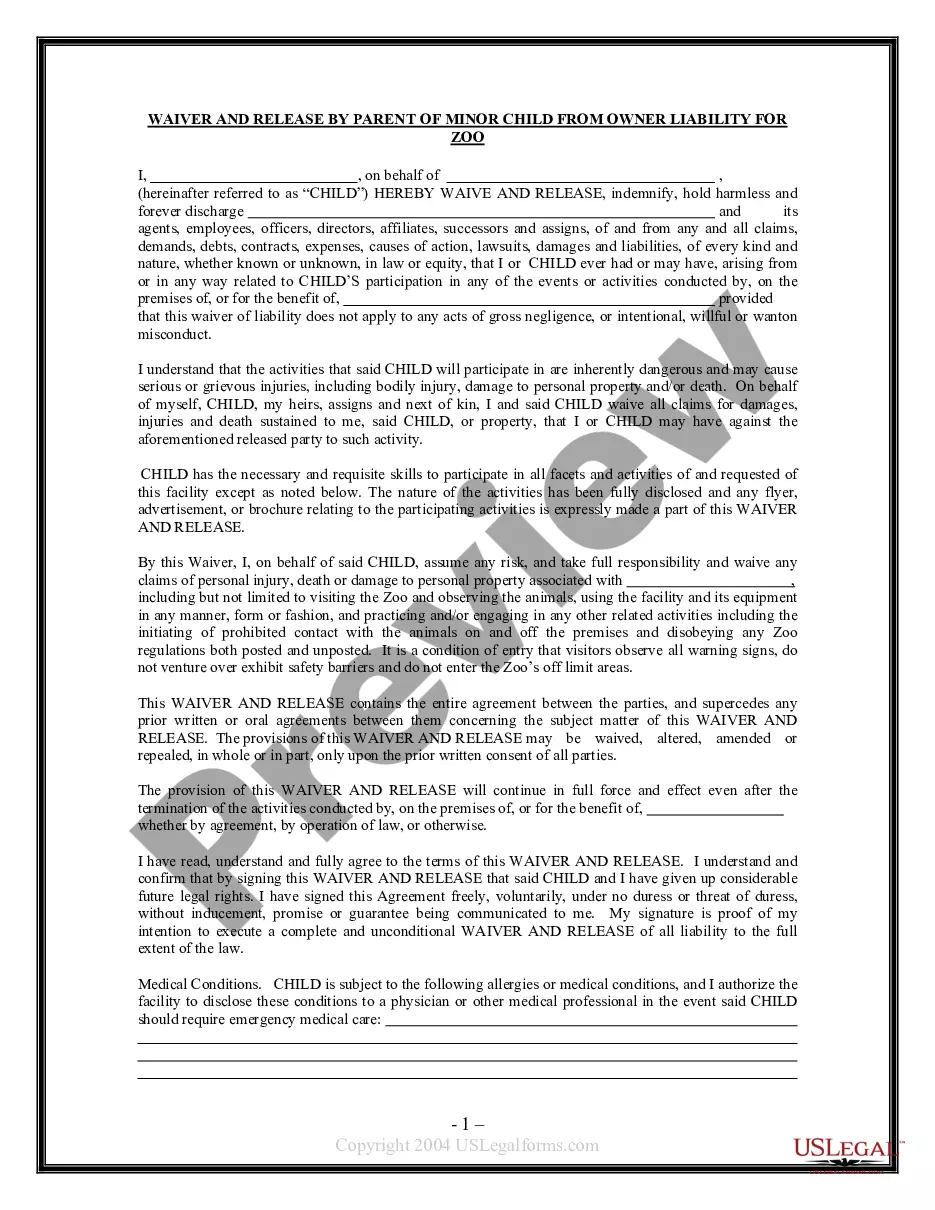
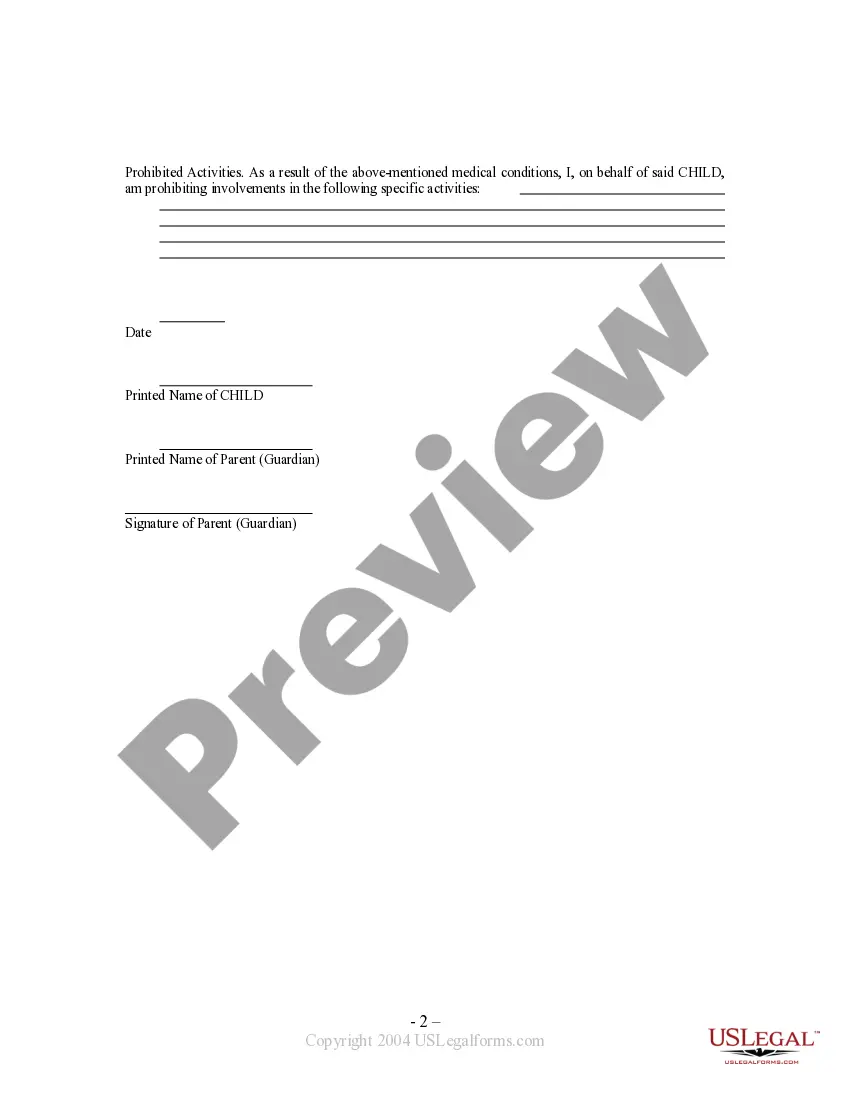
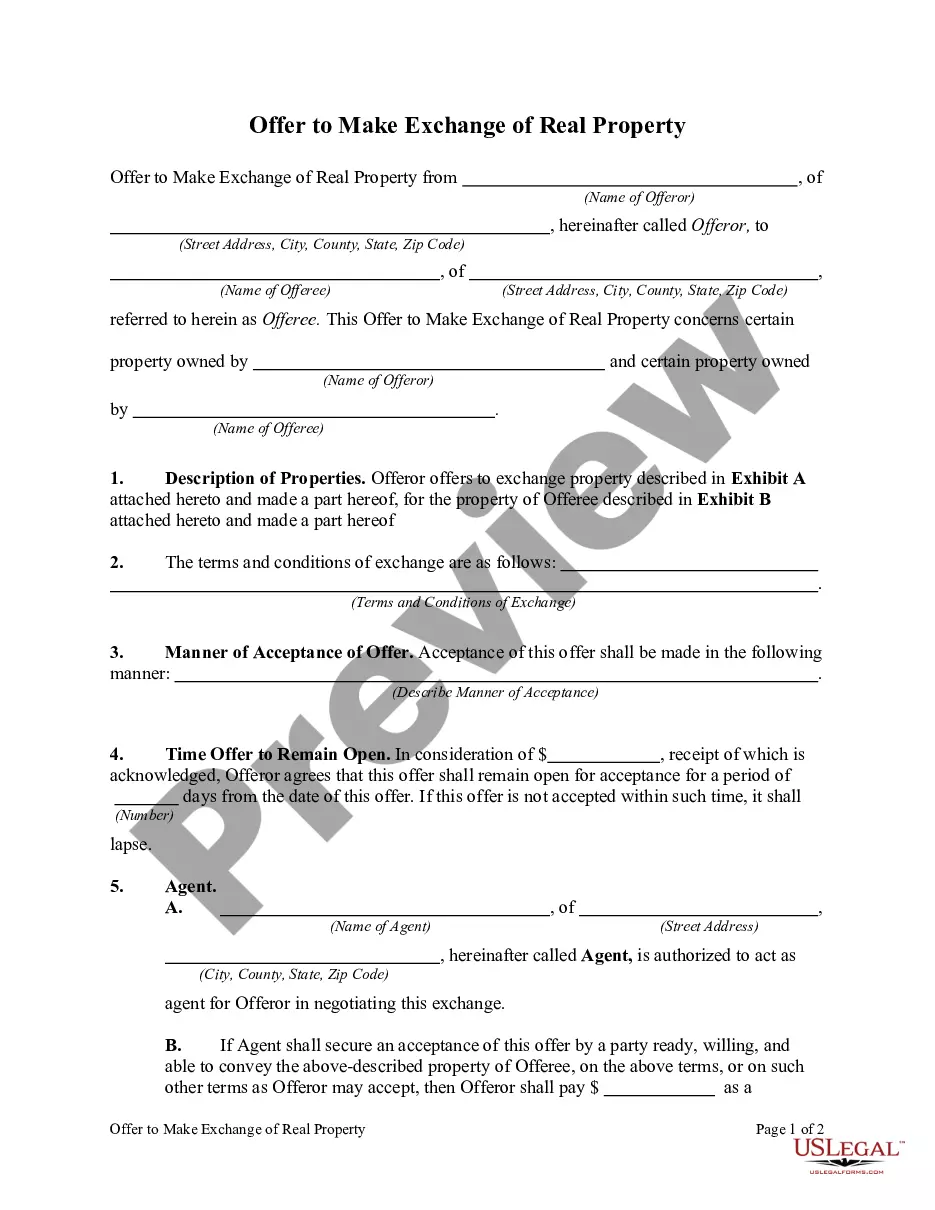
How to fill out Waiver And Release From Liability For Minor Child For Zoo?
It is feasible to spend hours online searching for the legal document template that meets your state and federal requirements. US Legal Forms offers numerous legal forms that have been reviewed by professionals.
You can conveniently download or print the South Dakota Waiver and Release From Liability For Minor Child for Zoo from your account.
If you already possess a US Legal Forms account, you may Log In and click the Download button. Afterwards, you can complete, modify, print, or sign the South Dakota Waiver and Release From Liability For Minor Child for Zoo. Each legal document template you purchase is yours to keep indefinitely. To obtain another copy of any acquired form, navigate to the My documents section and click the corresponding button.
Make adjustments to your document if necessary. You can complete, modify, sign, and print South Dakota Waiver and Release From Liability For Minor Child for Zoo. Download and print thousands of document templates using the US Legal Forms website, which offers the largest collection of legal forms. Utilize professional and state-specific templates to address your business or personal requirements.
- If you are using the US Legal Forms site for the first time, follow the simple instructions below.
- First, ensure that you have selected the correct document template for the county/city of your choice. Review the form description to confirm you have chosen the right one. If available, use the Preview button to view the document template as well.
- If you wish to find another version of the form, utilize the Search field to locate the template that meets your needs.
- Once you have found the template you want, click Purchase now to proceed.
- Select the pricing plan you prefer, enter your credentials, and register for an account on US Legal Forms.
- Complete the transaction. You can use your credit card or PayPal account to pay for the legal document.
- Choose the format of the document and download it to your device.
Form popularity
FAQ
In South Dakota, a minor is defined as anyone under the age of 18. This means that parents or guardians must provide consent for activities involving minors, including visits to places like the zoo. To ensure safety and legal protection, it is advisable to use a South Dakota Waiver and Release From Liability For Minor Child for Zoo. This document helps clarify responsibilities and protect against potential liabilities.
What is the purpose of a waiver? A waiver is a legal agreement the primary purpose of which is to let you or another party modify or relinquish a right, privilege, or claim. The agreement can be a separate document on its own, such as if you sign a waiver form, or added to a contract as a waiver clause.
Liability waiver: designed to protect a facility from a lawsuit in the event of ordinary negligence. Agreement to participate: another form used by facilities, it does not provide a facility with liability protection, but does often outline the typical rules and expected behaviors, as well as outlining potential risks.
A liability waiver is a legal document that a person who participates in an activity may sign to acknowledge the risks involved in their participation. By doing so, the company attempts to remove legal liability from the business or person responsible for the activity.
A participation waiver, or consent form, is a legally-binding document put in place to protect you and your organization. When the participant or their parent sign the document, they are stating that they fully acknowledge the risks involved, and therefore can not file frivolous lawsuits in case of damages or injury.
The main difference between releases and waivers is the transferring of ownership. When rights are released, they are transferred to another party. When rights are waived, they are gone altogether.
A waiver is a legally binding provision where either party in a contract agrees to voluntarily forfeit a claim without the other party being liable. Waivers can either be in written form or some form of action.
A waiver explained A release form or a waiver is simply a legal document containing an agreement between two parties. The first party is the releasor (person promising not to sue) and the releasee (the party that is reliable).
Within the United States, the most common types of waivers tend to fall into one of three categories criminal rights, procedural rights, and liability waivers.
A waiver is a legally binding provision where either party in a contract agrees to voluntarily forfeit a claim without the other party being liable.