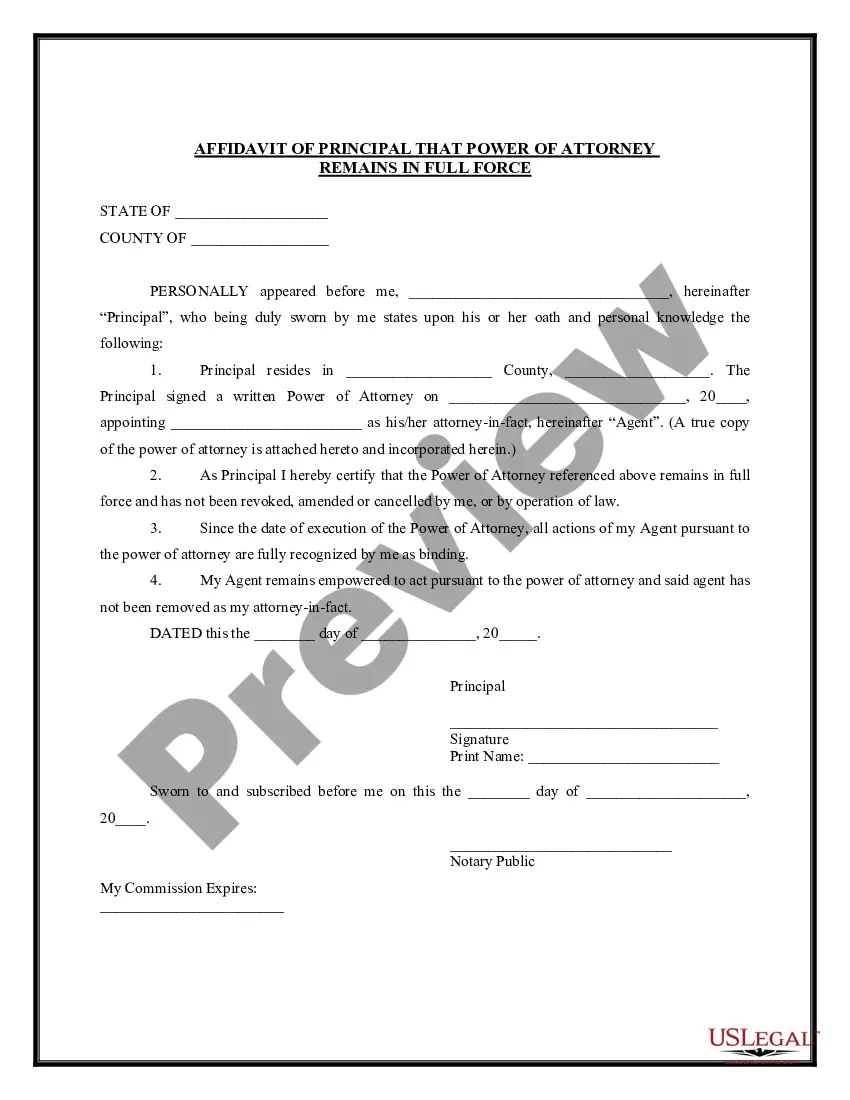
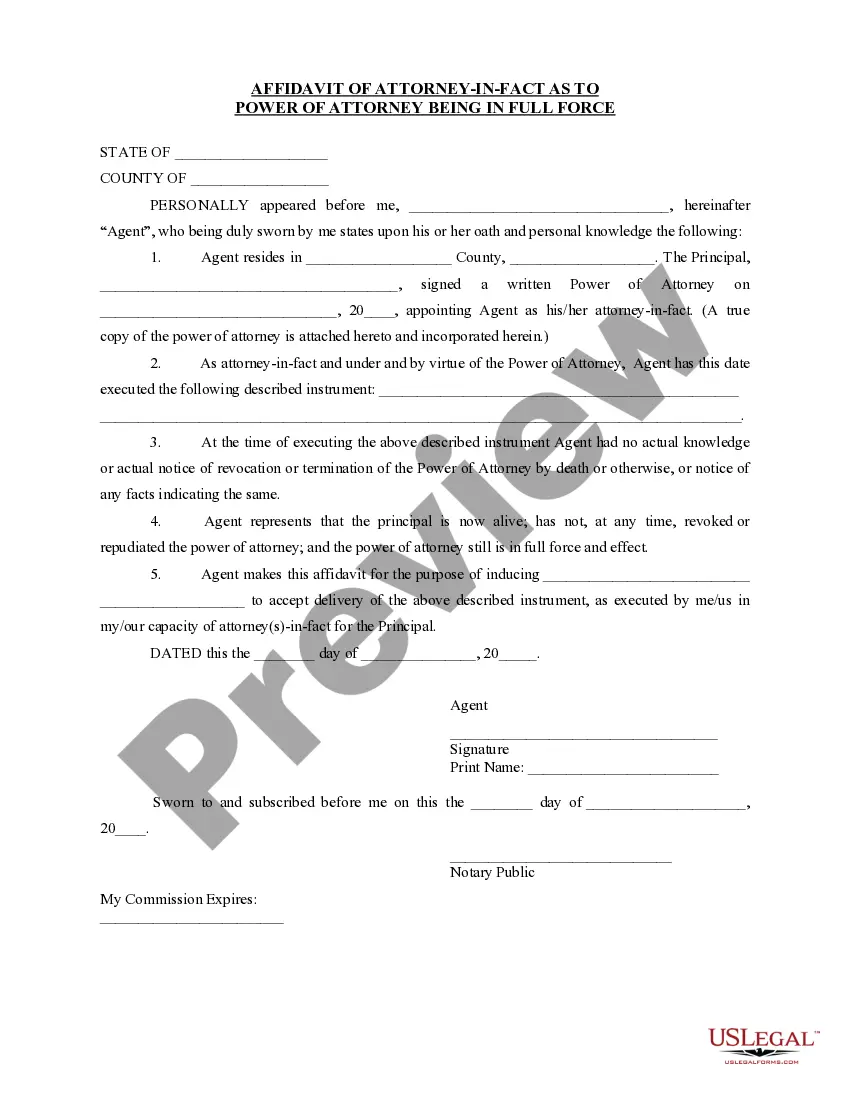
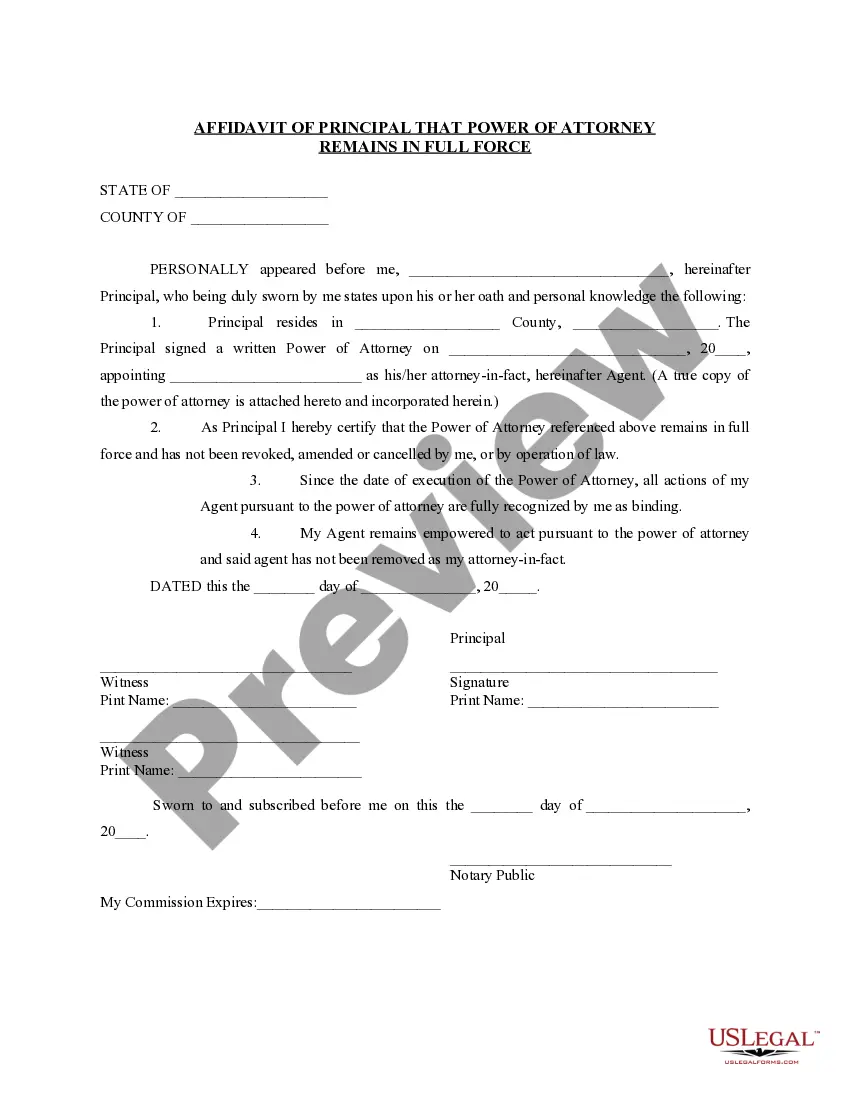
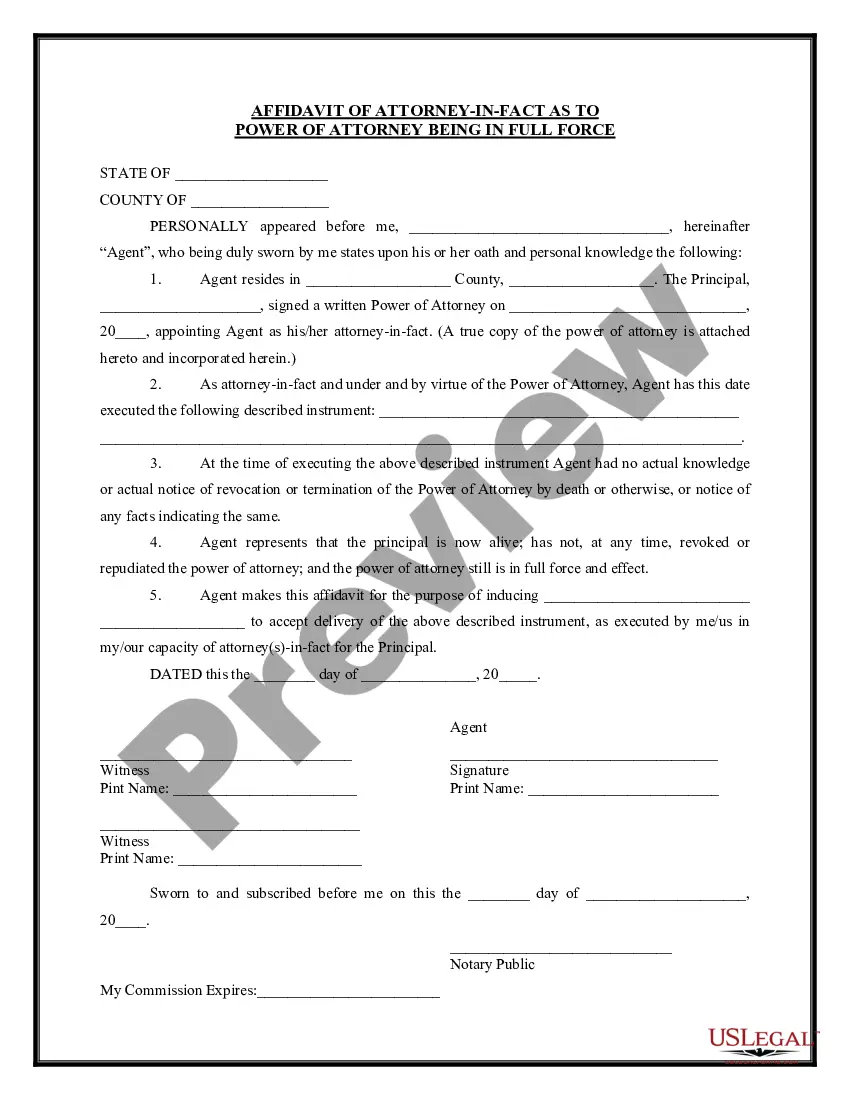
This affidavit is for a Principal to certify that the power of attorney has not been revoked and remains in full force. For all States except Florida, Georgia, Michigan, Ohio, South Carolina or Vermont.
South Dakota Affidavit of Principal that Power of Attorney not Revoked and in Full Force
Category:
State:
Multi-State
Control #:
US-P098A
Format:
Word;
Rich Text
Instant download
Description

How to fill out Affidavit Of Principal That Power Of Attorney Not Revoked And In Full Force?
If you wish to sum up, download, or print authentic legal document templates, utilize US Legal Forms, the largest selection of legal forms available online.
Employ the site’s simple and user-friendly search feature to locate the documents you require.
A range of templates for business and personal purposes are organized by categories and states, or keywords. Utilize US Legal Forms to find the South Dakota Affidavit of Principal that Power of Attorney is not Revoked and is in Full Force with just a few clicks.
Every legal document template you purchase is yours permanently. You have access to every form you acquired within your account. Click the My documents section and select a form to print or download again.
Complete and download, and print the South Dakota Affidavit of Principal that Power of Attorney is not Revoked and is in Full Force with US Legal Forms. There are millions of professional and state-specific forms available for your business or personal needs.
- If you are currently a US Legal Forms member, Log In to your account and click the Acquire option to obtain the South Dakota Affidavit of Principal that Power of Attorney is not Revoked and is in Full Force.
- You can also access forms you previously obtained in the My documents tab of your account.
- If you are using US Legal Forms for the first time, follow the steps below.
- Step 1. Ensure you have chosen the form for the correct state/region.
- Step 2. Use the Preview mode to review the form’s content. Remember to read the summary.
- Step 3. If you are not satisfied with the form, use the Search box near the top of the screen to find other versions of the legal form design.
- Step 4. Once you have located the form you need, select the Get now option. Choose the pricing plan you prefer and provide your details to register for an account.
- Step 5. Complete the transaction. You can use your credit card or PayPal account to finalize the purchase.
- Step 6. Choose the format of the legal form and download it to your device.
- Step 7. Complete, modify, and print or sign the South Dakota Affidavit of Principal that Power of Attorney is not Revoked and is in Full Force.
Form popularity
FAQ
To revoke a power of attorney, you need to provide a written notice of revocation, signed by you, the principal. This document should clearly state that you are revoking the power of attorney and must be delivered to the agent and any relevant institutions. It's vital to follow these steps to avoid confusion about your legal authority. For more assistance, the South Dakota Affidavit of Principal that Power of Attorney not Revoked and in Full Force can help ensure your decisions are documented correctly.
Common grounds for revocation of a power of attorney include the principal's decision to revoke, the death of the principal, or the completion of the purpose for which the power was granted. Additionally, if the principal becomes incapacitated, the power of attorney may be automatically revoked. Knowing these grounds is essential for anyone managing legal affairs. You can use the South Dakota Affidavit of Principal that Power of Attorney not Revoked and in Full Force to assert your intentions clearly.
An affidavit to affirm power of attorney is a legal document that confirms the validity of a power of attorney. This affidavit serves as proof that the power of attorney remains in full force and has not been revoked. It is particularly useful for ensuring that third parties recognize the authority granted to the agent. Utilizing the South Dakota Affidavit of Principal that Power of Attorney not Revoked and in Full Force can facilitate this process.
The 22-42-5 law in South Dakota pertains to the rules surrounding powers of attorney. Specifically, it outlines the requirements for creating valid powers of attorney and the conditions under which they can be revoked. Understanding this law can help you better navigate the complexities of managing your legal documents. For more details, consider reviewing the South Dakota Affidavit of Principal that Power of Attorney not Revoked and in Full Force.
To revoke an existing power of attorney, you must create a written document that explicitly states your intention to revoke it. You should sign this document in the presence of a notary. After revocation, it is crucial to notify the agent and any institutions with which the power was previously used. This ensures clarity and helps establish the South Dakota Affidavit of Principal that Power of Attorney not Revoked and in Full Force.
The holder of an LPA can make life changing decisions on behalf of the mentally incapable person, for example regarding their lifestyle arrangements, medical care and 'life sustaining treatment'. In contrast, for example under an EPA, the attorney cannot decide where the donor should live.
In order for a Lasting Power of Attorney to be valid and be used by the Attorney it must be registered. With a Property and Affairs Lasting Power of Attorney, once it has been successfully registered it can be used straight away.
To cancel a power of attorney, the Deed must be signed by the Donor and the Attorney must be informed that their power to act has been revoked. The Attorney's authority doesn't cease until they receive notice of the revocation, so a copy of the form should be sent to each Attorney.
You cannot give an attorney the power to: act in a way or make a decision that you cannot normally do yourself for example, anything outside the law. consent to a deprivation of liberty being imposed on you, without a court order.
An enduring power of attorney is a legal document that allows you to appoint someone you trust to make decisions for you during your life time, if you no longer have the capacity to do so. An enduring power of attorney usually takes effect when you lose capacity to manage your own affairs.