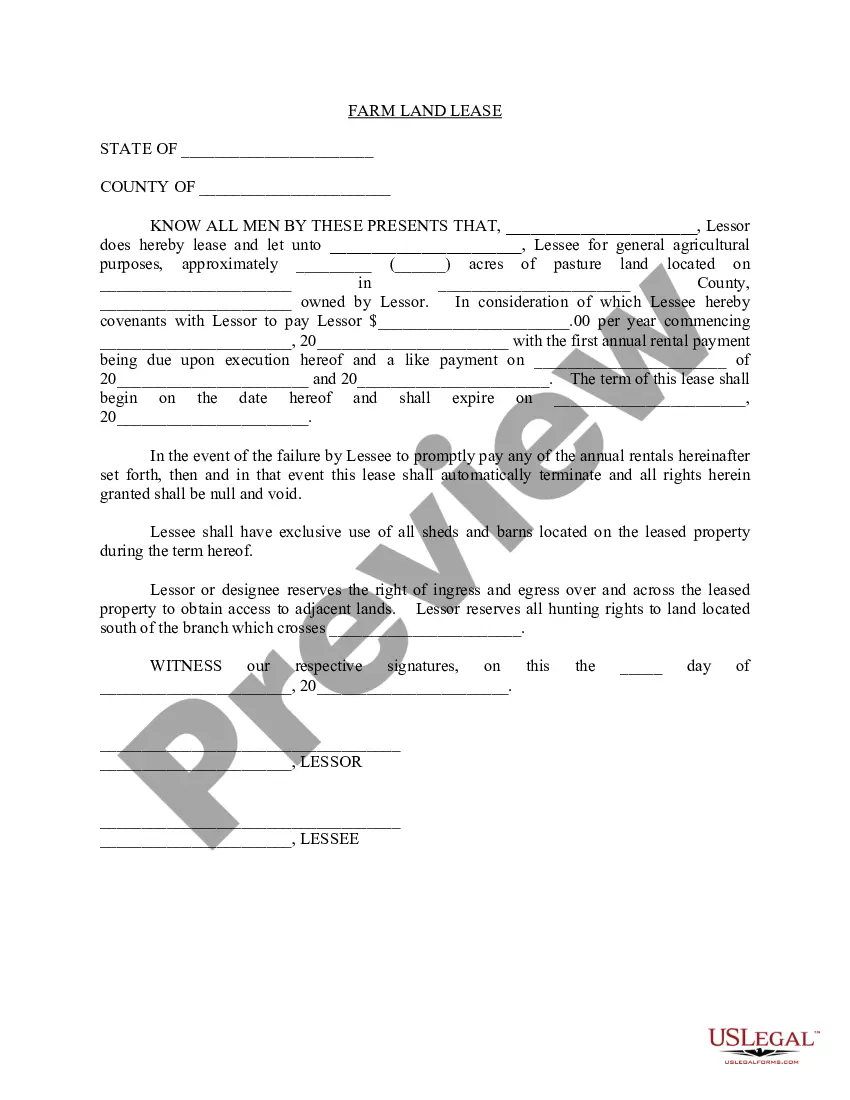
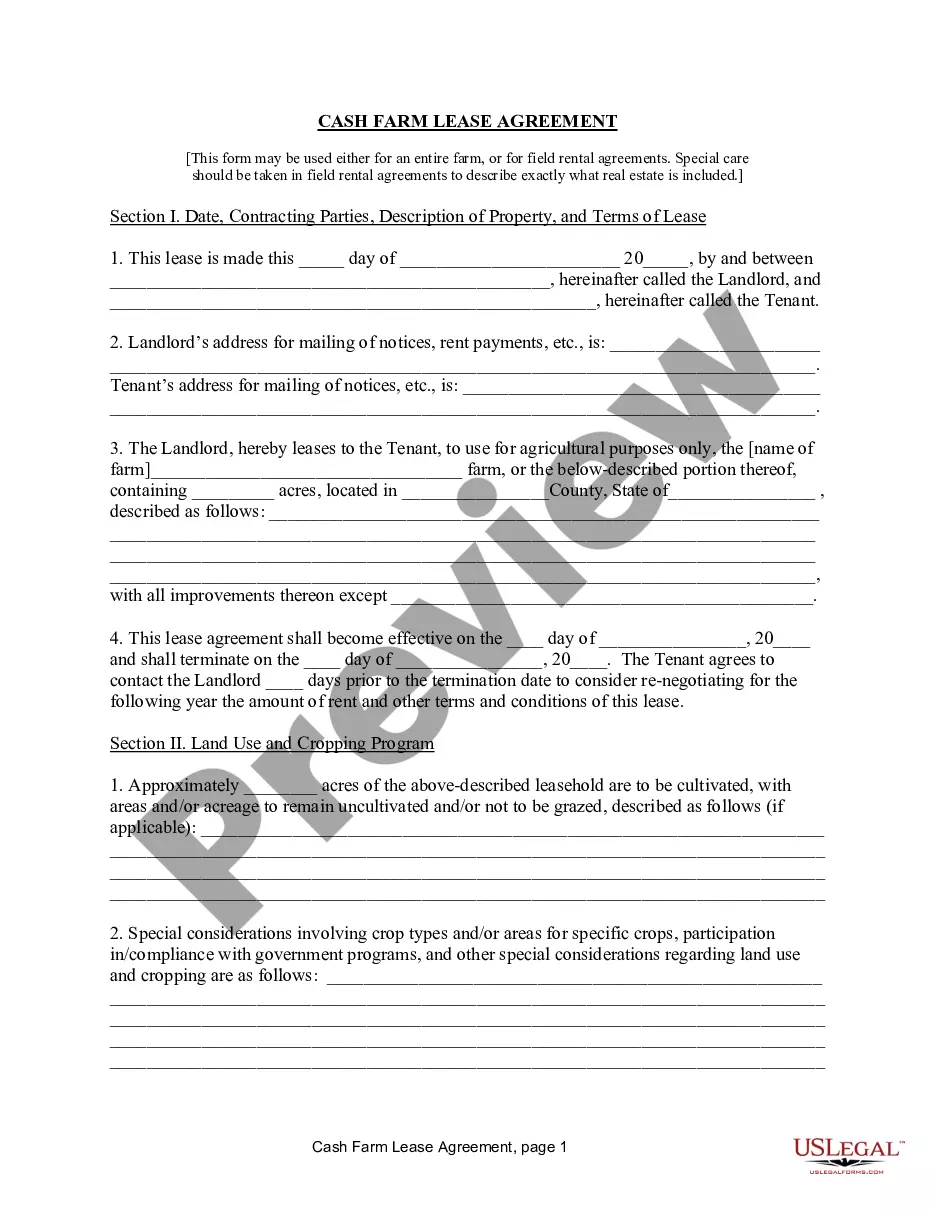
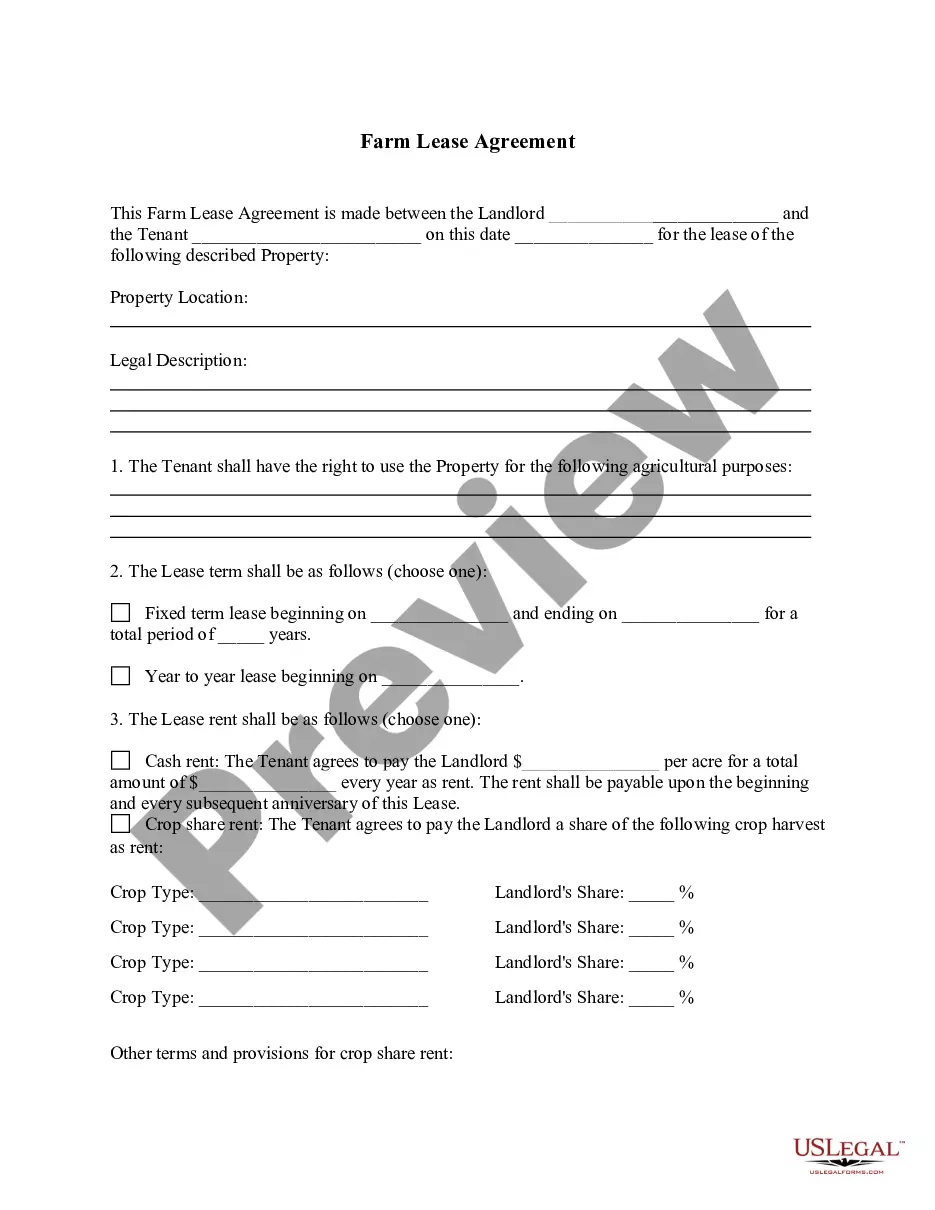
This form is a farm land lease. In the event of the failure by the lessee to promptly pay any of the annual rentals, then and in that event this lease will automatically terminate and all rights granted will be null and void. The lessee will have exclusive use of all sheds and barns located on the leased property during the term of the lease.
South Dakota Farm Lease or Rental - Short
State:
Multi-State
Category:
Control #:
US-60960
Format:
Word;
Rich Text
92 downloads
Description
Get your form ready online
Our built-in tools help you complete, sign, share, and store your documents in one place.
Built-in online Word editor
Make edits, fill in missing information, and update formatting in US Legal Forms—just like you would in MS Word.
Export easily
Download a copy, print it, send it by email, or mail it via USPS—whatever works best for your next step.
E-sign your document
Sign and collect signatures with our SignNow integration. Send to multiple recipients, set reminders, and more. Go Premium to unlock E-Sign.
Notarize online 24/7
If this form requires notarization, complete it online through a secure video call—no need to meet a notary in person or wait for an appointment.
Store your document securely
We protect your documents and personal data by following strict security and privacy standards.

Make edits, fill in missing information, and update formatting in US Legal Forms—just like you would in MS Word.

Download a copy, print it, send it by email, or mail it via USPS—whatever works best for your next step.

Sign and collect signatures with our SignNow integration. Send to multiple recipients, set reminders, and more. Go Premium to unlock E-Sign.

If this form requires notarization, complete it online through a secure video call—no need to meet a notary in person or wait for an appointment.

We protect your documents and personal data by following strict security and privacy standards.
Looking for another form?
How to fill out Farm Lease Or Rental - Short?
You might spend hours online looking for the legal document template that fulfills the federal and state requirements you require.
US Legal Forms offers a vast array of legal forms that are reviewed by professionals.
It's easy to obtain or print the South Dakota Farm Lease or Rental - Short from the platform.
If available, utilize the Review button to browse through the document template simultaneously.
- If you already have a US Legal Forms account, you can Log In and click the Download button.
- After that, you can complete, modify, print, or sign the South Dakota Farm Lease or Rental - Short.
- Every legal document template you purchase is yours to keep permanently.
- To obtain another copy of the acquired form, go to the My documents tab and click the corresponding button.
- If you are using the US Legal Forms website for the first time, follow the straightforward instructions below.
- Firstly, ensure that you have selected the correct document template for the area/city of your preference.
- Review the document outline to confirm that you have chosen the suitable form.
Form popularity
FAQ
South Dakota's anti-corporate farming law restricts certain corporations from owning farmland, protecting family farms from being overtaken by larger entities. This law aims to maintain the agricultural landscape rooted in family ownership. When considering a South Dakota Farm Lease or Rental - Short, this regulation is critical for those looking to ensure their farming operations remain community-focused.
Farmland has historically been a good investment. Unfortunately, not many investors have been able to benefit from this asset class, given the high upfront costs of buying farmland.
As of 2017, 89% of South Dakota's land area was farmland, totaling 43.2 million acres. There were a total of 29,968 farms with an average size of 1,443 acres.
A tenant farmer typically could buy or owned all that he needed to cultivate crops; he lacked the land to farm. The farmer rented the land, paying the landlord in cash or crops. Rent was usually determined on a per-acre basis, which typically ran at about one-third the value of the crop.
The advantages of the first are that the tenant in many cases is free to manage the farm as he pleases, and as a long-time proposition he may pay less rent than under crop-sharing arrangements. The chief disadvantage is that the tenant agrees to pay a definite sum before he knows what his income will be.
Notice to terminate a month-to-month lease. A 30-day written notice is required. The tenant may give the notice to terminate the lease effective the first day of the next month within 15 days of receiving notice from the landlord of a modification to the lease.
Some farmers lost their farms or their status as cash or share tenants because of crop failures, low cotton prices, laziness, ill health, poor management, exhaustion of the soil, excessive interest rates, or inability to compete with tenant labor.
Tenant farming is an agricultural production system in which landowners contribute their land and often a measure of operating capital and management, while tenant farmers contribute their labor along with at times varying amounts of capital and management.
Most farmers find that a combination of both ownership and leasing is desirable, especially when capital is limited. For many new farmers, especially in areas where land is quite expensive, leasing land is often the best option.
With a land lease agreement (also known as a ground lease), you purchase the home but rent the land. One of the main advantages is the lower price of this unique arrangement. One of the main disadvantages is that you will not be able to build valuable equity in the land on which you live.