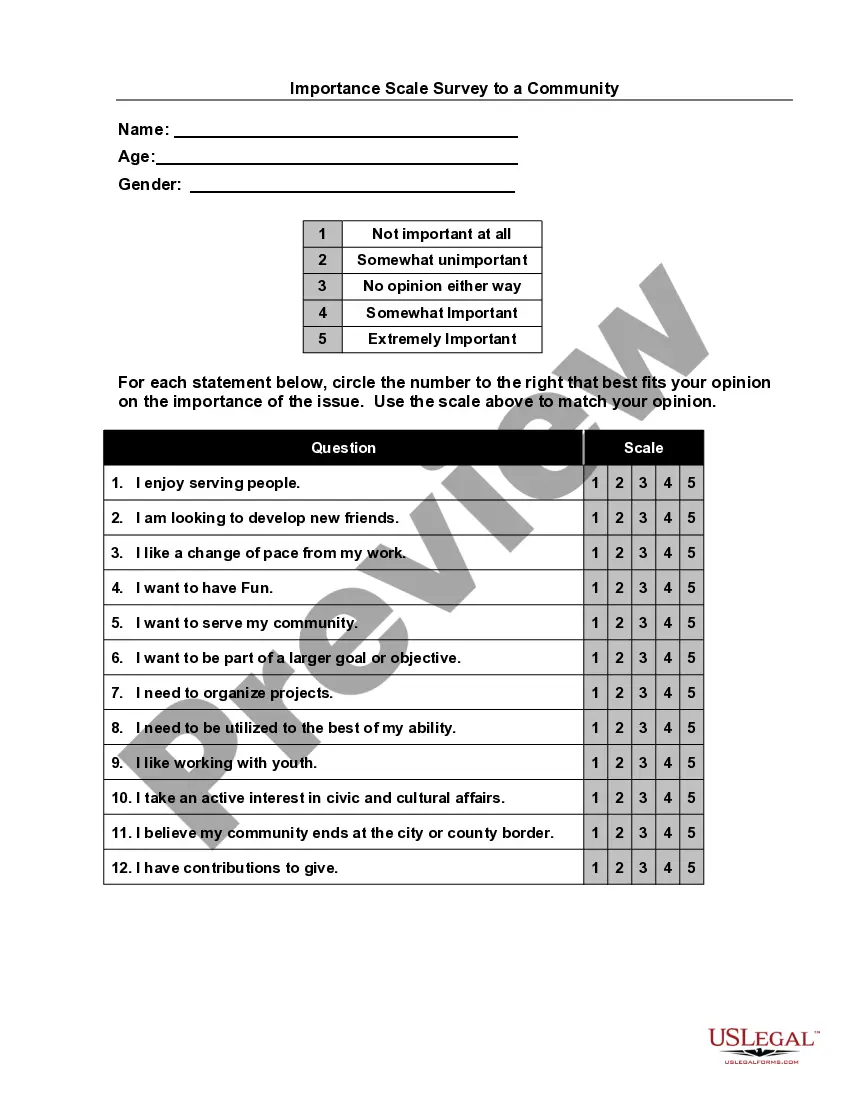
South Dakota Importance Scale Survey
Description

Get your form ready online
Our built-in tools help you complete, sign, share, and store your documents in one place.
Make edits, fill in missing information, and update formatting in US Legal Forms—just like you would in MS Word.
Download a copy, print it, send it by email, or mail it via USPS—whatever works best for your next step.
Sign and collect signatures with our SignNow integration. Send to multiple recipients, set reminders, and more. Go Premium to unlock E-Sign.
If this form requires notarization, complete it online through a secure video call—no need to meet a notary in person or wait for an appointment.
We protect your documents and personal data by following strict security and privacy standards.

Make edits, fill in missing information, and update formatting in US Legal Forms—just like you would in MS Word.

Download a copy, print it, send it by email, or mail it via USPS—whatever works best for your next step.

Sign and collect signatures with our SignNow integration. Send to multiple recipients, set reminders, and more. Go Premium to unlock E-Sign.

If this form requires notarization, complete it online through a secure video call—no need to meet a notary in person or wait for an appointment.

We protect your documents and personal data by following strict security and privacy standards.
Looking for another form?



How to fill out Importance Scale Survey?
Selecting the optimal legal document format can be challenging.
Of course, there are numerous templates available online, but how can you find the legal form you need.
Utilize the US Legal Forms website. This service provides thousands of templates, including the South Dakota Importance Scale Survey, suitable for both business and personal purposes.
You can preview the form using the Preview button and read the form description to confirm it is suitable for you.
- Each template is reviewed by specialists and complies with state and federal regulations.
- If you are already registered, Log In to your account and click the Download button to access the South Dakota Importance Scale Survey.
- You can use your account to search for the legal forms you have acquired previously.
- Visit the My documents section of your account to download another copy of the documents you need.
- If you are a new user of US Legal Forms, follow these simple steps.
- First, ensure you have selected the correct form for your city/county.
Form popularity
FAQ
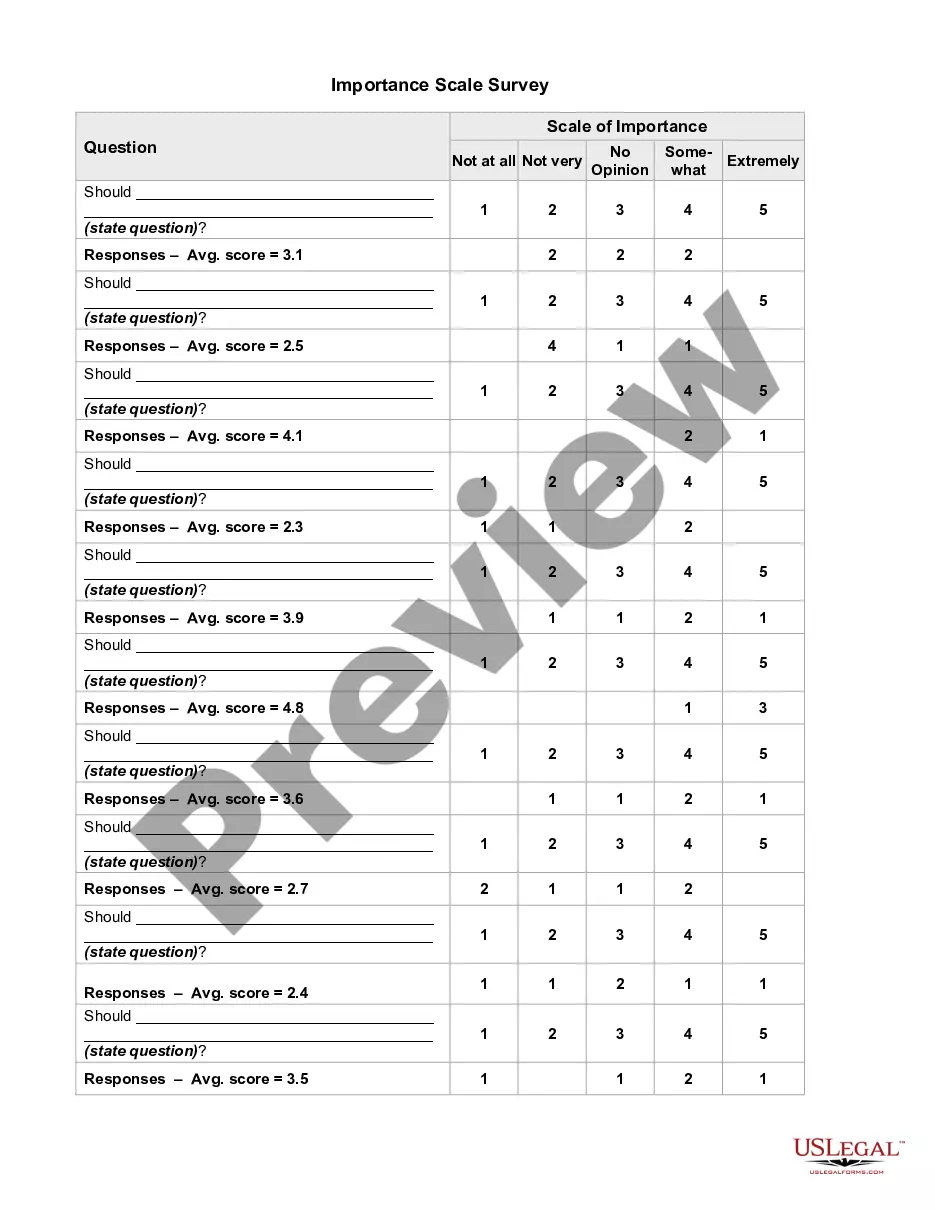
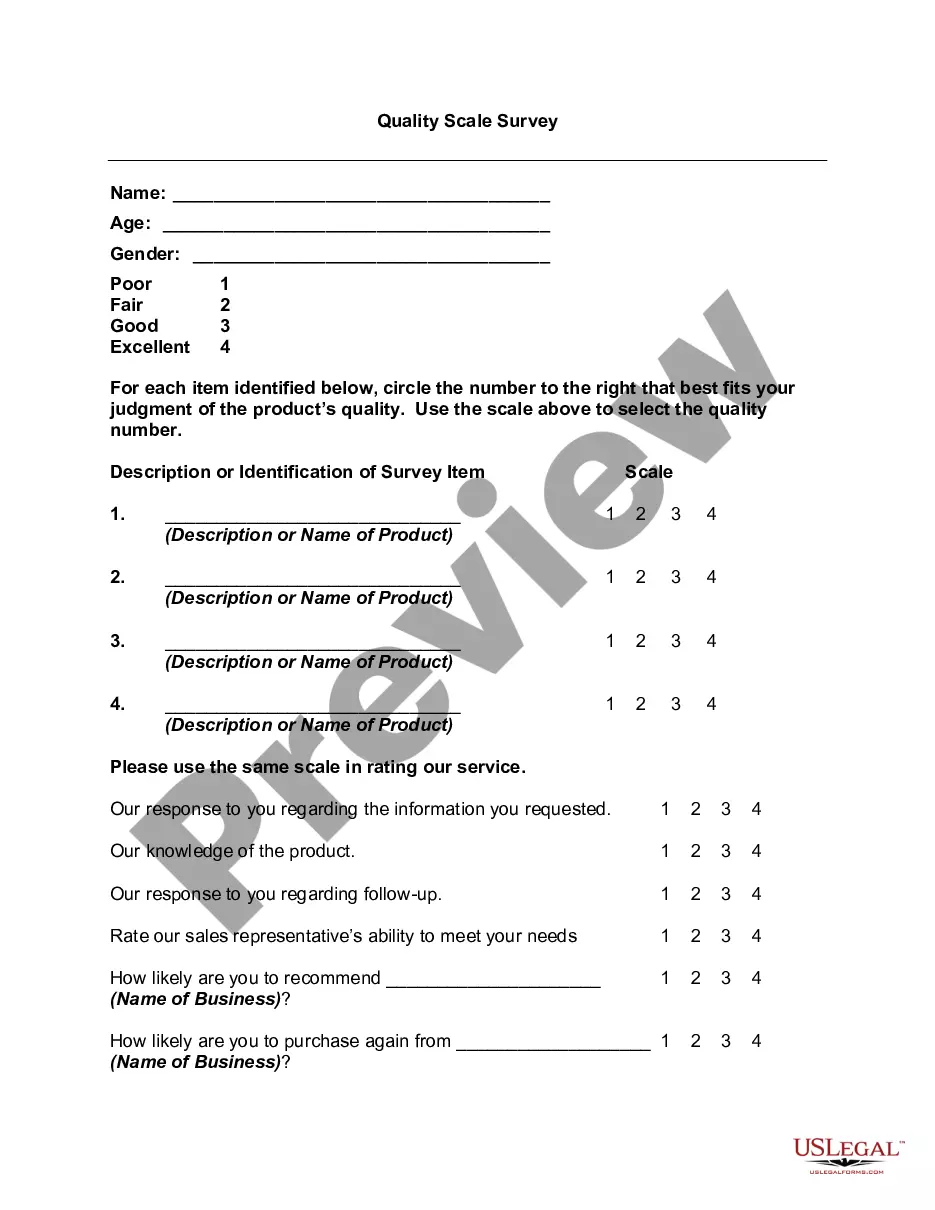
A more appropriate scale when rating importance in your questionnaire is: Not at all important, Slightly Important, Important, Fairly Important, and Very Important, or numbering 0 to 5 as an interval scale.
One way to measure importance is to not ask it at all! Instead, importance can be derived statistically from the data set. Consider the scenario where you have questions measuring the satisfaction with various aspects of a product or service and you want to know how important each is to overall satisfaction.
Demographic variables include such measures as ethnicity, socioeconomic status, race, and age. Surveys often assess the preferences and attitudes of individuals, and many employ self-report scales to measure people's opinions and judgements about different items presented on a scale.
A more appropriate scale when rating importance in your questionnaire is: Not at all important, Slightly Important, Important, Fairly Important, and Very Important, or numbering 0 to 5 as an interval scale.
The 5-point Likert scale contains 5 response options that will consist of two extreme sides and a neutral option linked to the middle answer options. Examples of a 5-point rating scale for measuring satisfaction are: Very Satisfied, Satisfied, Neutral, Dissatisfied, and Very Dissatisfied.
U can follow 5 point Likert scale. To prevent neutral response each statement should have five points 'strongly agree' , 'agree' , 'undecided', 'disagree' and 'strongly disagree' and may be scored as 5,4,3,2,1.
One way to measure importance is to not ask it at all! Instead, importance can be derived statistically from the data set. Consider the scenario where you have questions measuring the satisfaction with various aspects of a product or service and you want to know how important each is to overall satisfaction.
Psychologists have used the balanced 6-point scale in millions of surveys over more than a hundred years, and it has proven to be extremely effective in gathering actionable, useful information from a customer survey.
The rating scale is a popular choice for conducting market research. It can serve the purpose of gathering more relative information about a product or certain aspects of the product. The scale is commonly used to gain feedback or to evaluate.
The 5-point Likert scale contains 5 response options that will consist of two extreme sides and a neutral option linked to the middle answer options. Examples of a 5-point rating scale for measuring satisfaction are: Very Satisfied, Satisfied, Neutral, Dissatisfied, and Very Dissatisfied.