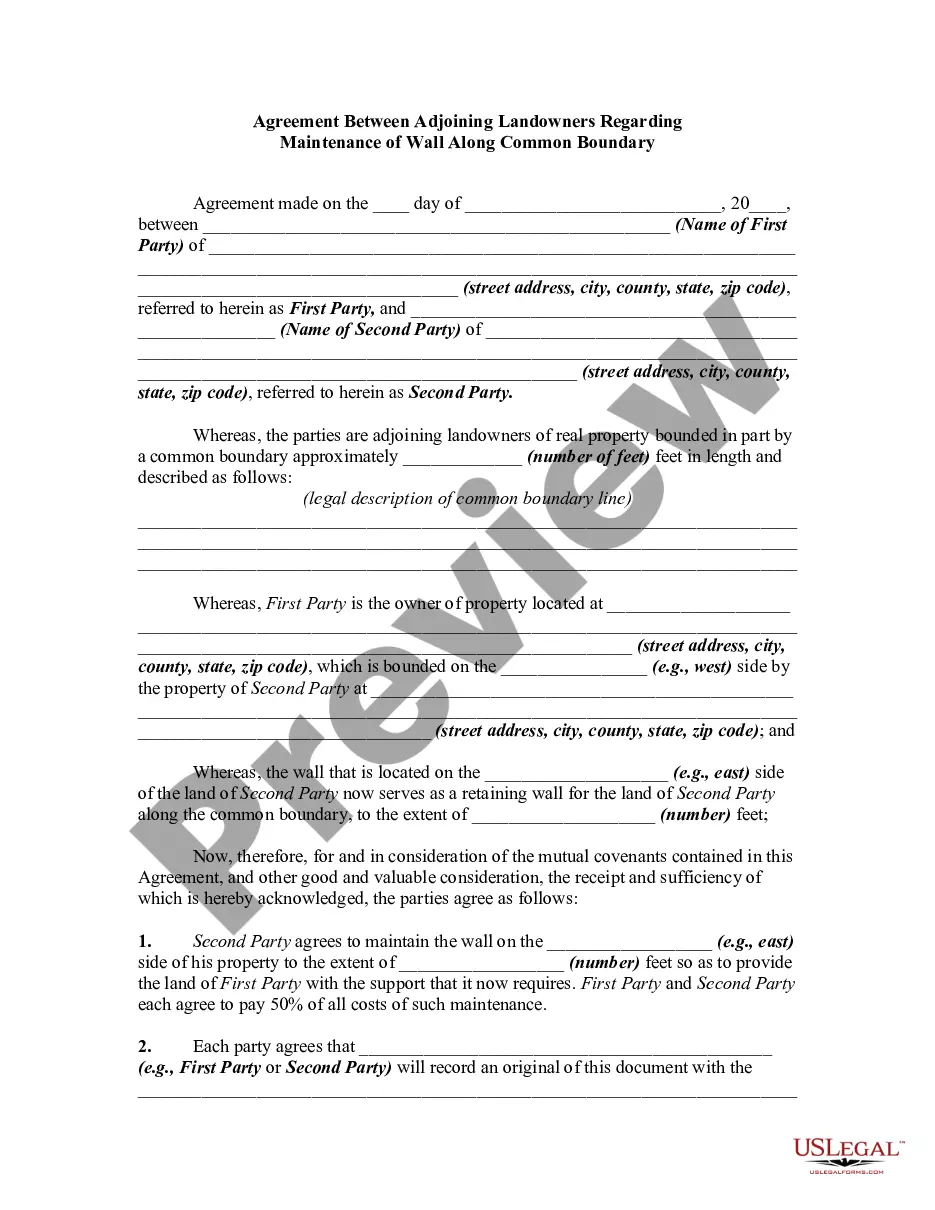
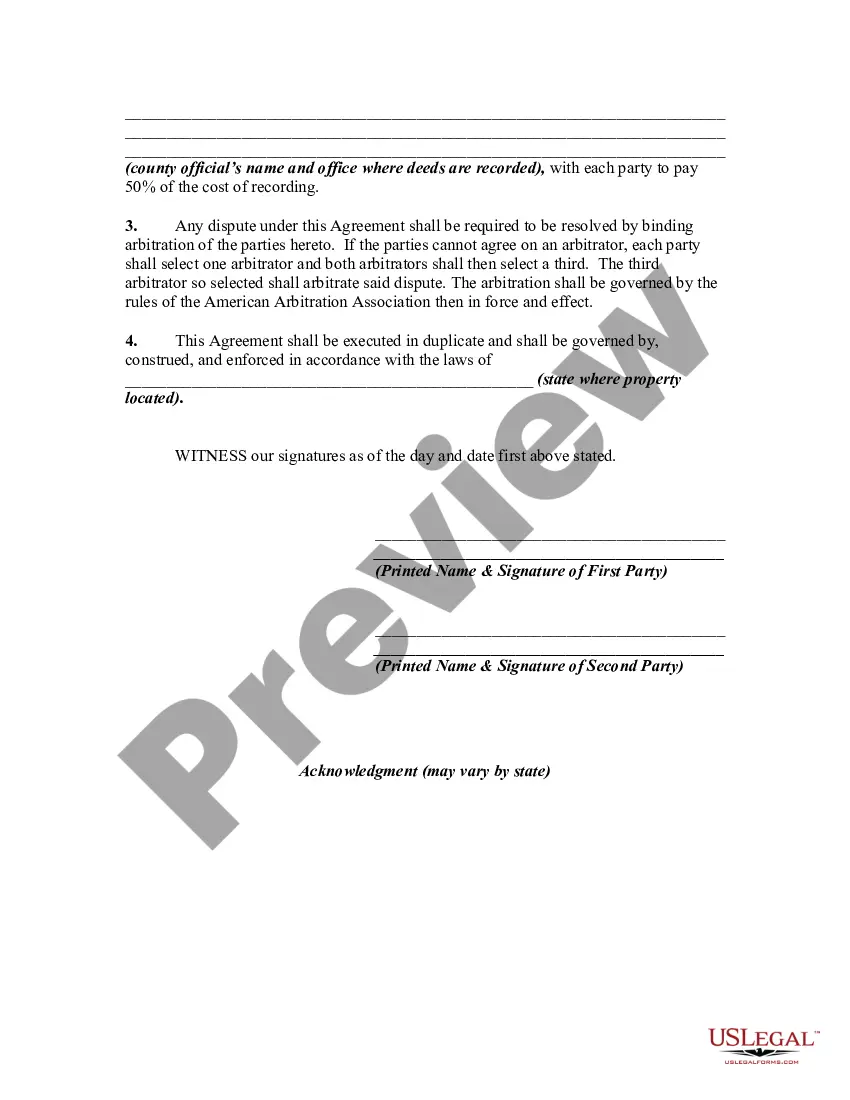
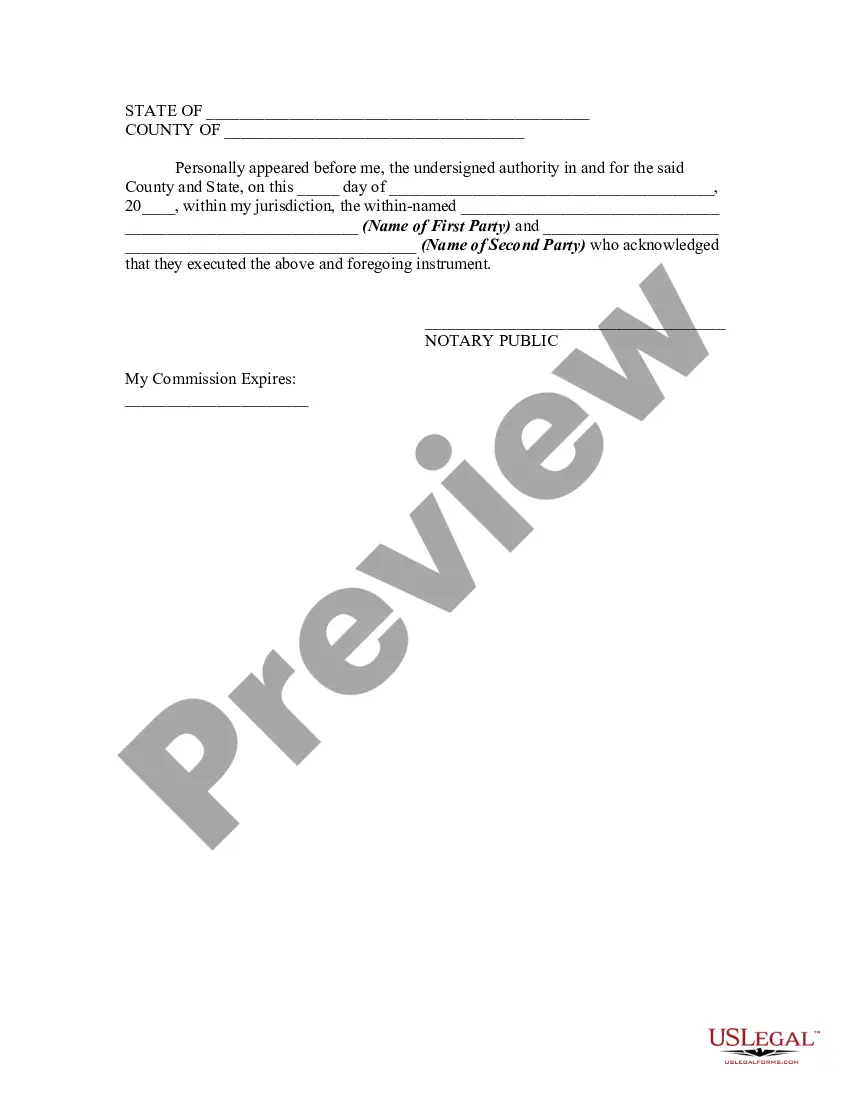
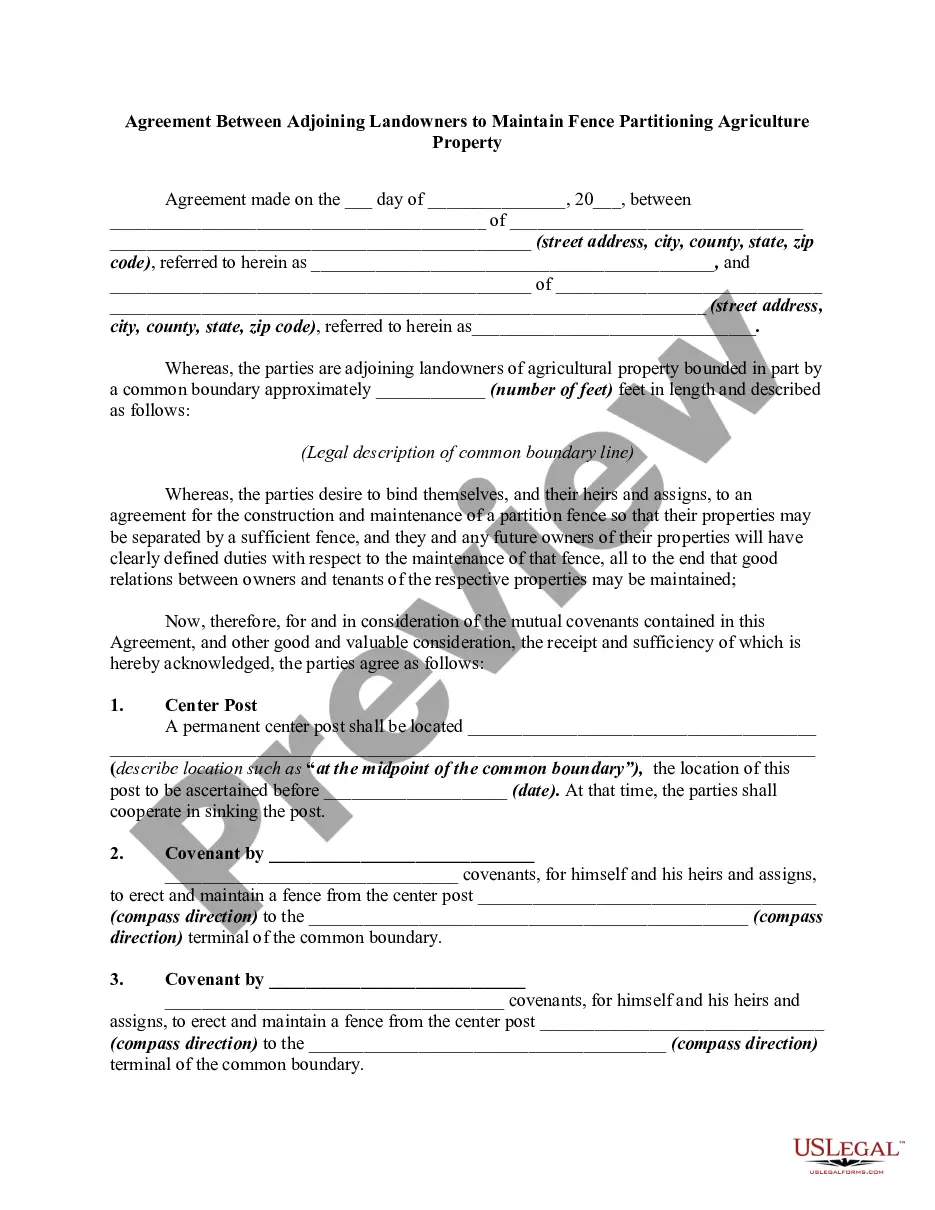
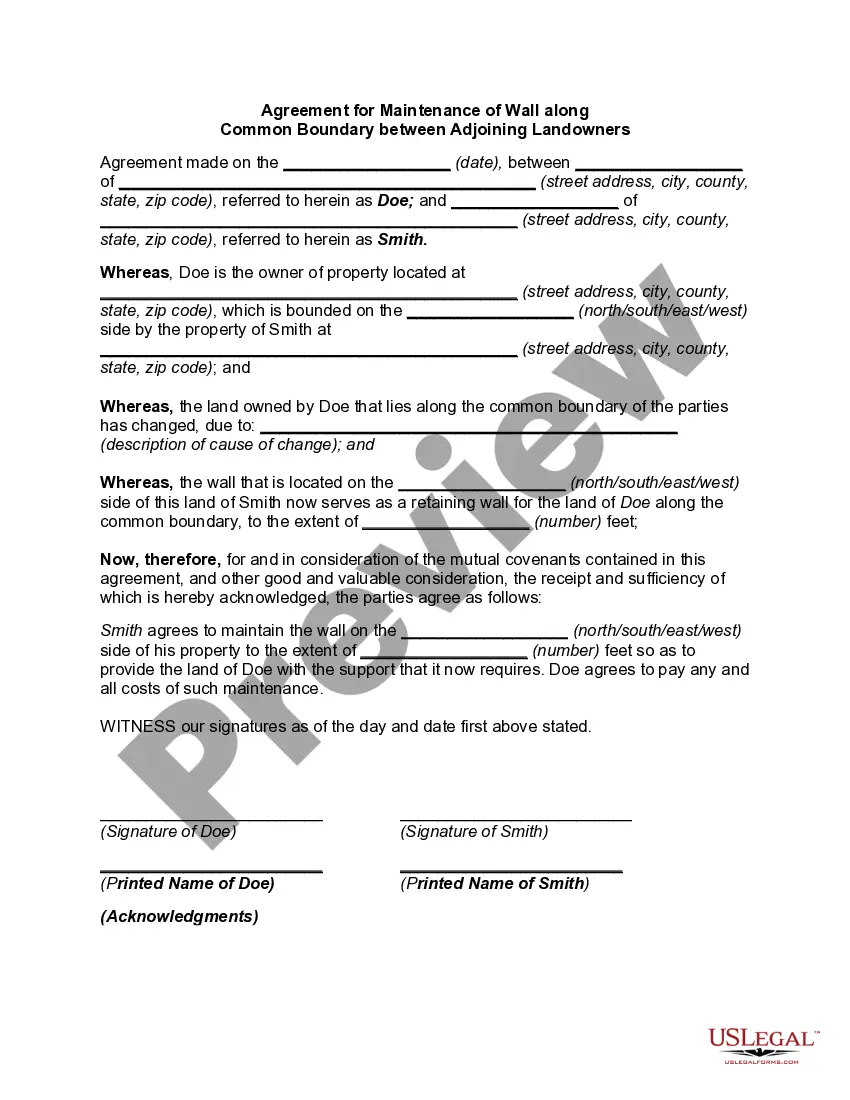
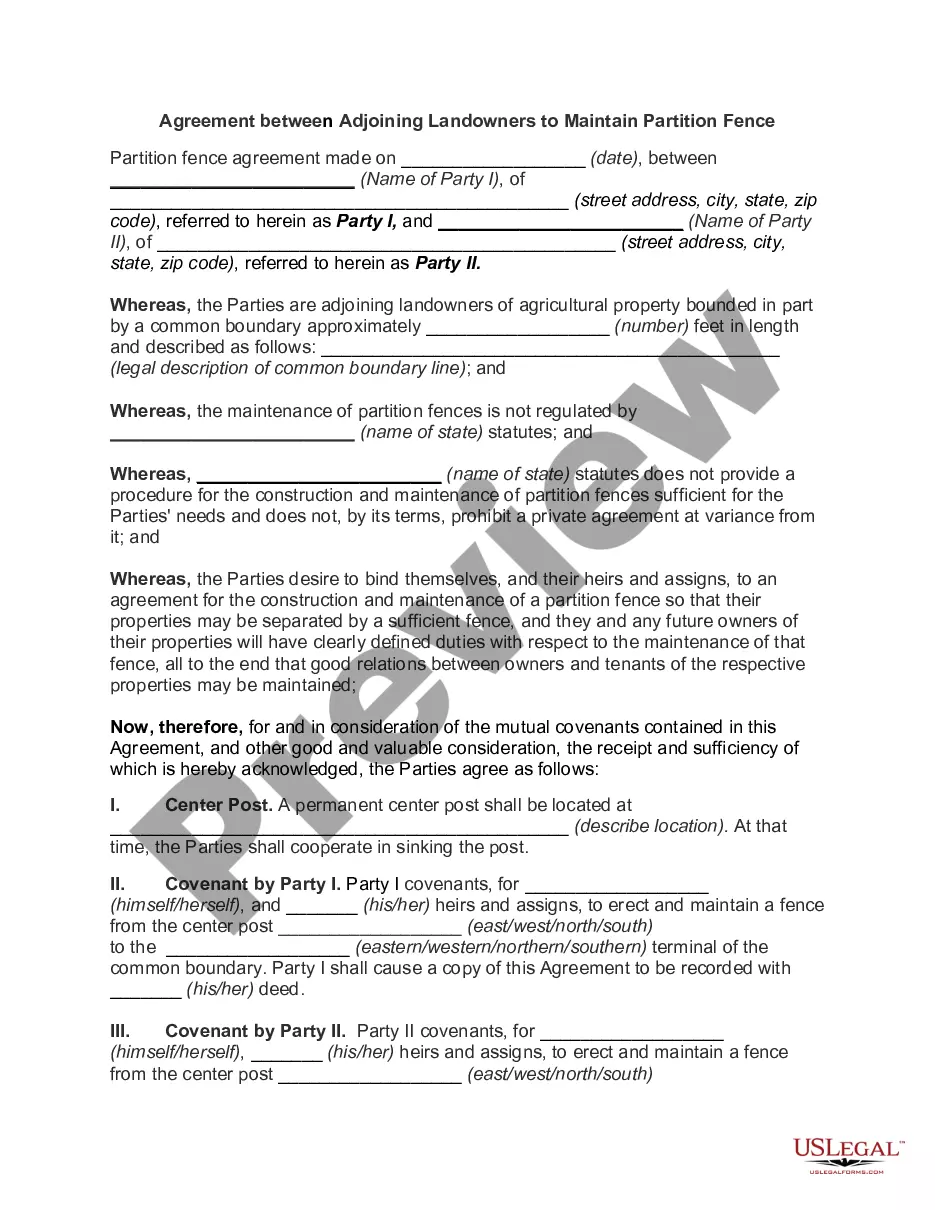
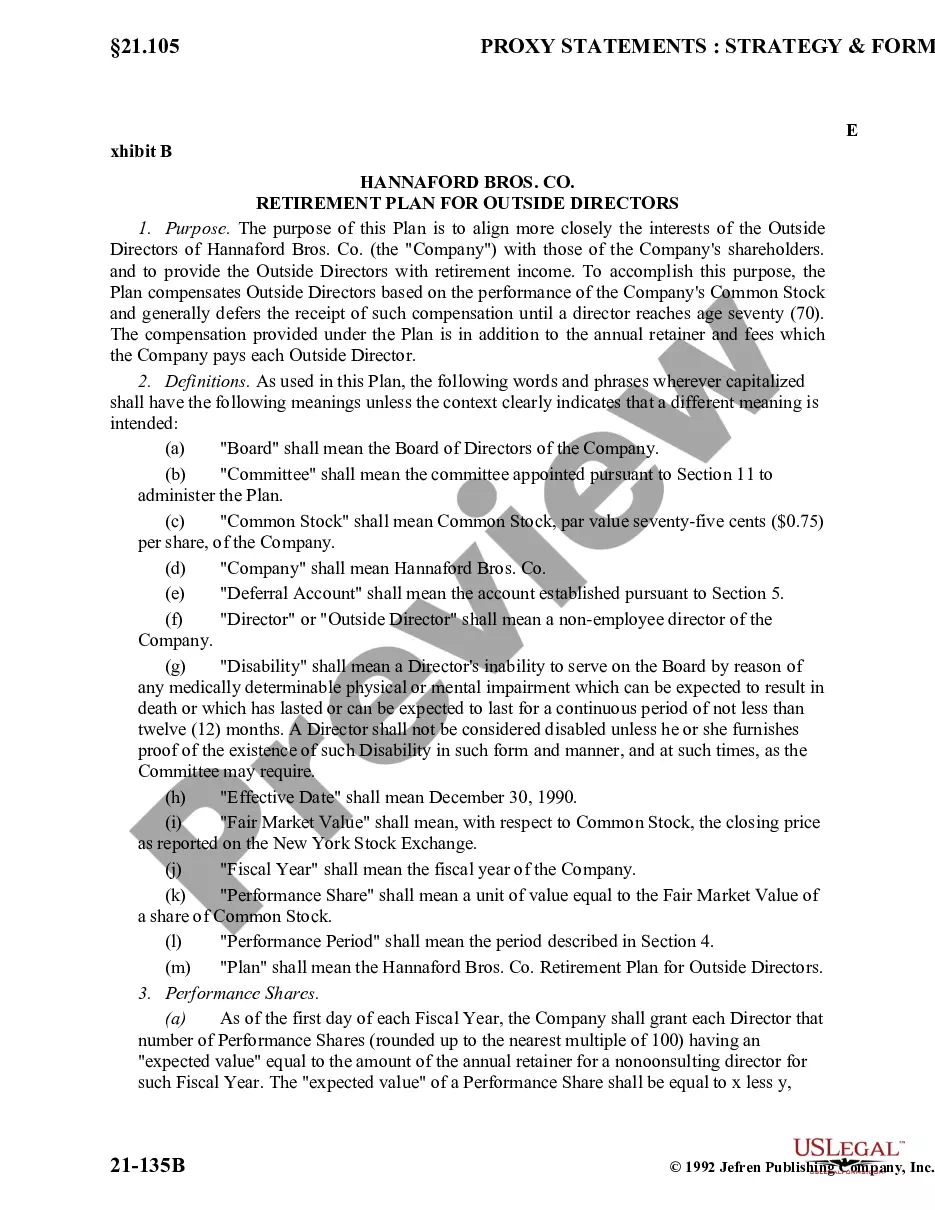
This form is a sample of an agreement between adjoining landowners to maintain a common wall along the boundary of their properties with each landowner to bear 50% of the maintenance costs. This form is a generic example that may be referred to when preparing such a form for your particular state. It is for illustrative purposes only. Local laws should be consulted to determine any specific requirements for such a form in a particular jurisdiction.
South Dakota Agreement Between Adjoining Landowners Regarding Maintenance of Wall Along Common Boundary
Category:
State:
Multi-State
Control #:
US-01187BG
Format:
Word;
Rich Text
Instant download
Description
Free preview
Get your form ready online
Our built-in tools help you complete, sign, share, and store your documents in one place.
Built-in online Word editor
Make edits, fill in missing information, and update formatting in US Legal Forms—just like you would in MS Word.
Export easily
Download a copy, print it, send it by email, or mail it via USPS—whatever works best for your next step.
E-sign your document
Sign and collect signatures with our SignNow integration. Send to multiple recipients, set reminders, and more. Go Premium to unlock E-Sign.
Notarize online 24/7
If this form requires notarization, complete it online through a secure video call—no need to meet a notary in person or wait for an appointment.
Store your document securely
We protect your documents and personal data by following strict security and privacy standards.

Make edits, fill in missing information, and update formatting in US Legal Forms—just like you would in MS Word.

Download a copy, print it, send it by email, or mail it via USPS—whatever works best for your next step.

Sign and collect signatures with our SignNow integration. Send to multiple recipients, set reminders, and more. Go Premium to unlock E-Sign.

If this form requires notarization, complete it online through a secure video call—no need to meet a notary in person or wait for an appointment.

We protect your documents and personal data by following strict security and privacy standards.
Looking for another form?


How to fill out Agreement Between Adjoining Landowners Regarding Maintenance Of Wall Along Common Boundary?
You have the capability to spend hours online searching for the legal format that meets both state and federal requirements necessary for you.
US Legal Forms provides a vast array of legal forms that are evaluated by specialists.
You can easily download or print the South Dakota Agreement Between Adjoining Landowners Concerning Wall Maintenance Along Common Boundary using the service.
First, confirm that you have selected the correct format for the region/city of your choice. Review the form description to ensure you have chosen the proper form. If available, utilize the Preview button to examine the format as well.
- If you possess a US Legal Forms account, you can sign in and click on the Acquire button.
- After that, you can fill out, modify, print, or sign the South Dakota Agreement Between Adjoining Landowners Concerning Wall Maintenance Along Common Boundary.
- Every legal format you obtain is yours indefinitely.
- To retrieve another copy of any acquired form, visit the My documents section and click the corresponding button.
- If you are accessing the US Legal Forms site for the first time, follow the straightforward instructions below.
Form popularity
FAQ
In South Dakota, the statute of limitations for debt collections usually spans six years. This applies to various types of debt including written contracts. Understanding this timeframe is important for any agreements or negotiations related to debt, especially when it intersects with the South Dakota Agreement Between Adjoining Landowners Regarding Maintenance of Wall Along Common Boundary.
Adverse possession in South Dakota refers to a situation where someone may acquire legal ownership of land by possessing it openly and continuously without the permission of the original owner for a specified time period, typically 20 years. This concept can affect neighboring landowners involved in boundary disputes. Being informed about adverse possession is beneficial when drafting the South Dakota Agreement Between Adjoining Landowners Regarding Maintenance of Wall Along Common Boundary.
In South Dakota, the statute of limitations for property damage claims is typically six years. This means you have six years from the date of the damage to file a claim in court. When addressing issues related to boundary maintenance or the South Dakota Agreement Between Adjoining Landowners Regarding Maintenance of Wall Along Common Boundary, staying aware of this timeline is vital.
Yes, South Dakota has a statute of limitations that applies to various types of legal actions. This means there is a specific time period set by law for bringing forward claims. When involved in matters concerning the South Dakota Agreement Between Adjoining Landowners Regarding Maintenance of Wall Along Common Boundary, it is essential to understand these time frames to protect your rights.
The 22-42-5 law in South Dakota deals with the responsibilities and rights of adjoining landowners concerning boundary walls and fences. This law helps clarify how maintenance responsibilities are shared. For those engaging in agreements regarding boundary issues, knowledge of this law can complement the South Dakota Agreement Between Adjoining Landowners Regarding Maintenance of Wall Along Common Boundary.
The statute of limitations in South Dakota typically allows a specific time frame in which a plaintiff must file a lawsuit. For most civil claims, this period is three years. However, in scenarios involving property and boundary agreements, such as the South Dakota Agreement Between Adjoining Landowners Regarding Maintenance of Wall Along Common Boundary, it is wise to act promptly to ensure you stay within legal limits.
In South Dakota, the cap on damages varies depending on the type of case. For instance, personal injury claims often have specific limits that affect the total recoverable damages. Understanding these limits is crucial, especially for those affected by decisions related to the South Dakota Agreement Between Adjoining Landowners Regarding Maintenance of Wall Along Common Boundary, as you might need to consider potential liabilities.
The dividing wall is often referred to as a party wall, delineating the boundary shared by two adjacent properties. This wall can have implications for both landowners regarding maintenance and repairs. The South Dakota Agreement Between Adjoining Landowners Regarding Maintenance of Wall Along Common Boundary helps property owners clearly outline their obligations, ensuring that both parties maintain the wall appropriately and avoid potential disputes.
A boundary wall serves as a physical marker delineating the edge of one property from another. Such walls are crucial for land use and ownership clarity. The South Dakota Agreement Between Adjoining Landowners Regarding Maintenance of Wall Along Common Boundary helps owners establish clear guidelines about the maintenance and responsibilities regarding boundary walls, fostering good neighborly relations.
A wall partition is commonly referred to as a partition wall. It serves to divide spaces within a building while offering structural support. For those involved in property disputes, the South Dakota Agreement Between Adjoining Landowners Regarding Maintenance of Wall Along Common Boundary can provide a framework for resolving issues related to such partitions.