South Dakota Plaintiff's Affidavit in Support of Decree
What this document covers
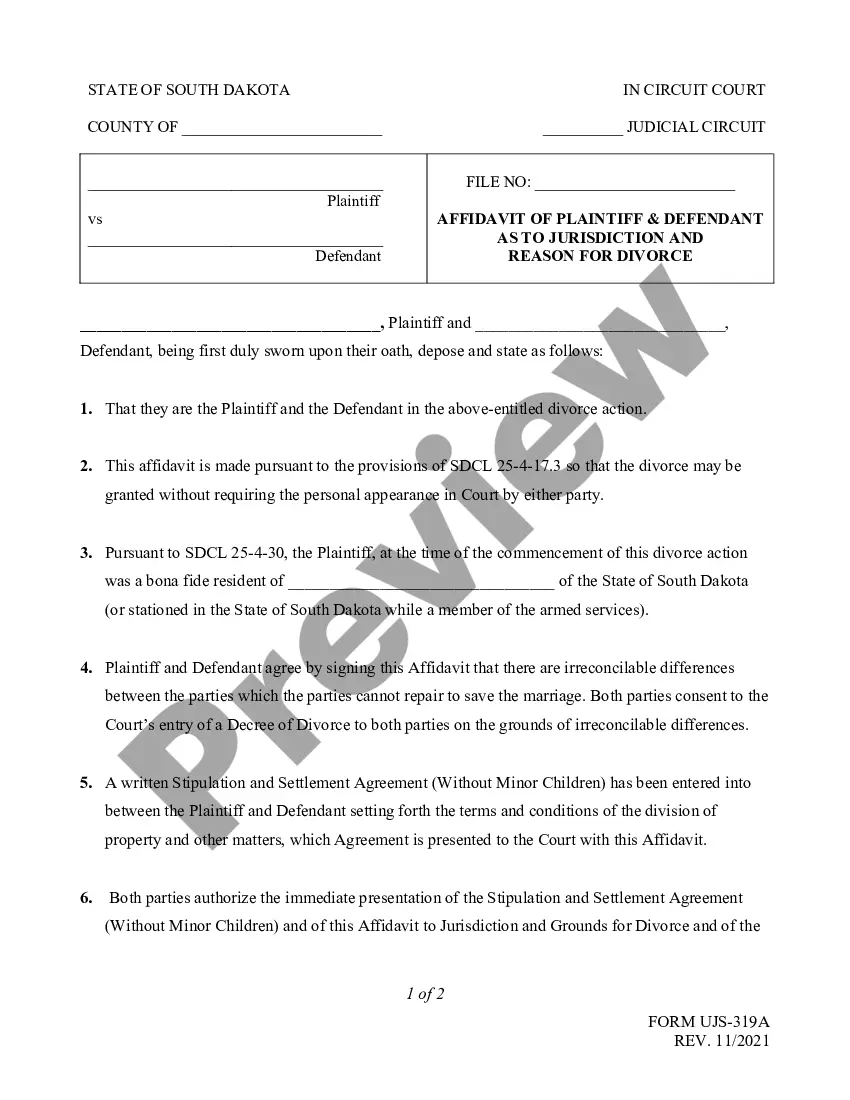
The Plaintiff's Affidavit in Support of Decree is a legal document used in divorce proceedings in South Dakota. It confirms that both parties have agreed to divorce due to irreconcilable differences and have settled all related terms in a Separation and Property Settlement Agreement. This affidavit is essential for requesting the court to issue a decree of divorce without requiring personal appearances by the parties involved.
What’s included in this form
- Verification of residency of the Plaintiff in South Dakota.
- Statement confirming irreconcilable differences between the parties.
- A written Stipulation and Settlement Agreement outlining the division of property.
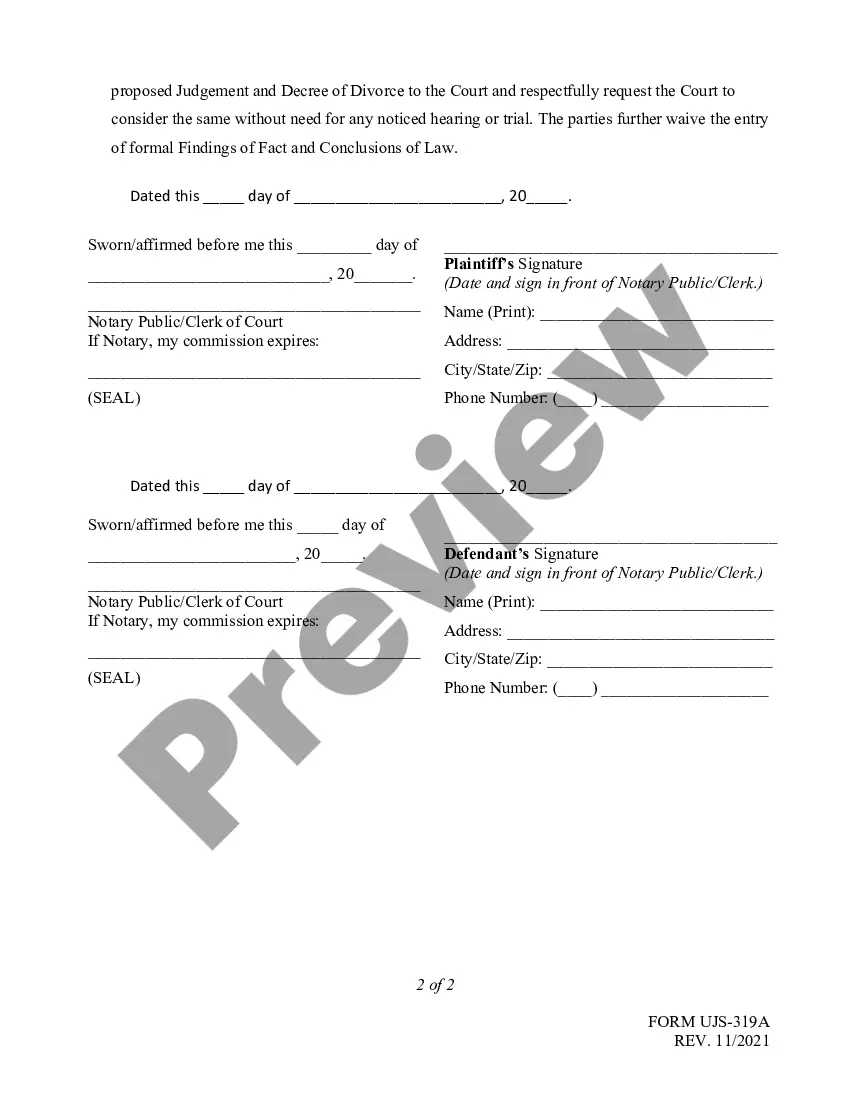
- Signature lines for both the Plaintiff and Defendant before a notary public.
- Request for the court to enter a decree of divorce without hearing.
When to use this form
This form is needed when both spouses agree to divorce due to irreconcilable differences and wish to expedite the process without a court hearing. It is used after the parties have created and signed a Separation and Property Settlement Agreement that resolves all their marital issues.
Who needs this form
- Any Plaintiff initiating a divorce in South Dakota when both parties agree.
- Individuals seeking to finalize divorce proceedings without the need for court appearances.
- Couples who have completed a Separation and Property Settlement Agreement.
Instructions for completing this form
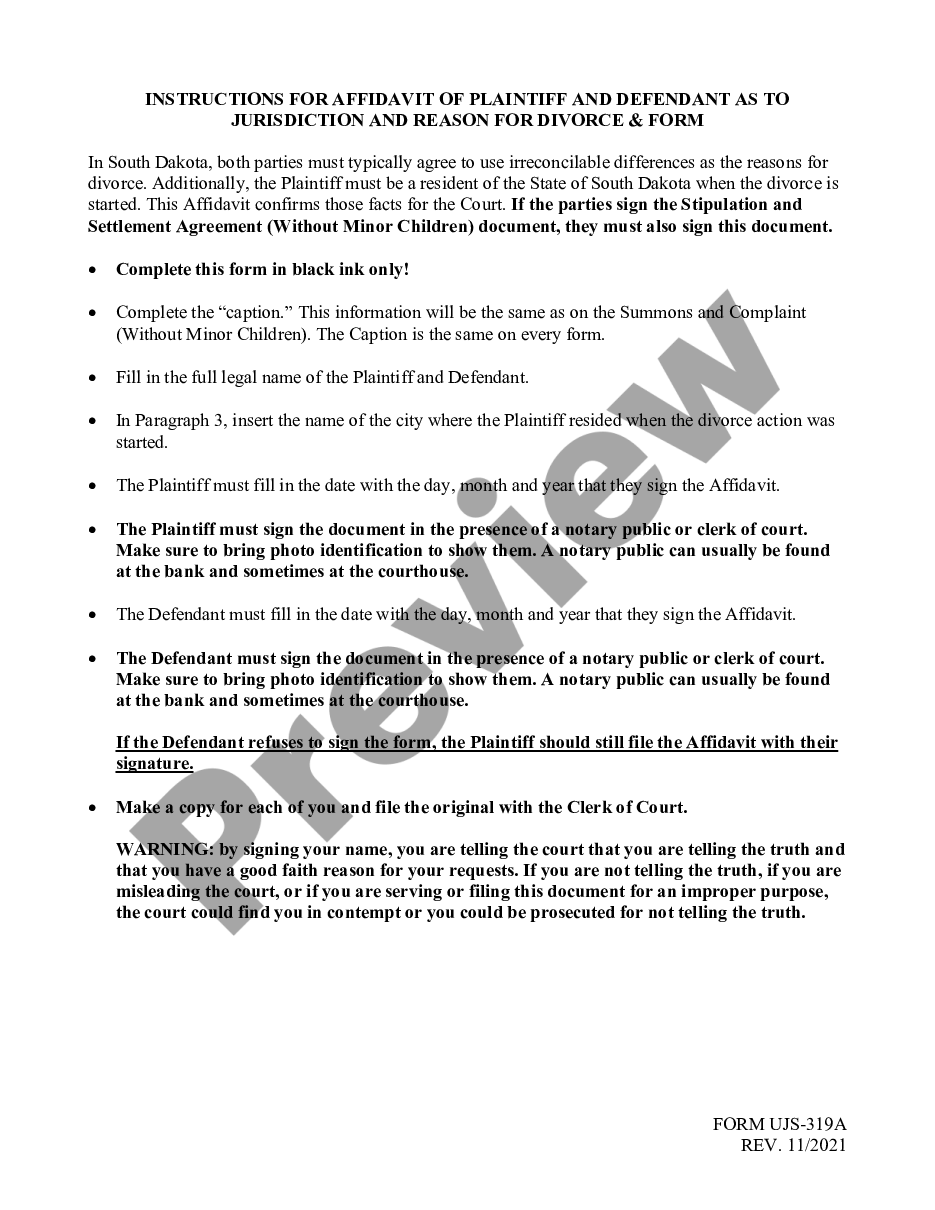
- Fill in the caption with the same information found in the Summons and Complaint.
- Provide the full legal names of the Plaintiff and Defendant.
- Indicate the city where the Plaintiff was a resident at the time of filing.
- Sign the affidavit in front of a notary public and provide identification.
- Make copies for both parties and file the original with the Clerk of Court.
Notarization requirements for this form
Yes, this form must be notarized to be legally valid. Both the Plaintiff and Defendant must sign the affidavit in front of a notary public or clerk of court. US Legal Forms offers integrated online notarization services, available 24/7, which enable you to complete the notarization process conveniently and securely without the need to travel.
Get your form ready online
Our built-in tools help you complete, sign, share, and store your documents in one place.
Make edits, fill in missing information, and update formatting in US Legal Forms—just like you would in MS Word.
Download a copy, print it, send it by email, or mail it via USPS—whatever works best for your next step.
Sign and collect signatures with our SignNow integration. Send to multiple recipients, set reminders, and more. Go Premium to unlock E-Sign.
If this form requires notarization, complete it online through a secure video call—no need to meet a notary in person or wait for an appointment.
We protect your documents and personal data by following strict security and privacy standards.

Make edits, fill in missing information, and update formatting in US Legal Forms—just like you would in MS Word.

Download a copy, print it, send it by email, or mail it via USPS—whatever works best for your next step.

Sign and collect signatures with our SignNow integration. Send to multiple recipients, set reminders, and more. Go Premium to unlock E-Sign.

If this form requires notarization, complete it online through a secure video call—no need to meet a notary in person or wait for an appointment.

We protect your documents and personal data by following strict security and privacy standards.
Common mistakes
- Failing to complete the form in black ink as required.
- Not providing accurate residency information for the Plaintiff.
- Omitting signatures or dates for both Plaintiff and Defendant.
- Forgetting to file the original affidavit with the Clerk of Court.
What to keep in mind
- The Plaintiff's Affidavit in Support of Decree is essential for simplifying divorce proceedings in South Dakota.
- Both parties must agree and affirm the grounds for divorce to use this affidavit.
- Notarization is a critical step in completing this form correctly.
Looking for another form?

Form popularity
FAQ
South Dakota Divorce Overview In South Dakota, a divorce can be completed on average in a minimum of 60 days, with court fees of $95.00. Unlike many states, South Dakota does not have any divorce residency requirements determining how long the appellant must have lived in South Dakota prior to filing for divorce.
The court fees for filing the paperwork for a basic divorce in a South Dakota court is $95.00. However, the total costs for a divorce can be much higher - especially in the case of a contested divorce, where attorney fees and mediation costs average from $15,000 to $20,000 or more.
Starting a Divorce First, complete the "Case Filing Statement" either in Word or Word form. For divorce, select "Divorce" under the Family section on the first page. Next, select Plaintiff/Petitioner under the Family section on the second page. Also complete your personal information.
An Affidavit of Default is a sworn statement telling the court that you served the Summons (with Children) and Complaint with Minor Children on the Defendant and that he/she has not responded within thirty days after the completed service.
You will typically file the divorce paperwork in the county circuit court where you live. If you have separated from your spouse and live in different counties, you may file your paperwork in either county's circuit court. (S.D. Codified Laws § 25-4-30.1.)
Under South Dakota law a divorce may be granted for any of the following grounds: adultery, extreme cruelty (including bodily injury or grievous mental suffering), willful desertion, willful neglect, habitual intemperance, conviction of a felony, chronic mental illness or irreconcilable differences.
Unlike some other states, South Dakota does not accept joint divorce petitions, even for uncontested divorces. Instead, the spouse who prepares and files the initial paperwork, the "plaintiff," must file the following documents with the court before the court proceeds with the case: Case Filing Statement.