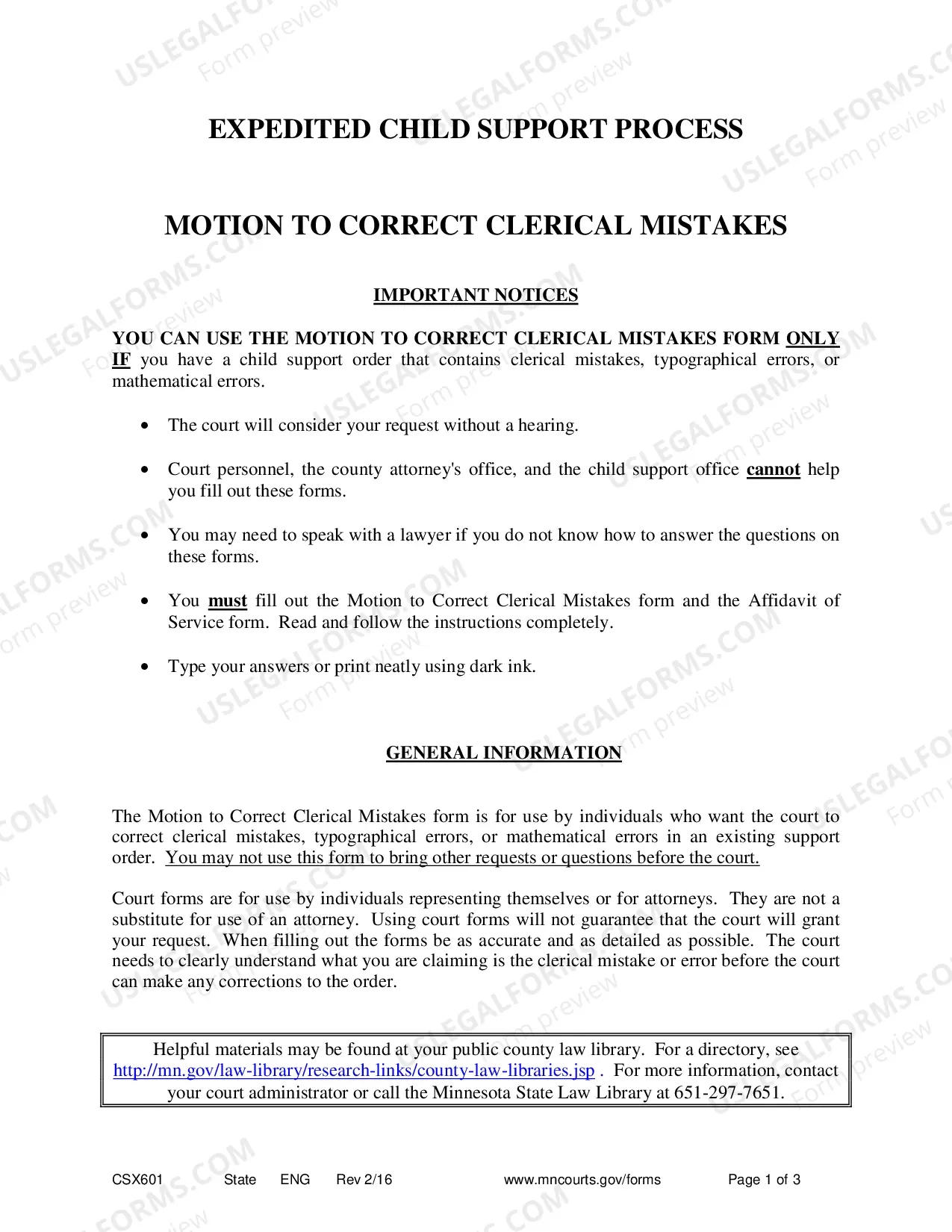
Minnesota Response to Motion to Correct Clerical Mistakes is a document used in court proceedings in the state of Minnesota. It is used when a party wishes to correct an error or omission in a court record or document. Minnesota's law permits a motion to correct clerical mistakes to be filed at any time, provided the error or omission is “patent” or obvious. The responding party then files a response to the motion, either objecting to the requested correction or consenting to it. There are two types of Minnesota Response to Motion to Correct Clerical Mistakes: Objection to Motion to Correct Clerical Mistakes and Consent to Motion to Correct Clerical Mistakes. The Objection to Motion to Correct Clerical Mistakes is filed by the responding party if they disagree with the requested correction, while the Consent to Motion to Correct Clerical Mistakes is filed if the responding party agrees to the requested correction.
Minnesota Response To Motion To Correct Clerical Mistakes
Description

Get your form ready online
Our built-in tools help you complete, sign, share, and store your documents in one place.
Make edits, fill in missing information, and update formatting in US Legal Forms—just like you would in MS Word.
Download a copy, print it, send it by email, or mail it via USPS—whatever works best for your next step.
Sign and collect signatures with our SignNow integration. Send to multiple recipients, set reminders, and more. Go Premium to unlock E-Sign.
If this form requires notarization, complete it online through a secure video call—no need to meet a notary in person or wait for an appointment.
We protect your documents and personal data by following strict security and privacy standards.

Make edits, fill in missing information, and update formatting in US Legal Forms—just like you would in MS Word.

Download a copy, print it, send it by email, or mail it via USPS—whatever works best for your next step.

Sign and collect signatures with our SignNow integration. Send to multiple recipients, set reminders, and more. Go Premium to unlock E-Sign.

If this form requires notarization, complete it online through a secure video call—no need to meet a notary in person or wait for an appointment.

We protect your documents and personal data by following strict security and privacy standards.
Looking for another form?
How to fill out Minnesota Response To Motion To Correct Clerical Mistakes?
Drafting legal documents can be quite a strain unless you have accessible fillable templates. With the US Legal Forms online repository of official paperwork, you can trust the forms you encounter, as they all adhere to federal and state regulations and are verified by our experts.
Acquiring your Minnesota Response To Motion To Correct Clerical Mistakes from our collection is as easy as 1-2-3. Previously registered users with an active subscription just need to Log In and click the Download button once they locate the appropriate template. Later, if necessary, users can retrieve the same form from the My documents section of their account.
Haven't you used US Legal Forms yet? Register for our service today to acquire any formal document swiftly and effortlessly whenever you need to, and keep your paperwork organized!
- Document compliance assessment. You should thoroughly review the content of the form you desire and confirm whether it fulfills your requirements and aligns with your state laws. Examining your document and reviewing its general overview will assist you in doing just that.
- Alternative search (optional). If there are any discrepancies, search the library using the Search tab at the top of the page until you identify a suitable form, and click Buy Now once you find the one you require.
- Account setup and form acquisition. Sign up for an account with US Legal Forms. After your account is verified, Log In and choose your desired subscription plan. Make a payment to proceed (PayPal and credit card options are available).
- Template download and continued usage. Select the file format for your Minnesota Response To Motion To Correct Clerical Mistakes and click Download to save it to your device. Print it to fill out your documents manually, or utilize a multi-featured online editor to create an electronic version more quickly and efficiently.
Form popularity
FAQ
Rule 37 of the Minnesota Rules of Civil Procedure addresses the failure to make disclosures or cooperate in discovery. This rule outlines the consequences for parties who do not comply, which can include sanctions or dismissal of claims. Understanding Rule 37 is vital when preparing your Minnesota Response To Motion To Correct Clerical Mistakes, as it emphasizes the importance of proper documentation and adherence to legal standards. For assistance, consider using USLegalForms to ensure you meet all procedural requirements.
A Rule 60 motion in Minnesota allows a party to request relief from a judgment or order due to specific reasons, such as clerical mistakes, fraud, or newly discovered evidence. This motion is crucial for ensuring fairness within the legal process. When you file a Minnesota Response To Motion To Correct Clerical Mistakes, it is important to understand how Rule 60 can affect your case. Utilizing resources like USLegalForms can guide you through this process effectively.
A clerical error refers to a mistake made in the recording or transcription of legal documents. These errors can include incorrect names, typos, or misstatements of fact. In the context of a Minnesota Response To Motion To Correct Clerical Mistakes, it is essential to identify these errors promptly to ensure accurate legal records. Correcting these mistakes helps maintain the integrity of court documents.
The court shall grant summary judgment if the movant shows that there is no genuine issue as to any material fact and the movant is entitled to judgment as a matter of law. The court shall state on the record or in a written decision the reasons for granting or denying the motion.
59.04Time for Serving Affidavits When a motion for a new trial is based upon affidavits, they shall be served with the notice of motion. The opposing party shall have 14 days after such service in which to serve opposing affidavits, which period may be extended by the court pursuant to Rule 59.03.
Rule 377.10Notice of Order or Judgment The notice shall state that the parties have a right to appeal to the Court of Appeals under Rule 378. If the order was issued by a district court judge, the court administrator shall provide a copy of the order to the child support magistrate.
Rule 521(b) establishes a 20-day time period for removing the case to district court. The 20 days is measured from the mailing of the notice of judgment, and the law requires that an additional three days be added to the time period when notice is served by mail.
Rule 15. A party may amend a pleading once as a matter of course at any time before a responsive pleading is served or, if the pleading is one to which no responsive pleading is permitted and the action has not been placed upon the trial calendar, the party may so amend it at any time within 21 days after it is served.
56.05Failing to Properly Support or Address a Fact.
Rule 115.07Relaxation of Time Limits If irreparable harm will result absent immediate action by the court, or if the interests of justice otherwise require, the court may waive or modify the time limits established by this rule.