South Carolina ASSISTING ESCAPE
Overview of this form
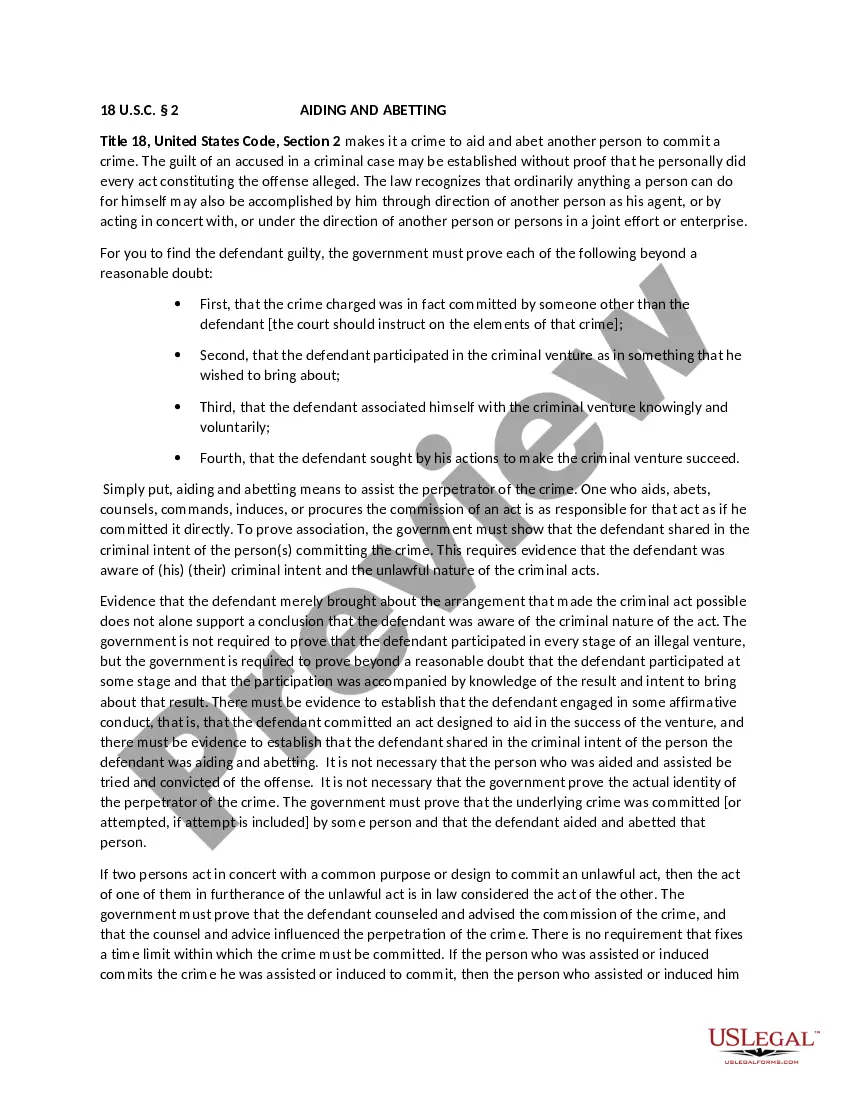
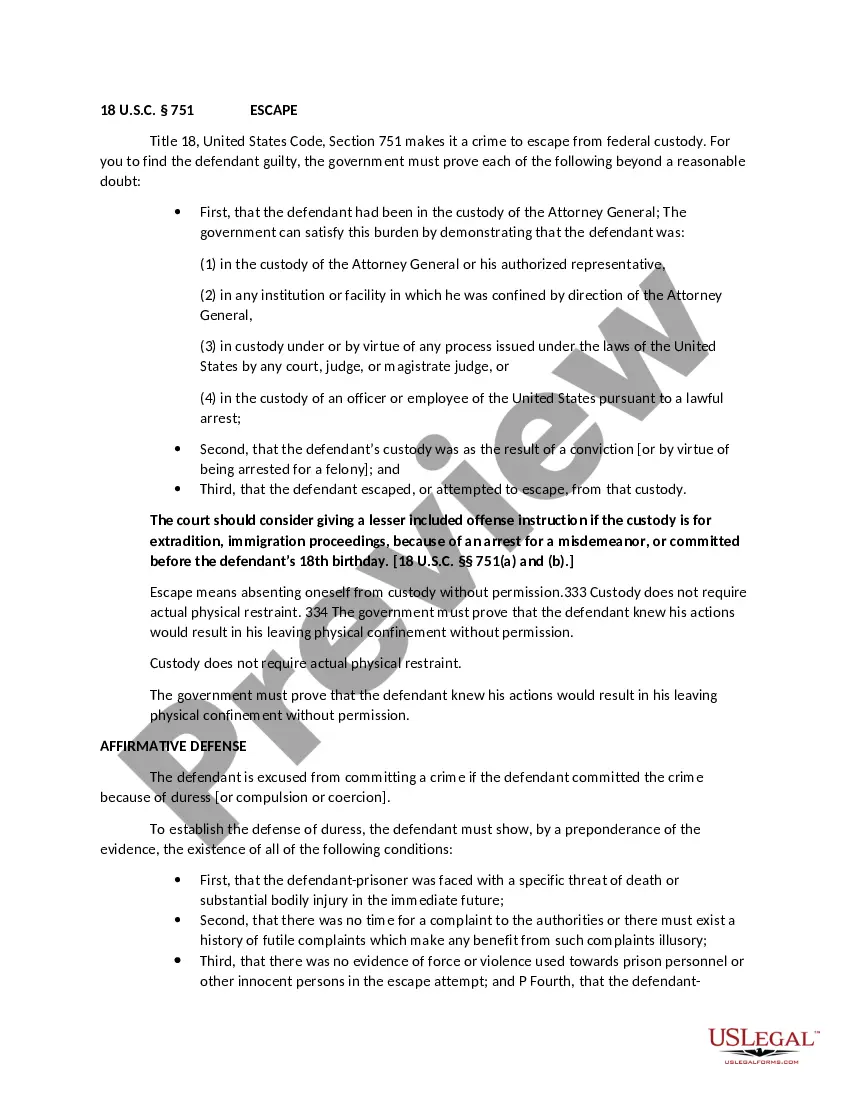
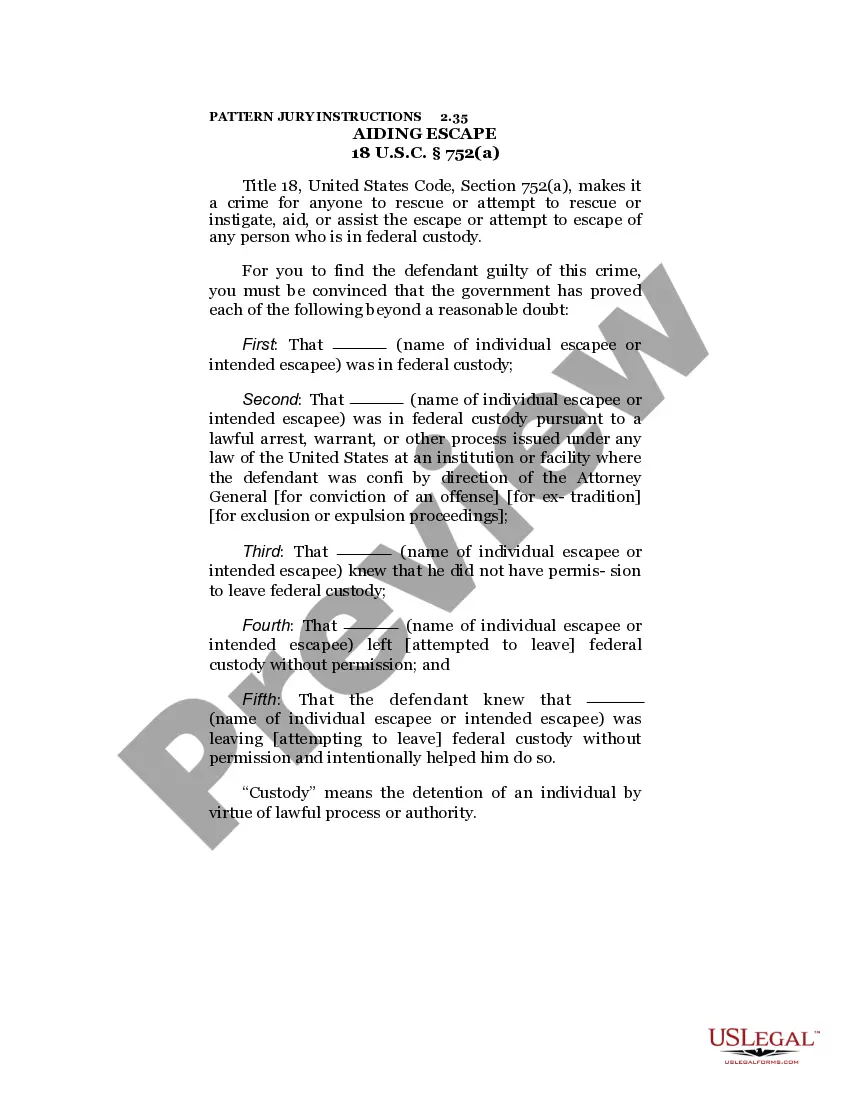
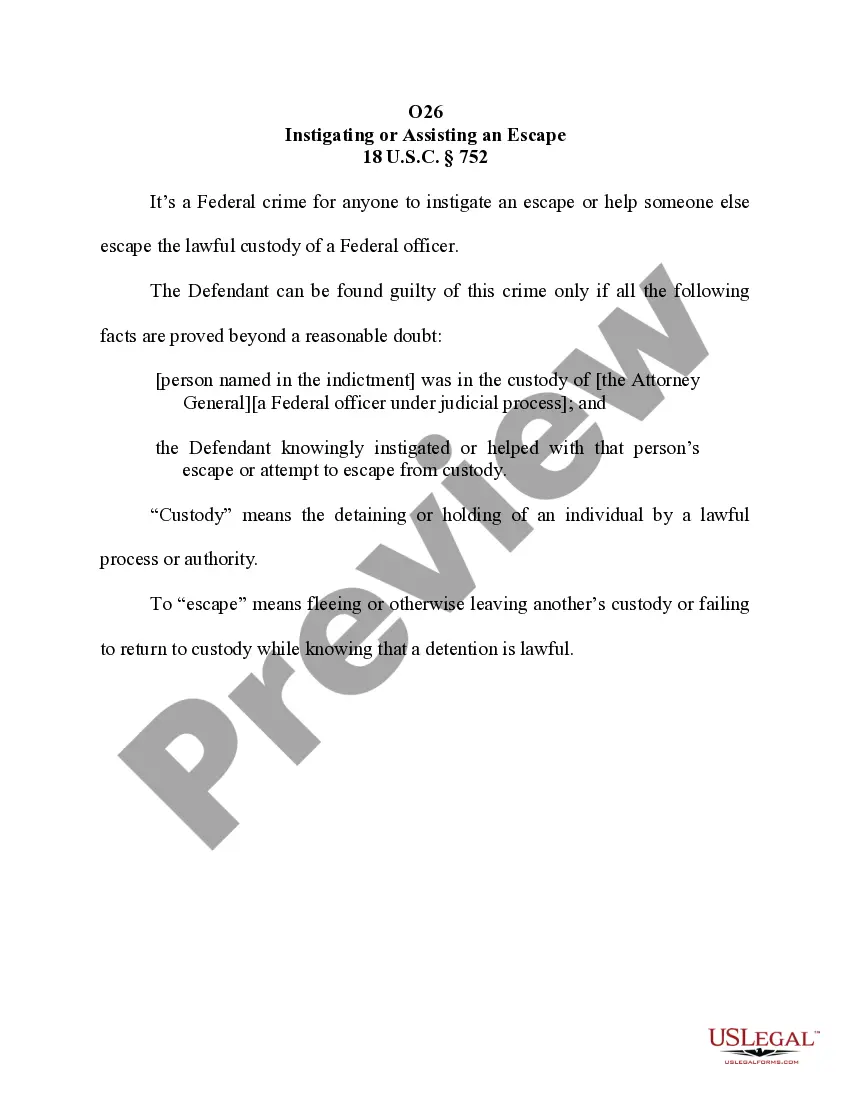
The Assisting Escape form is a legal document that outlines the official pattern jury instructions applicable to criminal cases involving assisting a federal prisoner in escape in federal district court in South Carolina. This form details the specific elements that the government must prove in cases of assisting an escape, ensuring that jury members understand the legal nuances involved in such crimes.
Form components explained
- The definition of "escape" and "rescue" as per the legal standards.
- Criteria outlining the government's burden of proof in the case of assisting an escape.
- Details on what constitutes willful action in assisting an escape.
- Indications for less serious charges related to escape in specific circumstances.
Situations where this form applies
This form should be used in situations where an individual is facing charges related to assisting a federal prisoner in escaping custody. It provides guidance on the jury deliberation process and ensures that jurors are adequately informed about the legal principles that govern such cases.
Intended users of this form
- Judges presiding over criminal cases involving escape charges.
- Legal practitioners representing defendants accused of assisting an escape.
- Jurors assigned to cases involving charges of escape assistance.
Completing this form step by step
- Understand the definitions of "escape" and "rescue" provided in the form.
- Review the criteria that must be met for a guilty verdict, including the elements that establish willful action.
- Consider any applicable lesser included offenses that may influence the charge.
- Ensure that the instructions are provided clearly and thoroughly to jurors during deliberations.
- Follow federal guidelines for jury instructions to maintain legal consistency.
Notarization requirements for this form
This form does not typically require notarization unless specified by local law. It is advisable to check local regulations for any special requirements.
Get your form ready online
Our built-in tools help you complete, sign, share, and store your documents in one place.
Make edits, fill in missing information, and update formatting in US Legal Forms—just like you would in MS Word.
Download a copy, print it, send it by email, or mail it via USPS—whatever works best for your next step.
Sign and collect signatures with our SignNow integration. Send to multiple recipients, set reminders, and more. Go Premium to unlock E-Sign.
If this form requires notarization, complete it online through a secure video call—no need to meet a notary in person or wait for an appointment.
We protect your documents and personal data by following strict security and privacy standards.

Make edits, fill in missing information, and update formatting in US Legal Forms—just like you would in MS Word.

Download a copy, print it, send it by email, or mail it via USPS—whatever works best for your next step.

Sign and collect signatures with our SignNow integration. Send to multiple recipients, set reminders, and more. Go Premium to unlock E-Sign.

If this form requires notarization, complete it online through a secure video call—no need to meet a notary in person or wait for an appointment.

We protect your documents and personal data by following strict security and privacy standards.
Typical mistakes to avoid
- Failing to clearly explain the difference between "assisting an escape" and other related actions.
- Overlooking the requirement of proving willfulness in the defendant's actions.
- Not providing adequate guidance on lesser included offenses when appropriate.
Why complete this form online
- Accessibility for legal professionals and jury members at any time.
- Ability to download and edit the form as needed for specific cases.
- Reliability based on officially drafted instructions by licensed attorneys.
Legal use & context
- The form is legally enforceable in federal cases of escape assistance.
- Understanding this form helps ensure legal due process for defendants.
- Jurors must be instructed on the exact legal definitions to prevent misinterpretation of the law.
Summary of main points
- The Assisting Escape form outlines essential jury instructions for federal escape cases.
- Clear understanding of the definitions and defenses available is critical in legal proceedings.
- Compliance with federal guidelines ensures that jury instructions are executed correctly.
Looking for another form?

Form popularity
FAQ
(A) It is unlawful for a person knowingly and wilfully to oppose or resist a law enforcement officer in serving, executing, or attempting to serve or execute a legal writ or process or to resist an arrest being made by one whom the person knows or reasonably should know is a law enforcement officer, whether under
SECTION 16-9-340. Intimidation of court officials, jurors or witnesses. (2) destroy, impede, or attempt to obstruct or impede the administration of justice in any court.
Death by electrocution or lethal injection. (A) A person convicted of a capital crime and having imposed upon him the sentence of death shall suffer the penalty by electrocution or, at the election of the person, lethal injection under the direction of the Director of the Department of Corrections.
(A) It is unlawful for a person, lawfully confined in a prison or local detention facility or while in the custody of an officer or another employee, to escape, to attempt to escape, or to have in his possession tools, weapons, or other items that may be used to facilitate an escape.
Under South Carolina Code § 16-13-110, shoplifting is criminal charge where the defendant is accused of trying to defraud a business or merchant not paying the retail price for their items.
Ing to South Carolina Code of Laws §16-3-910, a person may face criminal charges of kidnapping if they unlawfully abduct, confine, or carry away any person, unless that person is a minor and the alleged kidnapper is that minor's lawful parent or guardian.
(A) It is unlawful for a person knowingly and wilfully to oppose or resist a law enforcement officer in serving, executing, or attempting to serve or execute a legal writ or process or to resist an arrest being made by one whom the person knows or reasonably should know is a law enforcement officer, whether under
You have the right to remain silent and you are not required to identify yourself to law enforcement in South Carolina.