South Carolina Living Trust Property Record
What this document covers
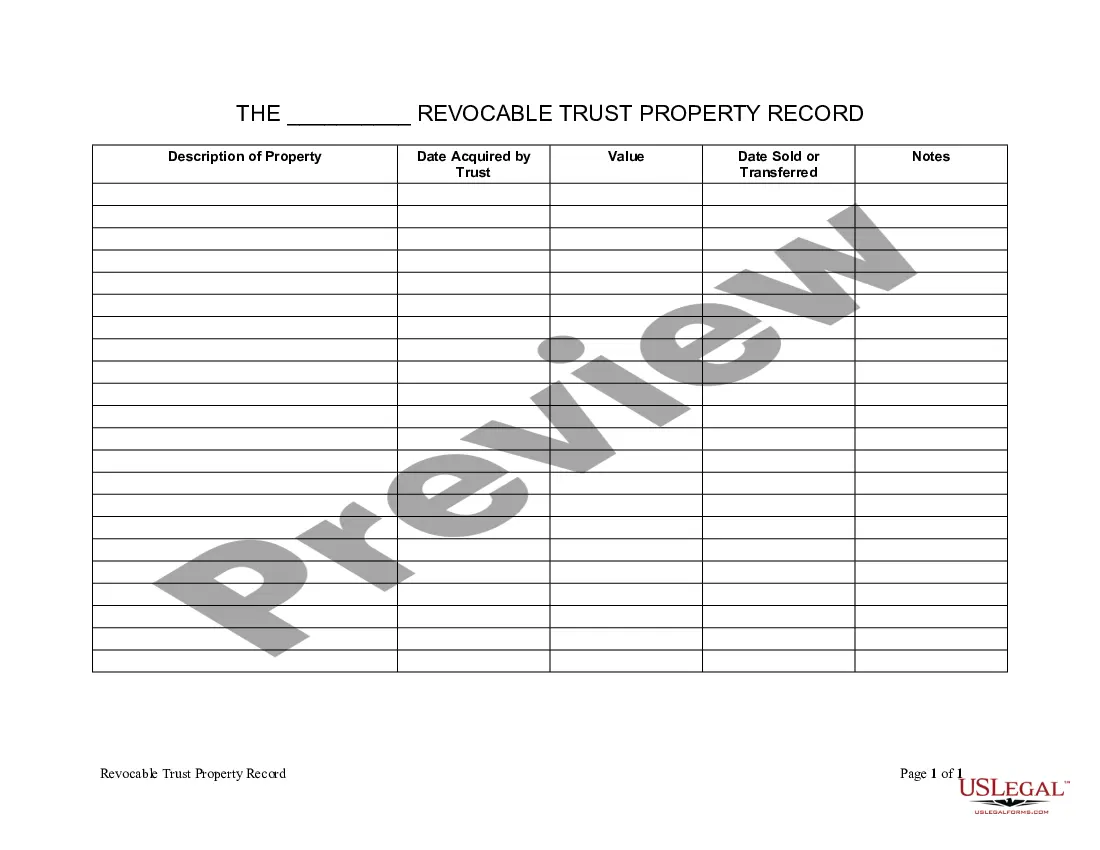
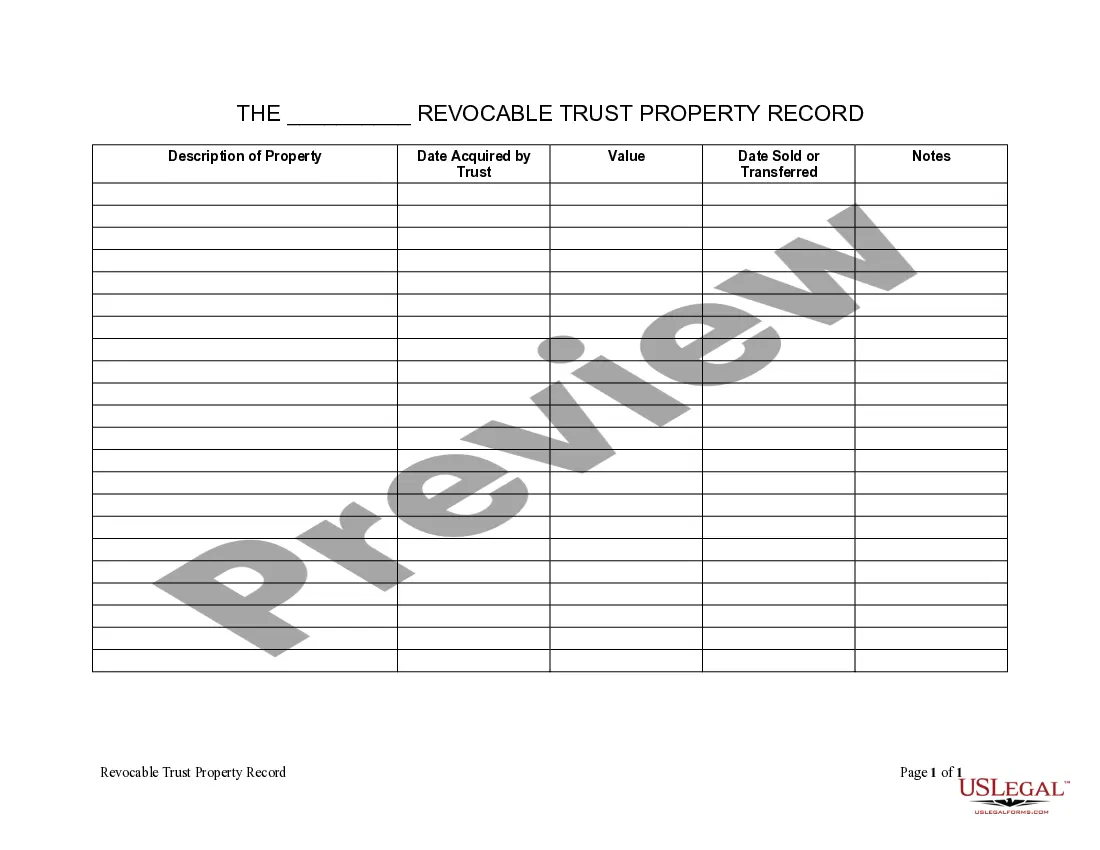
The Living Trust Property Record is a vital document designed for individuals setting up a living trust. This form allows the Trustee to document detailed information about the trust's assets, including property descriptions, acquisition dates, and values. It is essential for estate planning, ensuring that all property, whether real, personal, or intellectual, is correctly accounted for. Unlike a general asset inventory, this form is specifically tailored to the requirements of a living trust, helping to streamline the management and distribution of assets.
What’s included in this form
- Description of Property: Provides a detailed account of each asset within the trust.
- Date Acquired by Trust: Records when the property was placed into the trust.
- Value: Indicates the current or estimated worth of each asset.
- Date Sold or Transferred: Captures when any property has been sold or transferred out of the trust.

When this form is needed
This form should be used when setting up or managing a living trust. If you are about to create a living trust, it is crucial to document your assets accurately to ensure your estate plan is executed according to your wishes. It is also applicable when assets are added to or sold from the trust, providing a clear record for future reference and estate settlement.
Who can use this document
- Individuals creating a living trust to manage their assets.
- Trustees responsible for overseeing the trustâs property inventory.
- Estate planners and legal professionals advising clients on living trusts.
Completing this form step by step
- Start by identifying the property owned by the trust.
- Specify the description of each asset in detail.
- Document the date each property was acquired by the trust.
- Assign an accurate value for each asset as per current market assessments.
- If applicable, note the date when any property was sold or transferred.
Notarization guidance
This form does not typically require notarization unless specified by local law. Ensure you verify any additional requirements specific to your jurisdiction.
Get your form ready online
Our built-in tools help you complete, sign, share, and store your documents in one place.
Make edits, fill in missing information, and update formatting in US Legal Forms—just like you would in MS Word.
Download a copy, print it, send it by email, or mail it via USPS—whatever works best for your next step.
Sign and collect signatures with our SignNow integration. Send to multiple recipients, set reminders, and more. Go Premium to unlock E-Sign.
If this form requires notarization, complete it online through a secure video call—no need to meet a notary in person or wait for an appointment.
We protect your documents and personal data by following strict security and privacy standards.

Make edits, fill in missing information, and update formatting in US Legal Forms—just like you would in MS Word.

Download a copy, print it, send it by email, or mail it via USPS—whatever works best for your next step.

Sign and collect signatures with our SignNow integration. Send to multiple recipients, set reminders, and more. Go Premium to unlock E-Sign.

If this form requires notarization, complete it online through a secure video call—no need to meet a notary in person or wait for an appointment.

We protect your documents and personal data by following strict security and privacy standards.
Common mistakes
- Failing to include all significant assets in the record.
- Not updating the form when assets are added or sold.
- Recording inaccurate values, which can lead to disputes.
Advantages of online completion
- Convenience of downloading and filling out the form at your own pace.
- Editable format allows for easy updates and changes as needed.
- Reliability of using a form drafted by licensed attorneys.
Legal use & context
- The form is recognized legally in estate planning and trust management.
- It serves as an accountable record for asset management within trusts.
- Additionally, precise records help safeguard against disputes during estate distribution.
What to keep in mind
- The Living Trust Property Record is essential for documenting assets in a living trust.
- Accurate record-keeping helps avoid disputes and ensures smooth estate transitions.
- The form is convenient, legally vetted, and simple to complete.
Looking for another form?
Form popularity
FAQ
With an irrevocable trust, the assets that fund the trust become the property of the trust, and the terms of the trust direct that the trustor no longer controls the assets.Because the assets within the trust are no longer the property of the trustor, a creditor cannot come after them to satisfy debts of the trustor.
Trusts may be revocable or irrevocable. Each trust is different, and the creator of each trust generally determines whether the trust is revocable.Therefore, if a judgment debtor is also the creator of a revocable trust, the judgment creditor can generally garnish the money or property held by that trust.
If you can't find original living trust documents, you can contact the California Bar Association for assistance. Trusts aren't recorded anywhere, so you can't go to the County Recorder's office in the courthouse to ask to see a copy of the trust.
Trusts aren't public record, so they're not usually recorded anywhere. Instead, the trust attorney determines who is entitled to receive a copy of the document, even if state law doesn't require it.
With a revocable trust, your assets will not be protected from creditors looking to sue. That's because you maintain ownership of the trust while you're alive. Therefore if you lose a lawsuit and a judgment is awarded to the creditor, the trust may have to be closed and the money handed over.
A living trust does not protect your assets from a lawsuit. Living trusts are revocable, meaning you remain in control of the assets and you are the legal owner until your death.
Its primary purpose is to avoid probate court, since revocable living trusts do not reduce estate taxes. With a revocable trust, your assets will not be protected from creditors looking to sue.With this kind of trust, assets are more protected from creditors.
If you can't find original living trust documents, you can contact the California Bar Association for assistance. Trusts aren't recorded anywhere, so you can't go to the County Recorder's office in the courthouse to ask to see a copy of the trust.
Legally your Trust now owns all of your assets, but you manage all of the assets as the Trustee. This is the essential step that allows you to avoid Probate Court because there is nothing for the courts to control when you die or become incapacitated.