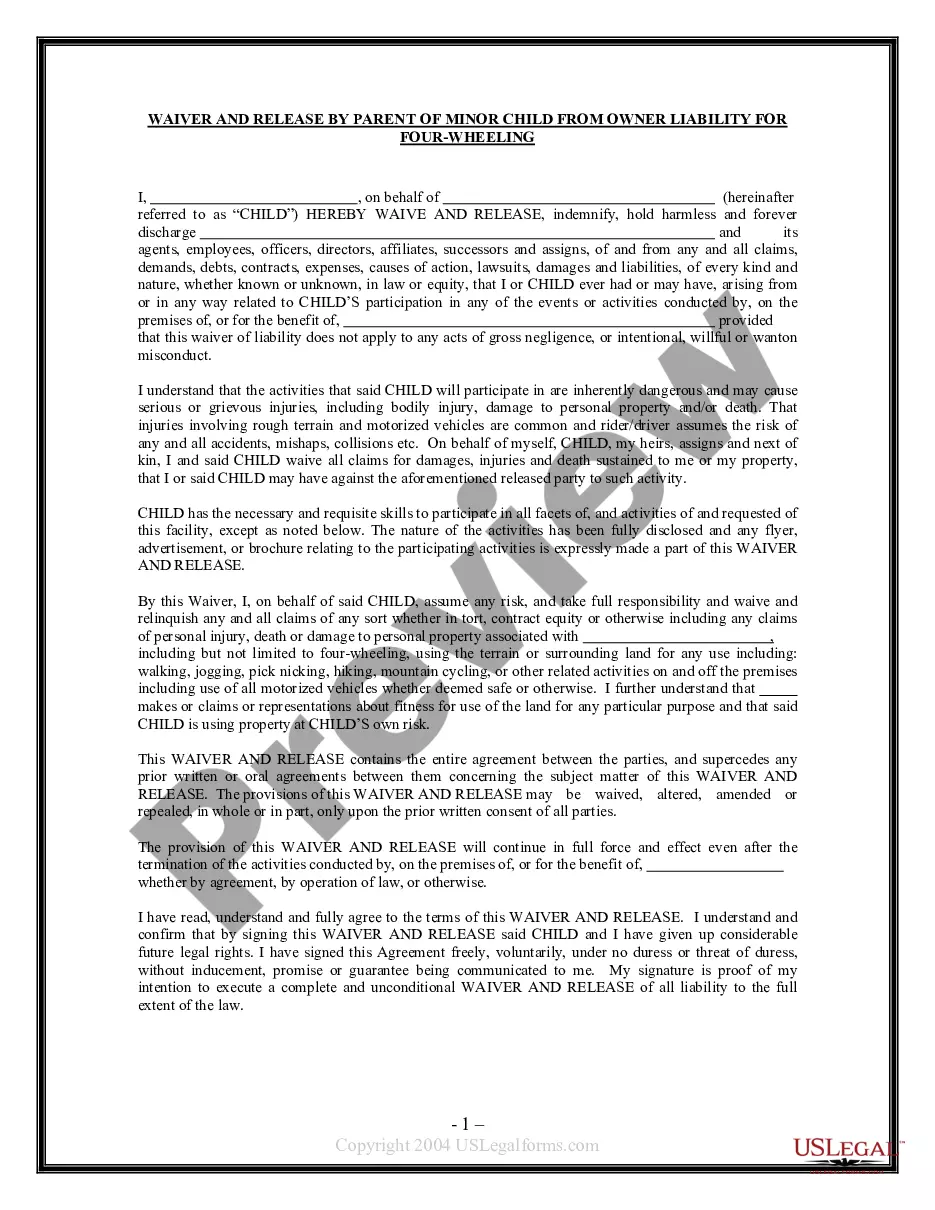
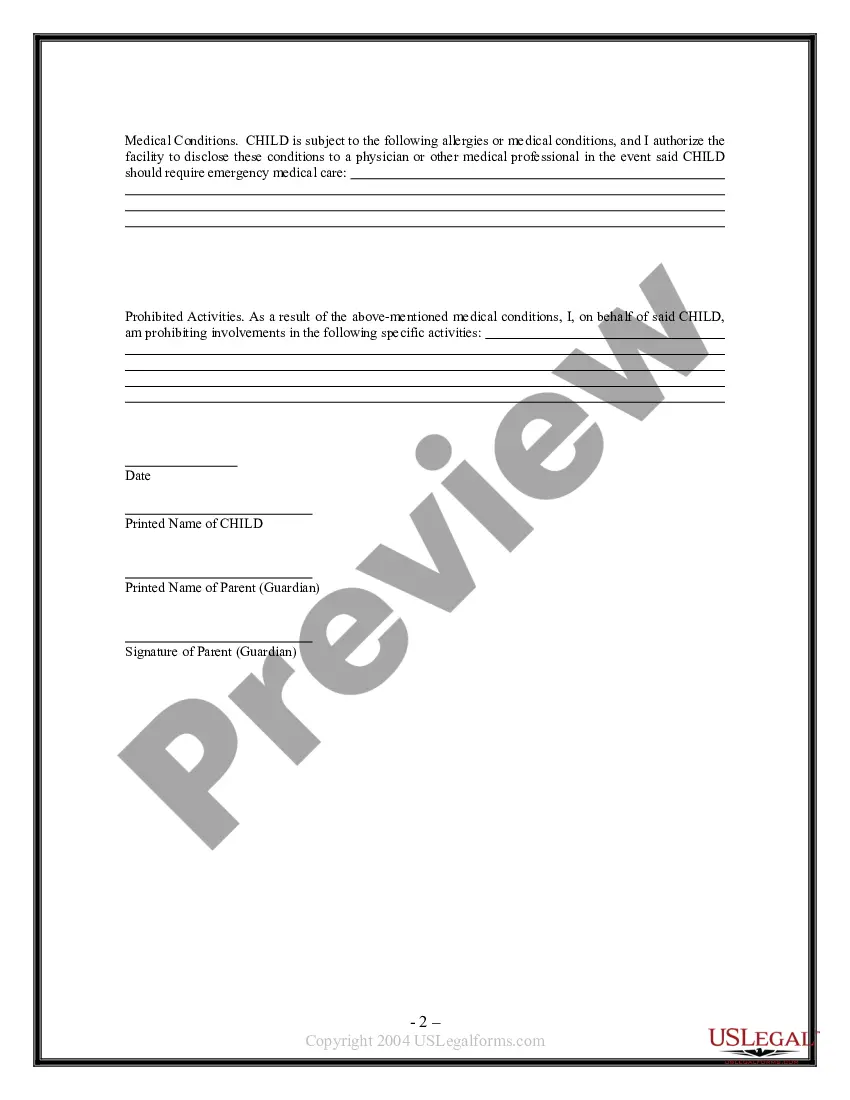
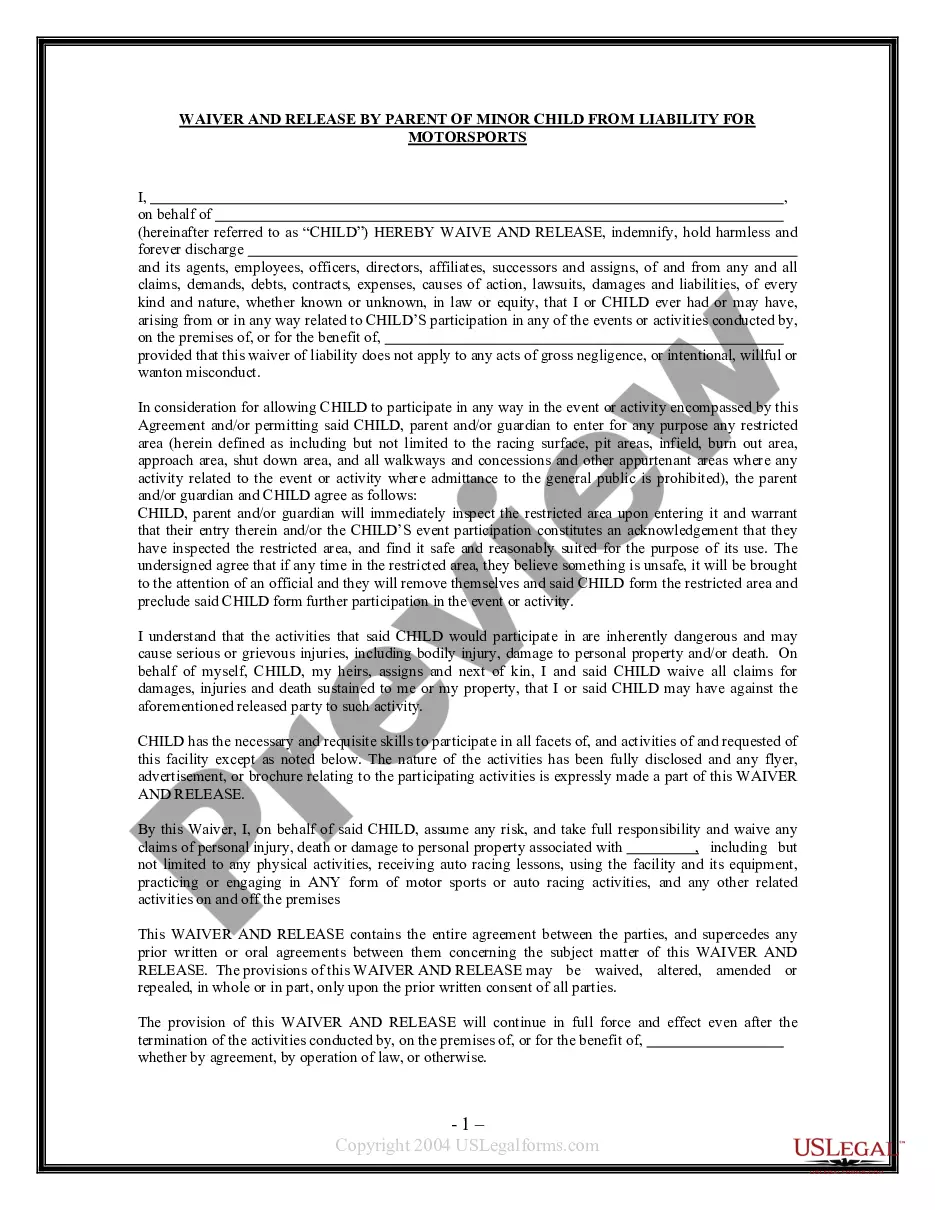
This form allows a parent or guardian to release a four-wheeling facility from liability for injuries which may be incurred by a minor child while on the premises, taking part in activities, etc.
Rhode Island Waiver and Release From Liability For Minor Child for Four-Wheeling
Category:
State:
Multi-State
Control #:
US-WAV-34M
Format:
Word;
Rich Text
Instant download
Description
Free preview
How to fill out Waiver And Release From Liability For Minor Child For Four-Wheeling?
Are you currently in a circumstance where you require documents for either business or personal purposes almost every day.
There are numerous legal document templates accessible online, but finding versions you can trust is not straightforward.
US Legal Forms offers a vast selection of form templates, including the Rhode Island Waiver and Release From Liability For Minor Child for Four-Wheeling, which can be tailored to meet federal and state requirements.
Select the payment plan you prefer, enter the required information to create your account, and complete the transaction using your PayPal or credit card.
Choose a convenient document format and download your version.
- If you are already familiar with the US Legal Forms website and possess an account, simply Log In.
- Then, you can download the Rhode Island Waiver and Release From Liability For Minor Child for Four-Wheeling template.
- If you do not have an account and wish to start using US Legal Forms, follow these steps.
- Find the form you need and ensure it is for the correct area/region.
- Use the Review button to examine the form.
- Check the summary to ensure you have selected the appropriate form.
- If the form is not what you require, use the Search section to locate the form that meets your needs and requirements.
- Once you find the correct form, click on Acquire now.
Form popularity
FAQ
In Rhode Island, car insurance typically follows the vehicle rather than the driver. This means that if someone else drives your car and gets into an accident, your insurance may cover the damages. However, it is crucial to understand the specific terms of your policy, as certain exclusions may apply. To ensure you have the right coverage while engaging in activities like four-wheeling, refer to your insurance provider and consider drafting a Rhode Island Waiver and Release From Liability For Minor Child for Four-Wheeling to further protect your interests.
A waiver of liability is a legal document that helps protect one party from being held liable for injuries or damages incurred by another party. For instance, a Rhode Island Waiver and Release From Liability For Minor Child for Four-Wheeling would outline the risks associated with off-road activities and require the parent or guardian to acknowledge these risks on behalf of their child. This document serves as a vital tool to ensure that families can enjoy four-wheeling while minimizing legal risks. Using uslegalforms can help you create a customized waiver that fits your needs.
In Rhode Island, a minor is defined as an individual who is under the age of 18. This classification is important when considering legal documents, such as a Rhode Island Waiver and Release From Liability For Minor Child for Four-Wheeling. It ensures that parents or guardians must provide consent for minors to participate in certain activities. Understanding this age definition helps protect your child while enjoying four-wheeling adventures.
To write a release of liability waiver, start by clearly stating the purpose of the waiver and identifying the parties involved. Include specific language that outlines the risks associated with the activity, such as four-wheeling, and specify that the waiver covers those risks. It is advisable to use a trusted platform like uslegalforms to ensure that your Rhode Island Waiver and Release From Liability For Minor Child for Four-Wheeling meets legal standards and effectively protects all parties involved.
In Rhode Island, the statute of limitations for personal injury claims is typically three years from the date of the injury. This means you have three years to file a lawsuit if an incident occurs while four-wheeling, for instance. Understanding this timeframe is crucial when dealing with the Rhode Island Waiver and Release From Liability For Minor Child for Four-Wheeling, as it helps you determine how long you have to seek legal recourse.
A personal liability waiver is a legal document that allows an individual to release another party from liability for potential injuries or damages that may occur during an activity. In the context of the Rhode Island Waiver and Release From Liability For Minor Child for Four-Wheeling, this document protects organizations and individuals from claims made by parents or guardians of minor participants. By signing this waiver, you acknowledge the risks involved in four-wheeling and agree to assume those risks on behalf of your child.
Generally, a liability waiver document is a legally binding agreement that relinquishes the right of one party to pursue legal remedy for injuries accrued on the property, regardless of fault involved.
Ambiguous language or missing information can invalidate a waiver. The waiver contains errors that make it invalid. The language of the waiver must obey relevant state laws. An improperly worded or drafted waiver, as well as one that violates the law or public policy, may not hold up in court.
Liability waivers are enforceable in California solely to the extent they shift to the customer the risk of ordinary negligence. Under California law, a liability waiver cannot excuse an injury caused by a defendant's gross negligence, recklessness or intentionally wrongful act.
You might think that since you signed a waiver acknowledging the risks of the activity, you have no legal leg to stand on to file a personal injury lawsuit. Waivers can make personal injury lawsuits more complex, but you can still seek damages for injuries that could have and should have been prevented.