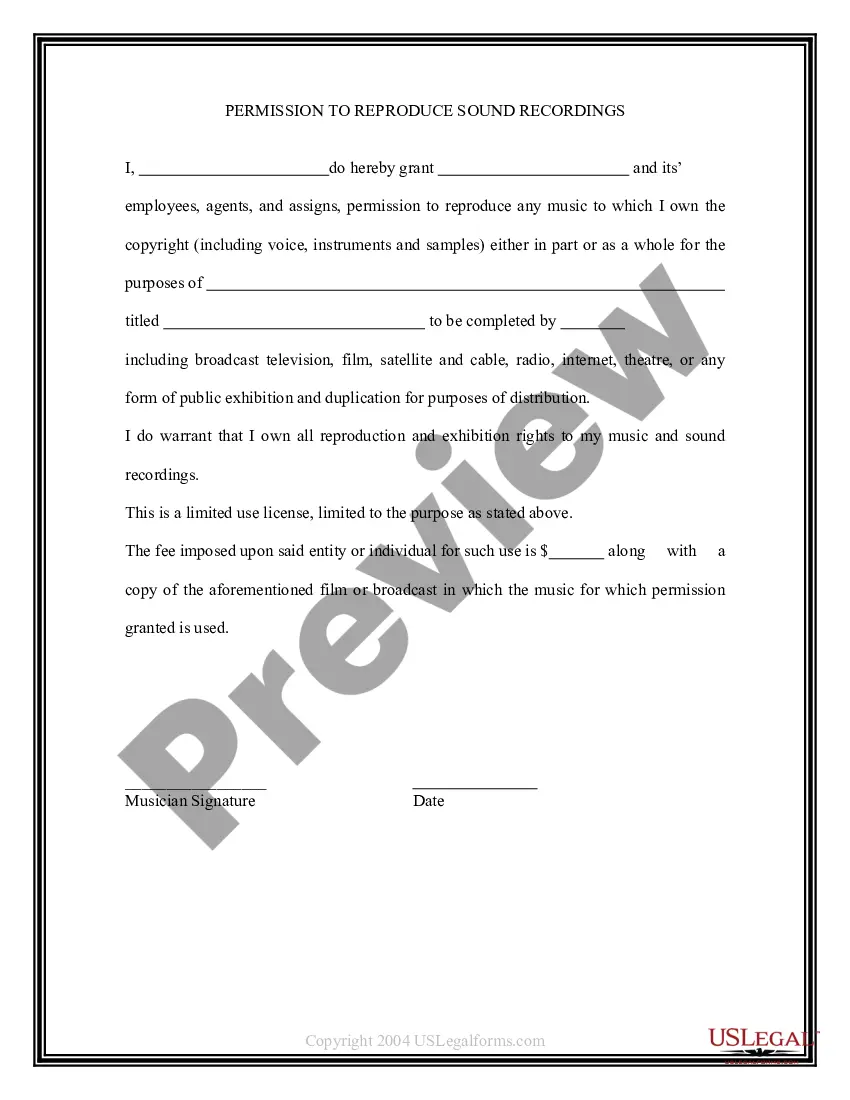
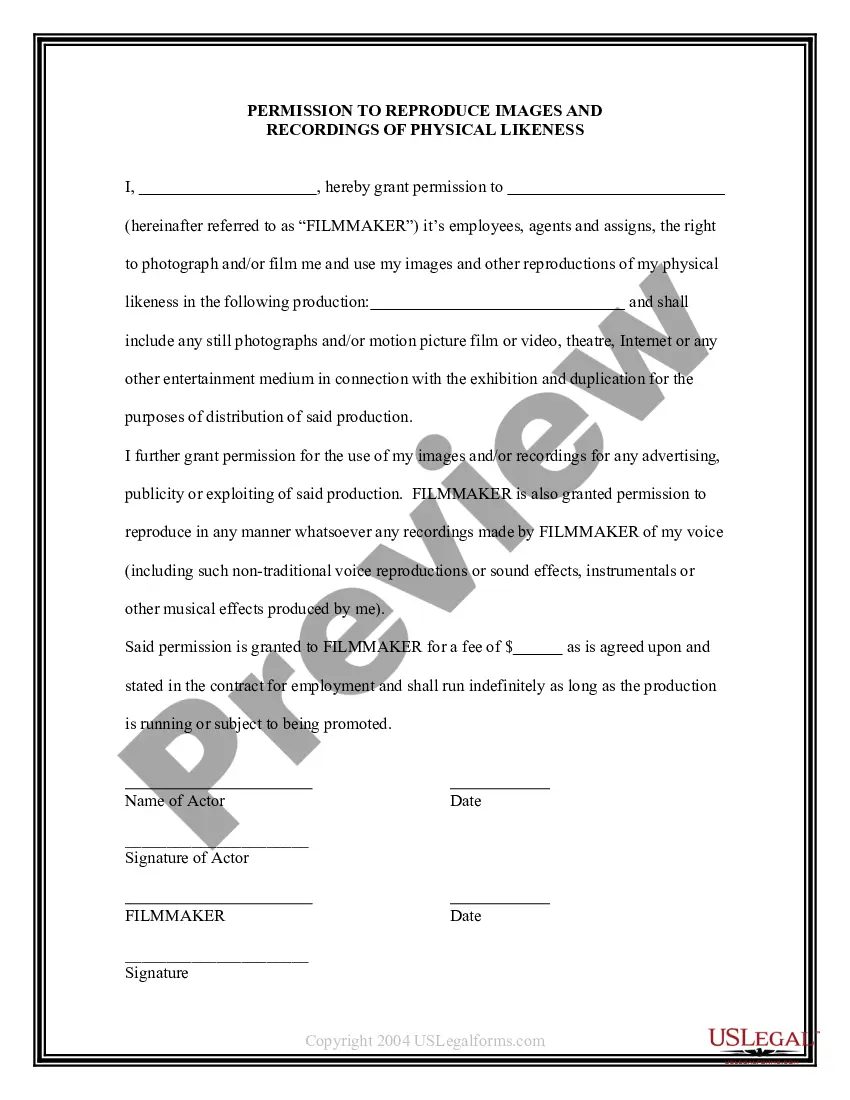
This is a form signed by a musician or owner of music granting permission to reproduce copyrighted music for use in a film, television, Internet, radio etc.
Rhode Island Permission To Reproduce Sound Recordings
State:
Multi-State
Control #:
US-PRM-23
Format:
Word;
Rich Text
Instant download
Description


How to fill out Permission To Reproduce Sound Recordings?
If you need to compile, download, or print authentic document templates, utilize US Legal Forms, the largest compilation of legal forms available online. Take advantage of the site's straightforward and user-friendly search to locate the documents you require. Various templates for business and personal purposes are categorized by groups and states, or keywords. Use US Legal Forms to obtain the Rhode Island Permission To Reproduce Sound Recordings with just a few clicks.
If you are already a US Legal Forms customer, Log In to your account and click on the Download option to access the Rhode Island Permission To Reproduce Sound Recordings. You can also find forms you previously acquired in the My documents section of your account.
If you are using US Legal Forms for the first time, follow the instructions below: Step 1. Ensure you have selected the form for the correct city/state. Step 2. Use the Preview option to review the form's content. Don’t forget to read the description. Step 3. If you are not satisfied with the form, use the Search field at the top of the screen to find other versions of the legal form template. Step 4. Once you have located the form you need, click on the Purchase now option. Choose the payment plan you prefer and provide your details to register for an account. Step 5. Complete the transaction. You can use your credit card or PayPal account to finalize the purchase. Step 6. Select the format of the legal form and download it to your device. Step 7. Complete, edit, and print or sign the Rhode Island Permission To Reproduce Sound Recordings.
- Every legal document template you buy is yours permanently.
- You have access to every form you purchased in your account.
- Go to the My documents section and select a form to print or download again.
- Complete and download, and print the Rhode Island Permission To Reproduce Sound Recordings with US Legal Forms.
- There are thousands of professional and state-specific forms you can use for your business or personal needs.
Form popularity
FAQ
Yes, you can record audio in Rhode Island, but there are important legal considerations to keep in mind. The state requires that you obtain permission from individuals being recorded, especially if you intend to reproduce sound recordings for commercial use. To ensure compliance, it’s beneficial to consult USLegalForms for guidance on Rhode Island Permission To Reproduce Sound Recordings. This helps you understand your rights and responsibilities when recording audio.
Rhode Island has specific noise laws that aim to maintain public peace and order. These laws regulate excessive noise levels in residential and commercial areas, particularly during nighttime hours. Understanding these laws is crucial if you plan to reproduce sound recordings in public or private settings. Utilizing USLegalForms can provide you with the necessary resources to navigate Rhode Island's noise regulations effectively.
In Rhode Island, recording sound without consent can lead to legal complications. Generally, you need permission to reproduce sound recordings, especially if the recording involves private conversations. Engaging with USLegalForms can help you understand the legal requirements for Rhode Island Permission To Reproduce Sound Recordings. This ensures that you comply with local laws and avoid potential legal issues.
In Rhode Island it is legal to record an in-person or phone communication with the consent of at least one party if the recording is not made with criminal or tortious intent. Illegal recording is punishable by imprisonment and can also be the basis for civil damages.
An individual who is a party to an in-person, telephone or electronic conversation, or who has the consent of one of the parties to the conversation, can lawfully record and disclose it, unless the person is doing so for the purpose of committing a criminal or tortious act. R.I.
4 attorney answersYour voicemail is your private matter, and thus it's your choice whether or not to disclose it, not his...
California is an all-party consent state. It is illegal to record a confidential conversation, including private conversations or telephone calls, without consent in California. A violation of this rule is the crime of eavesdropping, per Penal Code 632 PC.
California is an all-party consent state. It is illegal to record a confidential conversation, including private conversations or telephone calls, without consent in California.
In California, all parties to any confidential conversation must give their consent to be recorded. For calls occurring over cellular or cordless phones, all parties must consent before a person can record, regardless of confidentiality. Both civil and criminal penalties are available to victims of illegal recordings.
Under the federal Wiretap Act, it is illegal for any person to secretly record an oral, telephonic, or electronic communication that other parties to the communication reasonably expect to be private. (18 U.S.C. § 2511.)