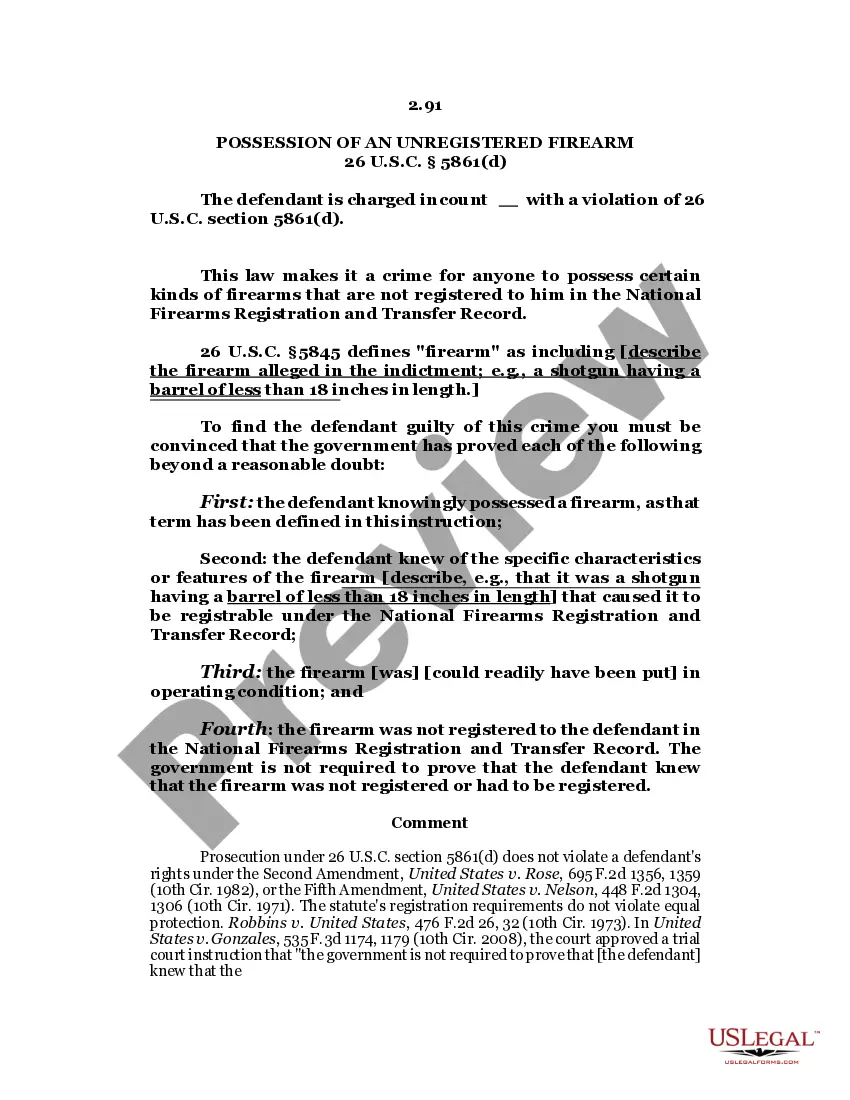
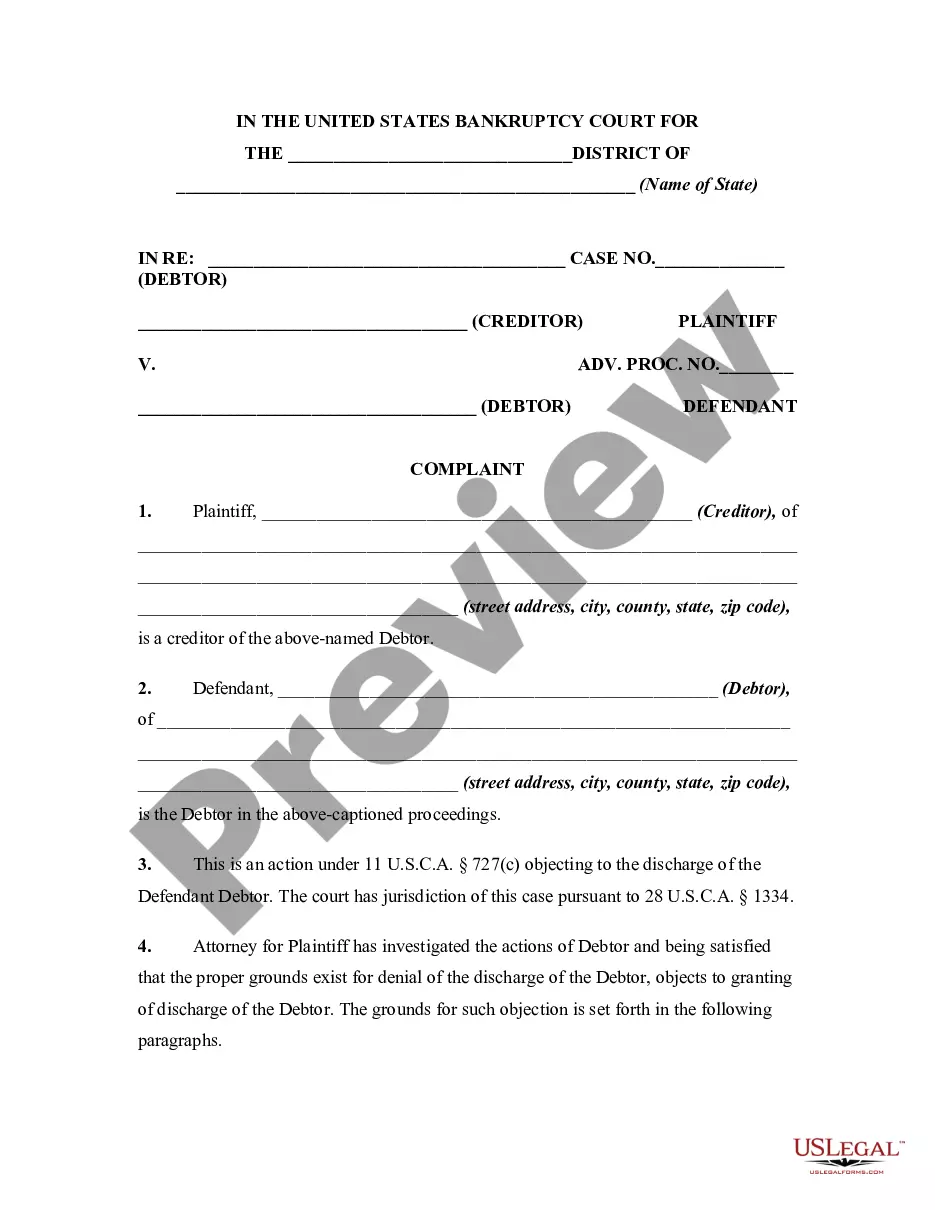
The decree of the bankruptcy court which terminates the bankruptcy proceedings is generally a discharge that releases the debtor from most debts. A bankruptcy court may refuse to grant a discharge under certain conditions.
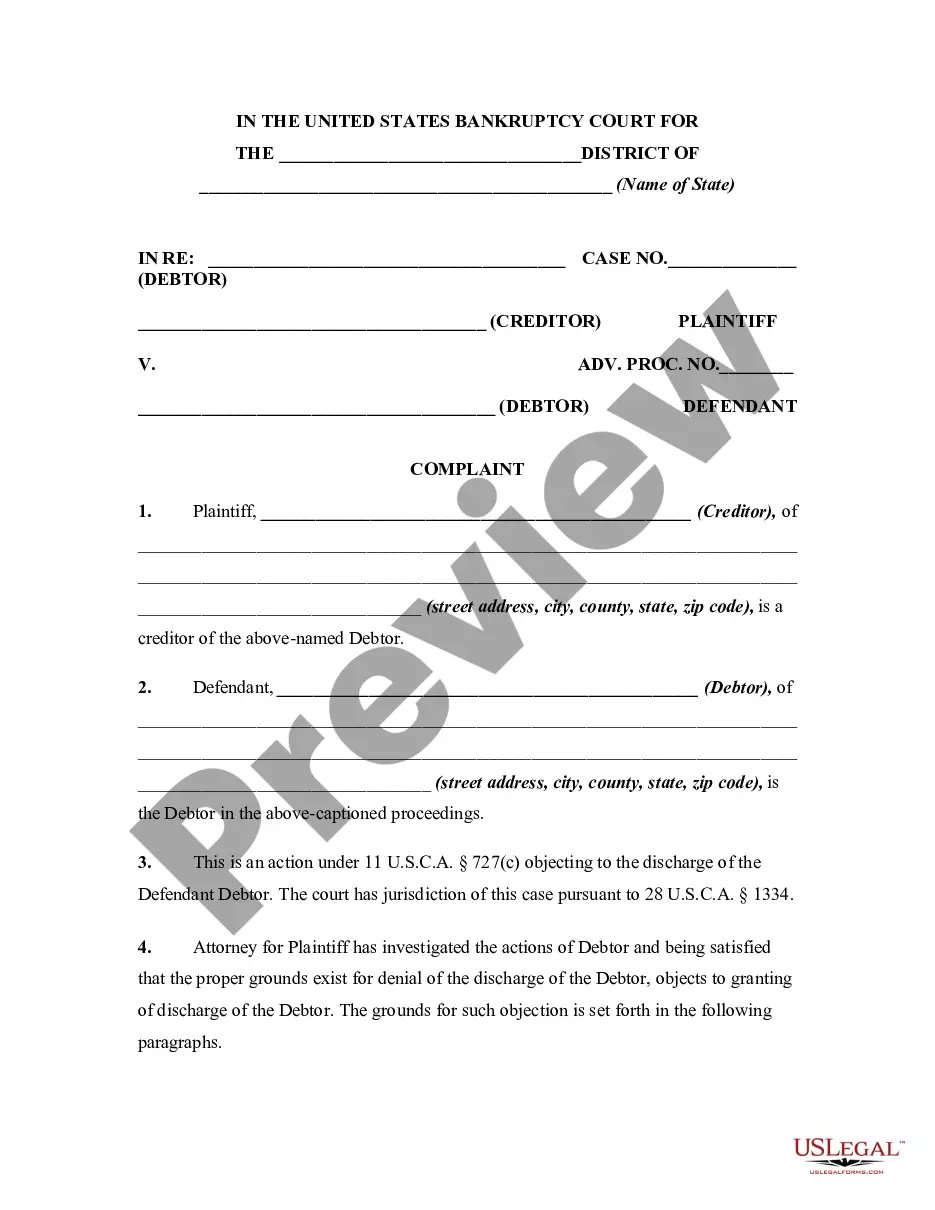
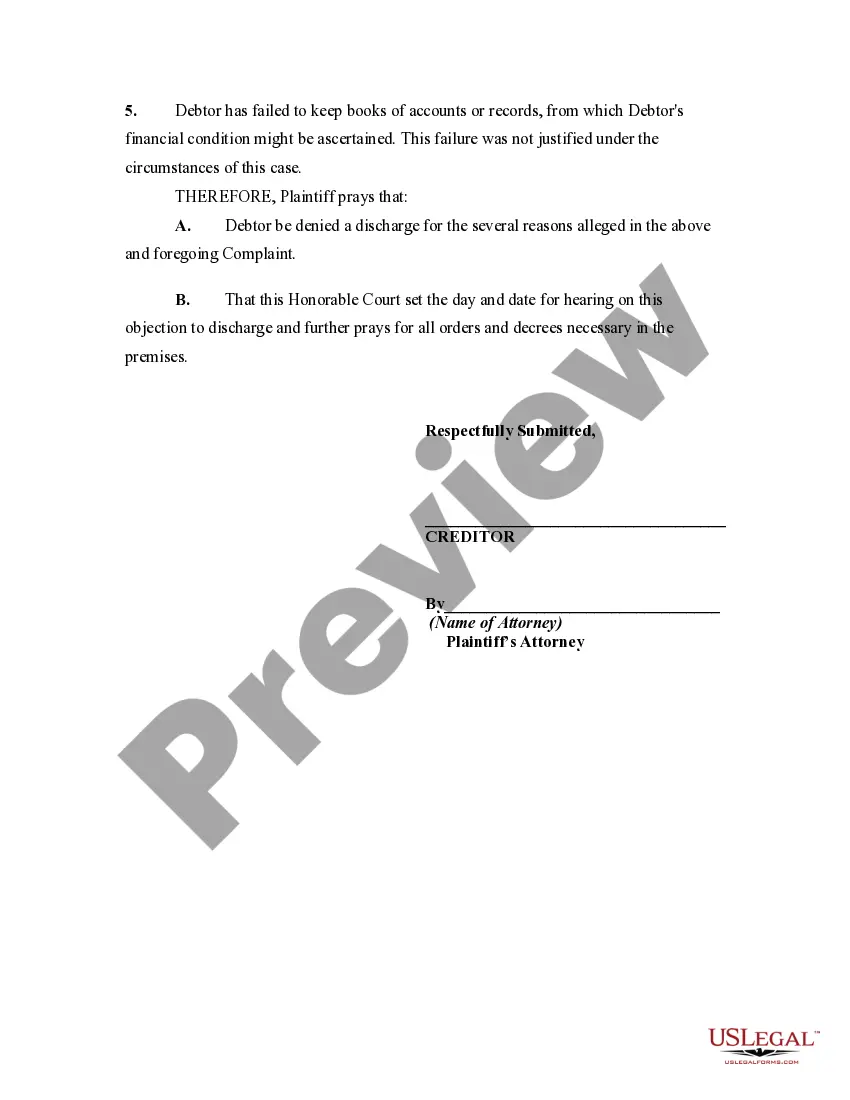
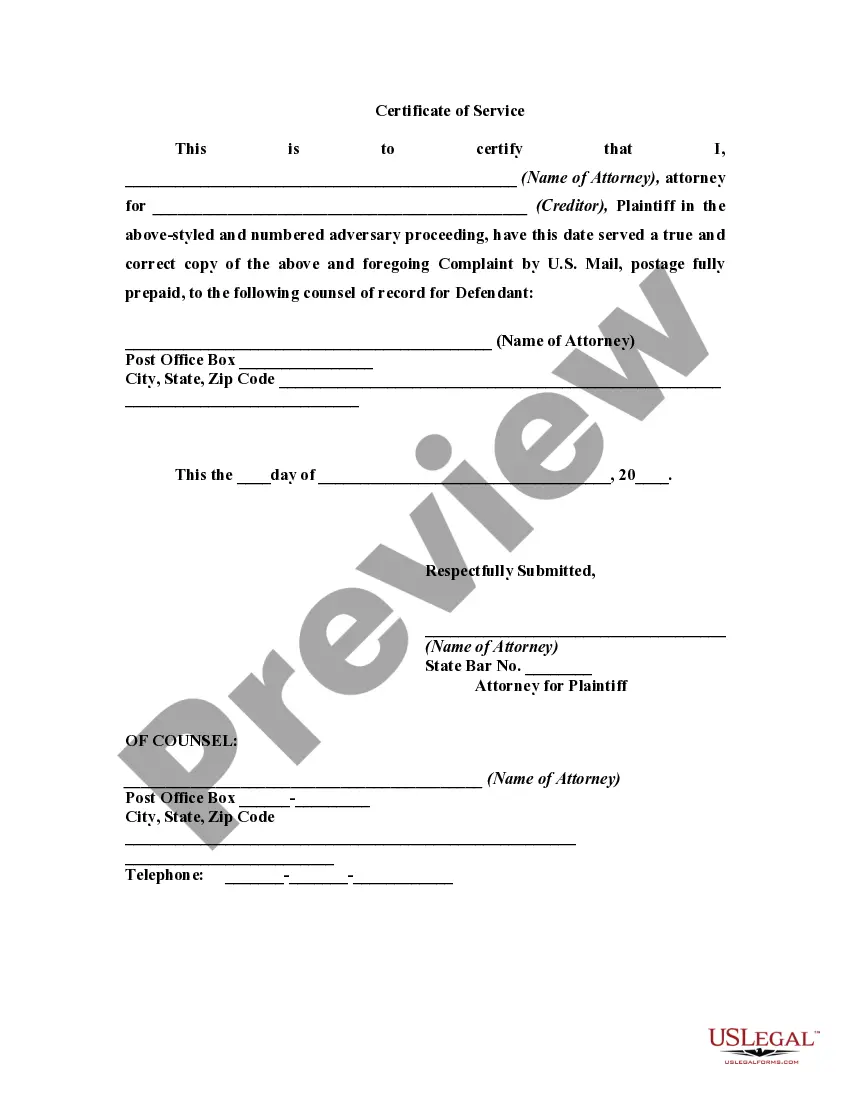
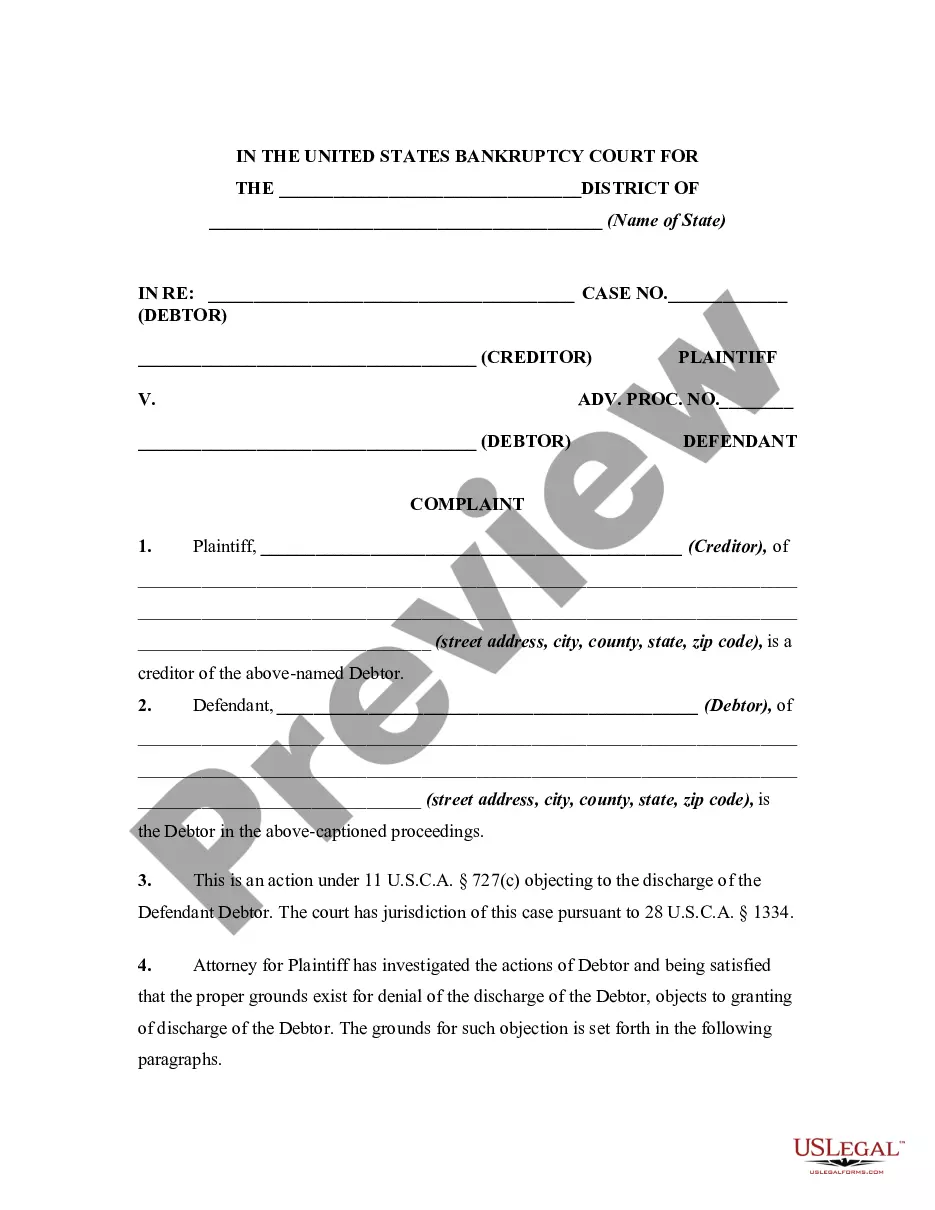
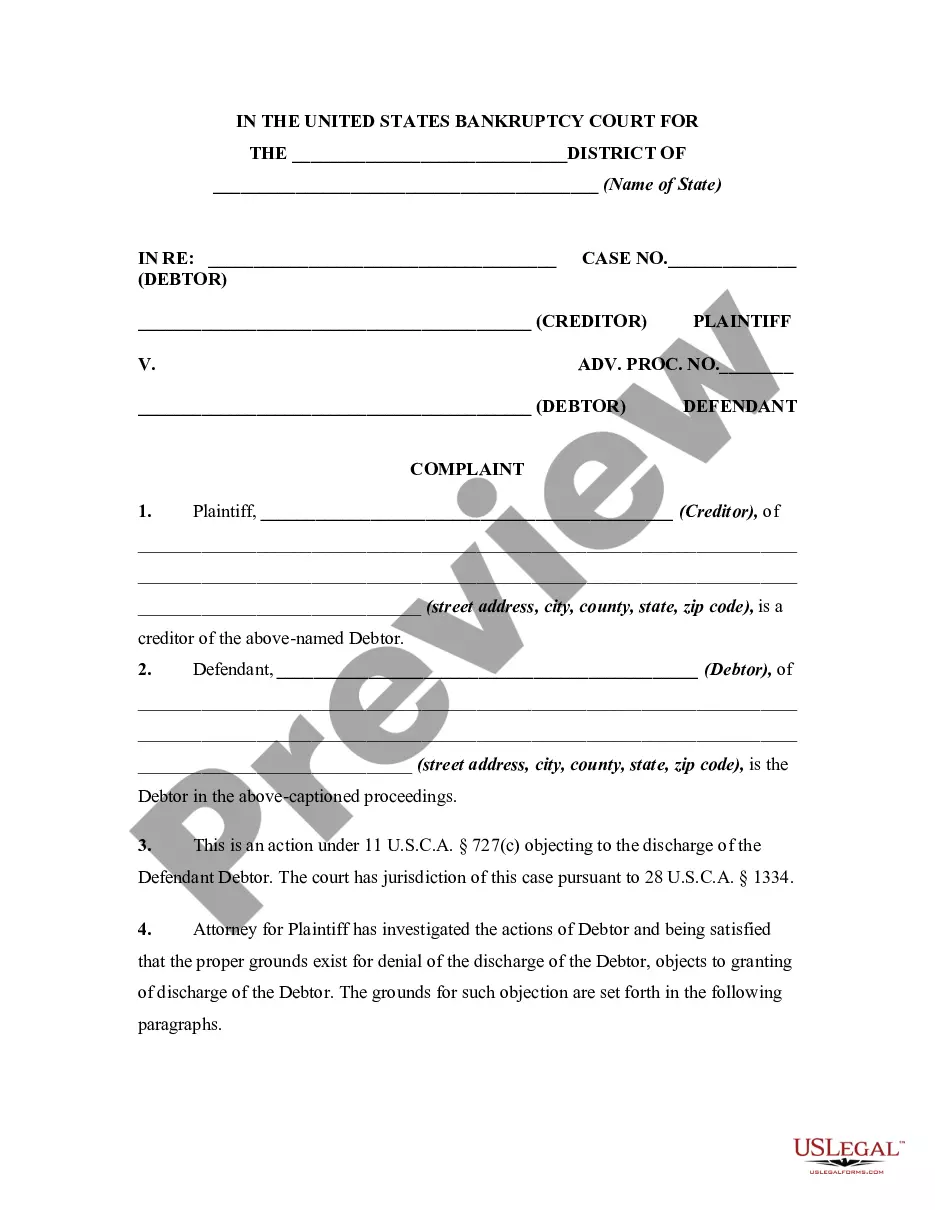
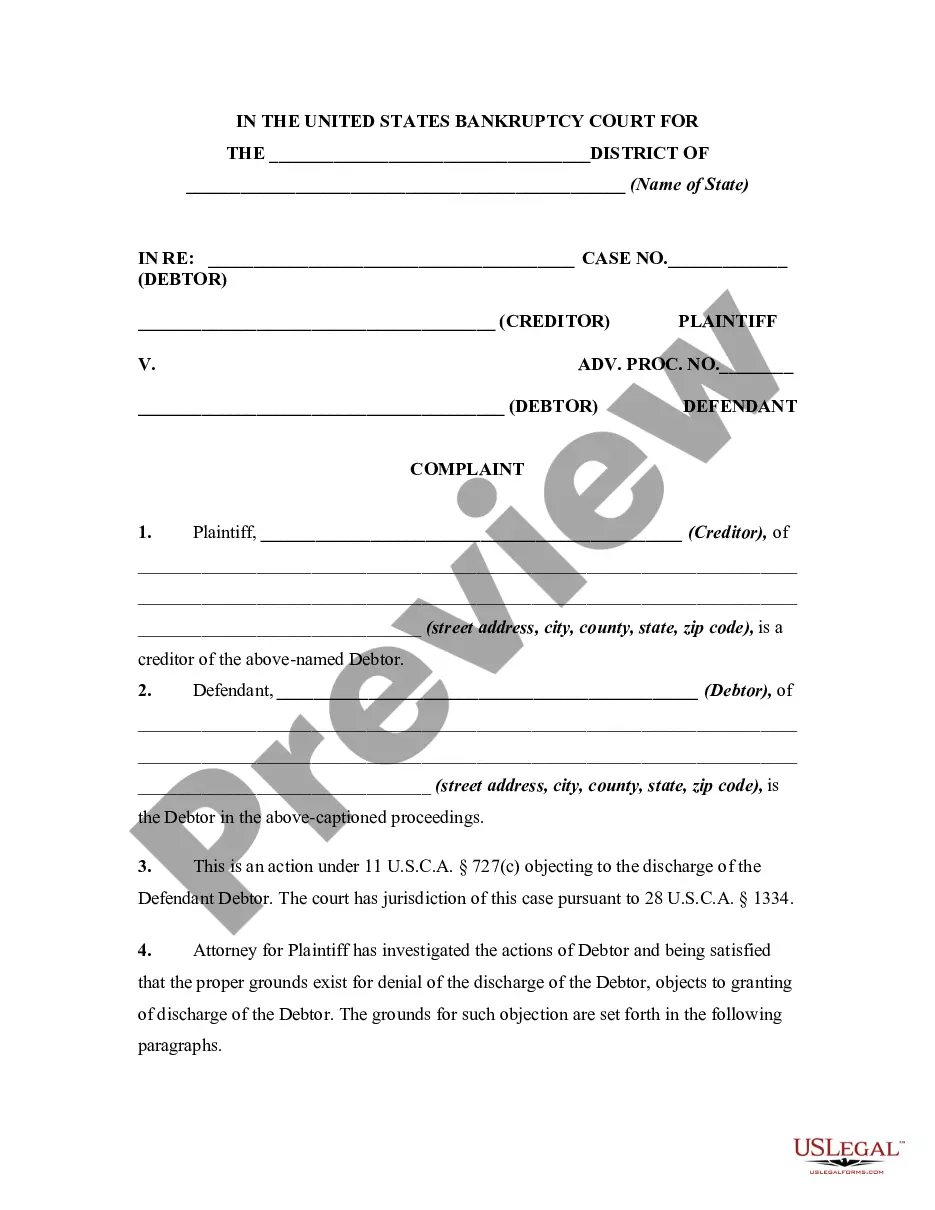
Rhode Island Complaint Objecting to Discharge or Debtor in Bankruptcy Proceeding for Failure to Keep Books and Records
State:
Multi-State
Control #:
US-01088BG
Format:
Word;
Rich Text
Instant download
Description
Free preview
Get your form ready online
Our built-in tools help you complete, sign, share, and store your documents in one place.
Built-in online Word editor
Make edits, fill in missing information, and update formatting in US Legal Forms—just like you would in MS Word.
Export easily
Download a copy, print it, send it by email, or mail it via USPS—whatever works best for your next step.
E-sign your document
Sign and collect signatures with our SignNow integration. Send to multiple recipients, set reminders, and more. Go Premium to unlock E-Sign.
Notarize online 24/7
If this form requires notarization, complete it online through a secure video call—no need to meet a notary in person or wait for an appointment.
Store your document securely
We protect your documents and personal data by following strict security and privacy standards.

Make edits, fill in missing information, and update formatting in US Legal Forms—just like you would in MS Word.

Download a copy, print it, send it by email, or mail it via USPS—whatever works best for your next step.

Sign and collect signatures with our SignNow integration. Send to multiple recipients, set reminders, and more. Go Premium to unlock E-Sign.

If this form requires notarization, complete it online through a secure video call—no need to meet a notary in person or wait for an appointment.

We protect your documents and personal data by following strict security and privacy standards.
Looking for another form?

How to fill out Complaint Objecting To Discharge Or Debtor In Bankruptcy Proceeding For Failure To Keep Books And Records?
If you intend to be thorough, acquire, or print official document templates, utilize US Legal Forms, the premier collection of legal forms, available online.
Leverage the site's straightforward and user-friendly search to find the documents you need. Numerous templates for business and personal purposes are organized by categories and states, or keywords.
Use US Legal Forms to obtain the Rhode Island Complaint Objecting to Discharge or Debtor in Bankruptcy Proceeding for Failure to Maintain Books and Records with just a few clicks.
Step 5. Complete the payment. You can use your credit card or PayPal account to finalize the transaction.
Step 6. Choose the format of your legal form and download it to your device. Step 7. Fill out, edit, and print or sign the Rhode Island Complaint Objecting to Discharge or Debtor in Bankruptcy Proceeding for Failure to Maintain Books and Records. Every legal document format you purchase is yours indefinitely. You will have access to each form you saved in your account. Review the My documents section and select a form to print or download again. Compete and acquire, and print the Rhode Island Complaint Objecting to Discharge or Debtor in Bankruptcy Proceeding for Failure to Maintain Books and Records with US Legal Forms. There are numerous professional and state-specific forms you can use for your business or personal needs.
- If you are already a US Legal Forms user, Log In to your account and click the Download button to get the Rhode Island Complaint Objecting to Discharge or Debtor in Bankruptcy Proceeding for Failure to Maintain Books and Records.
- You can also access forms you previously saved from the My documents tab of your account.
- If you are using US Legal Forms for the first time, follow the instructions below.
- Step 1. Ensure you have selected the form for your relevant city/state.
- Step 2. Use the Review option to examine the form's content. Remember to read the description.
- Step 3. If you are not satisfied with the form, use the Search field at the top of the screen to find other types of your legal form format.
- Step 4. Once you have found the form you need, click the Get now button. Choose the pricing plan you prefer and provide your details to register for an account.
Form popularity
FAQ
A willful violation exists when a party knew of the automatic stay and the actions taken in violation of the stay were intentional.[3] The presence of intention is irrelevant, however, as only the actions taken must be intentional.[4]
As part of the Reform Act of 1978, paragraph (2) of this section provided that "a debt for obtaining money, property, services, or a refinancing, extension, or renewal of credit by false pretenses, a false representation, or actual fraud, or by use of a statement in writing respecting the debtor's financial condition ...
Debts not discharged Some debts are not dischargeable in bankruptcy. See 11 U.S.C. 523 for the list of non dischargeable debts. Non dischargeable debts are unaltered by the bankruptcy discharge and remain just as valid as they were before the bankruptcy. The debtor's personal liability continues.
The elements are that: (1) the debtor made a false representation with the intent to deceive the creditor; (2) the creditor justifiably relied on the misrepresentation; and (3) the creditor suffered a loss as a result of the misrepresentation.
Section 362(k)(1) provides that an individual injured by any willful violation of the automatic stay ?shall recover actual damages, including costs and attorneys' fees, and in appropriate circumstances, may recover punitive damages.?
Except as otherwise provided in subdivision (d), a complaint to determine the dischargeability of a debt under §523(c) shall be filed no later than 60 days after the first date set for the meeting of creditors under §341(a).
A trustee's or creditor's objection to the debtor being released from personal liability for certain dischargeable debts. Common reasons include allegations that the debt to be discharged was incurred by false pretenses or that debt arose because of the debtor's fraud while acting as a fiduciary.
Immediately notify your attorney of any violations of the bankruptcy automatic stay. Your bankruptcy attorney can act on your behalf to notify the bankruptcy court which will then take action to stop violators.
Under section 523(a)(2)(B)(i) a discharge is barred only as to that portion of a loan with respect to which a false financial statement is materially false.In many cases, a creditor is required by state law to refinance existing credit on which there has been no default.
If a creditor intentionally violates the Automatic Stay, then they subject themselves to punishment by the Court, which could include not only undoing what they did, but they also are likely to be sanctioned with a fine and/or some other more severe penalty decided by the Court.