Rhode Island Installments Fixed Rate Promissory Note Secured by Residential Real Estate
Overview of this form
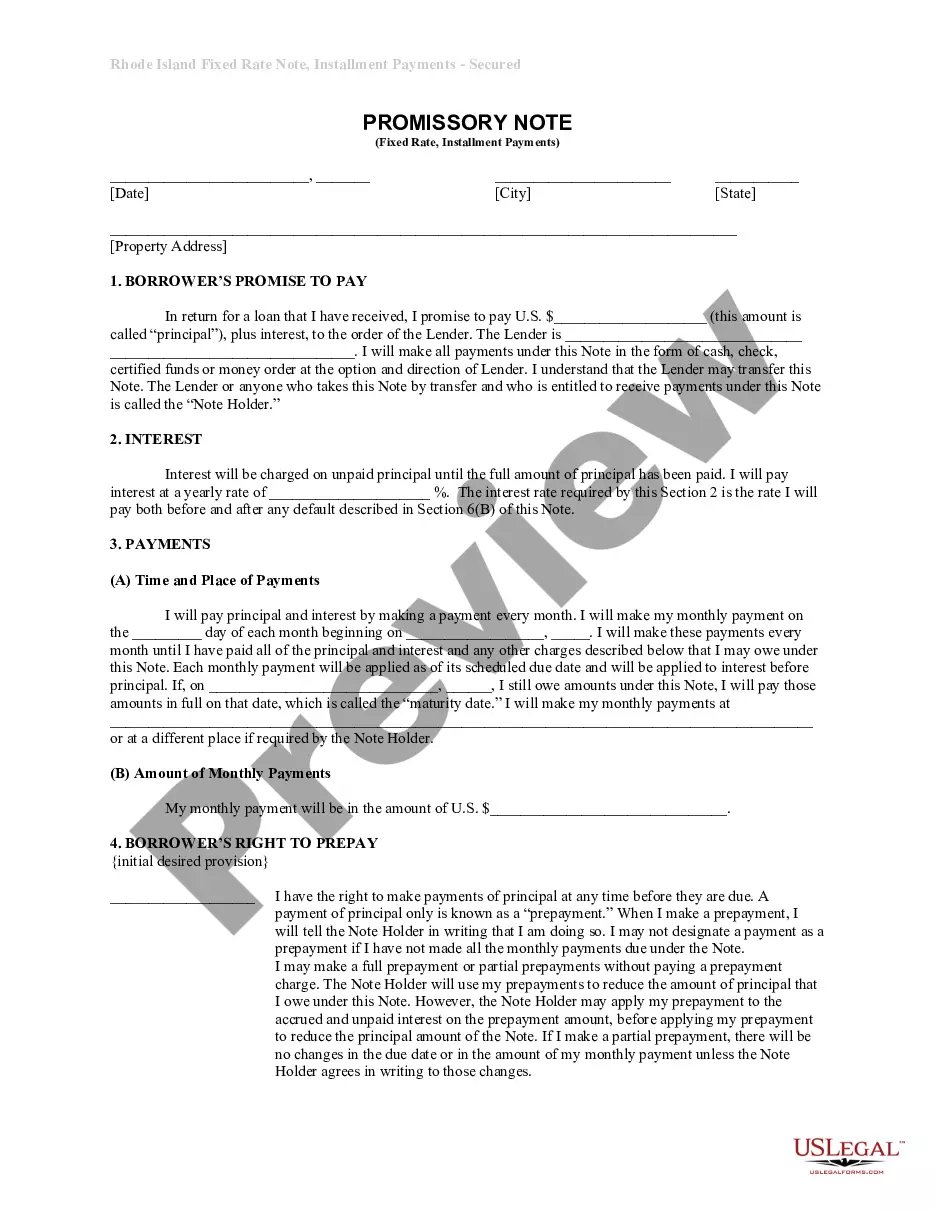
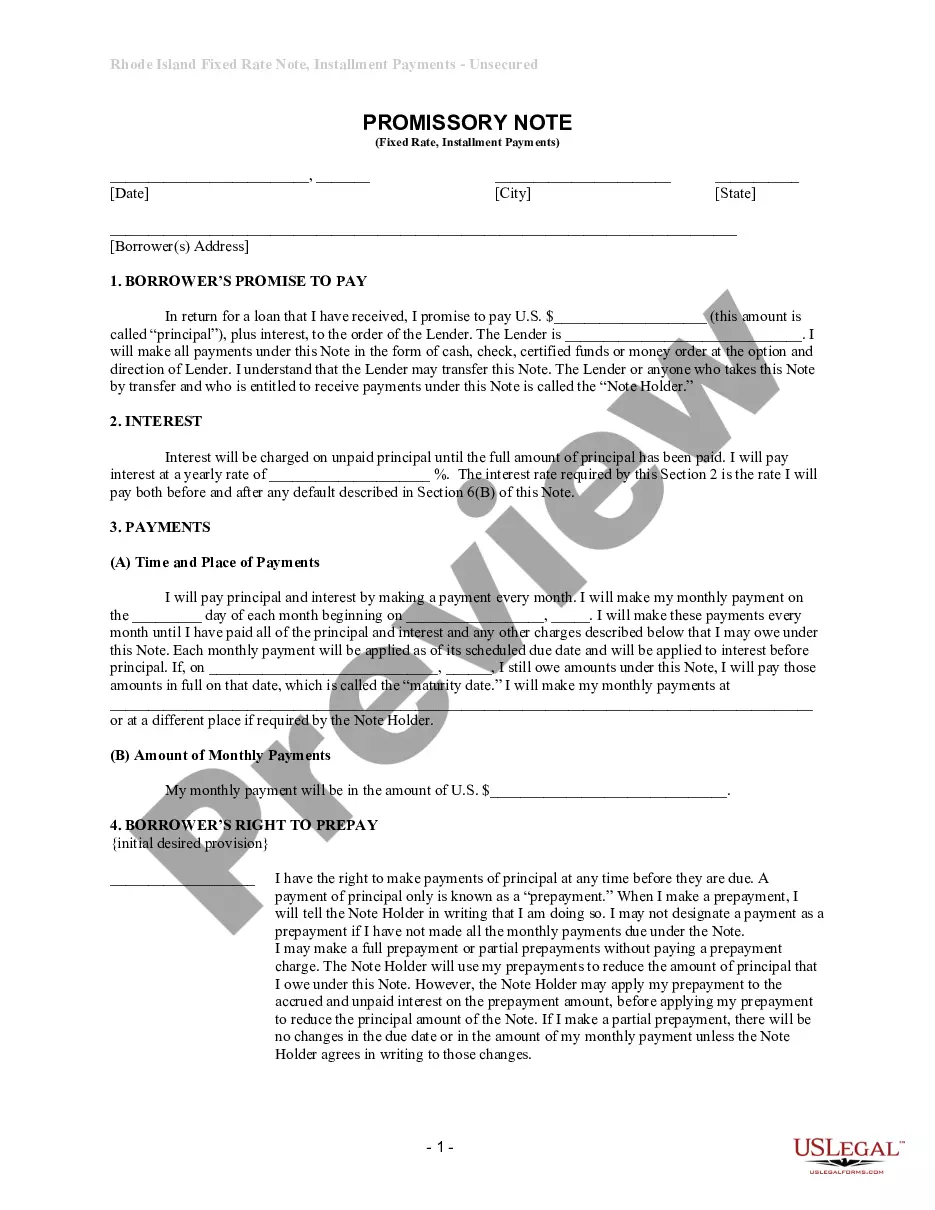
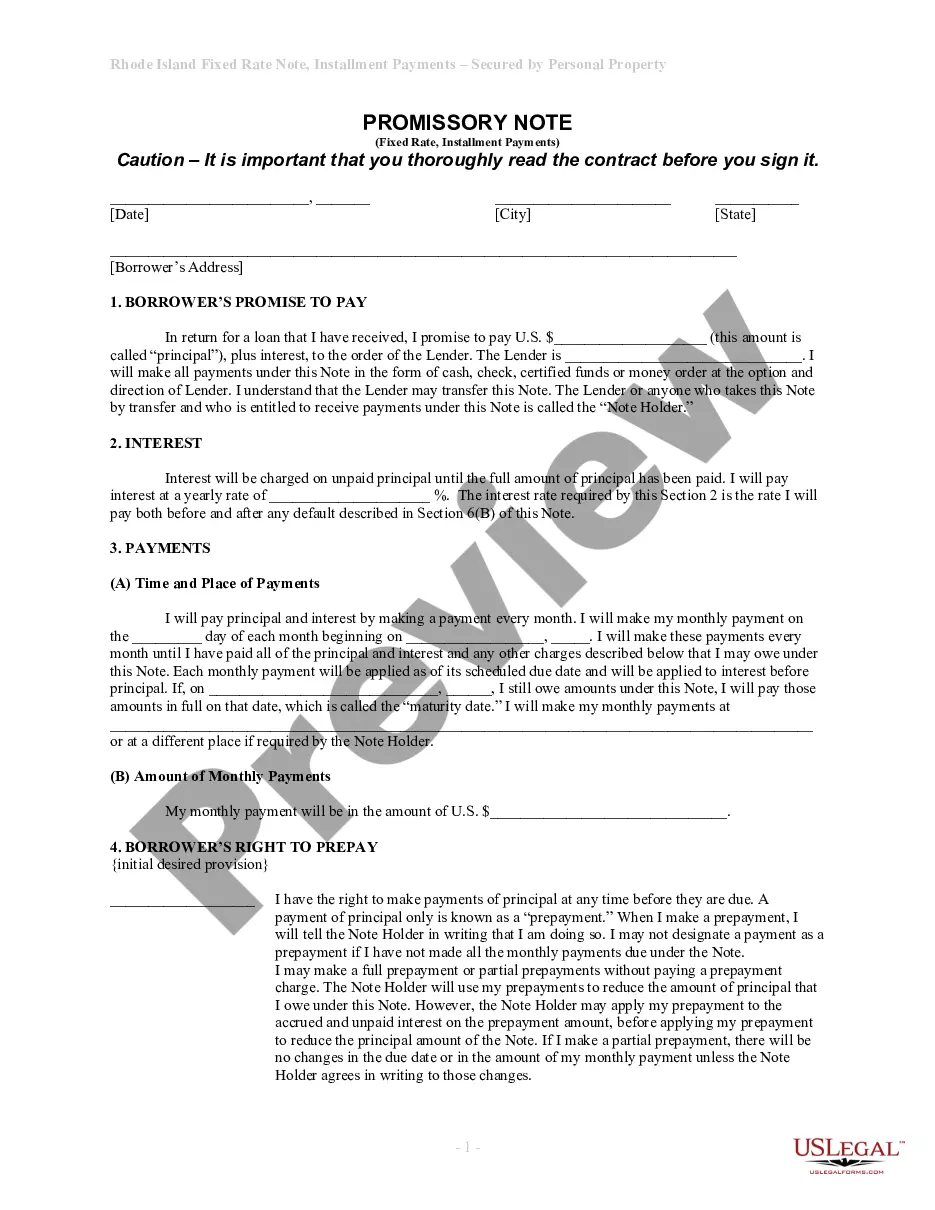
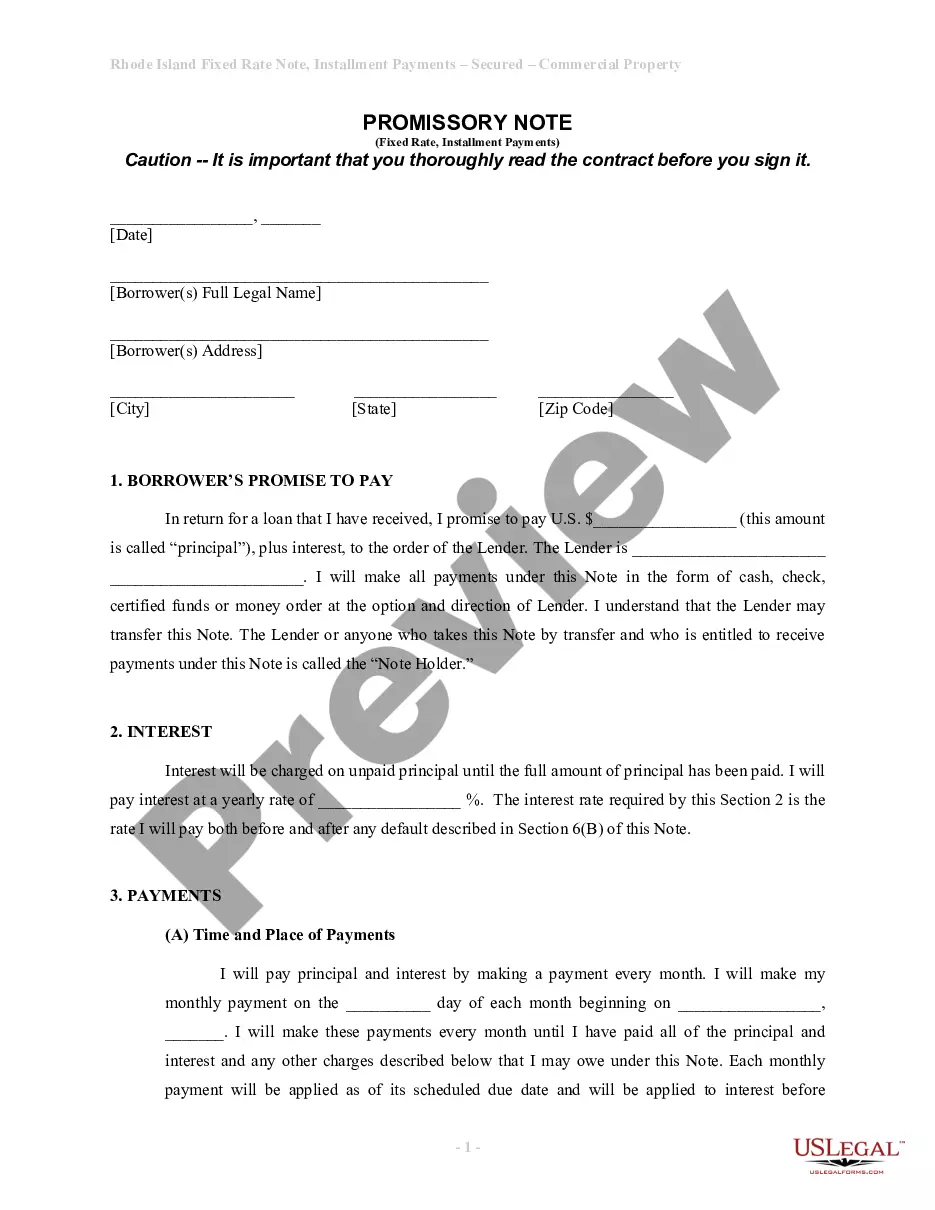
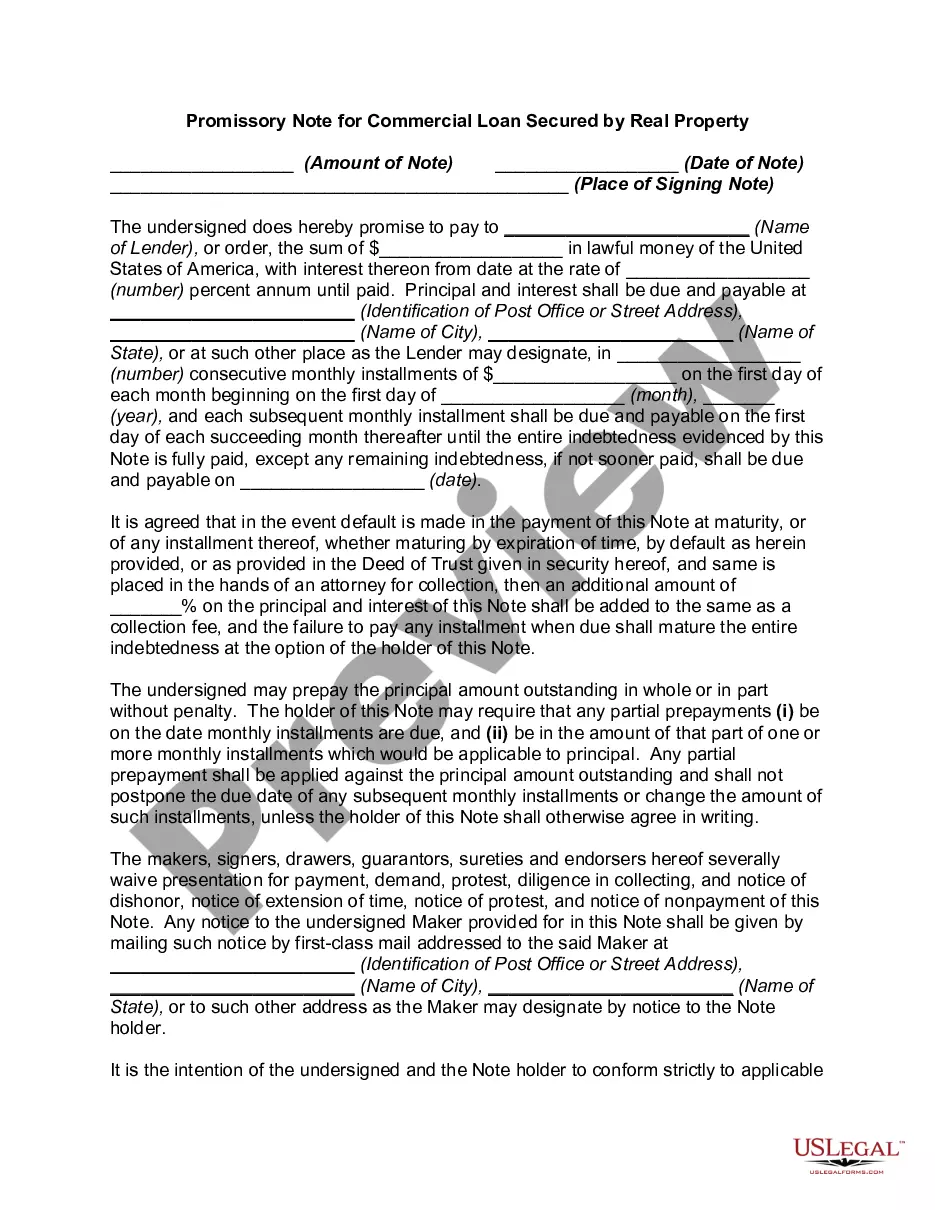
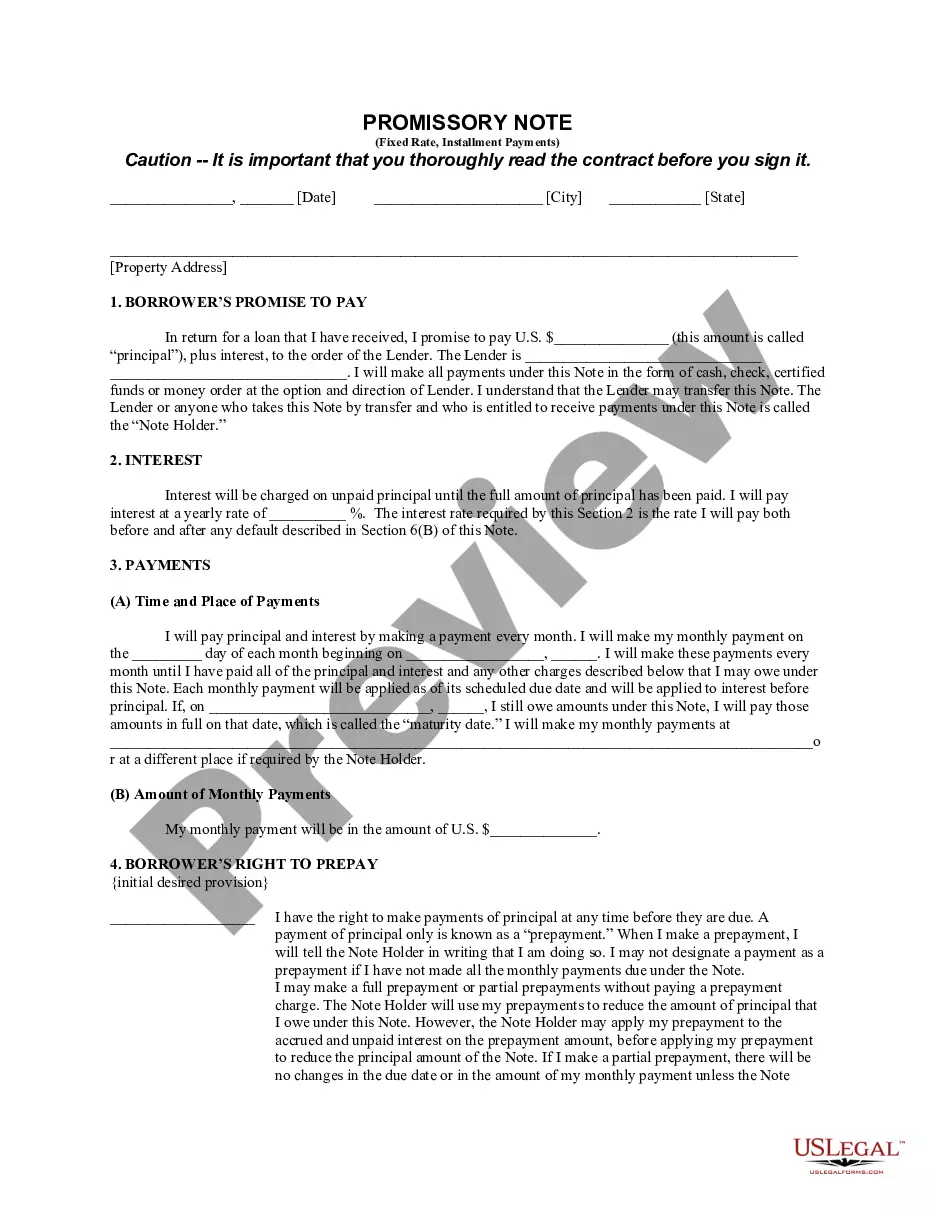
The Rhode Island Installments Fixed Rate Promissory Note Secured by Residential Real Estate is a formal agreement between a borrower and a lender. It outlines the borrower's unconditional promise to repay a specific loan amount, known as the principal, along with interest. This type of promissory note is secured by residential property, distinguishing it from unsecured loan agreements. A separate mortgage or deed of trust is also necessary to protect the lender's interests in the secured property.
Main sections of this form
- Borrower's promise to pay the specified principal and interest.
- Details on the interest rate charged over the life of the loan.
- Payment schedule indicating when monthly payments are due.
- Provisions allowing for prepayment of the loan without penalties.
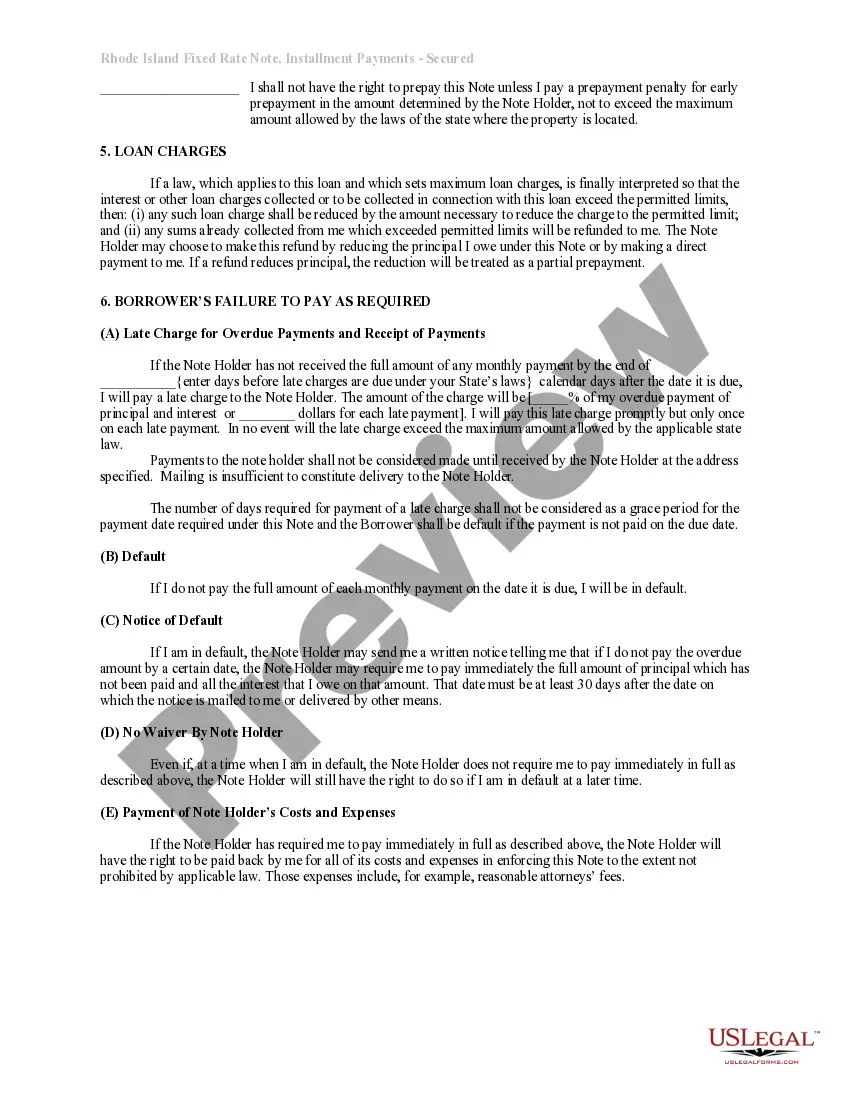
- Conditions regarding late payments and any applicable late fees.
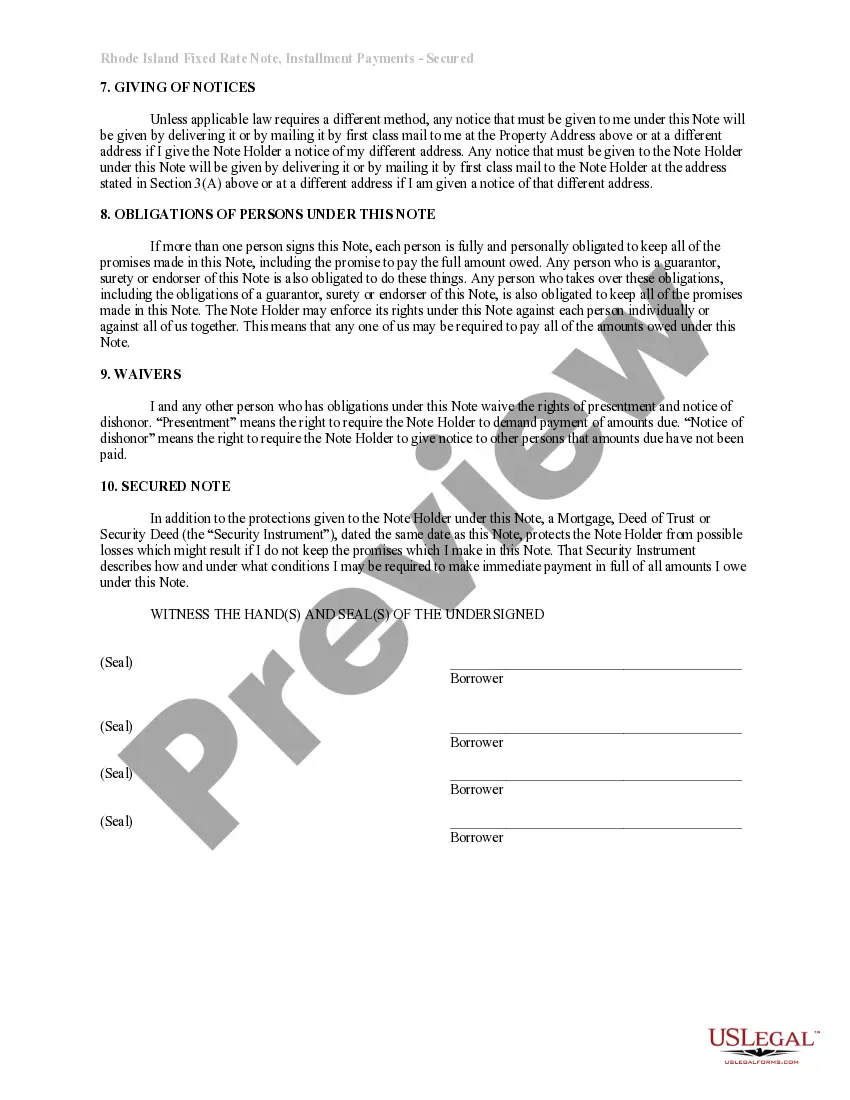
- Rights and obligations of both the borrower and the lender in the event of default.
When this form is needed
This promissory note is useful when securing financing for a home purchase or refinancing an existing mortgage. It helps formalize the terms of the loan between an individual borrower and a lender, creating legal clarity and offering financial security. Use this form when residential real estate serves as collateral for the loan, ensuring both parties understand their rights and obligations regarding repayment.
Intended users of this form
- Individual borrowers seeking a loan secured by residential property.
- Lenders providing loans that require security in the form of real estate.
- Homeowners refinancing their current mortgage with a new loan.
- Real estate professionals facilitating loans for clients.
How to prepare this document
- Identify the parties involved, including full names and addresses of borrowers and lenders.
- Specify the loan amount as the principal and the interest rate to be paid annually.
- Set the schedule for monthly payments, including the start date and payment amount.
- Clarify rights regarding prepayment and any associated penalties.
- Review sections about late payments and defaults, ensuring all relevant fees are noted.
- All parties should sign and date the document to finalize the agreement.
Does this form need to be notarized?
This form does not typically require notarization unless specified by local law. Always check the regulations in your jurisdiction to ensure compliance.
Get your form ready online
Our built-in tools help you complete, sign, share, and store your documents in one place.
Make edits, fill in missing information, and update formatting in US Legal Forms—just like you would in MS Word.
Download a copy, print it, send it by email, or mail it via USPS—whatever works best for your next step.
Sign and collect signatures with our SignNow integration. Send to multiple recipients, set reminders, and more. Go Premium to unlock E-Sign.
If this form requires notarization, complete it online through a secure video call—no need to meet a notary in person or wait for an appointment.
We protect your documents and personal data by following strict security and privacy standards.

Make edits, fill in missing information, and update formatting in US Legal Forms—just like you would in MS Word.

Download a copy, print it, send it by email, or mail it via USPS—whatever works best for your next step.

Sign and collect signatures with our SignNow integration. Send to multiple recipients, set reminders, and more. Go Premium to unlock E-Sign.

If this form requires notarization, complete it online through a secure video call—no need to meet a notary in person or wait for an appointment.

We protect your documents and personal data by following strict security and privacy standards.
Mistakes to watch out for
- Failing to specify the exact payment schedule or amount.
- Not including necessary signatures from all parties involved.
- Ignoring the state's specific requirements regarding interest rates.
- Overlooking terms related to prepayment or late fees.
Benefits of using this form online
- Convenience of downloading and printing the form instantly.
- Editability allows customization to meet specific needs.
- Reliability of documents drafted by licensed attorneys.
Legal use & context
- This promissory note is legally enforceable as a binding contract when completed properly.
- Specific laws in Rhode Island govern the terms and requirements of such notes, providing both parties with legal protections.
- Any deviations from the standard template may require legal consultation to ensure compliance with state laws.
Key takeaways
- The form secures a loan with residential property, protecting the lender's interests.
- Clear terms regarding payment schedules and default conditions help avoid disputes.
- Proper completion and understanding of terms can prevent common mistakes.
Looking for another form?


Form popularity
FAQ
There are only seven note names (A, B, C, D, E, F, G), and each line or space on a staff will correspond with one of those note names. To get all twelve pitches using only the seven note names, we allow any of these notes to be sharp, flat, or natural. Look at the notes on a keyboard. Figure 1.33.
Notes can be either natural, sharp, or flat. The musical alphabet as we've seen is made up of the letters A, B, C, D, E, F and G. But any of these notes can be sharp or flat. In other words, notes on the staff can be as follows: Ab, A, A#, Bb, B, B#, Cb, C, C#, Db, D, D#, Eb, E, E#, Fb, F, F#, Gb, G, and G#.
In the chromatic scale there are 7 main musical notes called A, B, C, D, E, F, and G. They each represent a different frequency or pitch. For example, the "middle" A note has a frequency of 440 Hz and the "middle" B note has a frequency of 494 Hz.
We get the pitches (F, C, G, D, A, E, B, F sharp, C sharp, G sharp, D sharp, A sharp, F)--after which, being back at F, the sequence repeats. We ended up hitting each of the twelve pitches exactly once: first all the naturals, then all the accidentals.
The musical alphabet is, in ascending order by pitch, A, B, C, D, E, F and G. After G, the cycle repeats going back to A. Each line and space on the staff represents a different pitch.
A: A REAL ID-compliant credential costs the same as a standard Rhode Island license or identification card if you obtain it within 90 days or less of your regular time of renewal. It will cost $26.50 to obtain it outside of your regular time of renewal. 16.
Musical notes are named using the first seven letters of the alphabet: A, B, C, D, E, F, and G. These letter names indicate notes in an ascending sequence-from low to high. After the final G note, the sequence begins again: A, B, C, D, E, F, G; A, B, C, D, E, F, G; and so on.
In Western music, there are a total of twelve notes per octave, named A, A#, B, C, C#, D, D#, E, F, F#, G and G#. The sharp notes, or 'accidentals', fall on the black keys, while the regular or 'natural' notes fall on the white keys. As well as sharps, the black keys can also be flats - ie, Bb, Db, Eb, Gb, and Ab.