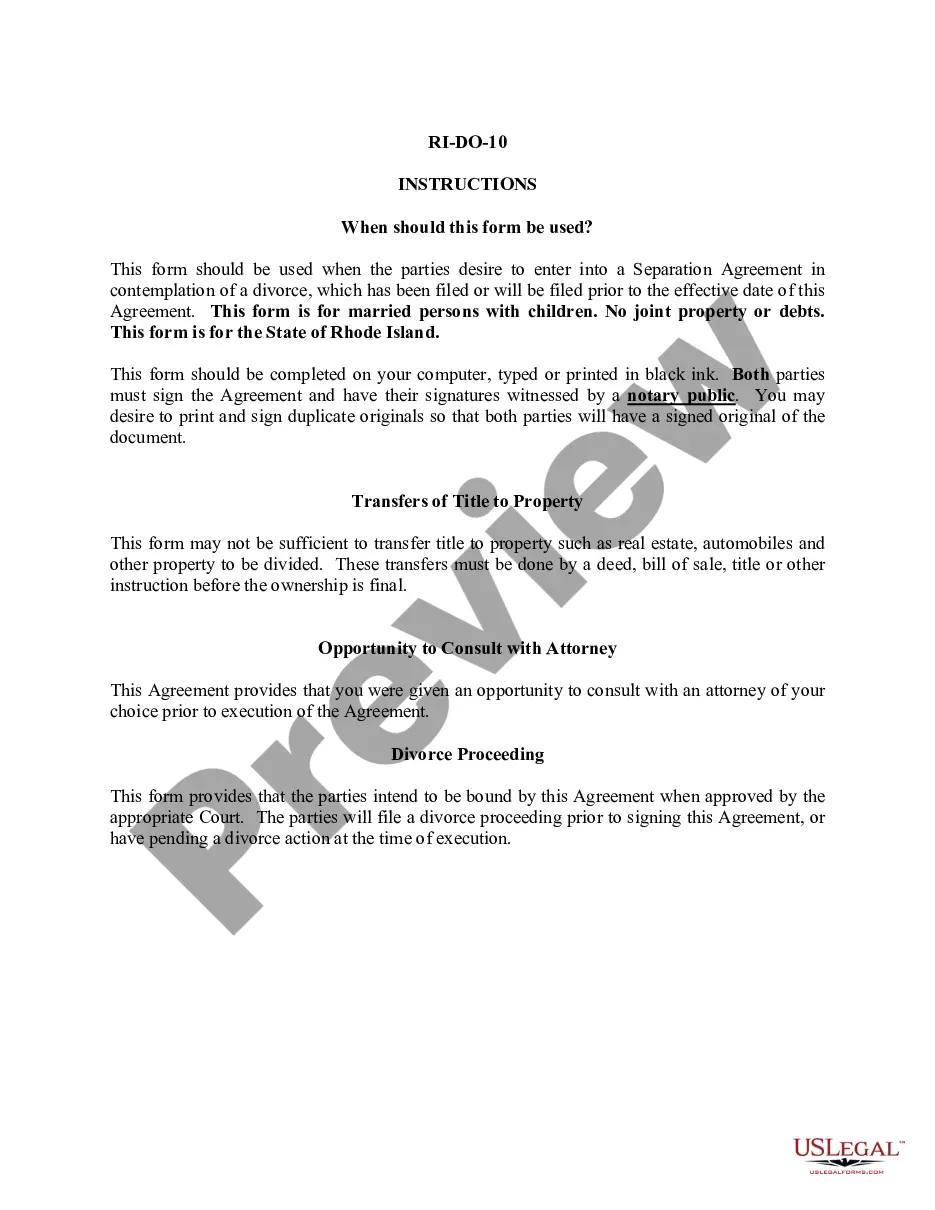
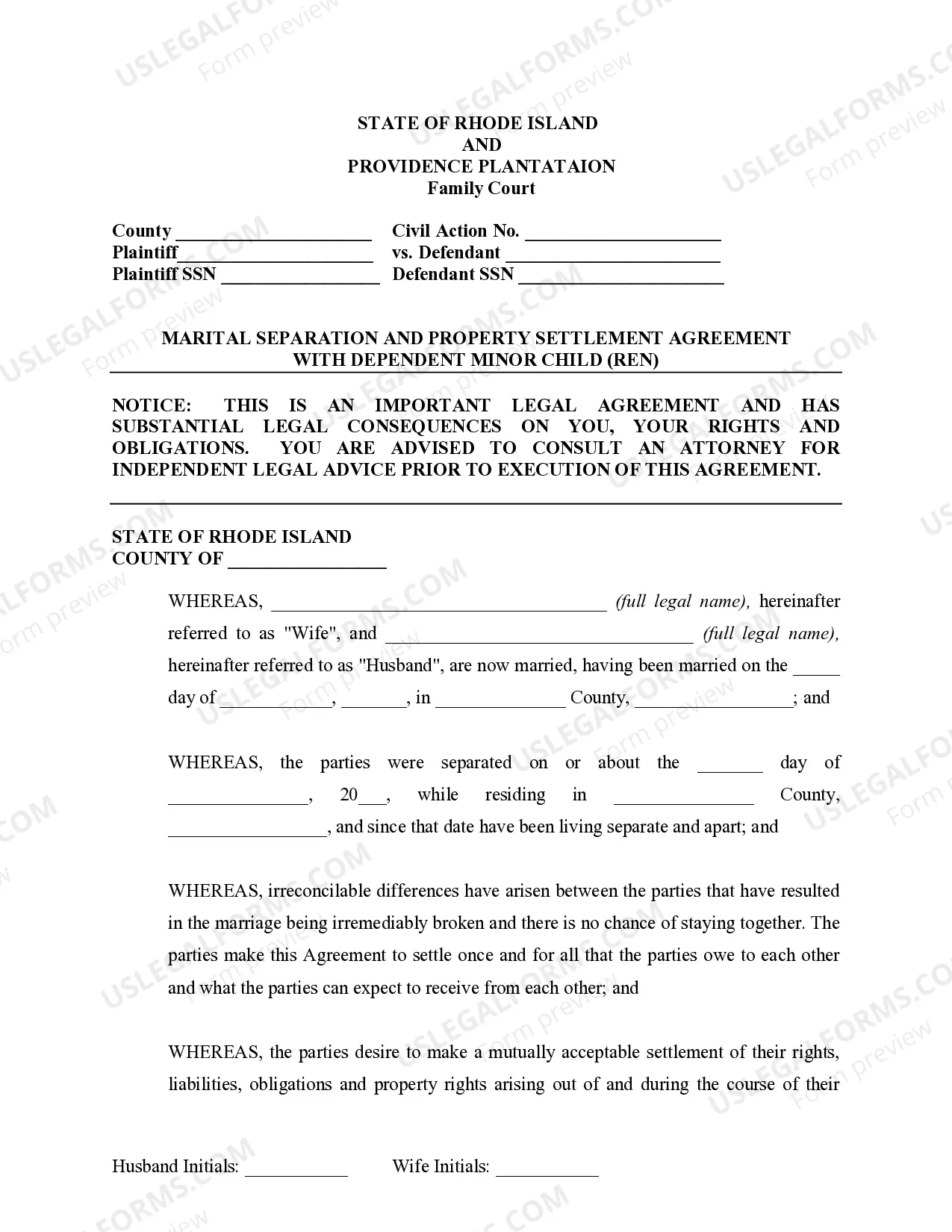
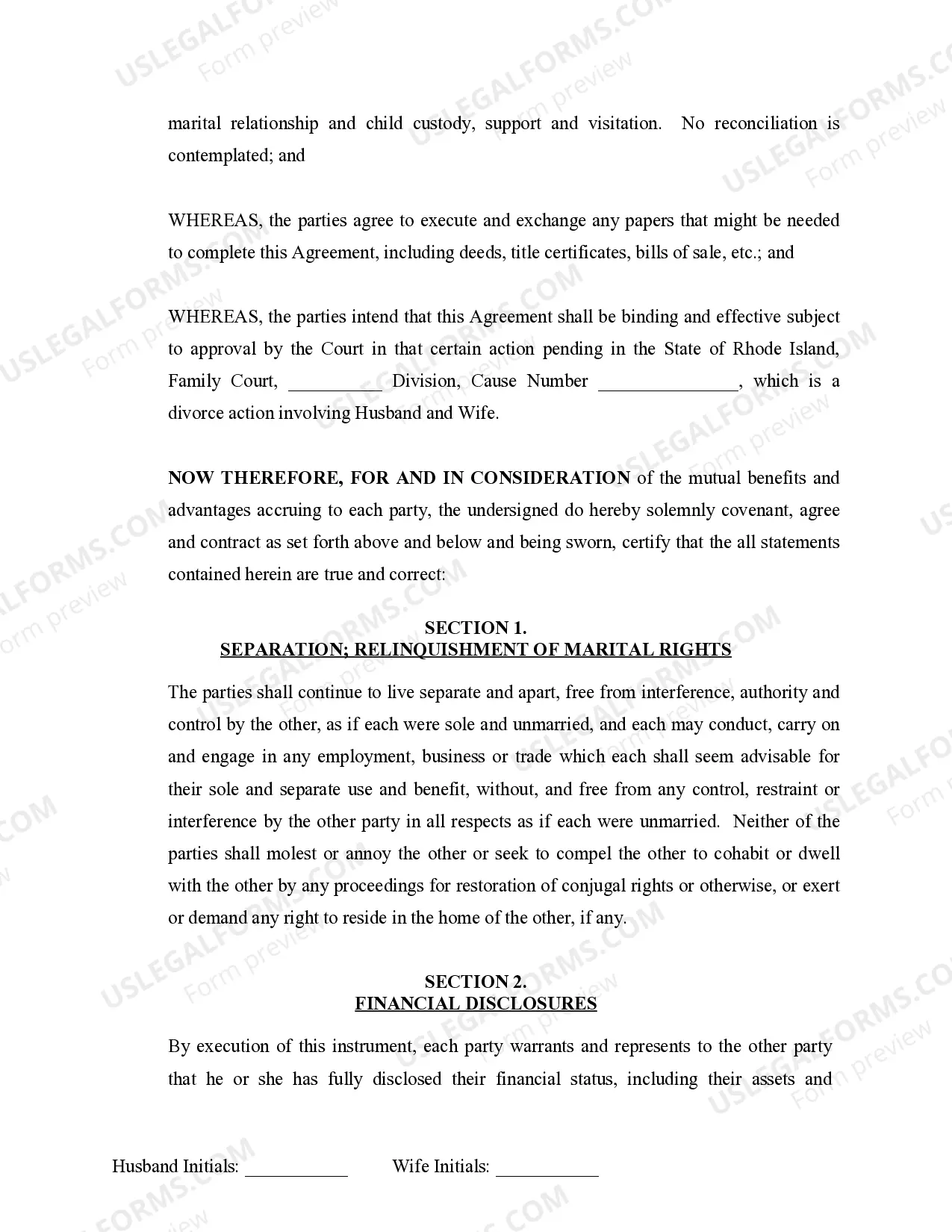
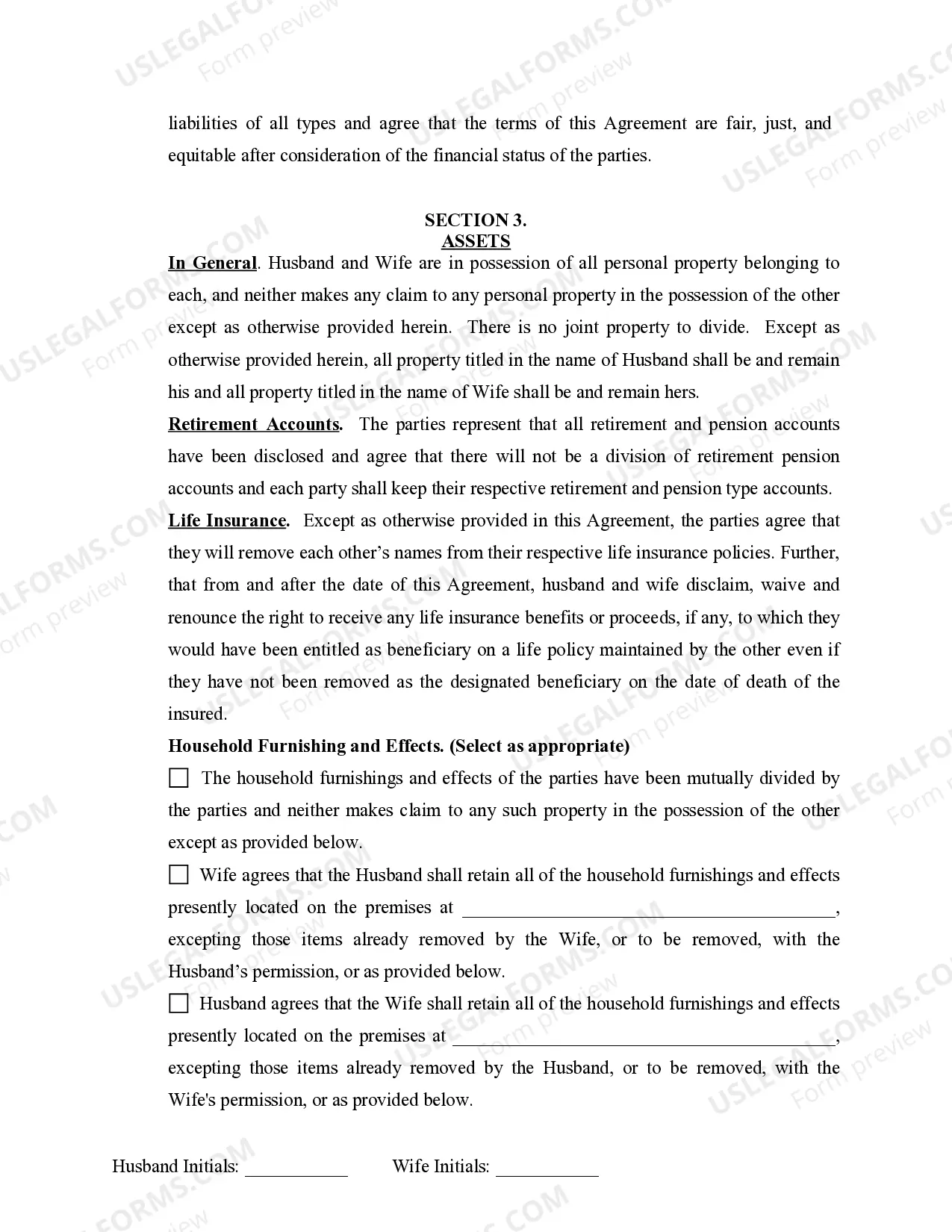
Marital Domestic Separation and Property Settlement Agreement Minor Children no Joint Property or Debts where Divorce Action Filed
Note: This summary is not intended to be an all inclusive
discussion of the law of separation agreements in Rhode Island, but does
include basic and other provisions.
General Summary:
Separation and Property Agreements may be entered into before a divorce is filed to be effective immediately.
When the Agreement is approved by the court and "incorporated" but not
merged into the agreement, it retains its status as an independent contract
between the parties.
An incorporated but not merged agreement retains its independent
contract status and may be enforced as a contract. The Court then
lacks the power to amend the agreement without the agreement of the parties.
Statutes:
Rhode Island General Laws
Title 15 Domestic Relations
CHAPTER 15-5 Divorce and Separation
Assignment of property:
(a) In addition to or in lieu of an order to pay spousal
support made pursuant to a complaint for divorce, the court may assign
to either the husband or wife a portion of the estate of the other. In
determining the nature and value of the property, if any, to be assigned,
the court after hearing the witnesses, if any, of each party shall consider
the following:
(3) The contribution of each of the parties during the marriage
in the acquisition, preservation, or appreciation in value of their respective
estates;
(9) The contribution by one party to the education, training, licensure,
business, or increased earning power of the other;
(10) The need of the custodial parent to occupy or own the marital
residence and to use or own its household effects, taking into account
the best interests of the children of the marriage;
(11) Either party's wasteful dissipation of assets or any transfer
or encumbrance of assets made in contemplation of divorce without fair
consideration; and
(b) The court may not assign property or an interest in the property
held in the name of one of the parties if the property was held by the
party prior to the marriage, but may assign income which has been derived
from the property during the term of the marriage, and the court may assign
the appreciation of value from the date of the marriage of property or
an interest in it which was held in the name of one party prior to the
marriage which increased in value as a result of the efforts of either
spouse during the marriage. The court also shall not assign property or
an interest in the property which has been transferred to one of the parties
by inheritance before, during, or after the term of the marriage. The court
shall not assign property or an interest in the property which has been
transferred to one of the parties by gift from a third party before, during,
or after the term of the marriage.
(c) The assignment of property, if any, to be made shall precede
the award of alimony, since the needs of each party will be affected by
the assignment of property, and once made in a final decree shall be final,
subject only to any right of appeal which the parties may have. Any assignment
made by the family court shall be regarded as a judgment for debt that
suit may be brought or execution may issue on the debt for the property
due and undelivered, or the amount due and unpaid to be shown by affidavits
of the person entitled to the property and the attorney of record of the
person, the executions to run against the goods and chattels of the husband and wife, as the
case may be; and the court may make all necessary orders and decrees concerning
the suits or executions. §15-5-16.1
Child support:
(a) In a proceeding for divorce, divorce from bed and board,
a miscellaneous petition without the filing of divorce proceedings, or
child support, the court shall order either or both parents owing a duty
of support to a child to pay an amount based upon a formula and guidelines
adopted by an administrative order of the family court. If, after calculating
support based upon court established formula and guidelines, the court,
in its discretion, finds the order would be inequitable to the child or
either parent, the court shall make findings of fact and shall order either
or both parents owing a duty of support to pay an amount reasonable or
necessary for the child's support after considering all relevant factors
including, but not limited to:
(b) The court may, if in its discretion it deems it necessary or advisable,
order child support and education costs for children attending high school
at the time of their eighteenth (18th) birthday and for ninety (90) days
after graduation, but in no case beyond their nineteenth (19th) birthday.
In addition, the court may order child support to continue, in the case
of a child with a severe physical or mental impairment, until the twenty-first
(21st) birthday of the child.
(c) The court may, if in its discretion it deems it necessary or
advisable, appoint an attorney or a guardian ad litem to represent the
interest of a minor or dependent child with respect to his or her support,
custody, and visitation. The court shall enter an order for costs, fees,
and disbursements in favor of the child's attorney. The order shall be
made against either or both parents. After a decree for support has been
entered, the court may from time to time upon the petition of either party,
review and alter its decree relative to the amount of support and the payment
of it, and may make any decree relative to support which it might have
made in the original suit. The decree may be made retroactive in the court's
discretion only to the date that notice of a petition to modify was given
to the adverse party if the court finds that a substantial change in circumstances
has occurred; provided, the court sets forth in its decision the specific
findings of fact which show a substantial change in circumstances and upon
which findings of facts the court has decided to make the decree retroactive.
(d) In a proceeding to enforce a child support order, or a spousal
support order for a custodial parent having custody of a minor child, the
court or its magistrate may assign to the obligee any tangible personal
property of the obligor that will be sufficient to satisfy the child or
spousal support arrearage owed. The court or its magistrate, after a hearing,
shall establish the amount of the child or spousal support arrearage, and
the nature and value of the tangible personal property. To effect the assignment,
the court or its magistrate may order the obligor to execute and deliver
the documents of title which may be necessary to complete the transfer
of title to the property, and may order the obligor to deliver possession
of the property to the obligee. Whenever the obligor fails to comply with
the order assigning the property, the order of assignment shall be regarded
as a judgment vesting title to the property in the obligor as fully and
completely as if the obligor had executed and delivered the documents of
title.
(2) Any order for child support issued by the family court
shall contain a provision requiring either or both parents owing a duty
of support to a child to obtain health insurance coverage for the child
when coverage is available to the parent or parents through their employment
without cost or at a reasonable cost. Any existing child support orders
may be modified in accordance with this subsection unless the court makes
specific written findings of fact that take into consideration the best
interests of the child and conclude that a child support order would be
unjust or inappropriate in a particular case.
(e) In a proceeding to establish support, the court in its discretion
may, after opportunity for hearing, issue a temporary order for child support
payable into the registry of the court and to be held pending entry of
judgment. In the event of a final adjudication requiring no payment or
payments in an amount less than those payments which have been made pursuant
to a temporary order under this section, the defendant shall be entitled
to a refund of all or a portion of the amounts so paid.
(f) In any proceeding to establish support, or in any case in which
an obligor owes past due support, for a child or children receiving public
assistance pursuant to chapter 5.1 of title 40, the court or its magistrate,
upon a finding that an able bodied absent parent is unemployed, underemployed
or otherwise lacks sufficient income or resources from which to make payment
of support equal to the public assistance payment for the child or children,
or is unable to pay the arrearages in accordance with a payment plan, may
order that parent to perform unpaid community service for at least twenty
(20) hours per week through community service placements arranged and supervised
by the department of human services and/or the division of taxation within
the department of administration. The performance of community service
shall not be a basis for retroactive suspension of arrears due and owing.
(g) In any proceeding to establish support for a minor child whose
adjudicated parent is a minor (minor-parent), the court or its magistrate
may order a grandparent of the minor child to reimburse the department
of human services in an amount not to exceed the total amount of cash assistance
benefits paid to or for the minor child pursuant to chapter 5.1 of title
40 until the minor-parent reaches the age of eighteen (18), less any payment
made to the department by the minor parent.
(2) It is declared that the obligation of reimbursement
for the minor child shall be the joint and several responsibility of the
minor parent and the grandparent(s) until the minor parent reaches the
age of eighteen (18) and provided, that each joint obligor shall have a
right of contribution against each joint obligor, which right shall be enforceable by an action in the family court.
(h) All support orders established or modified in the state on or after
October 1, 1998, shall be recorded with the Rhode Island family court/department
of administration, division of taxation child support computer enforcement
system which maintains the official registry of support orders entered
from then on in accordance with applicable administrative orders issued
by the Rhode Island family court. The support order shall be recorded whether
or not services are being provided under the IV-D state plan.
(2) Each party to a paternity or child support proceeding
shall be required to file with the family court, upon the entry of the
order, the appropriate form as provided by family court, which includes
the full name of the parties, residential and mailing address, telephone
number, drivers license number, social security number and the name, address
and telephone number of the employer. The form shall also include the full
order amount and date and amount of arrearages if any, the name of the
child(ren), their date of birth, address and social security number and
any other information as required by administrative order.
(3) Thereafter, each party is required to file an amended form whenever
any of the information contained on the original form has been changed
in any way, within ten (10) days of the change. The information shall be
entered in the child support enforcement computer system within five (5)
business days of receipt of the amended form.
(i) In any subsequent child support enforcement action between the
parties, upon sufficient showing that diligent effort has been made to
ascertain the location of a party, the court may deem state due process
requirements for notice and service of process to be met with respect to
the party, upon service by first class mail or, where appropriate, by service
as specified in the Rhode Island rules of procedure for domestic relations
for the Family Court of Rhode Island, of written notice to the most recent
residential or employer address of record. §15-5-16.2
Case Law:
In Riffenburg v. Riffenburg 585 A.2d 627 (R.I. 1991), both the divorce decree and
the agreement specifically stated that the agreement was to be incorporated but not merged into the divorce decree.
As such the agreement survived as an independent, enforceable contract
between the two parties.
In Riffenburg v. Riffenburg 585 A.2d 627 (R.I. 1991), the Rhode Island court held that the Family Court has no
authority to modify a separation agreement which has been incorporated
by reference but not merged into a final divorce judgment.
When a term of a property settlement agreement is ambiguous and
may be construed in different ways this court has held that it will adopt
that construction which is most equitable and which will not give to one
party an unconscionable advantage over
another. Flynn v. Flynn, 615 A.2d 119, 122 (R.I. 1992).
The Rhode Island courts adhered to the well-settled principle that
modification of contracts can only be accomplished by the contracting parties.
We further held that the judiciary has no authority to modify alimony in
a nonmerged separation agreement. Flynn v. Flynn, 615 A.2d 119,
122 (R.I. 1992).