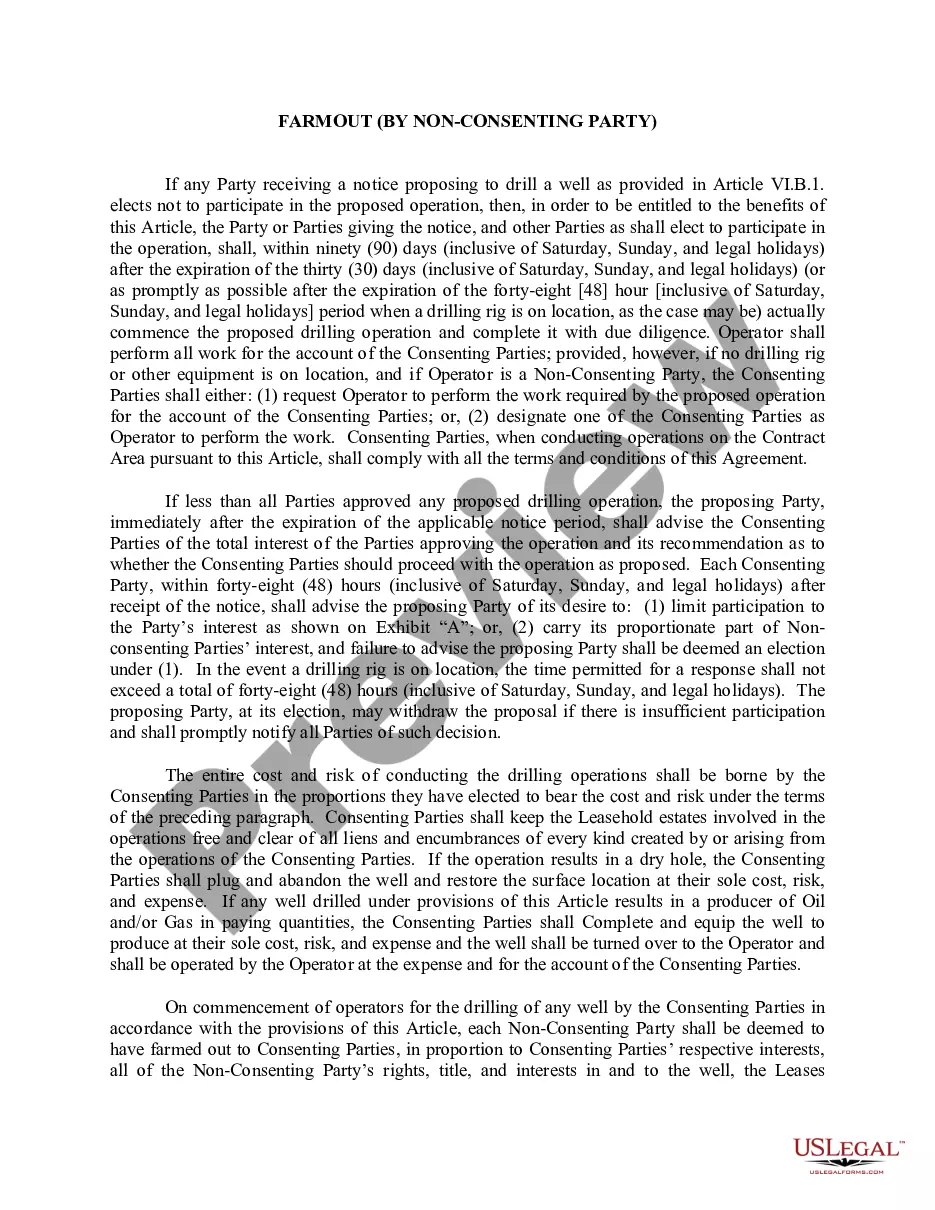
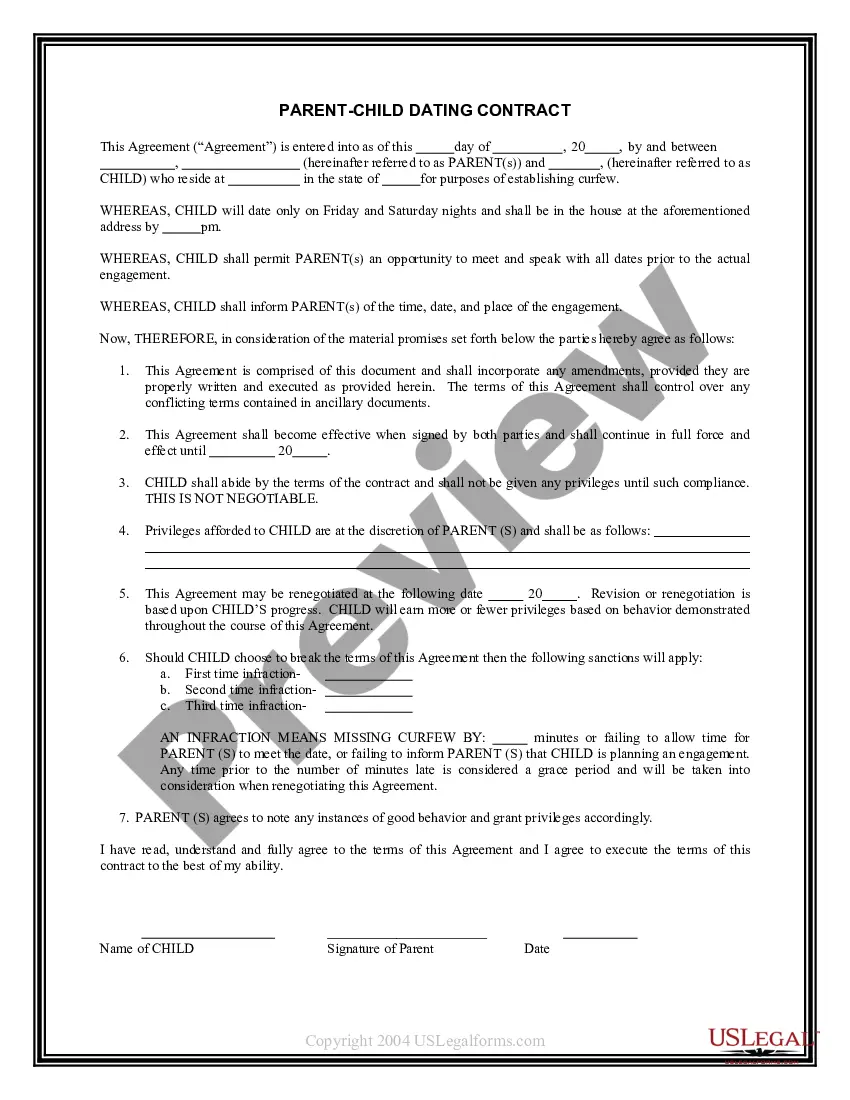
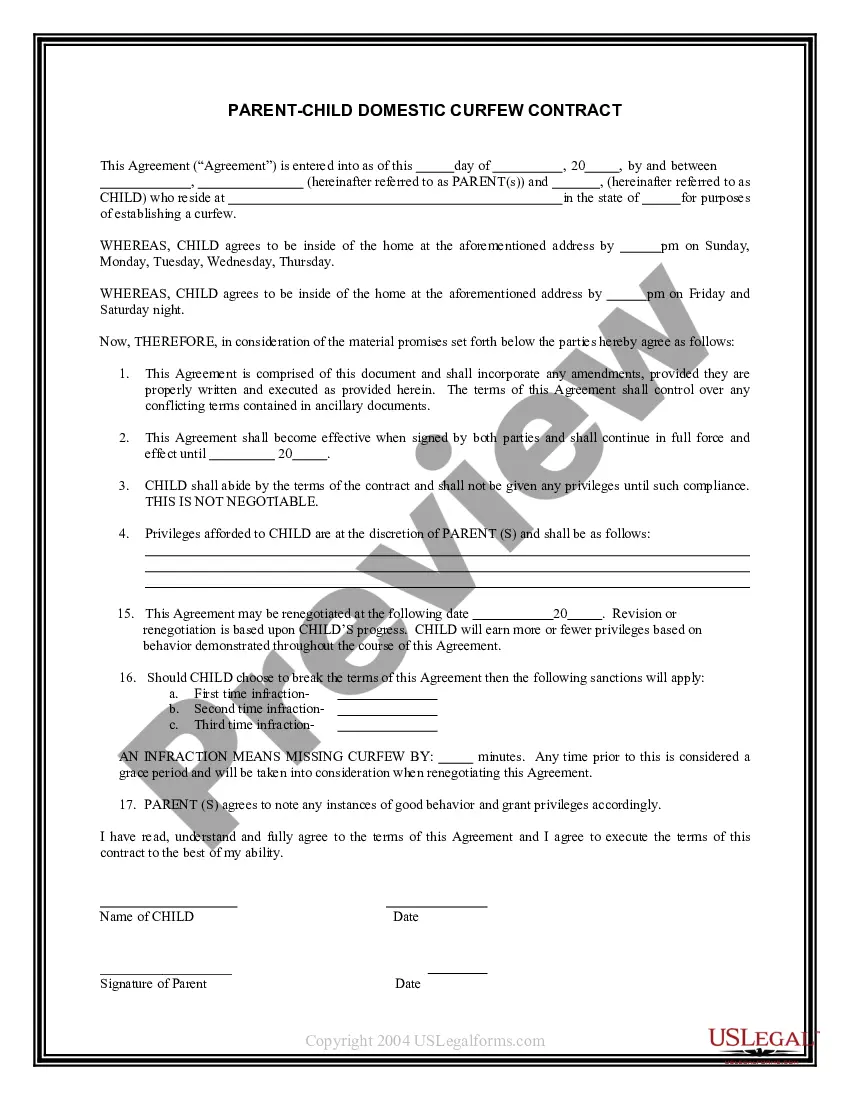
This is a contract between parent(s) and child detailing the days that child is allowed to go on a date and the time that child is required to be home. This contract also indicates what repercussions will follow if child refuses to abide by its terms.
Pennsylvania Parent - Child Dating Contract
Category:
State:
Multi-State
Control #:
US-PC06
Format:
Word;
Rich Text
Instant download
Description
Get your form ready online
Our built-in tools help you complete, sign, share, and store your documents in one place.
Built-in online Word editor
Make edits, fill in missing information, and update formatting in US Legal Forms—just like you would in MS Word.
Export easily
Download a copy, print it, send it by email, or mail it via USPS—whatever works best for your next step.
E-sign your document
Sign and collect signatures with our SignNow integration. Send to multiple recipients, set reminders, and more. Go Premium to unlock E-Sign.
Notarize online 24/7
If this form requires notarization, complete it online through a secure video call—no need to meet a notary in person or wait for an appointment.
Store your document securely
We protect your documents and personal data by following strict security and privacy standards.

Make edits, fill in missing information, and update formatting in US Legal Forms—just like you would in MS Word.

Download a copy, print it, send it by email, or mail it via USPS—whatever works best for your next step.

Sign and collect signatures with our SignNow integration. Send to multiple recipients, set reminders, and more. Go Premium to unlock E-Sign.

If this form requires notarization, complete it online through a secure video call—no need to meet a notary in person or wait for an appointment.

We protect your documents and personal data by following strict security and privacy standards.
Looking for another form?




How to fill out Parent - Child Dating Contract?
US Legal Forms - one of the best collections of legal documents in the United States - offers a variety of legal form templates that you can download or print. By using the website, you can find thousands of forms for business and personal purposes, categorized by types, states, or keywords.
You can find the latest versions of forms such as the Pennsylvania Parent - Child Dating Agreement in moments. If you already have an account, Log In and download the Pennsylvania Parent - Child Dating Agreement from the US Legal Forms library. The Download button will appear on each form you view. You can access all previously downloaded forms in the My documents section of your account.
If you are using US Legal Forms for the first time, here are simple instructions to get started: Ensure you have selected the correct form for your city/county. Click on the Review button to look over the form's content. Check the form summary to confirm you have chosen the right one. If the form does not meet your requirements, utilize the Search field at the top of the screen to find the one that does. If you are satisfied with the form, confirm your selection by clicking the Get now button. Then, choose the payment plan you prefer and provide your details to register for an account. Complete the transaction. Use your credit card or PayPal account to finalize the purchase. Choose the format and download the form to your device. Make modifications. Fill out, edit, print, and sign the downloaded Pennsylvania Parent - Child Dating Agreement. Every template you added to your account has no expiration date and is yours indefinitely. So, if you want to download or print another copy, just visit the My documents section and click on the form you wish to access.
- Access the Pennsylvania Parent - Child Dating Agreement with US Legal Forms, the most extensive collection of legal document templates.
- Utilize thousands of professional and state-specific templates that meet your business or personal requirements and needs.
Form popularity
FAQ
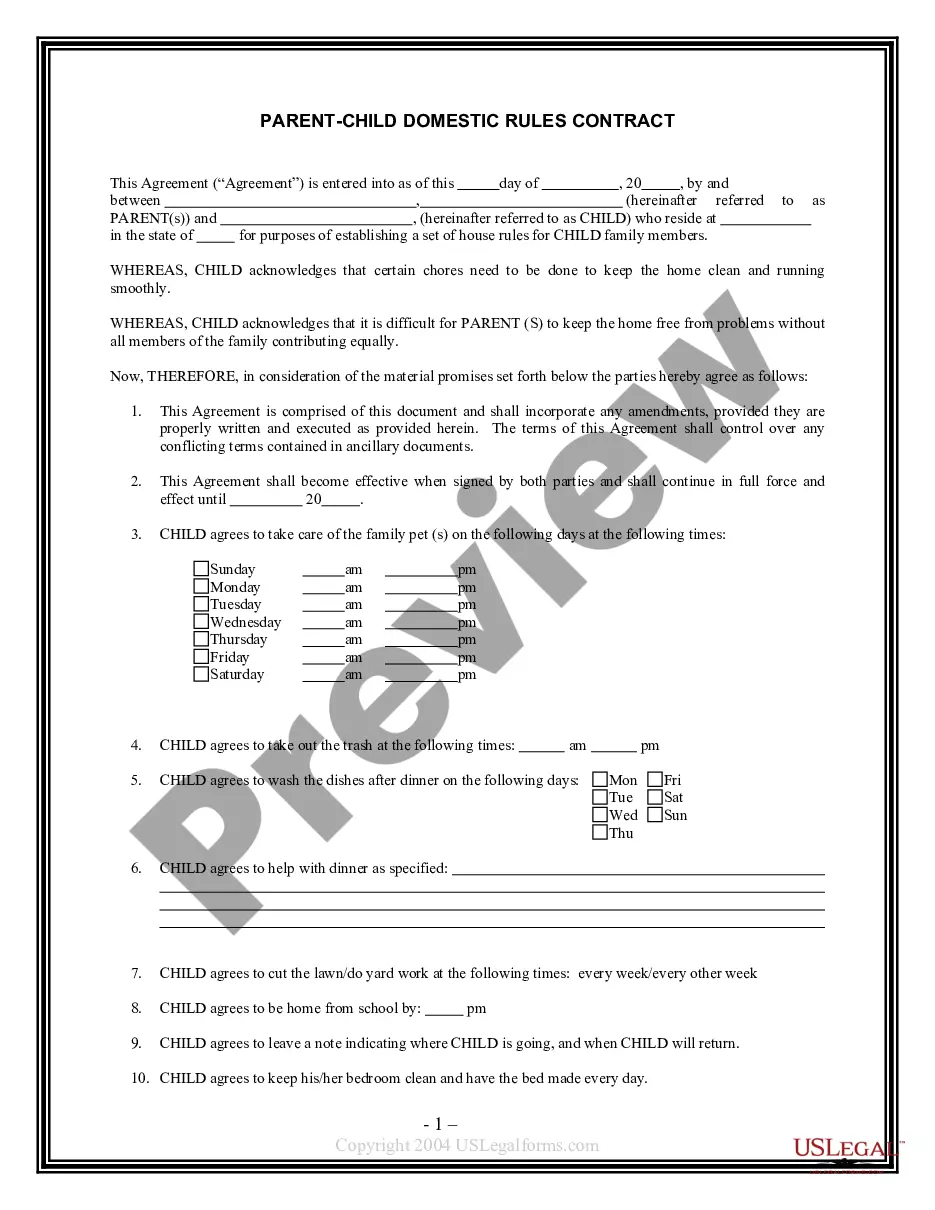
Writing a contract between a parent and a child involves discussing and outlining clear expectations and responsibilities. Start by identifying the key areas you want to address, such as behavior, curfews, and privileges. Utilizing a Pennsylvania Parent - Child Dating Contract template from US Legal Forms can streamline this process, ensuring that both parties understand and agree to the terms, thereby fostering a respectful relationship.
The best witnesses for a child custody trial often include teachers, family friends, or therapists who can provide objective insights into your parenting abilities. Their testimony can illustrate your positive interactions with your child and your commitment to their well-being. Additionally, having a well-documented Pennsylvania Parent - Child Dating Contract can serve as supporting evidence of your responsible parenting choices.
One significant mistake in a custody battle is allowing emotions to cloud your judgment. This can lead to poor decisions that may harm your case or relationship with your child. It’s crucial to approach the situation rationally and consider using a Pennsylvania Parent - Child Dating Contract to outline expectations and responsibilities, which can help reduce conflict and improve communication.
An unstable parent typically exhibits inconsistent behavior that may threaten the child's safety or emotional well-being. This may include unpredictable moods, substance abuse issues, or an inability to provide a stable living environment. When navigating a custody situation, having a clear Pennsylvania Parent - Child Dating Contract can help demonstrate your dedication to fostering a secure and nurturing space for your child.
In a custody battle, actions that may appear detrimental include failing to communicate effectively with your co-parent, neglecting your child's needs, or exhibiting unstable behavior. Demonstrating a lack of involvement in your child's life can also negatively impact your case. It is essential to maintain a positive image, especially when establishing a Pennsylvania Parent - Child Dating Contract, as it showcases your commitment to your child's well-being.
At What Age Can My Child Refuse Visitation? Contrary to popular belief, there is no specific age at which a child can refuse to see a parent or comply with a custody order. In fact, Pennsylvania law defines a "child" as an unemancipated individual under 18 years of age.
They appear to be uniformly surprised to learn that a minor child does not have the legal right to decide which parent to live with. Depending on the jurisdiction in which you live, the age of your child may matter only in terms of the weight a judge might give to a child's preference, should he or she have one.
In law, there is no fixed age that determines when a child can express a preference as to where they want to live. However, legally, a child cannot decide who they want to live with until they are 16 years old. Once a child reaches the age of 16, they are legally allowed to choose which parent to live with.
As most family law attorneys will tell you, legally, the age when a child can decide is 18. At this age they are no longer a child and subject to a custody action. Until that time it is never up to a child. There is no magic age before they turn 18.
There is no magic age before they turn 18. A judge must take a child's preference into account, along with that child's age, maturity and other factors. But the final decision is always up to the judge. Simply put, in a custody action, a child has a voice but not a choice.