Pennsylvania Quitclaim Deed from LLC to LLC or Corporation
Understanding this form
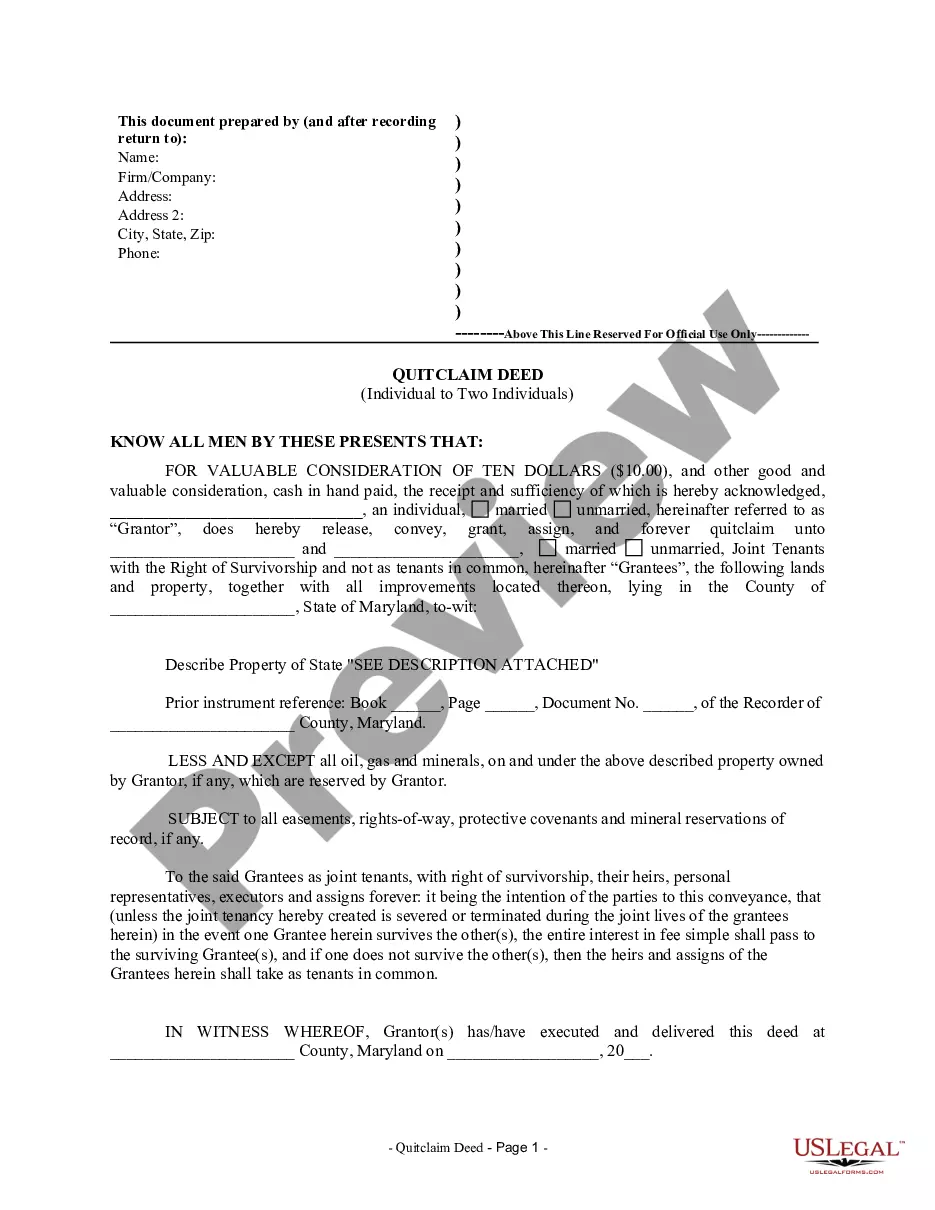
This Quitclaim Deed from LLC to LLC or Corporation is a legal document that allows a limited liability company (Grantor) to transfer its interest in a property to another limited liability company or a corporation (Grantee). This form is unique as it provides a way to convey property without guaranteeing that the Grantor holds clear title, differing fundamentally from a warranty deed that offers such guarantees. The form complies with state statutory laws, ensuring its validity in applicable jurisdictions.
Key components of this form
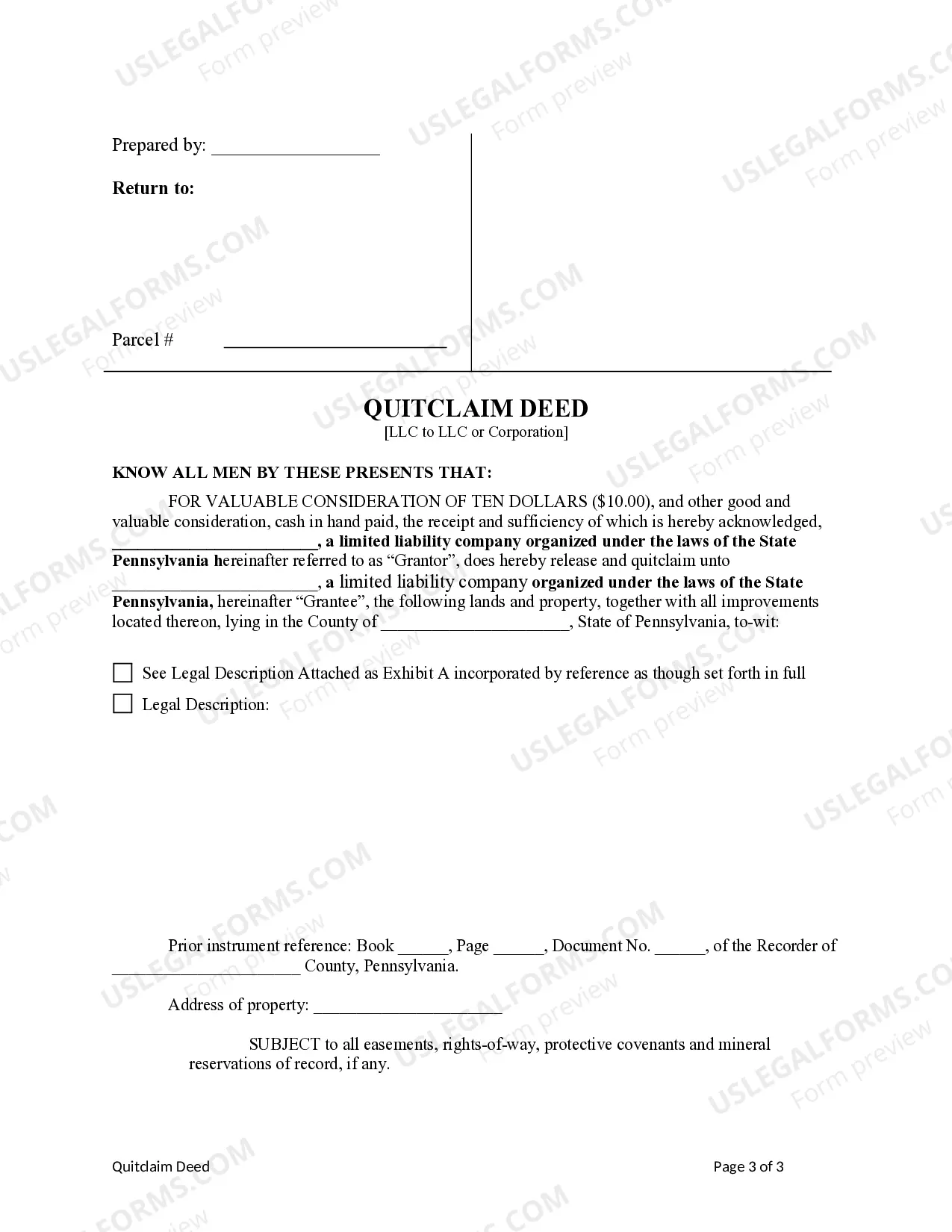
- Names of the Grantor and Grantee
- Legal description of the property
- Statement of the Grantor relinquishing interest
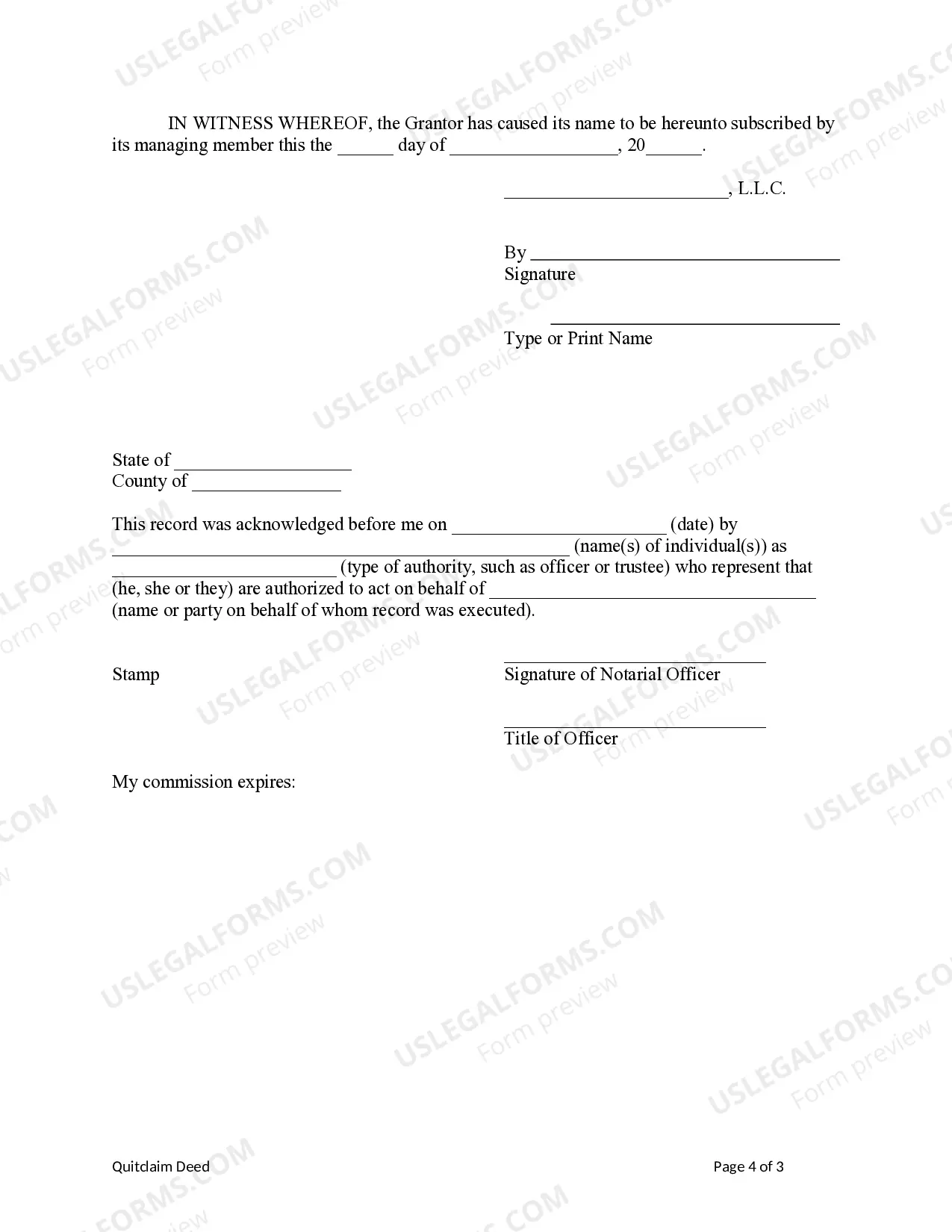
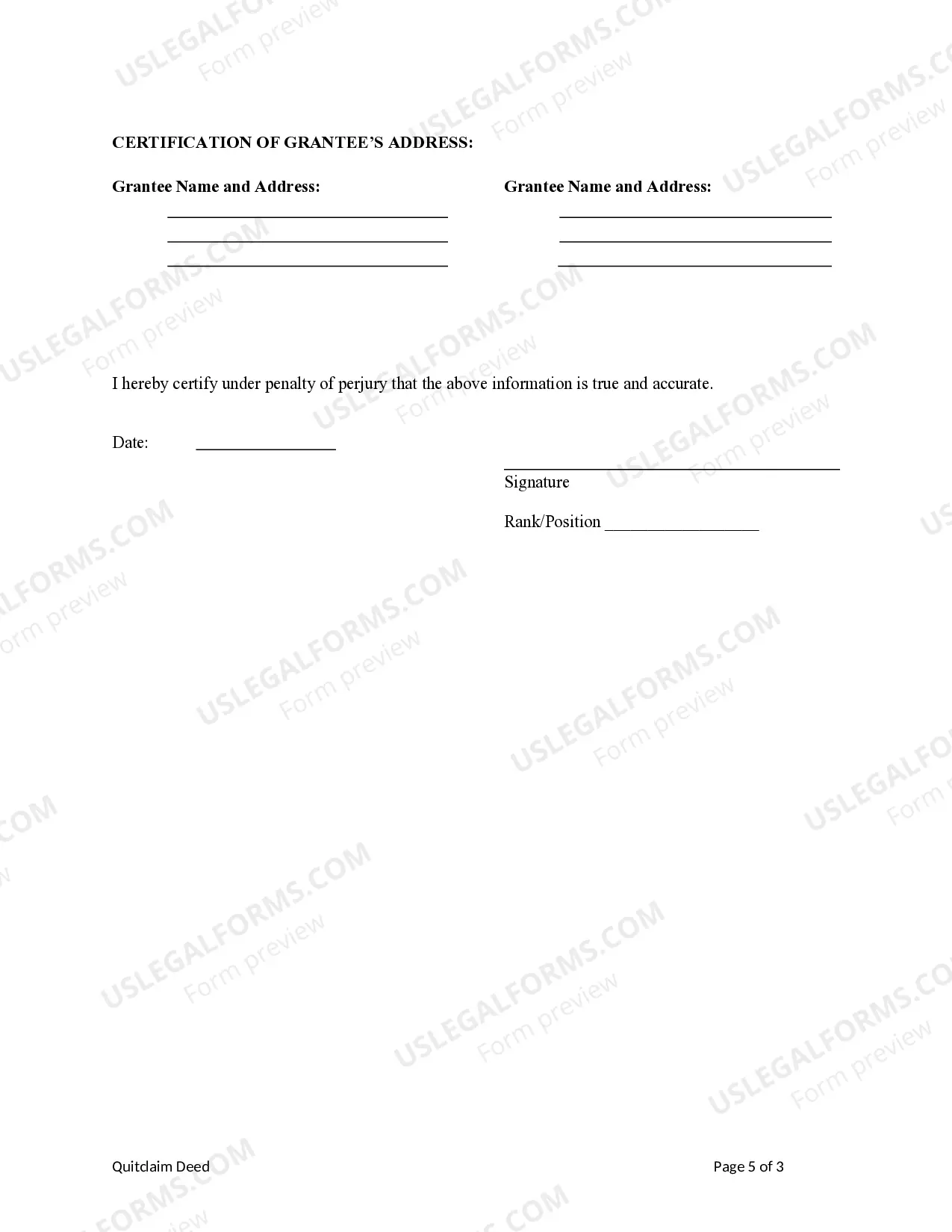
- Execution date and signatures
- Witness and notary sections, if applicable




Situations where this form applies
This form is typically used when an LLC wishes to transfer property ownership to another LLC or corporation, whether for business restructuring, property sale, or estate planning purposes. It is particularly relevant when no warranties regarding the property title are needed.
Who this form is for
This form is intended for:
- Limited liability companies looking to transfer real estate to another business entity
- Corporations receiving property from an LLC
- Real estate professionals managing property transactions among business entities
How to complete this form
- Identify the parties involved by filling in the names of the Grantor and Grantee.
- Provide a detailed legal description of the property to be transferred.
- Enter the date of execution of the deed.
- Ensure the appropriate signatures are included from the authorized representatives of the LLC.
- If applicable, have the form notarized according to state requirements.
Is notarization required?
This form does not typically require notarization unless specified by local law. However, including notarization can add an extra layer of validity to the transaction.
Get your form ready online
Our built-in tools help you complete, sign, share, and store your documents in one place.
Make edits, fill in missing information, and update formatting in US Legal Forms—just like you would in MS Word.
Download a copy, print it, send it by email, or mail it via USPS—whatever works best for your next step.
Sign and collect signatures with our SignNow integration. Send to multiple recipients, set reminders, and more. Go Premium to unlock E-Sign.
If this form requires notarization, complete it online through a secure video call—no need to meet a notary in person or wait for an appointment.
We protect your documents and personal data by following strict security and privacy standards.

Make edits, fill in missing information, and update formatting in US Legal Forms—just like you would in MS Word.

Download a copy, print it, send it by email, or mail it via USPS—whatever works best for your next step.

Sign and collect signatures with our SignNow integration. Send to multiple recipients, set reminders, and more. Go Premium to unlock E-Sign.

If this form requires notarization, complete it online through a secure video call—no need to meet a notary in person or wait for an appointment.

We protect your documents and personal data by following strict security and privacy standards.
Typical mistakes to avoid
- Failing to include a complete legal description of the property.
- Not obtaining the necessary signatures from authorized officers of the LLC.
- Overlooking the need for notarization, which can invalidate the deed.
- Using the form without checking state-specific requirements that may differ from the standard.
Why use this form online
- Convenient access and immediate download of your legal form, saving time.
- Editable fields allow for accurate completion on your computer.
- Secure and compliant with legal standards, ensuring protection for all parties involved.
- Easy to print and use for physical documentation as needed.
Legal use & context
- The Quitclaim Deed transfers ownership of property without warranties about the title.
- This form is enforceable once properly executed according to state laws.
- It is advisable to consult with a qualified attorney for complex transactions involving significant assets.
Summary of main points
- The Quitclaim Deed transfers property rights from one LLC to another without warranty.
- Ensure all parties are correctly identified and the property description is complete.
- Review state-specific regulations to ensure compliance with local laws.
- Consider the need for notarization and proper execution for legal validity.
Looking for another form?
Form popularity
FAQ
To transfer property in Pennsylvania, you'll need to prepare and execute a deed and record it in the county where the property is located. If the transfer was in exchange for money, you'll have to pay transfer tax.
But you might be wondering if an owner can transfer a deed to another person without a real estate lawyer. The answer is yes. Parties to a transaction are always free to prepare their own deeds.A quitclaim deed, for example, is far simpler than a warranty deed.
You'll need to pay a fee, which varies from county to county. For example, in Montgomery County, near Philadelphia, the fee for recording a deed is $86.75 for up to four pages and up to four names, and $1 per additional name and $4 per additional page.
It's usually a very straightforward transaction, but it's possible for a quitclaim deed to be challenged. If a quitclaim deed is challenged in court, the issue becomes whether the property was legally transferred and if the grantor had the legal right to transfer the property.
To use a Quitclaim Deed to add someone to a property deed or title, you would need to create a Quitclaim Deed and list all of the current owners in the grantor section. In the grantee section, you would list all of the current owners as well as the person you would like to add.
Fill in the deed form. Print it out. Have the grantor(s) and grantee(s) sign and get the signature(s) notarized. Fill out a Statement of Value form, if necessary. Get the Uniform Parcel Number (UPI) on the deed certified, if required by your county.
How to Quitclaim Deed to LLC. A quitclaim deed to LLC is actually a very simple process. You will need a deed form and a copy of the existing deed to make sure you identify titles properly and get the legal description of the property.
Quitclaim deeds are most often used to transfer property between family members. Examples include when an owner gets married and wants to add a spouse's name to the title or deed, or when the owners get divorced and one spouse's name is removed from the title or deed.
Step 1: Form an LLC or Corporation. You can't transfer your real estate property, or any other personal property, into your LLC or corporation until you've actually formed a new legal entity. Step 2: Complete a Quitclaim Deed. Step 3: Record Your Quitclaim Deed.