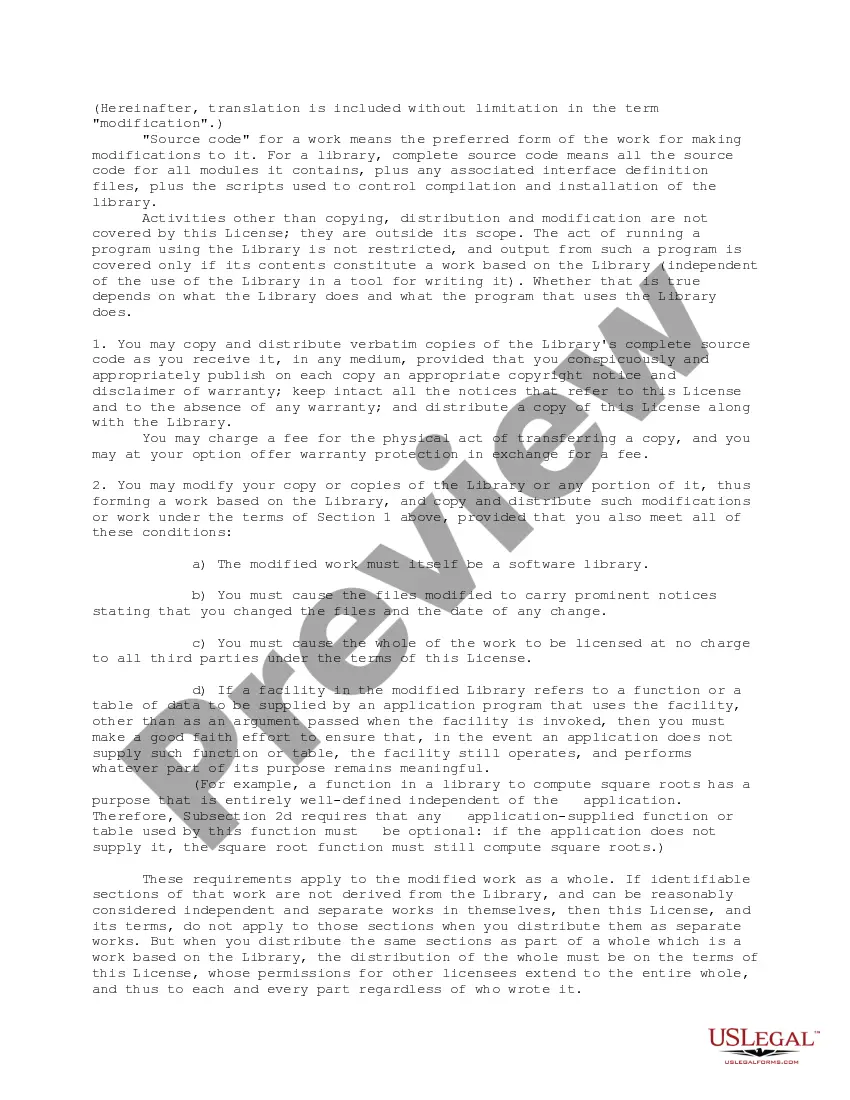
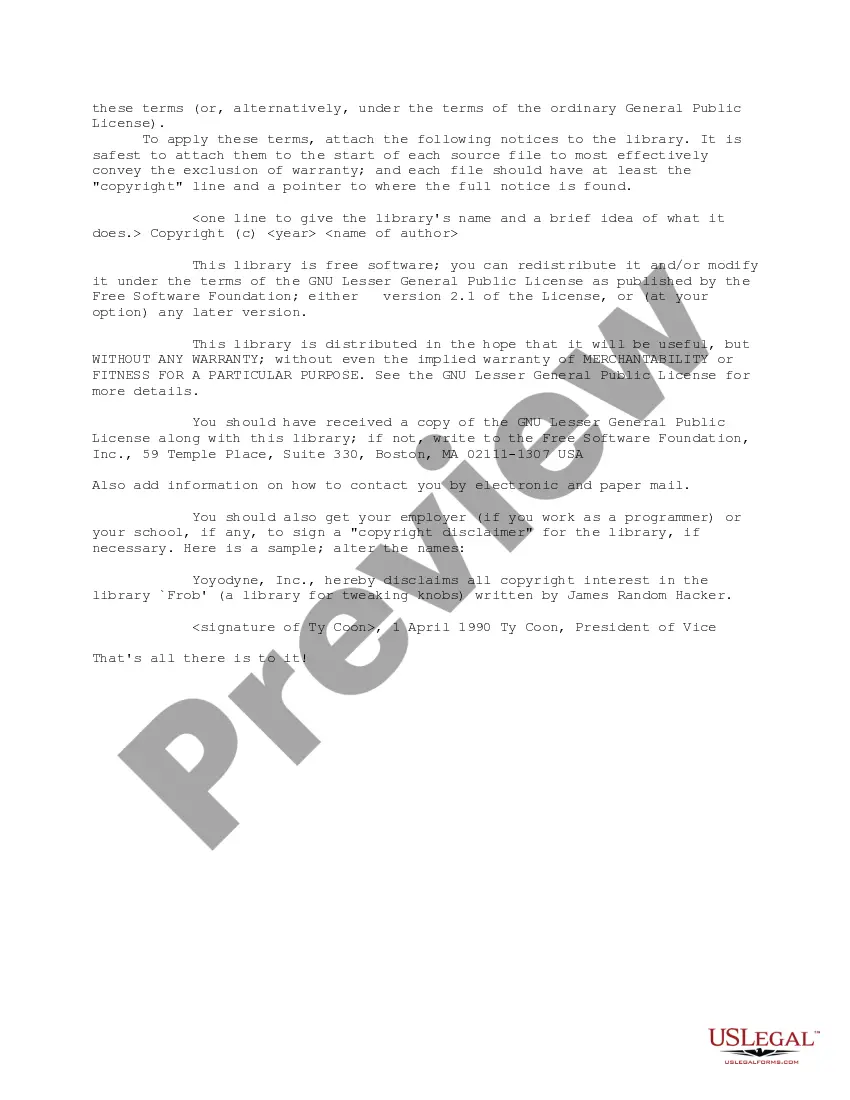
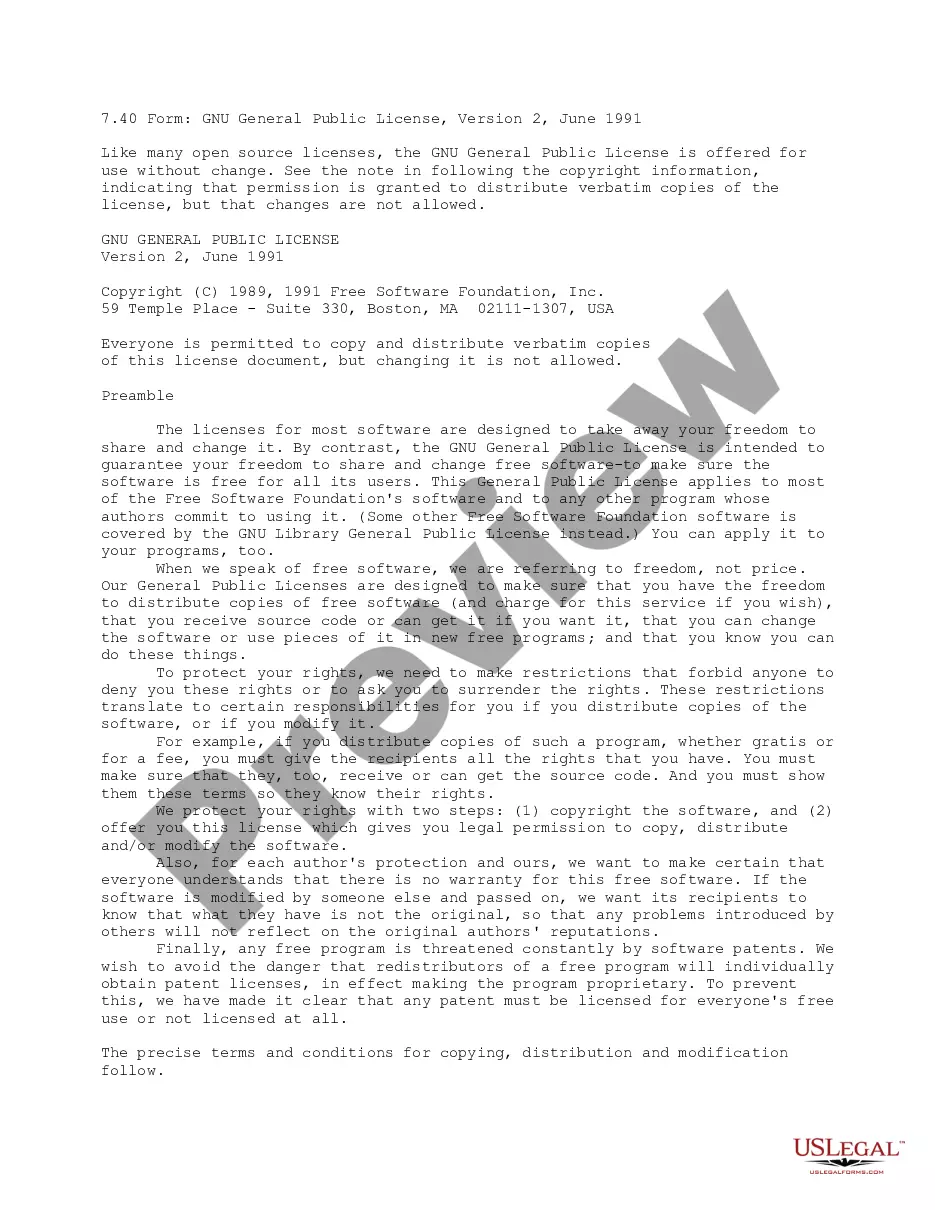
This license contains the terms and conditions needed to make free software libraries
available to the public. With this license, the software can be changed under certain
conditions and redistributed.
Oregon GNU Lesser General Public License
Instant download
Description
Free preview
Get your form ready online
Our built-in tools help you complete, sign, share, and store your documents in one place.
Built-in online Word editor
Make edits, fill in missing information, and update formatting in US Legal Forms—just like you would in MS Word.
Export easily
Download a copy, print it, send it by email, or mail it via USPS—whatever works best for your next step.
E-sign your document
Sign and collect signatures with our SignNow integration. Send to multiple recipients, set reminders, and more. Go Premium to unlock E-Sign.
Notarize online 24/7
If this form requires notarization, complete it online through a secure video call—no need to meet a notary in person or wait for an appointment.
Store your document securely
We protect your documents and personal data by following strict security and privacy standards.

Make edits, fill in missing information, and update formatting in US Legal Forms—just like you would in MS Word.

Download a copy, print it, send it by email, or mail it via USPS—whatever works best for your next step.

Sign and collect signatures with our SignNow integration. Send to multiple recipients, set reminders, and more. Go Premium to unlock E-Sign.

If this form requires notarization, complete it online through a secure video call—no need to meet a notary in person or wait for an appointment.

We protect your documents and personal data by following strict security and privacy standards.
Looking for another form?

How to fill out GNU Lesser General Public License?
You might spend hours online searching for the legal document template that meets the federal and state requirements you need.
US Legal Forms provides thousands of legal forms that can be reviewed by experts.
You can conveniently download or print the Oregon GNU Lesser General Public License from my service.
If available, use the Preview button to browse through the document template simultaneously.
- If you already possess a US Legal Forms account, you can Log In and click on the Obtain button.
- Then, you can complete, modify, print, or sign the Oregon GNU Lesser General Public License.
- Every legal document template you purchase is yours indefinitely.
- To obtain another copy of the purchased form, navigate to the My documents tab and click on the appropriate button.
- If you are using the US Legal Forms website for the first time, follow the simple instructions below.
- First, make sure you have selected the correct document template for your state/city.
- Review the form outline to ensure you have chosen correctly.
Form popularity
FAQ
The GNU Lesser General Public License provides several benefits, particularly for software developers in Oregon. It allows you to incorporate open-source libraries into your applications without the obligation to disclose your proprietary code, as long as you comply with its terms. By choosing the Oregon GNU Lesser General Public License, you gain access to a wealth of community-driven resources while fostering innovation. This balance encourages collaboration and expansion of software capabilities without compromising your project's integrity.
You may copy, distribute and modify the software as long as you track changes/dates of in source files and keep modifications under GPL. You can distribute your application using a GPL library commercially, but you must also provide the source code.
1 (LGPL v2. 1 for short) is a variation of the regular GNU General Public License (GPL). Originally known as the GNU Library General Public License, it was drafted by the Free Software Foundation (FSF) to provide a weaker (or Lesser) form of copyleft for use in certain specific circumstances.
Applying LGPL to a library ensures that the library itself and any modified versions of it will remain open source. But it can be used by closed source software.
You can license your commercial application under the GPLv3 license as long as you comply with the terms of the GPLv3 license. You may discover, however that these terms do not work so well in your favor, since one of the terms prevents you from adding restrictions to the license.
Short answer is yes, you can sell your application under any license you like.
The GNU Lesser General Public License (LGPL) is a member of the GNU family of open source licenses, along with the GNU GPL v2, the GNU GPL v3, and the GNU AGPL License.
The GNU General Public License (GPL) is a free, copyleft license used primarily for software. The GNU GPL allows users to change and share all versions of a program. GPL is provided through the Free Software Foundation, a nonprofit corporation that works to provide free software for the GNU Project.
Yes a company can use it internally. The GPL just says a person with the binary can request source. So if only the people with the binary are in the company then only they can request source.
You can use and distribute LGPL libraries on your website and use them in combination with commercial code. The only big restriction is that you must keep the library open source, including any modifications you make to it, and allow your users to obtain the source, licence and copyright information for the library.