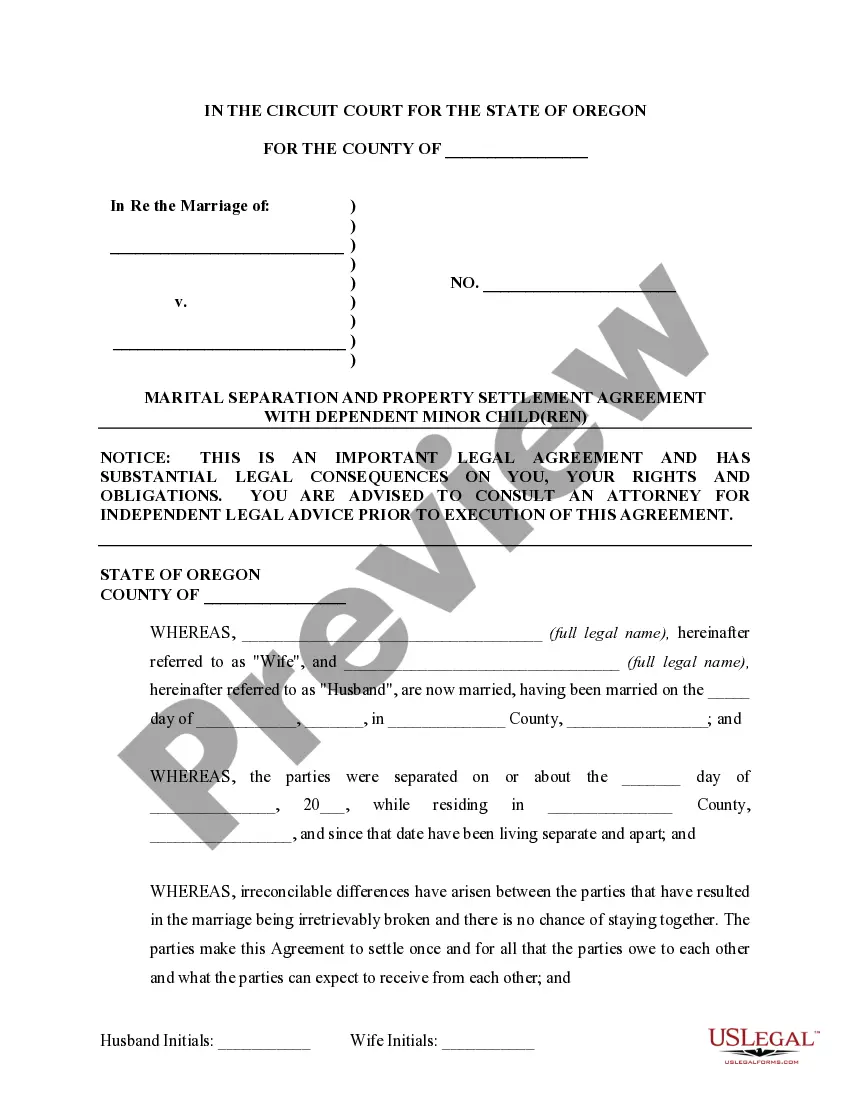
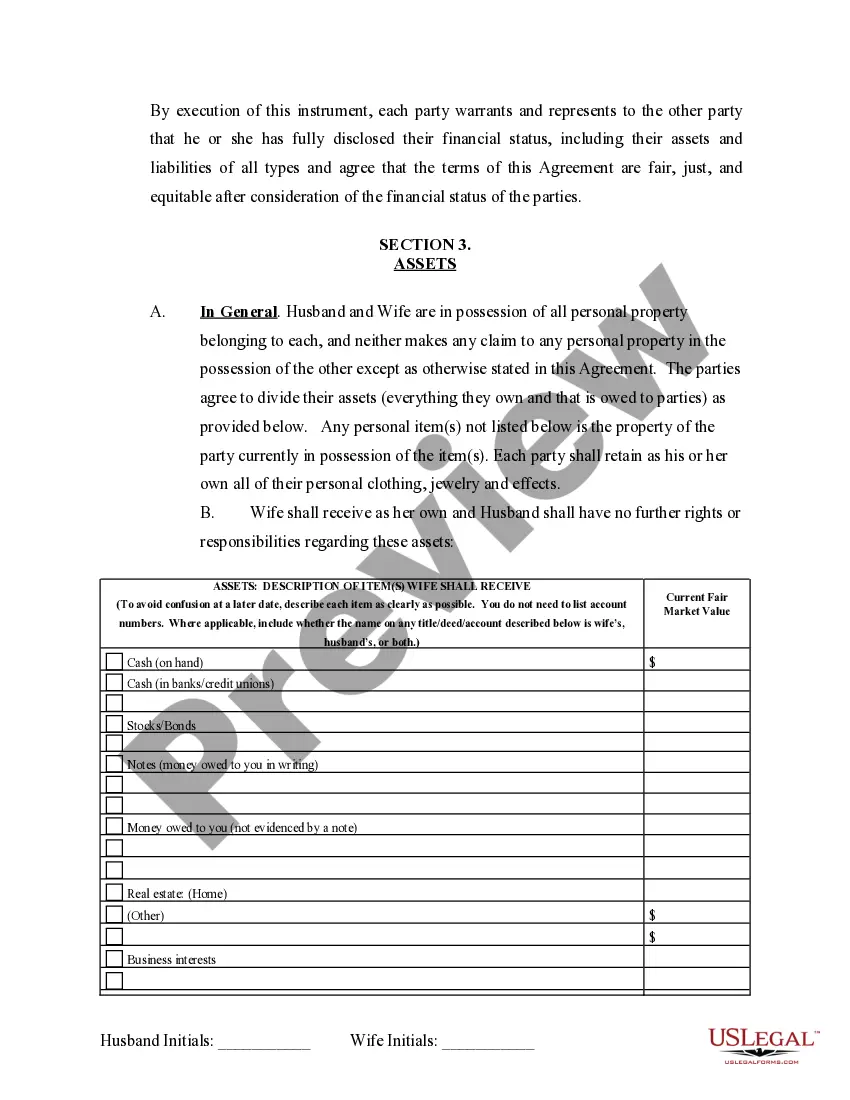
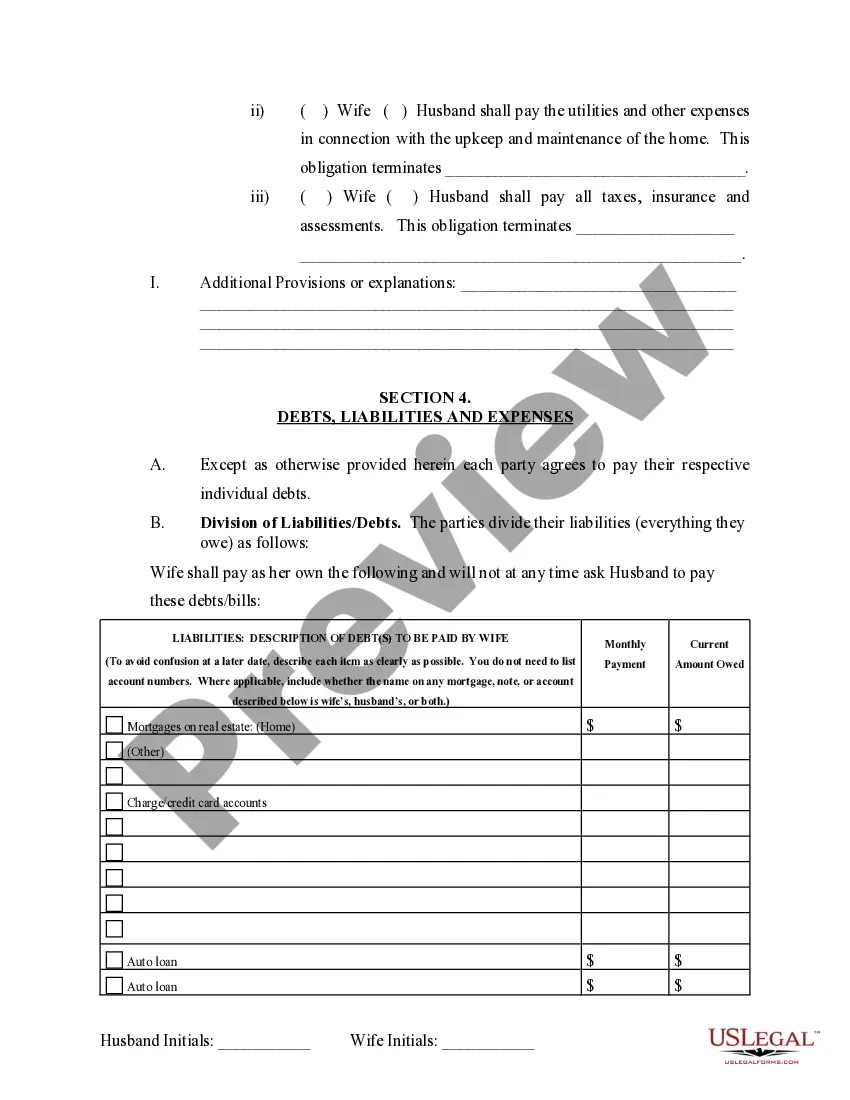
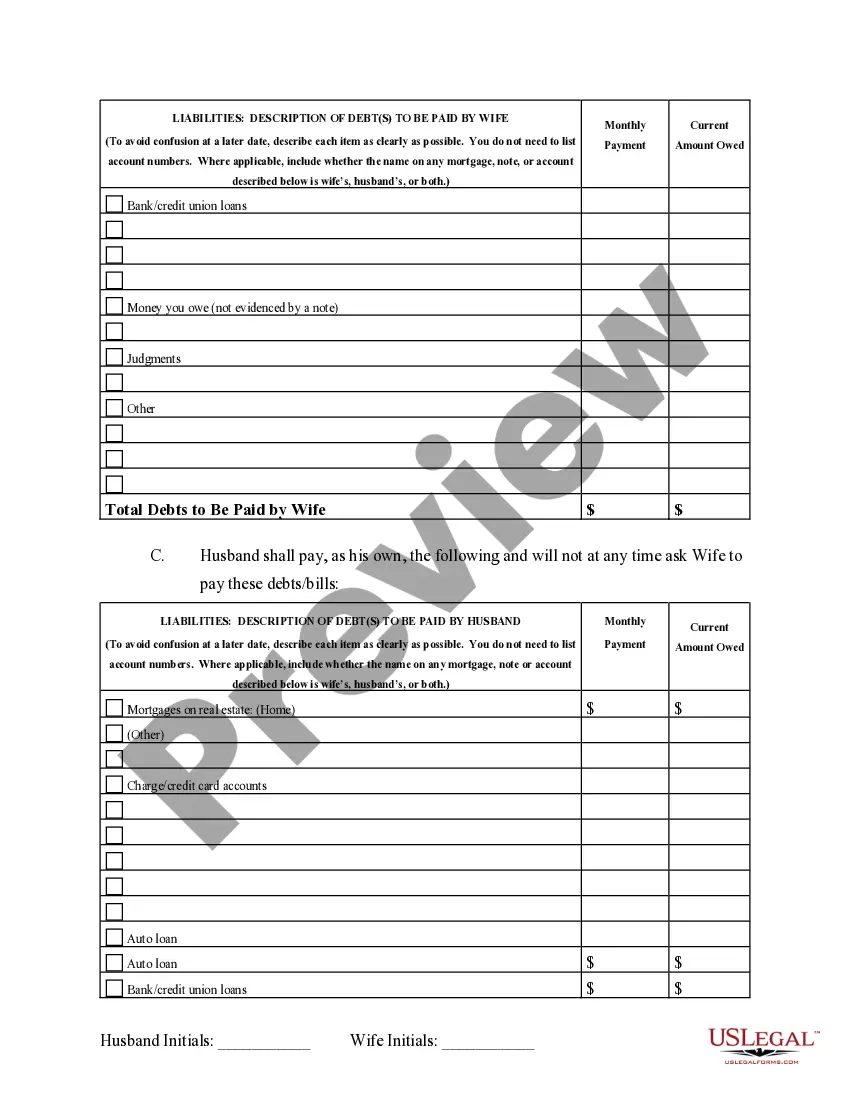
Marital Domestic Separation and Property Settlement Agreement Minor Children Parties May have Joint Property or Debts where Divorce Action Filed
Note: This summary is not intended to be an all inclusive
discussion of the law of separation agreements in Oregon, but does include
basic and other provisions.
General Summary:
Parties to a dissolution of marriage may enter into separate agreements regarding the terms of the dissolution.
Generally, if the parties asks, the trial court will review and incorporate
all or part of their agreement into the judgment. The trial court
is not required to incorporate into the judgment agreements that are "unfair"
to one or the other of the parties.
Statutes:
Oregon Revised Statutes
VOLUME 3
Title 11. DOMESTIC RELATIONS
Chapter 107.
Dissolution, Annulment; Separation; Mediation and Conciliation
Services
Provisions of decree:
(1) Whenever the court grants a decree of marital annulment,
dissolution or separation, it may further decree as follows:
(a) For the future care and custody, by one party or jointly,
of all minor children of the parties born, adopted or conceived during
the marriage, and for minor children born to the parties prior to the marriage,
as the court may deem just and proper under ORS 107.137. The court may
hold a hearing to decide the custody issue prior to any other issues. When
appropriate, the court shall recognize the value of close contact with
both parents and encourage joint parental custody and joint responsibility
for the welfare of the children.
(b) For parenting time rights of the parent not having custody of
such children, and for visitation rights of grandparents pursuant to a
petition filed under ORS 109.121. When a parenting plan has been developed
as required by ORS 107.102, the court shall review the parenting plan and,
if approved, incorporate the parenting plan into the court's final order.
When incorporated into a final order, the parenting plan is determinative
of parenting time rights. If the parents have been unable to develop a
parenting plan or if either of the parents requests the court to develop
a detailed parenting plan, the court shall develop the parenting plan in
the best interest of the child, ensuring the noncustodial parent sufficient
access to the child to provide for appropriate quality parenting time and
assuring the safety of the parties, if implicated. The court may deny parenting
time to the noncustodial parent under this subsection only if the court
finds that parenting time would endanger the health or safety of the child.
The court shall recognize the value of close contact with both parents
and encourage, when practicable, joint responsibility for the welfare of
such children and extensive contact between the minor children of the divided
marriage and the parties. If the court awards parenting time to a noncustodial
parent who has committed abuse, the court shall make adequate provision
for the safety of the child and the other parent in accordance with the
provisions of ORS 107.718 (4).
(c) For the support of the children of the marriage by the parties.
In ordering child support, the formula established by ORS 25.270 to 25.287
shall apply. The court may at any time require an accounting from the custodial
parent with reference to the use of the money received as child support.
The court is not required to order support for any minor child who has
become self-supporting, emancipated or married, or who has ceased to attend
school after becoming 18 years of age.
(d) For spousal support, an amount of money for a period of time
as may be just and equitable for one party to contribute to the other,
in gross or in installments or both. The court may approve an agreement
for the entry of an order for the support of a party. In making the
spousal support order, the court shall designate one or more categories
of spousal support and shall make findings of the relevant factors in the
decision. The court may order:
(B) Compensatory spousal support when there has been a significant
financial or other contribution by one party to the education, training,
vocational skills, career or earning capacity of the other party and when
an order for compensatory spousal support is otherwise just and equitable in all of the circumstances. The factors
to be considered by the court in awarding compensatory spousal support
include but are not limited to:
(e) For the delivery to one party of such party's personal property
in the possession or control of the other at the time of the giving of
the decree.
(f) For the division or other disposition between the parties of
the real or personal property, or both, of either or both of the parties
as may be just and proper in all the circumstances. A retirement plan or
pension or an interest therein shall be considered as property. The court
shall consider the contribution of a spouse as a homemaker as a contribution
to the acquisition of marital assets. There is a rebuttable presumption
that both spouses have contributed equally to the acquisition of property
during the marriage, whether such property is jointly or separately held.
Subsequent to the filing of a petition for annulment or dissolution of
marriage or separation, the rights of the parties in the marital assets
shall be considered a species of coownership, and a transfer of marital
assets under a decree of annulment or dissolution of marriage or of separation
entered on or after October 4, 1977, shall be considered a partitioning
of jointly owned property. The court shall require full disclosure of all
assets by the parties in arriving at a just property division. In arriving
at a just and proper division of property, the court shall consider reasonable
costs of sale of assets, taxes and any other costs reasonably anticipated
by the parties. If a spouse has been awarded spousal support in lieu of
a share of property, the court shall so state on the record, and shall
order the obligor to provide for and maintain life insurance in an amount
commensurate with the obligation and designating the obligee as beneficiary
for the duration of the obligation. If the obligor dies prior to the termination
of such support and such insurance is not in force, the court may modify
the method of payment of spousal support under the decree or order of support
from installments to a lump sum payment to the obligee from the estate
of the obligor in an amount commensurate with the present value of the
spousal support at the time of death. The obligee or attorney of the obligee
shall cause a certified copy of the decree to be delivered to the life
insurance company or companies. If the obligee or the attorney of the obligee
delivers a true copy of the decree to the life insurance company or companies,
identifying the policies involved and requesting such notification under
this section, the company or companies shall notify the obligee, as beneficiary
of the insurance policy, whenever the policyholder takes any action that
will change the beneficiary or reduce the benefits of the policy. Either
party may request notification by the insurer when premium payments have
not been made. If the obligor is ordered to provide for and maintain life
insurance, the obligor shall provide to the obligee a true copy of the
policy. The obligor shall also provide to the obligee written notice of
any action that will reduce the benefits or change the designation of the
beneficiaries under the policy.
(A) For the appointment of one or more trustees to hold,
control and manage for the benefit of the children of the parties, of the
marriage or otherwise, such of the real or personal property of either
or both of the parties, as the court may order to be allocated or appropriated
to their support and welfare; and to collect, receive, expend, manage or
invest any sum of money decreed for the support and welfare of minor children
of the parties.
(B) For the appointment of one or more trustees to hold, manage
and control such amount of money or such real or personal property of either
or both of the parties, as may be set aside, allocated or appropriated
for the support of a party.
(C) For the establishment of the terms of the trust and provisions
for the disposition or distribution of such money or property to or between
the parties, their successors, heirs and assigns after the purpose of the
trust has been accomplished. Upon petition of a party or a person having
an interest in the trust showing a change of circumstances warranting a
change in the terms of the trust, the court may make and direct reasonable
modifications in its terms.
(h) To change the name of either spouse to a name the spouse held before
the marriage. The court shall decree a change if it is requested by the
affected party.
(i) For a judgment against one party in favor of the other for any
sums of money found to be then remaining unpaid upon any enforceable order
or orders theretofore duly made and entered in the proceedings under any
of the provisions of ORS 107.095, and for a judgment against one party
in favor of the other or in favor of the other's attorney for any further
sums as additional attorney fees or additional costs and expenses of suit
or defense as the court finds reasonably and necessarily incurred by such
party; or, in the absence of any such order or orders pendente lite, a
like judgment for such amount of money as the court finds was reasonably
necessary to enable such party to prosecute or defend the suit. The decree
may include a judgment for any arrearage in any sum ordered while litigation
was pending, but if such a judgment is not included in the decree, such
arrearages shall not be deemed satisfied.
(2) In determining the proper amount of support and the proper division
of property under subsection (1)(c), (d) and (f) of this section, the court
may consider evidence of the tax consequences on the parties of its proposed
decree.
(3) Upon the filing of the decree, the property division ordered
shall be deemed effective for all purposes. This transfer by decree, which
shall effect solely owned property transferred to the other spouse as well
as commonly owned property in the same manner as would a declaration of
a resulting trust in favor of the spouse to whom the property is awarded,
shall not be deemed a taxable sale or exchange.
(4) If an appeal is taken from a decree of annulment or dissolution
of marriage or of separation or from any part of a decree rendered in pursuance
of the provisions of ORS 107.005 to 107.085, 107.095, 107.105, 107.115
to 107.174, 107.405, 107.425, 107.445 to 107.520, 107.540 and 107.610,
the court making such decree may provide in a separate order for any relief
provided for in ORS 107.095 and shall provide that the order is to be in
effect only during the pendency of the appeal. A temporary order under
this subsection may be enforced as provided in ORS 33.015 to 33.155. On
motion of a party the Court of Appeals may review the trial court's disposition
of a request for a temporary order. A motion under this subsection must
be filed with the Court of Appeals within 14 days after the entry of the
temporary order. The Court of Appeals may modify the trial court's order
only if the Court of Appeals finds an abuse of discretion by the trial
court. Upon such finding, the Court of Appeals may enter a temporary order,
affirm, modify or vacate the trial court's order, remand the order to the
trial court for reconsideration or impose terms and conditions on the order.
(5) If an appeal is taken from the decree or other appealable order
in a suit for annulment or dissolution of a marriage or for separation,
and the appellate court awards costs and disbursements to a party, it may
also award to that party, as part of the costs, the appeal.
(6) If, as a result of a suit for the annulment or dissolution of
a marriage or for separation, the parties to such suit become owners of
an undivided interest in any real or personal property, or both, either
party may maintain supplemental proceedings by filing a petition in
such suit for the partition of such real or personal property, or both,
within two years from the entry of said decree, showing among other things
that the original parties to such decree and their joint or several creditors
having a lien upon any such real or personal property, if any there be,
constitute the sole and only necessary parties to such supplemental proceedings.
The procedure in the supplemental proceedings, so far as applicable, shall
be the procedure provided in ORS 105.405, for the partition of real property,
and the court granting such decree shall have in the first instance and
retain jurisdiction in equity therefor. Section 107.105
Vacation or modification of decree:
(1) The court may at any time after a decree of annulment
or dissolution of marriage or of separation is granted, upon the motion
of either party and after service of notice on the other party in the manner
provided by ORCP 7, and after notice to the Division of Child Support when
required pursuant to subsection (8) of this section:
(a) Set aside, alter or modify so much of the decree as
may provide for the appointment and duties of trustees, for the custody,
parenting time, visitation, support and welfare of the minor children and
the children attending school, as defined in ORS 107.108, including any
provisions for health or life insurance, or for the support of a party
or for life insurance under ORS 107.820 or 107.830;
(b) Make an order, after service of notice to the other party, providing
for the future custody, support and welfare of minor children residing
in the state, who, at the time the decree was given, were not residents
of the state, or were unknown to the court or were erroneously omitted
from the decree;
(c) Terminate a duty of support toward any minor child who has become
self-supporting, emancipated or married;
(d) Notwithstanding section 84 (2), chapter 827, Oregon Laws 1973,
and after service of notice on the child in the manner provided by law
for service of a summons, suspend future support for any child who has
ceased to be a child attending school as defined in ORS 107.108; and
(e) Set aside, alter or modify so much of the decree as may provide
for a property award based on the enhanced earning capacity of a party
that was awarded before October 23, 1999. A property award may be set aside,
altered or modified under this paragraph:
(2) In a proceeding under this section to reconsider the spousal or
child support provisions of the decree, the following provisions apply:
(a) A substantial change in economic circumstances of a
party, which may include, but is not limited to, a substantial change in
the cost of reasonable and necessary expenses to either party, is sufficient
for the court to reconsider its order of support, except that an order
of compensatory spousal support may only be modified upon a showing of
an involuntary, extraordinary and unanticipated change in circumstances
that reduces the earning capacity of the paying spouse.
(b) If the decree provided for a termination or reduction of spousal
support at a designated age in anticipation of the commencement of pension,
social security or other entitlement payments, and if the obligee is unable
to obtain the anticipated entitlement payments, that inability is sufficient
change in circumstances for the court to reconsider its order of support.
(c) If social security is considered in lieu of spousal support
or partial spousal support, the court shall determine the amount of social
security the party is eligible to collect. The court shall take into consideration
any pension, retirement or other funds available to either party to effect
an equitable distribution between the parties and shall also take into
consideration any reduction of entitlement caused by taking early retirement.
(3) In considering under this section whether a change in circumstances
exists sufficient for the court to reconsider spousal or child support
provisions of a decree, the following provisions apply:
(a) The court or administrator, as defined in ORS 25.010,
shall consider income opportunities and benefits of the respective parties
from all sources, including but not limited to:
(C) Other benefits to which the obligor is entitled, such as travel
benefits, recreational benefits and medical benefits, contrasted with benefits
to which the obligee is similarly entitled.
(b) If the motion for modification is one made by the obligor to reduce
or terminate support, and if the obligee opposes the motion, the court
shall not find a change in circumstances sufficient for reconsideration
of support provisions, if the motion is based upon a reduction of the obligor's
financial status resulting from the obligor's taking voluntary retirement,
partial voluntary retirement or any other voluntary reduction of income
or self-imposed curtailment of earning capacity, if it is shown that such
action of the obligor was not taken in good faith but was for the primary
purpose of avoiding the support obligation. In any subsequent motion for
modification, the court shall deny the motion if the sole basis of the
motion for modification is the termination of voluntarily taken retirement
benefits and the obligor previously has been found not to have acted in
good faith.
(c) The court shall consider the following factors in deciding whether
the actions of the obligor were not in "good faith":
(4) Upon terminating a duty of spousal support, a court shall make
specific findings of the basis for the termination and shall include the
findings in the judgment order.
(5) Any modification of spousal support granted because of a change
of circumstances may be ordered effective retroactive to the date the motion
for modification was filed or to any date thereafter.
(6) The decree is a final judgment as to any installment or payment
of money that has accrued up to the time either party makes a motion to
set aside, alter or modify the decree, and the court does not have the
power to set aside, alter or modify such decree, or any portion thereof,
that provides for any payment of money, either for minor children or the
support of a party, that has accrued prior to the filing of such motion.
However:
(a) The court may allow a credit against child support
arrearages for periods of time, excluding reasonable parenting time unless
otherwise provided by order or decree, during which the obligated parent
has physical custody of the child with the knowledge and consent of the
custodial parent; and
(b) The court or the administrator, as defined in ORS 25.010, may
allow, as provided in the rules of the Child Support Program, a credit
against child support arrearages for any Social Security or Veterans' benefits
paid retroactively to the child, or to a representative payee administering
the funds for the child's use and benefit, as a result of a parent's disability
or retirement.
(7) In a proceeding under subsection (1) of this section, the court
may assess against either party a reasonable attorney fee and costs for
the benefit of the other party. If a party is found to have acted in bad
faith, the court shall order that party to pay a reasonable attorney fee
and costs of the defending party.
(8) Whenever a motion to establish, modify or terminate child support
or satisfy or alter support arrearages is filed and public assistance,
as defined in ORS 416.400, is being granted to or on behalf of a dependent
child or children, natural or adopted, of the parties, a true copy of the
motion shall be served by mail or personal delivery on the Administrator
of the Division of Child Support of the Department of Justice, or on the
branch office of the division providing service to the county in which
the motion is filed.
(9) (a) Except as provided in ORS 109.700 to 109.930, the courts
of Oregon, having once acquired personal and subject matter jurisdiction
in a domestic relations action, retain such jurisdiction regardless of
any change of domicile.
(b) The courts of Oregon, in a proceeding to establish,
enforce or modify a child support order, shall recognize the provisions
of the federal Full Faith and Credit for Child Support Orders Act (28 U.S.C.
1738B).
(10) In a proceeding under this section to reconsider provisions in
a decree relating to custody or parenting time, the court may consider
repeated and unreasonable denial of, or interference with, parenting time
to be a substantial change of circumstances.
(11) Within 30 days after service of notice under subsection (1)
of this section, the party served shall file a written response with the
court. Section 107.135.
Case Law:
Parties to a dissolution of marriage may enter into separate agreements
regarding the terms of the dissolution. Generally, if the parties ask,
the trial court will review and incorporate all or part of their agreement
into the judgment. Rigdon v. Rigdon, 219 Or. 271, 276, 347
P.2d 43 (1959). The trial court is not required to incorporate into
the judgment agreements that are "unfair to one or the other of the parties."
McDonnal and McDonnal, 293 Or. 772, 778, 652 P.2d 1247 (1982).
The parties may enter into a property settlement agreement providing
for spousal support which the court may approve and ratify by incorporating
it into the decree, or the court may itself determine the appropriate amount
and duration of spousal support based on the evidence presented. In the
second case, the court shall apply the factors set out in the statute.
A court is not required to accept an agreement between the parties, Unander
v. Unander, 265 Or. 102, 107, 506 P.2d 719 (1973); Frey and Frey, 23
Or. App. 25, 541 P.2d 145 (1975). It may, upon consideration, reject an
agreement as unfair to one or the other of the parties. Bach and Bach,
27 Or. App. 411, 555 P.2d 1264 (1976). However, agreements made in
anticipation of a dissolution are generally enforceable and accepted by
the court when they are equitable given the circumstances of the case.
The court is not required to apply an analysis of the statutory factors
to the circumstances of each case when confronted with a proposed agreement.
Jensen v. Jensen, 249 Or. 423, 438 P.2d 1013 (1968); Prime v. Prime,
172 Or. 34, 139 P.2d 550 (1943).
In Oregon, public policy requires that persons of full age and competent
understanding shall have the utmost liberty of contracting, and that their
contracts, when entered into freely and voluntarily, shall be held sacred
and shall be enforced by courts of justice; and it is only when some other
overpowering rule of public policy intervenes, rendering such agreements
unfair or illegal, that they will not be enforced. Eldridge v. Johnson,
195 Or. 379, 245 P.2d 239, 251; Feves v. Feves, 198 Or. 151,
159-160, 254 P.2d 694 (1953). Short of conflict with the statutory
powers of the court, it is the court's responsibility to discover and give
effect to the intent of the parties as reflected in the incorporated settlement
agreement. McDonnal and McDonnal, 293 Or. 772 (1982) 652 P.2d
1247.