Oregon Petitioner's - Respondent's Ex Parte Motion - Affidavit and Order for Non Disclosure of Info
Understanding this form
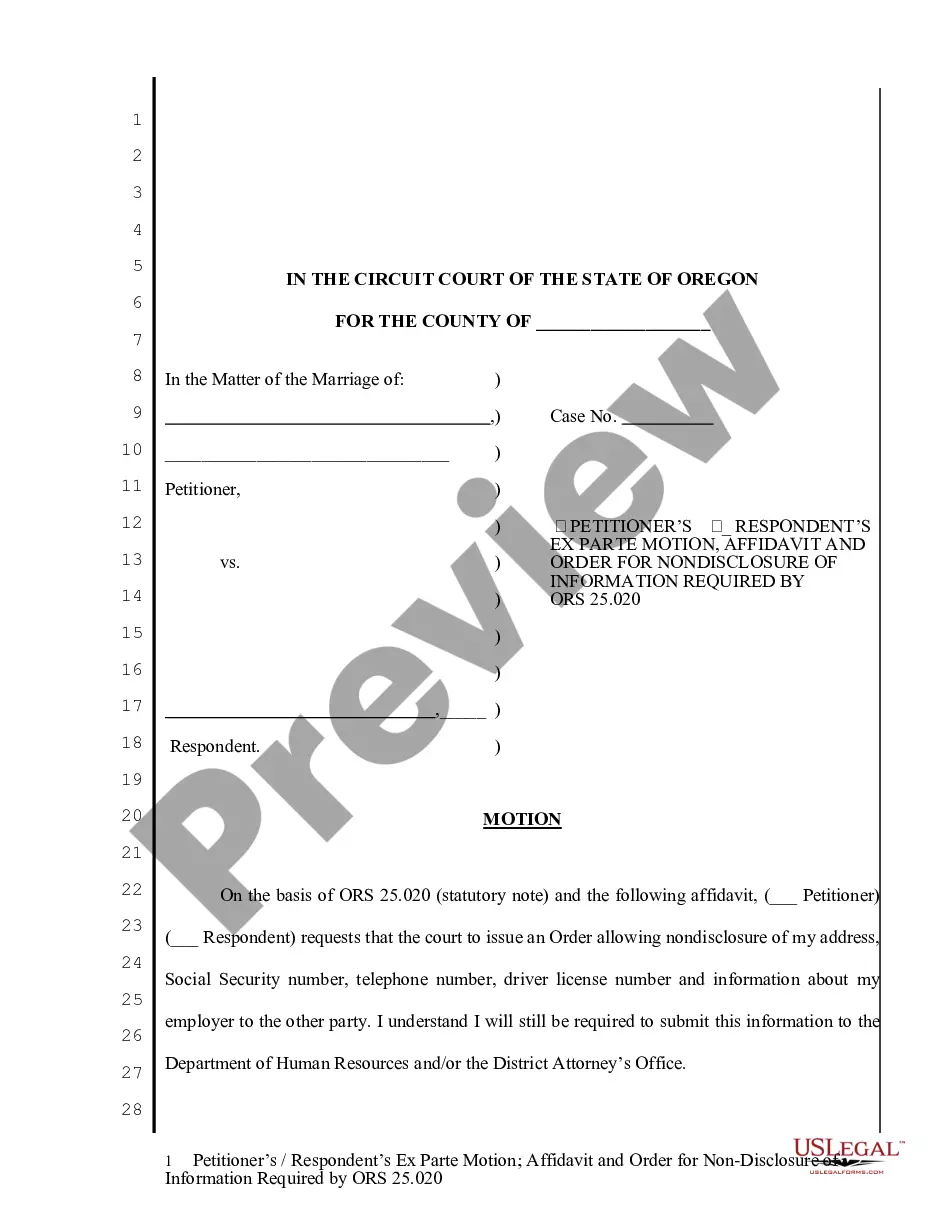
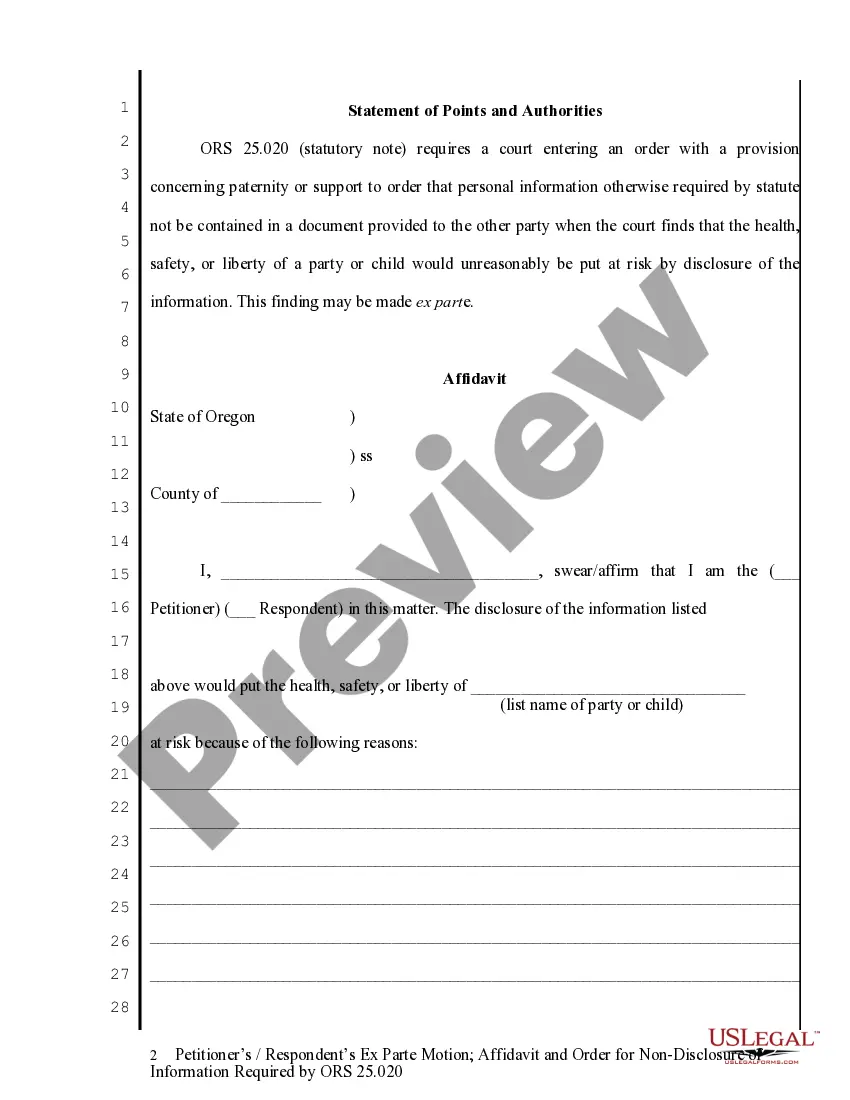
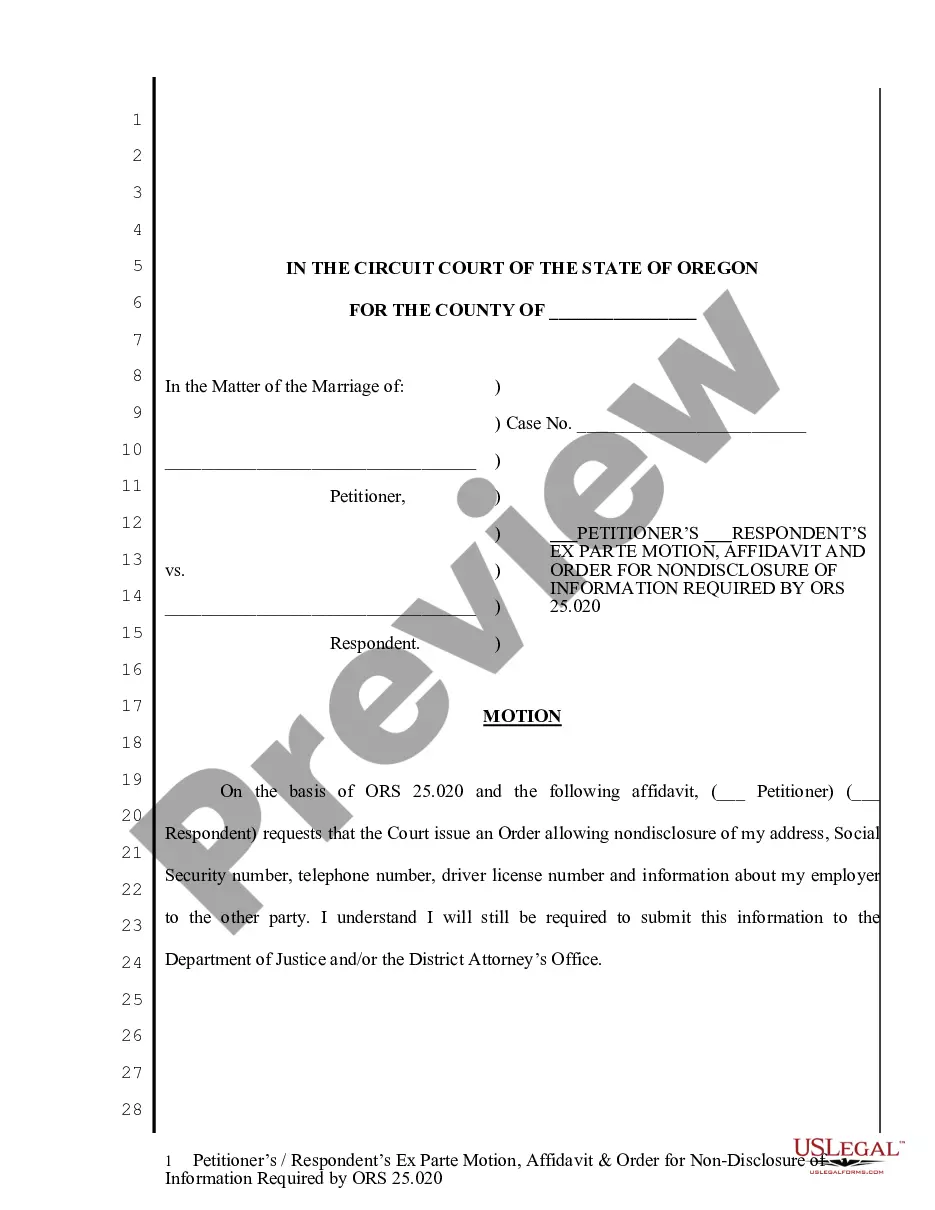
This form is a Petitioner's - Respondent's Ex Parte Motion - Affidavit and Order for Non-Disclosure of Information. It is specifically designed for use in Oregon domestic litigation cases where one party seeks to keep their personal information private to protect their safety and well-being. Unlike other motions, this request allows for the disclosure of sensitive information to be limited in court documents shared with the opposing party, provided there is a legitimate safety concern.
Key components of this form
- The case caption, which identifies the court and parties involved.
- A motion section where the requesting party outlines their need for confidentiality.
- A statutory reference to ORS 25.020, which governs the non-disclosure request.
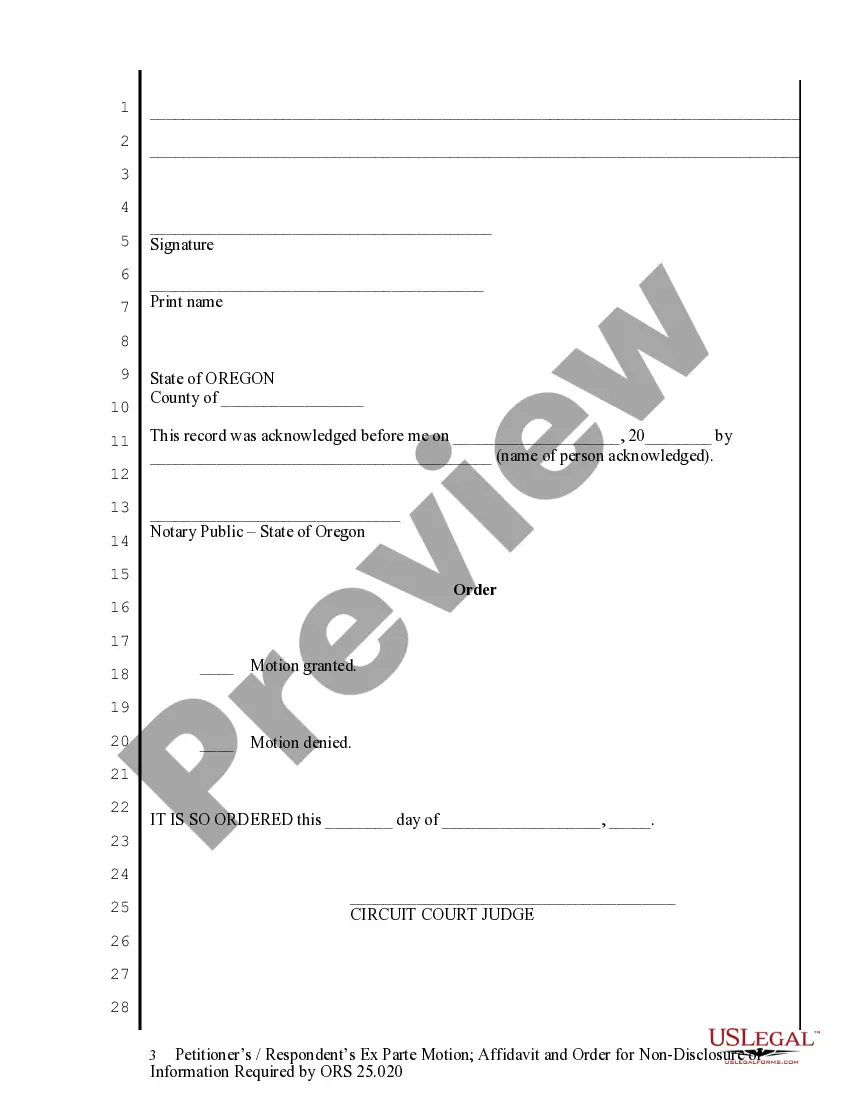
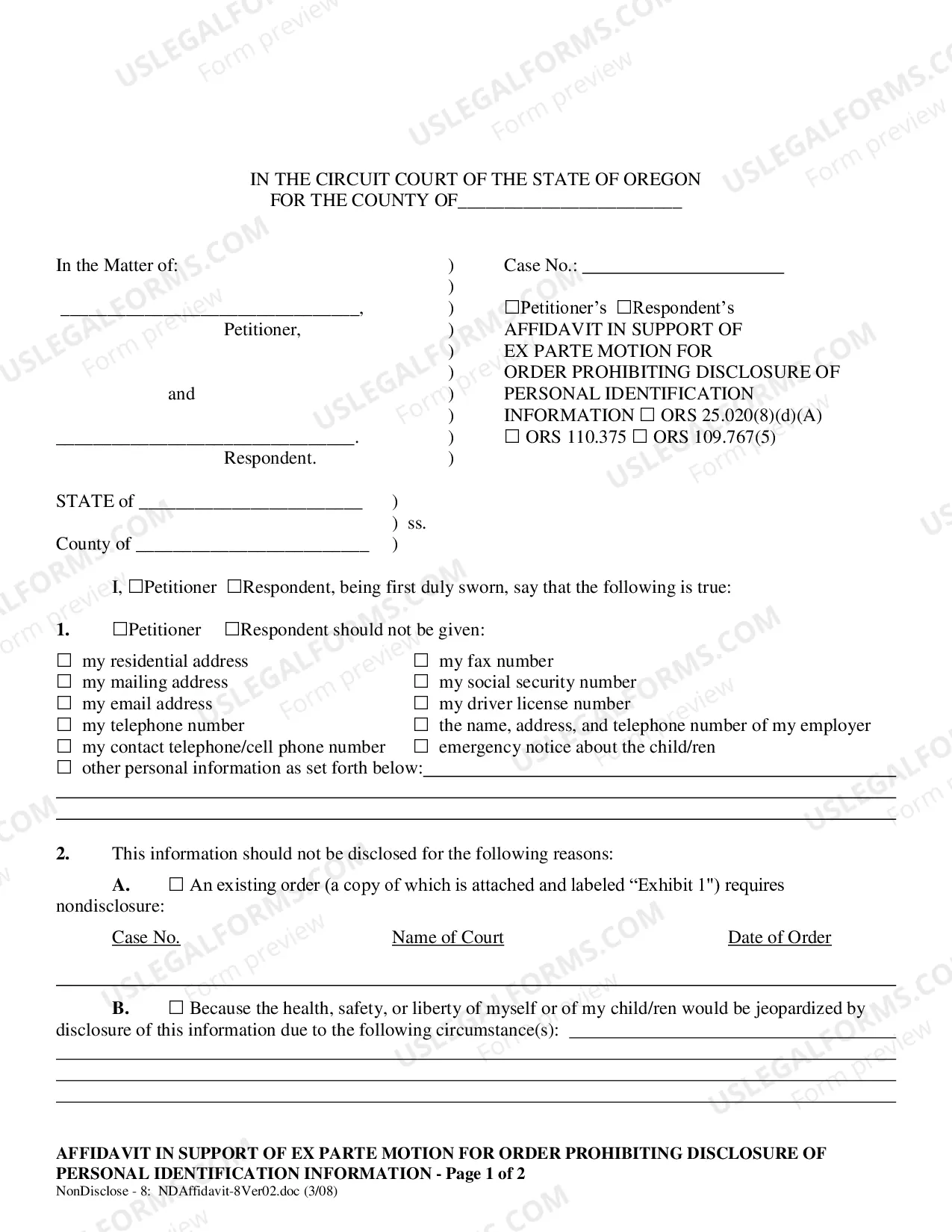
- An affidavit where the requesting party swears to the reasons for seeking non-disclosure.
- An order section for the judge to grant or deny the motion.
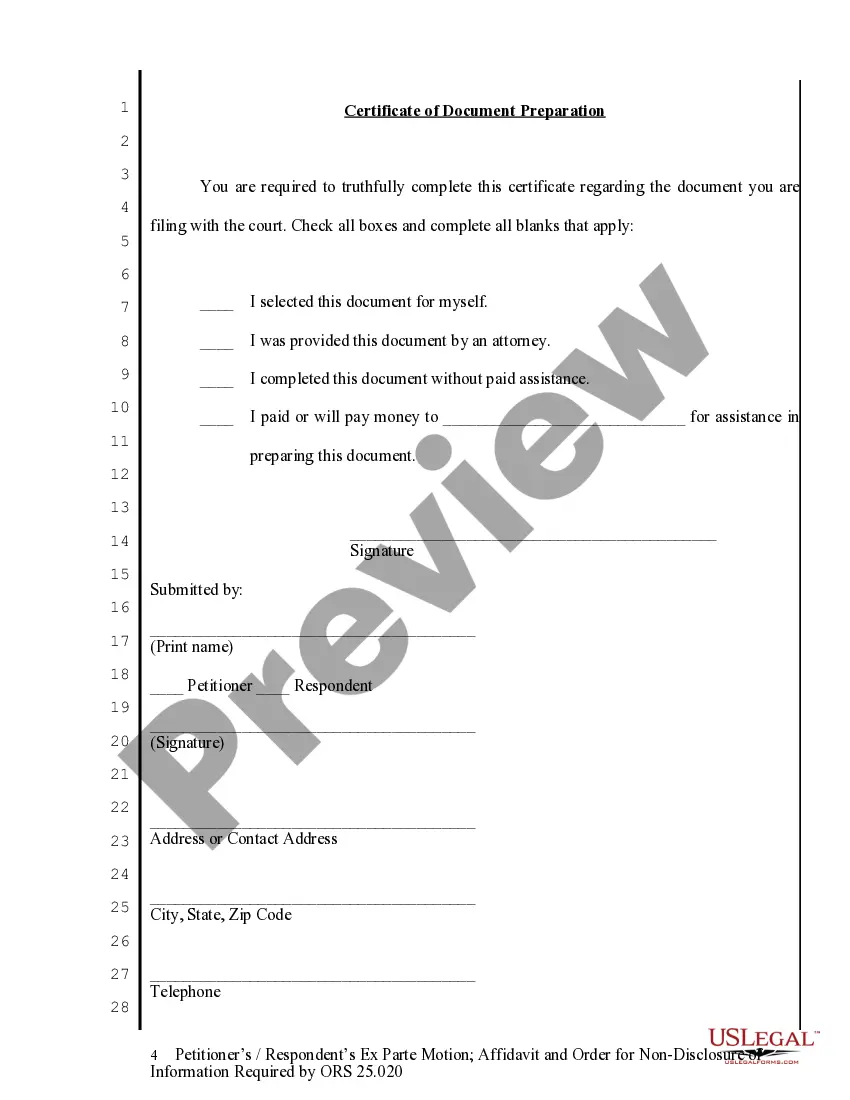
- A certificate of document preparation to affirm the preparation method of the form.
Situations where this form applies
This form should be used when a petitioner or respondent in a domestic litigation case believes that disclosing their personal information could put their health, safety, or liberty at risk. This is particularly relevant in cases involving sensitive dynamics such as domestic violence, paternity disputes, or situations where the parties may have a contentious relationship. By filing this motion, the individual seeks to protect their private information while still complying with legal requirements to disclose certain data to authorities.
Who needs this form
- Petitioners or respondents involved in domestic litigation in Oregon.
- Individuals who have concerns about their safety or privacy due to the circumstances of their case.
- Anyone who needs to protect their personal information from being disclosed to the opposing party while still fulfilling legal documentation requirements.
Completing this form step by step
- Fill in the case caption with the names of the parties and the case number.
- Choose whether you are the Petitioner or Respondent in the motion section.
- Provide a detailed affidavit outlining why the disclosure of your personal information would pose a risk.
- Sign and date the affidavit in front of a notary or court clerk.
- Complete the order section with the court's decision once submitted and heard.
- Fill out the certificate of document preparation to confirm how the form was completed.
Notarization guidance
Notarization is required for this form to take effect. Our online notarization service, powered by Notarize, lets you verify and sign documents remotely through an encrypted video session, available 24/7.
Get your form ready online
Our built-in tools help you complete, sign, share, and store your documents in one place.
Make edits, fill in missing information, and update formatting in US Legal Forms—just like you would in MS Word.
Download a copy, print it, send it by email, or mail it via USPS—whatever works best for your next step.
Sign and collect signatures with our SignNow integration. Send to multiple recipients, set reminders, and more. Go Premium to unlock E-Sign.
If this form requires notarization, complete it online through a secure video call—no need to meet a notary in person or wait for an appointment.
We protect your documents and personal data by following strict security and privacy standards.

Make edits, fill in missing information, and update formatting in US Legal Forms—just like you would in MS Word.

Download a copy, print it, send it by email, or mail it via USPS—whatever works best for your next step.

Sign and collect signatures with our SignNow integration. Send to multiple recipients, set reminders, and more. Go Premium to unlock E-Sign.

If this form requires notarization, complete it online through a secure video call—no need to meet a notary in person or wait for an appointment.

We protect your documents and personal data by following strict security and privacy standards.
Mistakes to watch out for
- Failing to provide sufficient details in the affidavit to justify the need for non-disclosure.
- Not signing the affidavit or omitting notarization, if required.
- Inaccurately identifying the party (petitioner or respondent) in the motion section.
- Leaving the case caption or court information incomplete.
Benefits of completing this form online
- Convenience of downloading and filling out the form from home.
- Editability allows for easy modifications until satisfied with the completed document.
- Access to professionally drafted forms ensures compliance with legal standards.
- Immediate access to the form reduces time associated with traditional legal processes.
Looking for another form?

Form popularity
FAQ
Confidentiality agreements and NDAs offer the most surefire ways to protect trade secrets and other confidential information meant to be kept under wraps.In most cases, there's nothing wrong with signing an NDA, as long as you understand the terms and rules.
A non-disclosure agreement is a legally binding contract that establishes a confidential relationship. The party or parties signing the agreement agree that sensitive information they may obtain will not be made available to any others.In this case, it may be called a mutual non-disclosure agreement.
Identification of the parties. Definition of what is deemed to be confidential. The scope of the confidentiality obligation by the receiving party. The exclusions from confidential treatment. The term of the agreement.
Depending on the complexity of what you need protected and the number of parties involved, the cost of having an NDA drafted can vary significantly. When you hire a lawyer in the Priori network, drafting an NDA typically costs anywhere from $175-$1,500.
NDAs are legally enforceable contracts, but they're now coming under increased scrutiny from lawmakers, attorneys and legal experts.Companies often use them as part of an employment contract or settlement agreement to protect sensitive information like trade secrets.
A letter of non-disclosure is a letter that is written from one party to another that acts as a contract of sorts. The objective of a letter of non disclosure is to guarantee that the receiving party will not disclose important information to others in regards to a deal they were working on.
Non-disclosure agreements are an important legal framework used to protect sensitive and confidential information from being made available by the recipient of that information. Companies and startups use these documents to ensure that their good ideas won't be stolen by people they are negotiating with.
Non-disclosure agreements are an important legal framework used to protect sensitive and confidential information from being made available by the recipient of that information. Companies and startups use these documents to ensure that their good ideas won't be stolen by people they are negotiating with.