Oregon Request for Hearing
Overview of this form
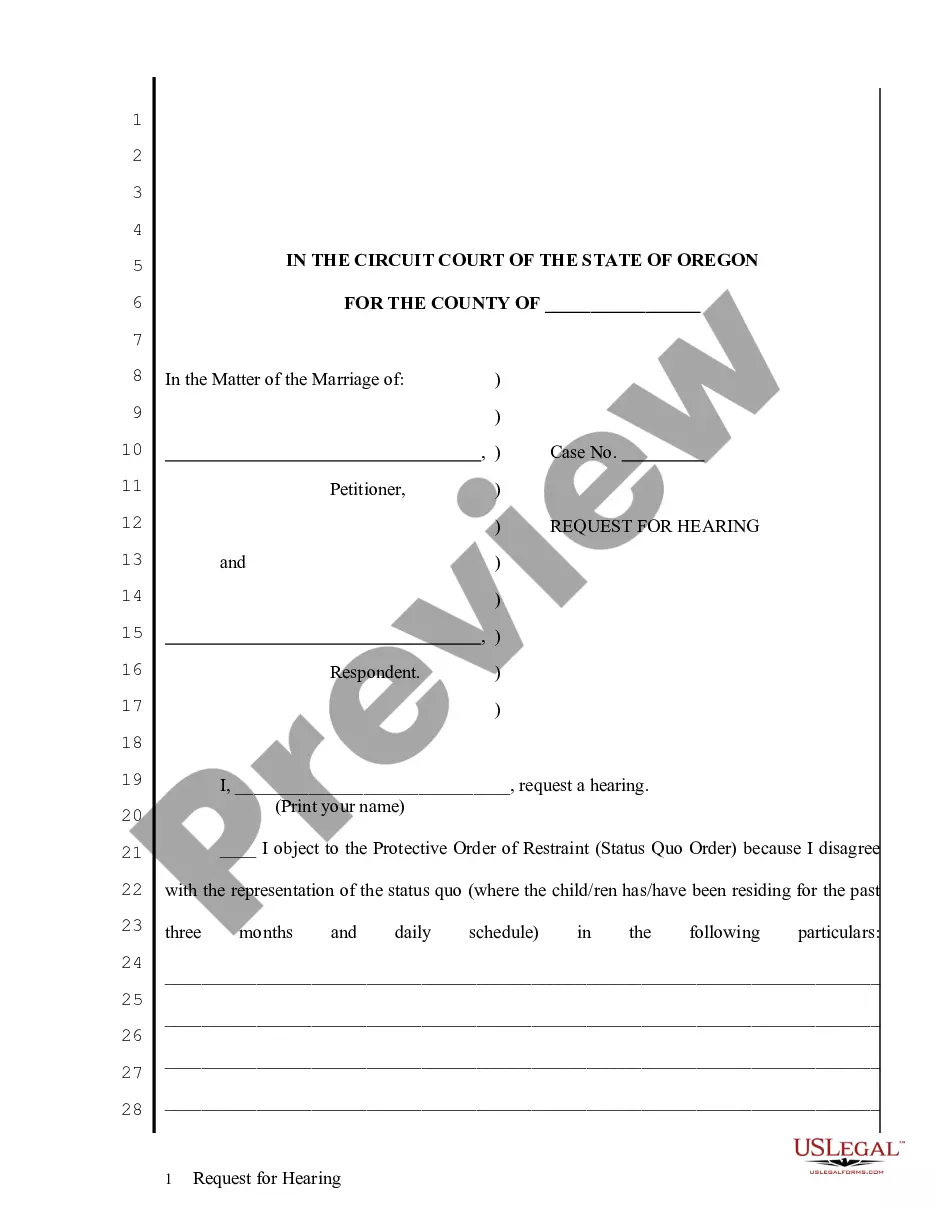
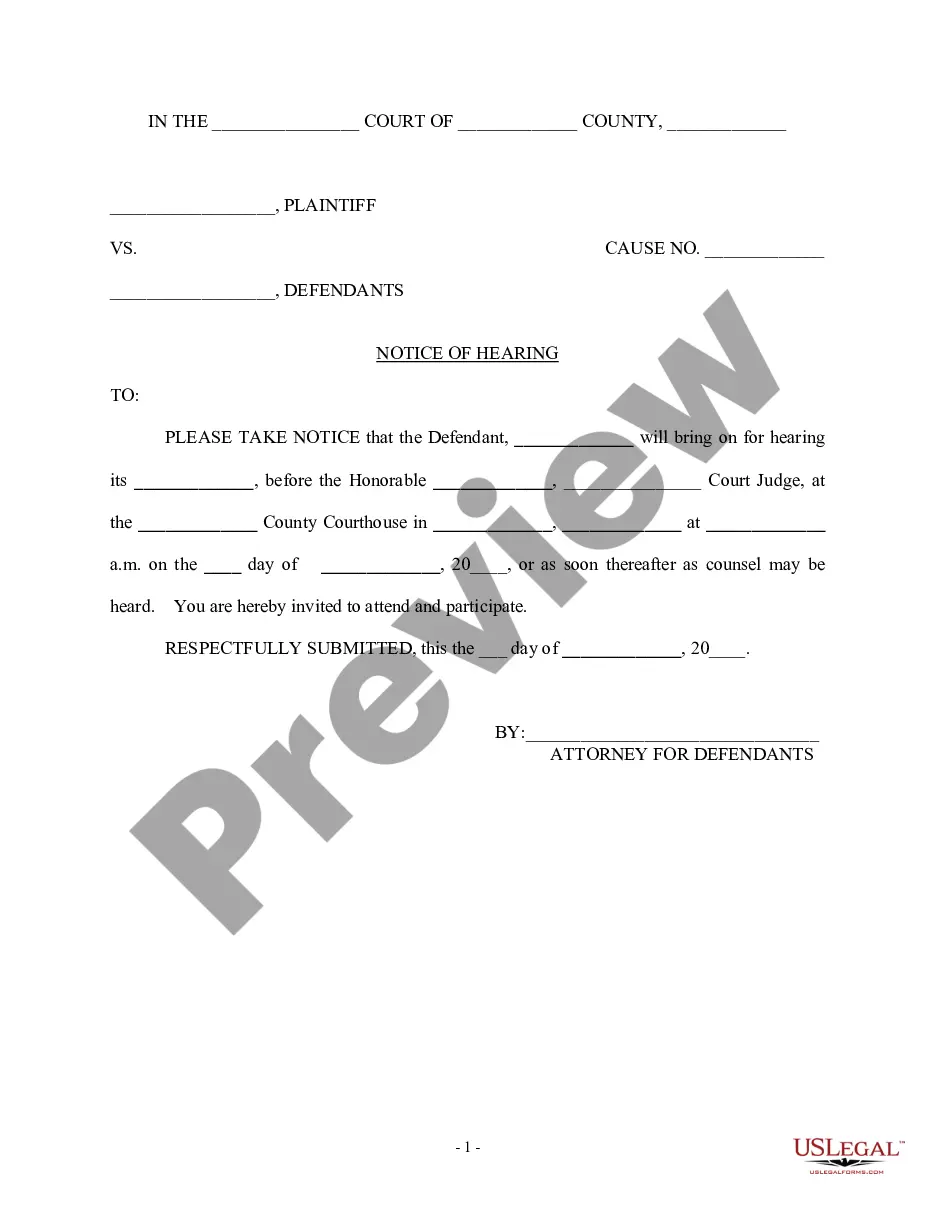
The Request for Hearing is a legal document used in domestic litigation in Oregon. This form allows an individual, either the petitioner or respondent, to formally request a hearing in court. By filing this form, one can object to existing protective orders or restraining orders and challenge the details surrounding child custody or other domestic matters. This process is essential for ensuring that all parties can present their case in front of a judge.
Form components explained
- Case information: Includes the names of the petitioner and respondent along with the case number.
- Request statement: A section where the individual states their request for a hearing.
- Objection details: An area to specify objections to current protective orders, particularly concerning the status quo of child residency and schedules.
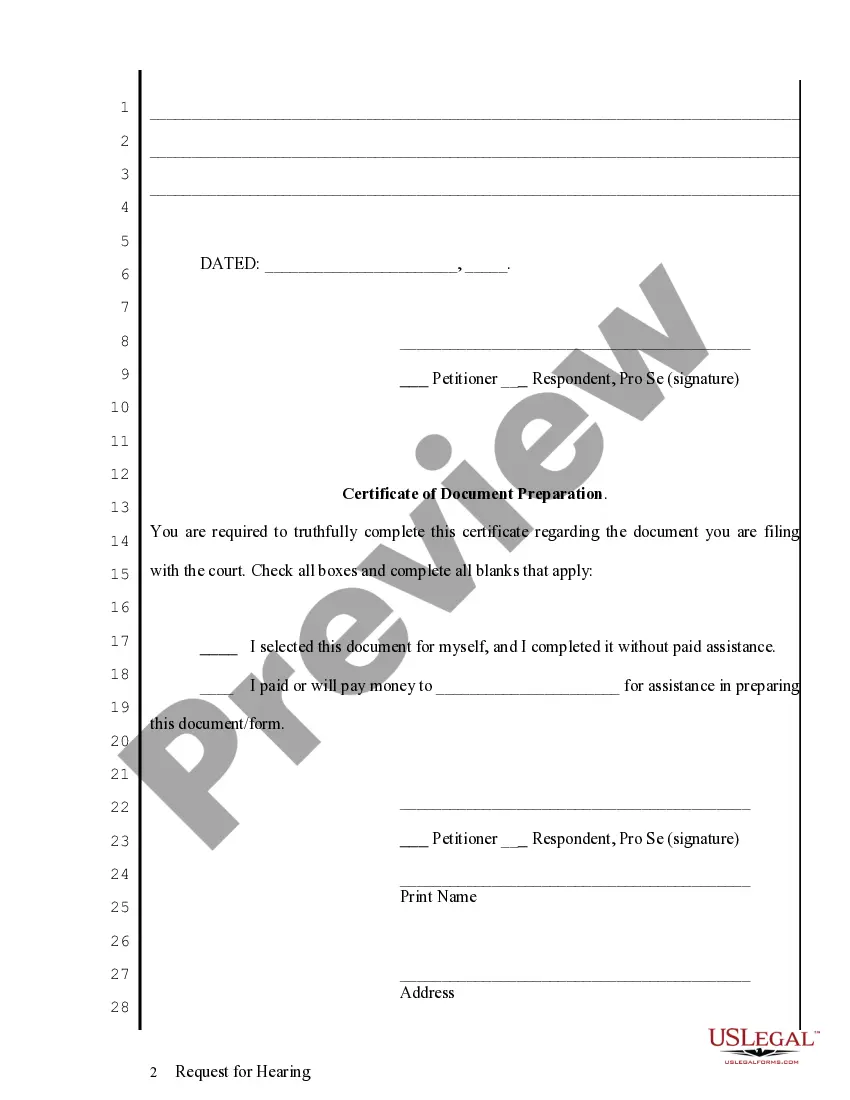
- Signature block: Spaces for signatures of the petitioner and respondent, confirming the request authenticity.
- Certificate of document preparation: A requirement to indicate whether the form was completed with or without assistance.
When to use this form
You should use the Request for Hearing when you need to contest a protective order or status quo arrangement regarding child custody in Oregon. It is typically necessary when there has been a change in circumstances that you believe warrants a new hearing or reevaluation of the current orders. If you disagree with how the status quo of child residency has been represented, this form is essential for initiating the process of legal review.
Who this form is for
This form is suitable for:
- Individuals involved in a custody or domestic litigation case in Oregon.
- Petitioners looking to challenge existing protective orders.
- Respondents wishing to present their side or contest issues related to custody arrangements.
- Pro se applicants who choose to represent themselves without an attorney.
Steps to complete this form
- Identify the parties involved by filling in the names of the petitioner and respondent.
- Enter the case number assigned to your domestic litigation case.
- Clearly state your request for a hearing and outline your objections to the protective order.
- Sign the form in the designated signature block, indicating whether you are the petitioner or respondent.
- Complete the certificate of document preparation to confirm how you filled out the form, indicating whether you received assistance.
Notarization guidance
In most cases, this form does not require notarization. However, some jurisdictions or signing circumstances might. US Legal Forms offers online notarization powered by Notarize, accessible 24/7 for a quick, remote process.
Get your form ready online
Our built-in tools help you complete, sign, share, and store your documents in one place.
Make edits, fill in missing information, and update formatting in US Legal Forms—just like you would in MS Word.
Download a copy, print it, send it by email, or mail it via USPS—whatever works best for your next step.
Sign and collect signatures with our SignNow integration. Send to multiple recipients, set reminders, and more. Go Premium to unlock E-Sign.
If this form requires notarization, complete it online through a secure video call—no need to meet a notary in person or wait for an appointment.
We protect your documents and personal data by following strict security and privacy standards.

Make edits, fill in missing information, and update formatting in US Legal Forms—just like you would in MS Word.

Download a copy, print it, send it by email, or mail it via USPS—whatever works best for your next step.

Sign and collect signatures with our SignNow integration. Send to multiple recipients, set reminders, and more. Go Premium to unlock E-Sign.

If this form requires notarization, complete it online through a secure video call—no need to meet a notary in person or wait for an appointment.

We protect your documents and personal data by following strict security and privacy standards.
Avoid these common issues
- Failing to include all necessary signatures on the form.
- Not providing specific details about objections to the protective order.
- Neglecting to fill out the certificate of document preparation correctly.
- Missing deadlines for filing the request with the court.
Benefits of completing this form online
- Convenient access: Download and complete the form from the comfort of your home.
- Editability: Easily modify the document as needed before finalizing and submitting.
- Reliability: Ensure you are using the latest and most accurate legal form approved by attorneys.
Looking for another form?
Form popularity
FAQ
Civil authority or civil government is the practical implementation of a state on behalf of its citizens, other than through military units (martial law), that enforces law and order and is used to distinguish between religious authority (for example, canon law) and secular authority.
: of or relating to a citizen, a city, citizenship, or community affairs civic duty civic pride civic leaders.
Some common synonyms of civil are chivalrous, courteous, gallant, and polite.
The definition of civil refers to something related to citizens or showing good manners and being polite. An example of civil is a war between citizens of a country. An example of civil is when you are polite and say hello to someone, even if you don't like him very much. adjective.