Oregon Affidavit of Publication
What this document covers
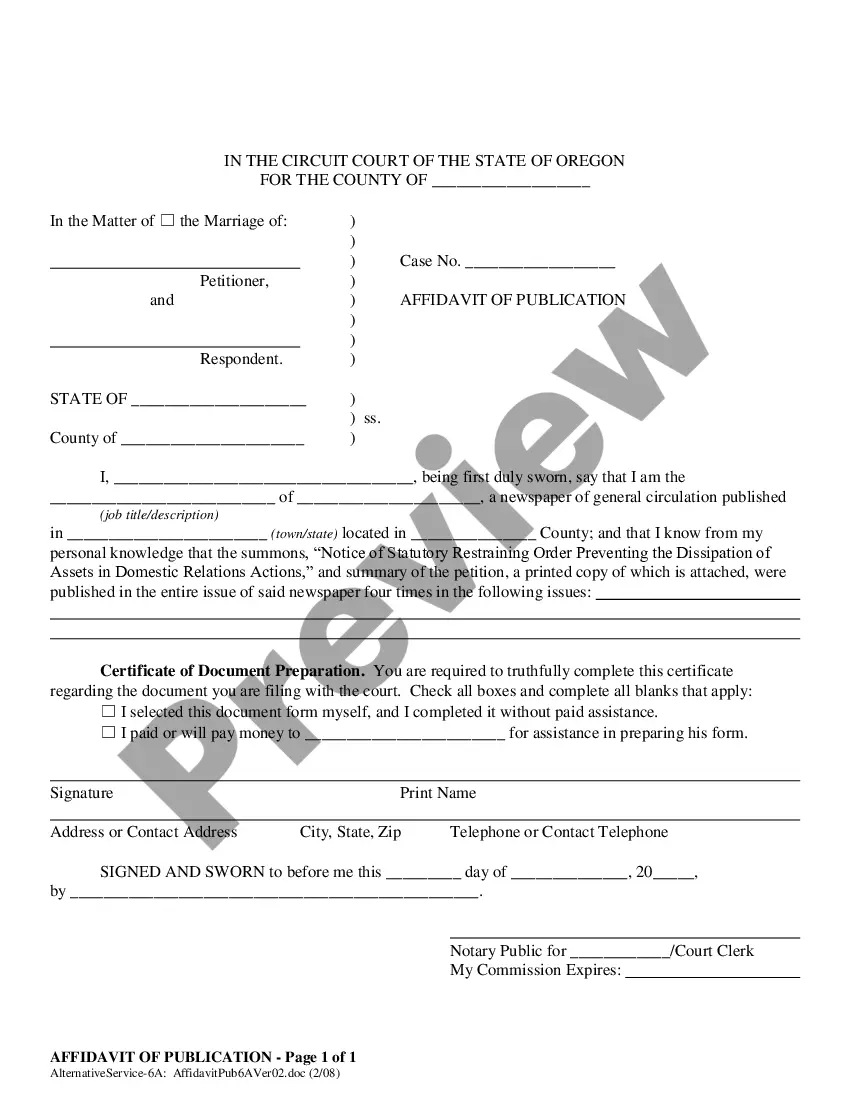
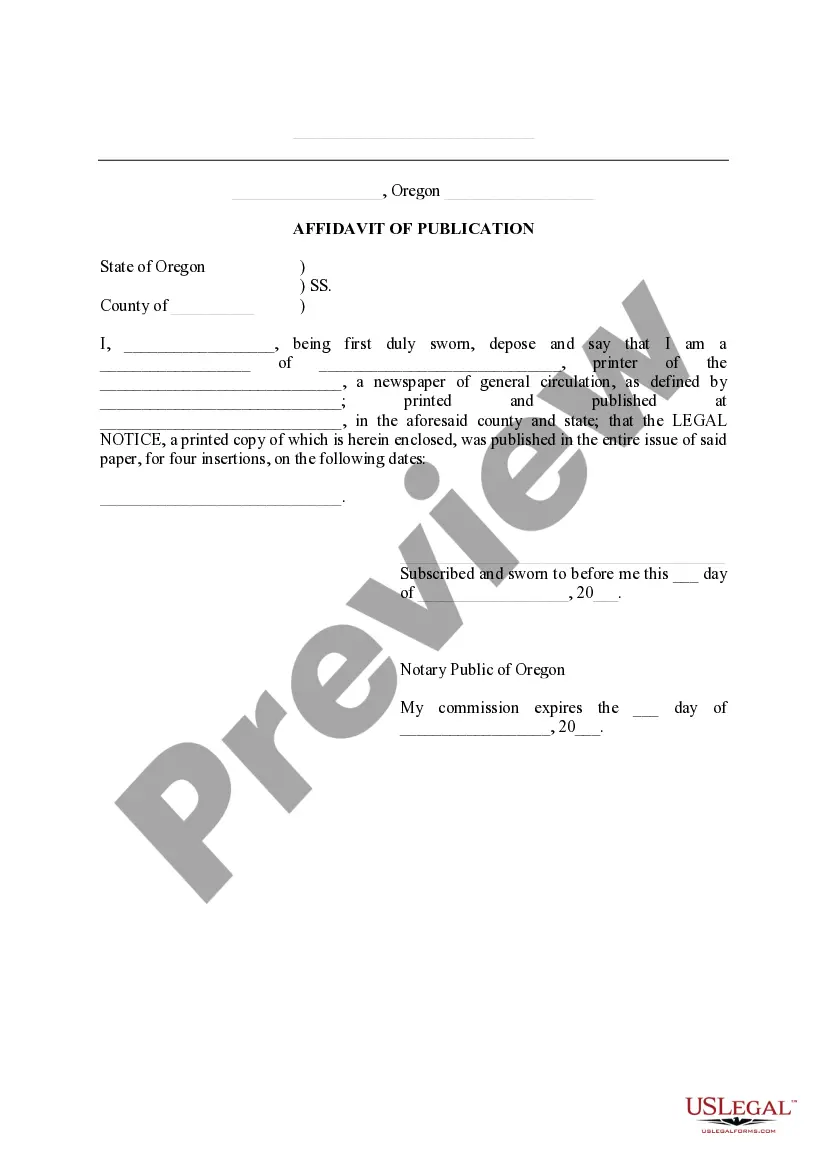
The Affidavit of Publication is a legal document used in domestic litigation, specifically in Oregon. This form serves to verify that a legal summons has been published in a newspaper of general circulation as required by law. It is a crucial step in the legal process, ensuring that a party is properly notified of court proceedings, and it differs from similar documents by its focus on publication verification rather than general service of process.
Form components explained
- Identification of the circuit court and county involved.
- Petitioner's and respondent's names and case number.
- Details of the newspaper publication, including dates and issues.
- Certification section for document preparation.
- Notary public or court clerk signature section.

When this form is needed
Use the Affidavit of Publication when you need to provide proof that a legal notice of summons has been published in a local newspaper. This form is typically required in divorce or domestic relation cases when a person cannot be reached via personal service. It ensures that the respondent has had a chance to be notified of legal actions against them.
Who should use this form
- Individuals filing for divorce in Oregon.
- Attorneys representing clients in domestic litigation cases.
- Parties who are seeking to meet legal requirements for notifying respondents.
How to prepare this document
- Identify the circuit court and county at the top of the form.
- Fill in the names of the petitioner and respondent, along with the case number.
- Provide details about the newspaper publication, including the names and dates of the issues where the summons was published.
- Complete the certification regarding how the form was prepared.
- Sign and date the form before a notary public or court clerk.
Is notarization required?
Yes, this form must be notarized to be legally valid. US Legal Forms offers an integrated online notarization service, available 24/7, through secure video calls that ensure legal equivalence without the need for in-person visits.
Get your form ready online
Our built-in tools help you complete, sign, share, and store your documents in one place.
Make edits, fill in missing information, and update formatting in US Legal Forms—just like you would in MS Word.
Download a copy, print it, send it by email, or mail it via USPS—whatever works best for your next step.
Sign and collect signatures with our SignNow integration. Send to multiple recipients, set reminders, and more. Go Premium to unlock E-Sign.
If this form requires notarization, complete it online through a secure video call—no need to meet a notary in person or wait for an appointment.
We protect your documents and personal data by following strict security and privacy standards.

Make edits, fill in missing information, and update formatting in US Legal Forms—just like you would in MS Word.

Download a copy, print it, send it by email, or mail it via USPS—whatever works best for your next step.

Sign and collect signatures with our SignNow integration. Send to multiple recipients, set reminders, and more. Go Premium to unlock E-Sign.

If this form requires notarization, complete it online through a secure video call—no need to meet a notary in person or wait for an appointment.

We protect your documents and personal data by following strict security and privacy standards.
Common mistakes to avoid
- Failing to accurately fill in the names and case number, which can lead to delays.
- Not providing all required publication dates and details.
- Omitting the certification section, which is critical for verification.
- Not having the form notarized if necessary.
Benefits of using this form online
- Convenient access to legal templates anytime, anywhere.
- Edit and customize the form easily to fit specific needs.
- Reliable and accurate forms created by licensed attorneys.
Looking for another form?
Form popularity
FAQ
About Civil ProcessCivil Processing requires a notice to the defendant to appear before the court or subjecting the defendant or his property to the jurisdiction of the court. It encompasses all types of writs, orders, summonses, and notices.
Also referred to as service of process, process serving is the process through which a party to a lawsuit serves an appropriate notice informing another party (such as the defendant) of initial legal action. This service empowers the serving party to exercise jurisdiction over the other party.
What does a process server do? Process servers are needed in an assortment of tasks such as filing court papers, serving legal documents, and document retrieval. Their principal job is to deliver or serve legal documents to a defendant or person involved in a court case.
The civil process division usually serves summons and complaints on defendants in civil cases where a lawsuit has been filed, as well subpoenas for appearances in court.
Process servers deliver legal documents in a litigation process. They deliver the documents to individuals who are involved in the case like defendants, witnesses, and other parties mentioned in the legal proceedings.
It may be served anywhere within the territorial limits of the state where the district court is located and, if authorized by a federal statute, beyond those limits. Proof of service must be made under Rule 4(l).
You must allow Process Servers Zone 7 to 10 days from the time the Process Server receives the documents, for the documents to be served. If you require the documents to be served within 7 to 10 days you must select urgent service when paying and your documents will be given priority. What is Urgent Service?
Process servers fill an essential role in the legal service; process servers are there to notify someone of an impending lawsuit or court case in which they are named. It may be a divorce case, a lawsuit against them, or a summons to be a witness.
Three basic methods are used for service of process: (1) actual, or personal, service, (2) substituted service, and (3) service by publication.