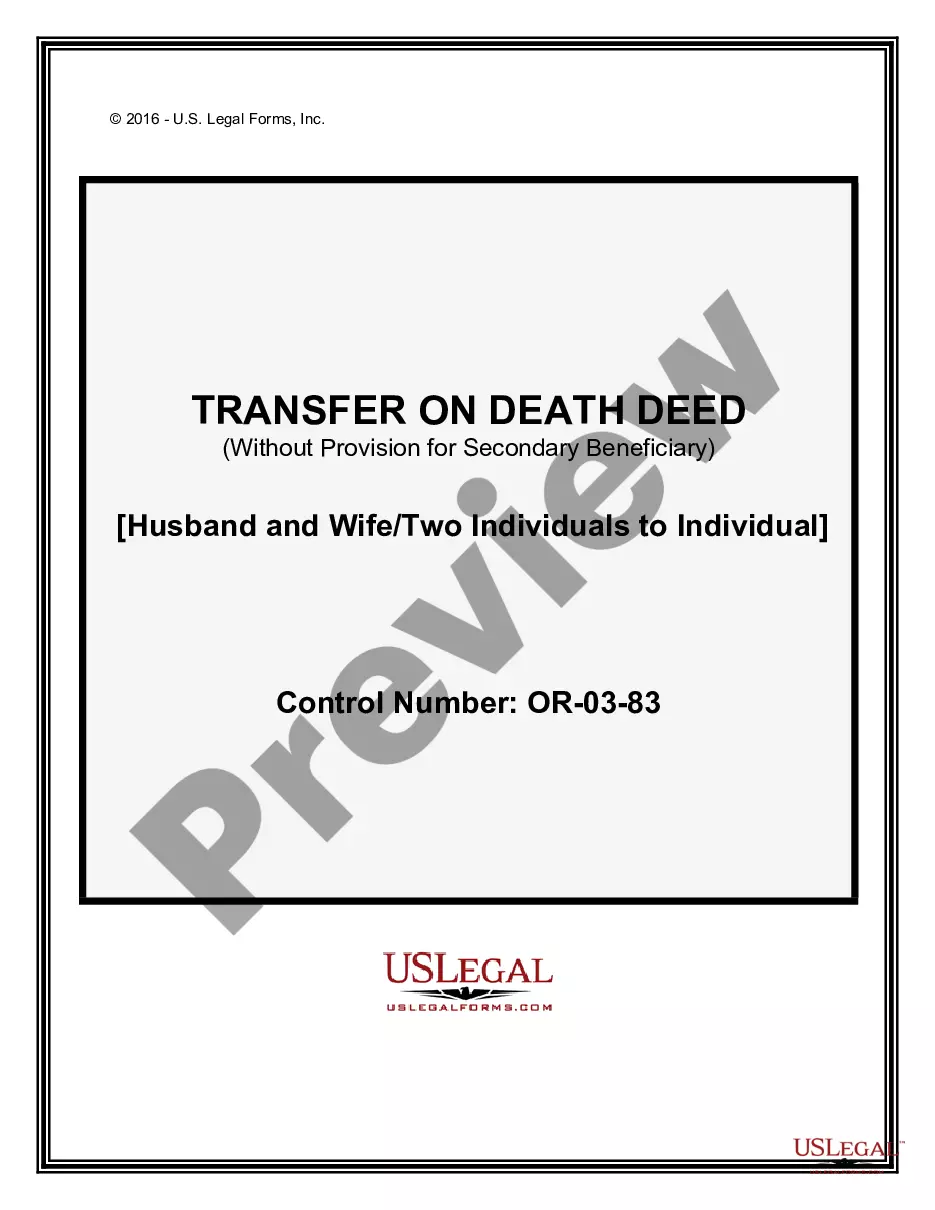
Oregon Transfer on Death Deed from Two (2) Individuals or Husband and Wife to an Individual WITHOUT provision for appointment of Alternate Beneficiary.
Overview of this form
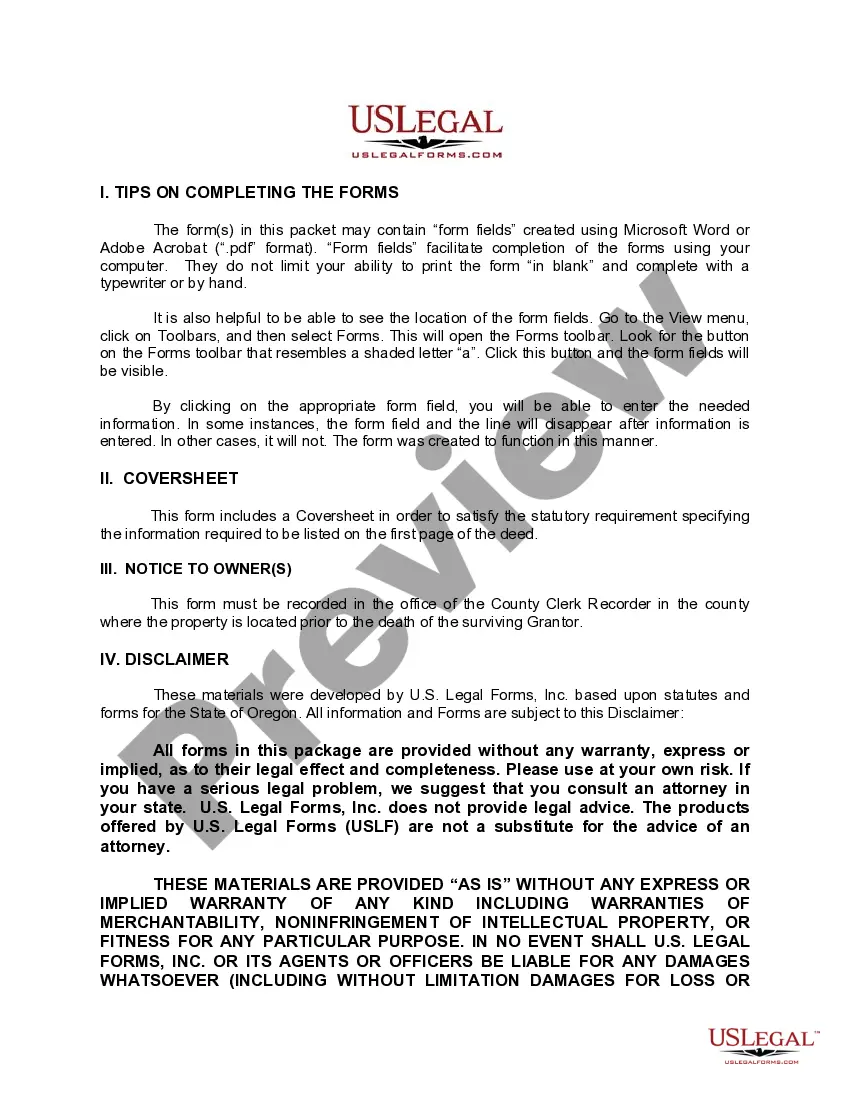
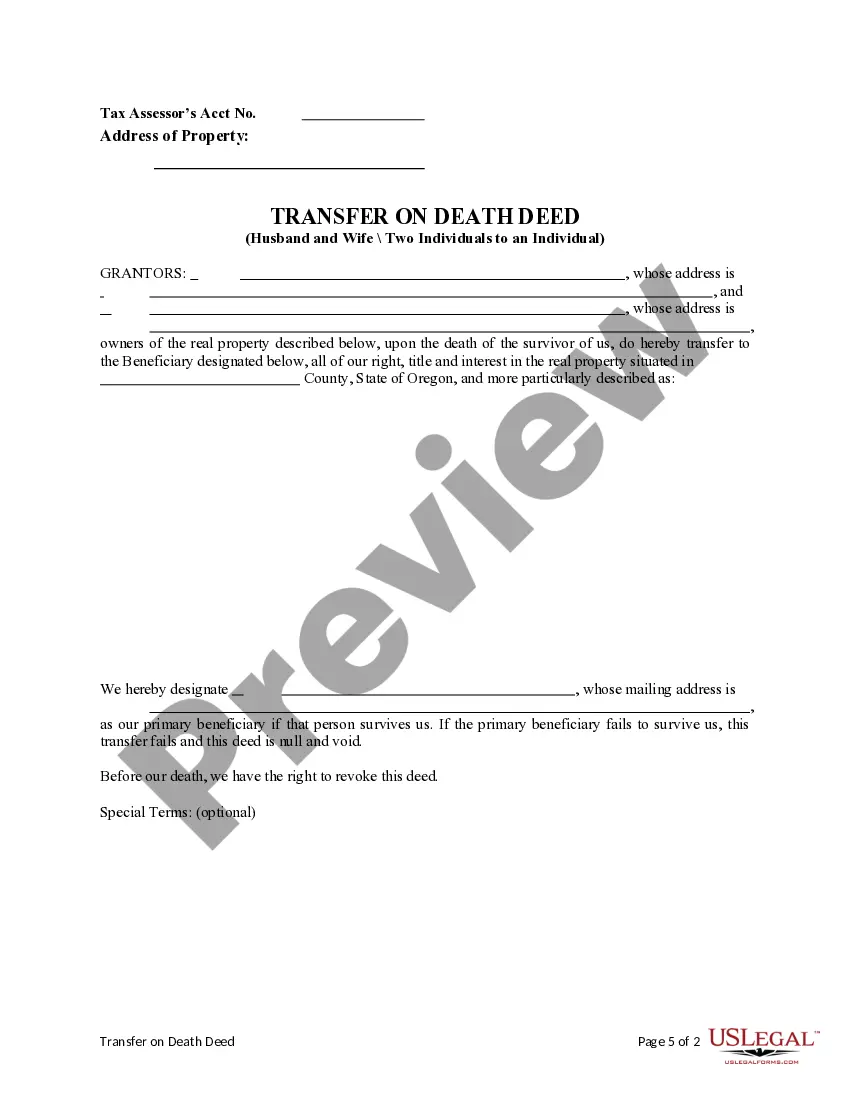
This form is a Transfer on Death Deed designed specifically for two individuals, typically a married couple, transferring property to an individual upon the death of the last surviving grantor. This document is revocable before the death of the last grantor and becomes effective only after their passing. Unlike other deeds, this version does not include provisions for an alternate beneficiary, meaning it will be null and void if the primary beneficiary does not survive the grantors. This form adheres to relevant state laws governing such transfers.
Form components explained
- Grantors: Identifies the individuals (typically a married couple) transferring the property.
- Grantee/Beneficiary: Names the individual who will receive the property upon the death of the last surviving grantor.
- Revocability clause: States that the deed can be revoked by the grantors prior to their death.
- No alternate beneficiary: Indicates that if the primary beneficiary does not survive, the deed is void.
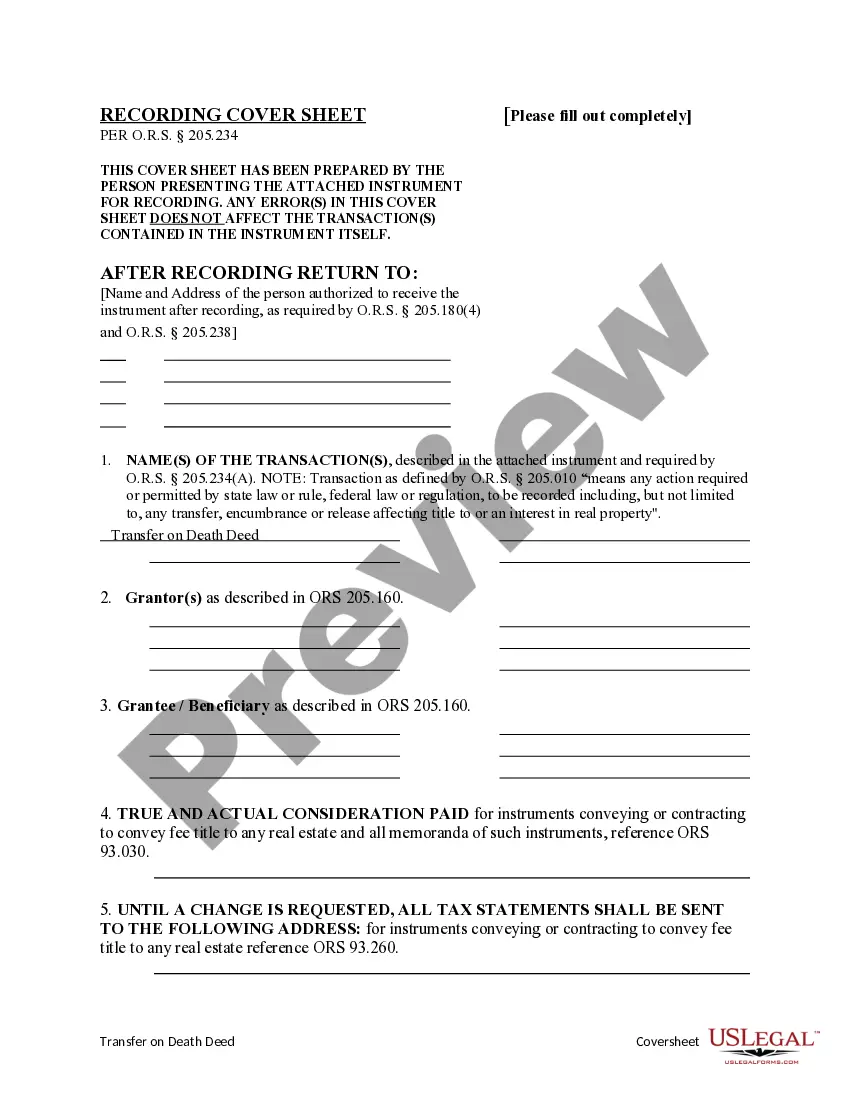
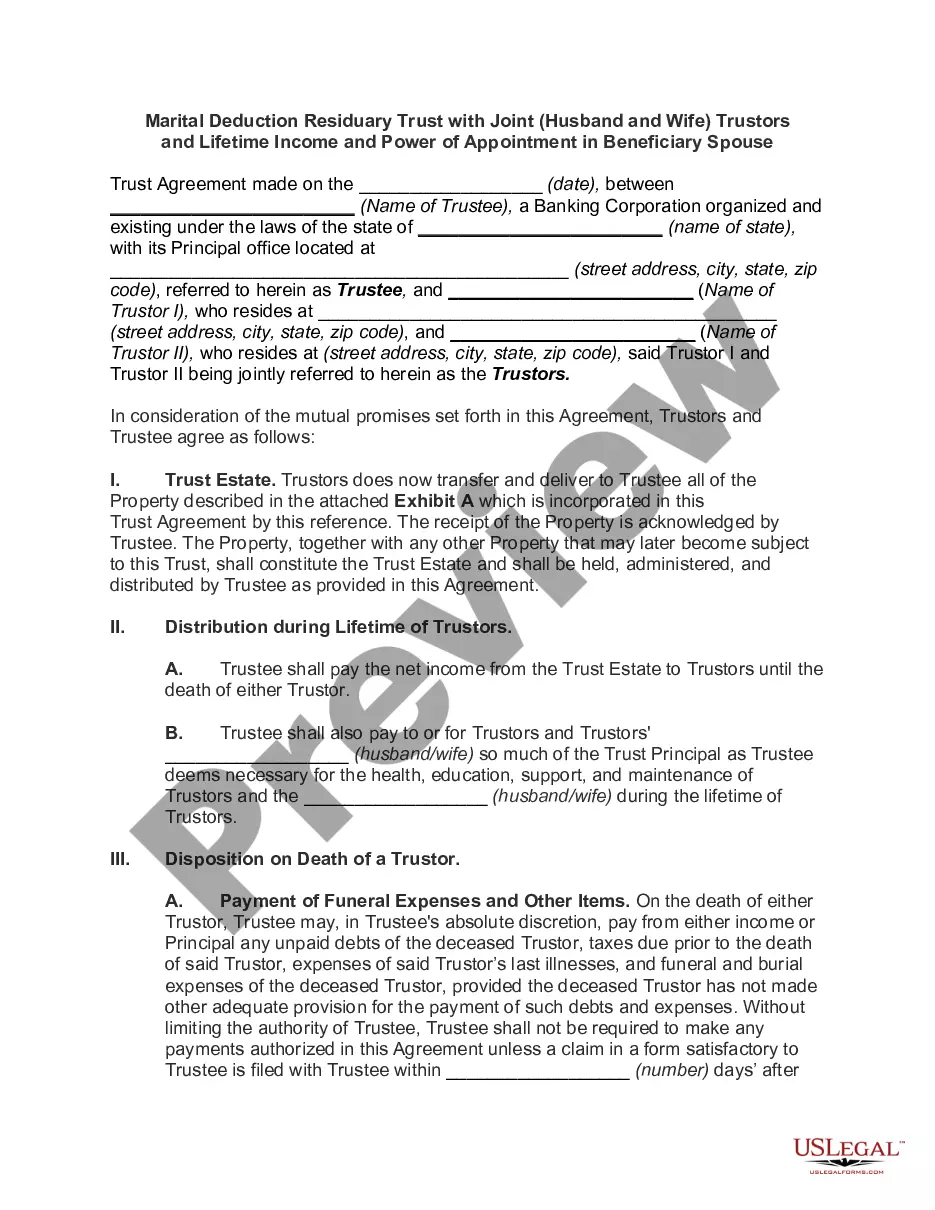
- Coversheet: Includes necessary legal information for recording the deed.
- Recording requirement: Specifies that the deed must be recorded in the county where the property is located.




When to use this form
This form should be used when a married couple wishes to transfer property to a single individual while ensuring that the transfer takes effect only after both grantors have passed away. It is particularly beneficial in estate planning, allowing the couple to designate their property to the chosen beneficiary without the complications of probate, provided that the beneficiary survives both grantors.
Intended users of this form
- Married couples who own property jointly and wish to transfer it to an individual.
- Individuals who want to avoid probate and ensure a direct transfer of property to a designated beneficiary.
- Those seeking a revocable option for estate planning that does not require additional provisions for alternate beneficiaries.
Completing this form step by step
- Identify the grantors: Fill in the names of both individuals transferring the property.
- Specify the grantee/beneficiary: Enter the name of the individual who will inherit the property.
- Describe the property: Clearly outline the property details being transferred.
- Review revocability: Ensure understanding that the deed is revocable until the death of the last surviving grantor.
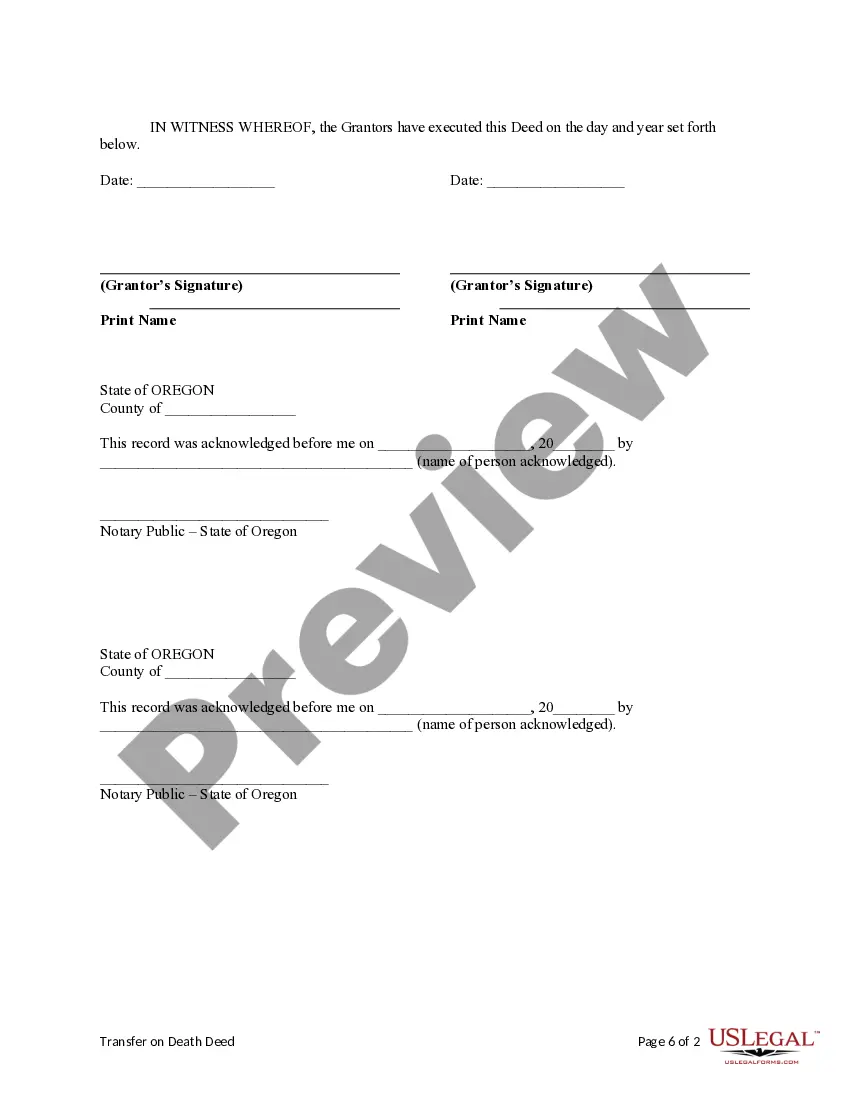
- Sign and date the form: Both grantors must sign and date the deed prior to submitting it for recording.
- Record the deed: Submit the completed deed and coversheet to the county clerk recorder in the county where the property is located.
Does this document require notarization?
This document requires notarization to meet legal standards. US Legal Forms provides secure online notarization powered by Notarize, allowing you to complete the process through a verified video call, available 24/7.
Get your form ready online
Our built-in tools help you complete, sign, share, and store your documents in one place.
Make edits, fill in missing information, and update formatting in US Legal Forms—just like you would in MS Word.
Download a copy, print it, send it by email, or mail it via USPS—whatever works best for your next step.
Sign and collect signatures with our SignNow integration. Send to multiple recipients, set reminders, and more. Go Premium to unlock E-Sign.
If this form requires notarization, complete it online through a secure video call—no need to meet a notary in person or wait for an appointment.
We protect your documents and personal data by following strict security and privacy standards.

Make edits, fill in missing information, and update formatting in US Legal Forms—just like you would in MS Word.

Download a copy, print it, send it by email, or mail it via USPS—whatever works best for your next step.

Sign and collect signatures with our SignNow integration. Send to multiple recipients, set reminders, and more. Go Premium to unlock E-Sign.

If this form requires notarization, complete it online through a secure video call—no need to meet a notary in person or wait for an appointment.

We protect your documents and personal data by following strict security and privacy standards.
Common mistakes
- Failing to properly identify both grantors or the beneficiary.
- Not understanding that the deed is null and void if the primary beneficiary does not survive both grantors.
- Neglecting to record the deed before the death of the last surviving grantor.
- Leaving out details about the property being transferred.
Benefits of completing this form online
- Convenient access to high-quality legal forms from anywhere at any time.
- Editability allows for quick adjustments without needing to start over.
- Reliable templates drafted by licensed attorneys, ensuring legal compliance.
- Easy downloading and printing options for immediate use.
Looking for another form?


Form popularity
FAQ
Effective January 1, 2012, Oregon law provides for a new form of deed known as a transfer on death (TOD) deed. These deeds allow an owner of real property to designate a beneficiary who will obtain title to that real property when the owner dies, without having to go through probate (subject to some exceptions).
Accounts or assets with named beneficiaries may be transferred without going through the probate process.If there is a TOD on the account, the assets will only go to the beneficiary if both joint owners pass away. In either case, the asset will not likely go through probate.
Get a Deed Form or Prepare Your Own. You can buy a state-specific TOD deed form for your state or type up your own document. Name the Beneficiary. Describe the Property. Sign the Deed. Record the Deed.
On a nonretirement account, designating a beneficiary or beneficiaries establishes a transfer on death (TOD) registration for the account. For an individual account, a TOD registration generally allows ownership of the account to be transferred to the designated beneficiary upon your death.
An account holder may choose to list both of their children as equal beneficiaries. However, an account holder can also choose to list individuals in unequal amounts. For example, you could designate a primary beneficiary to receive 50 percent of the funds and two secondary beneficiaries who receive 25 percent each.
All you need to do is fill out a simple form, provided by the bank, naming the person you want to inherit the money in the account at your death. As long as you are alive, the person you named to inherit the money in a payable-on-death (POD) account has no rights to it.
A TOD designation supersedes a will. For bank accounts, you can set up a similar account known as payable-on-death, sometimes referred to as a Totten trust. Your beneficiaries can't touch the account while you're alive, and you're free to change beneficiaries or close the accounts at any time.
TOD account holders can name multiple beneficiaries and divide assets any way they like.However, the beneficiaries have no access or rights to a TOD account while its owner is alive. Those beneficiaries can also be changed at any time, so long as the TOD account holder is deemed mentally competent.