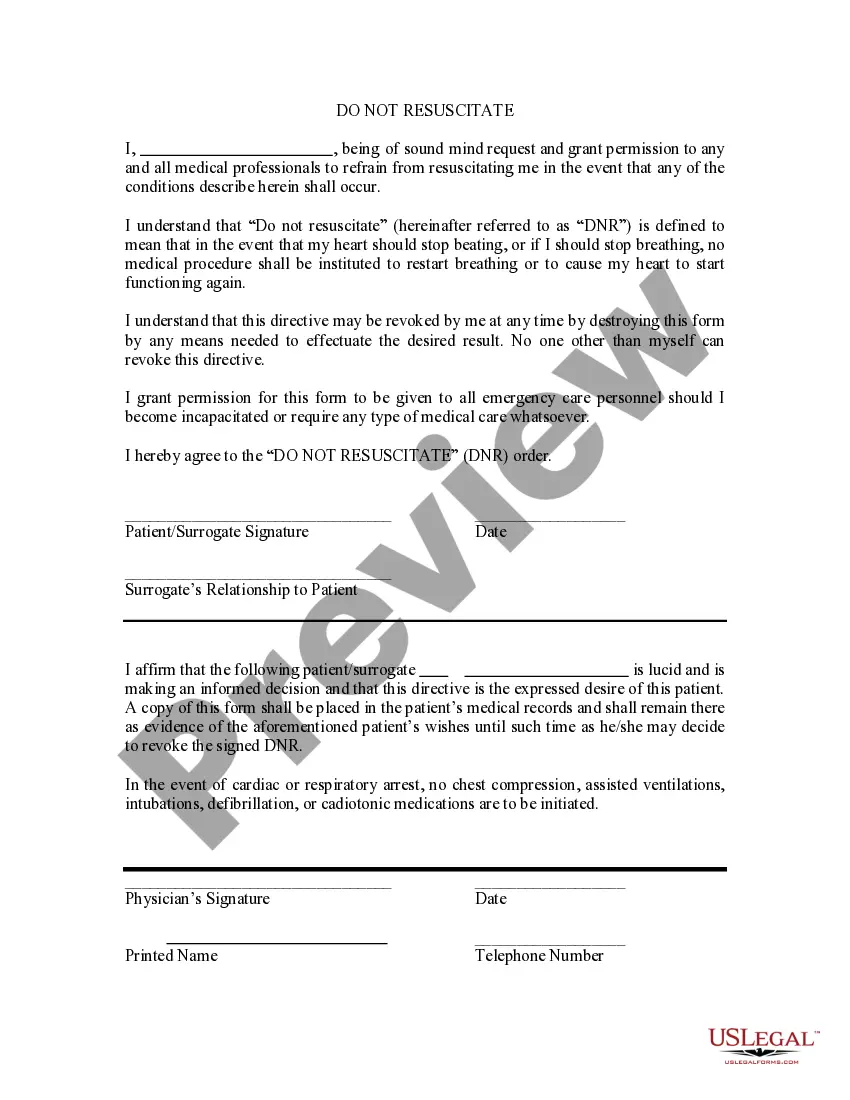
This is a form initiated by a patient requesting that he/she not be resuscitated should he/she stop breathing or should his/her heart stop beating. This form is also to be signed by a physician attesting to patient's wishes and to be placed in the patient's file.
Oklahoma Do Not Resuscitate Request - DNR
State:
Multi-State
Control #:
US-PRM-12
Format:
Word;
Rich Text
Instant download
Description
Free preview

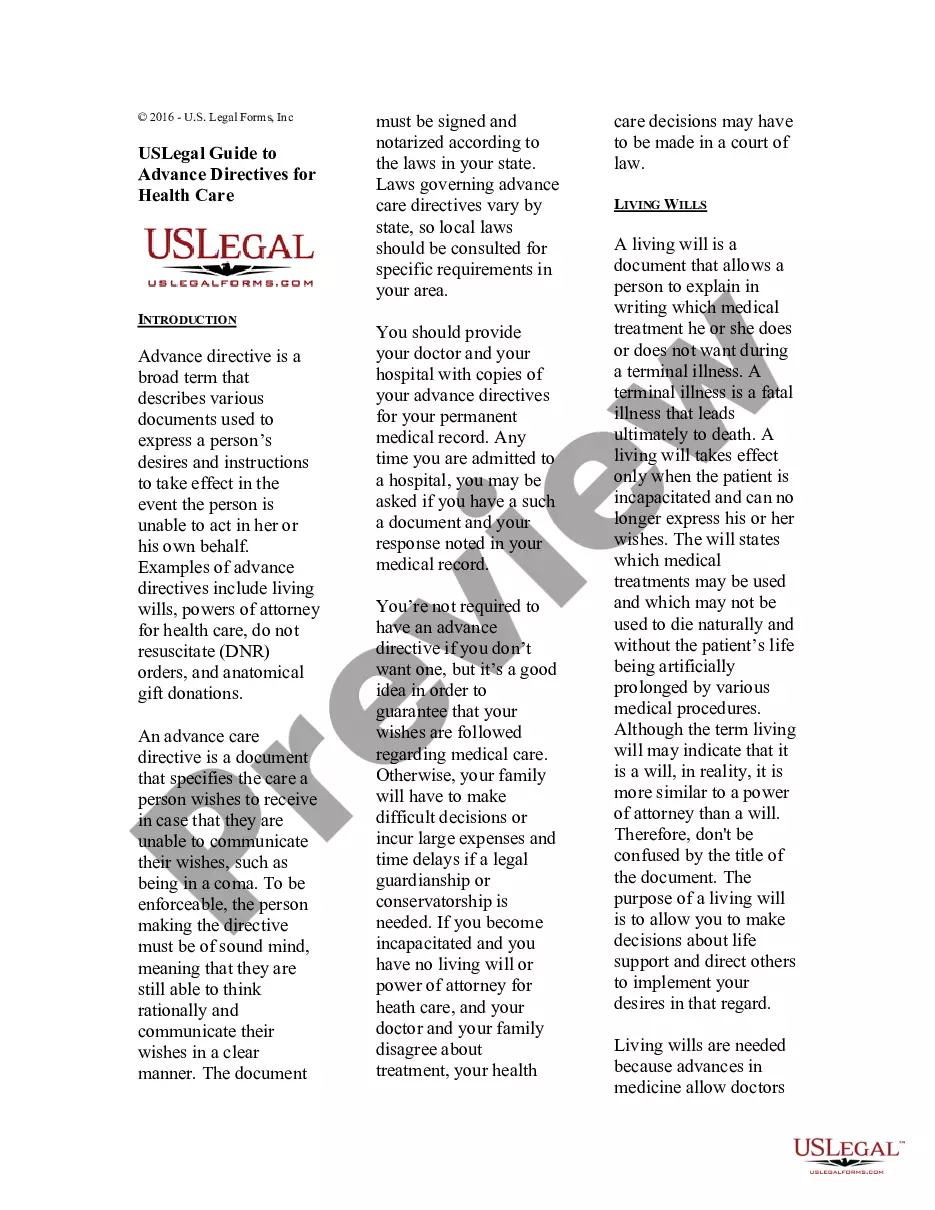
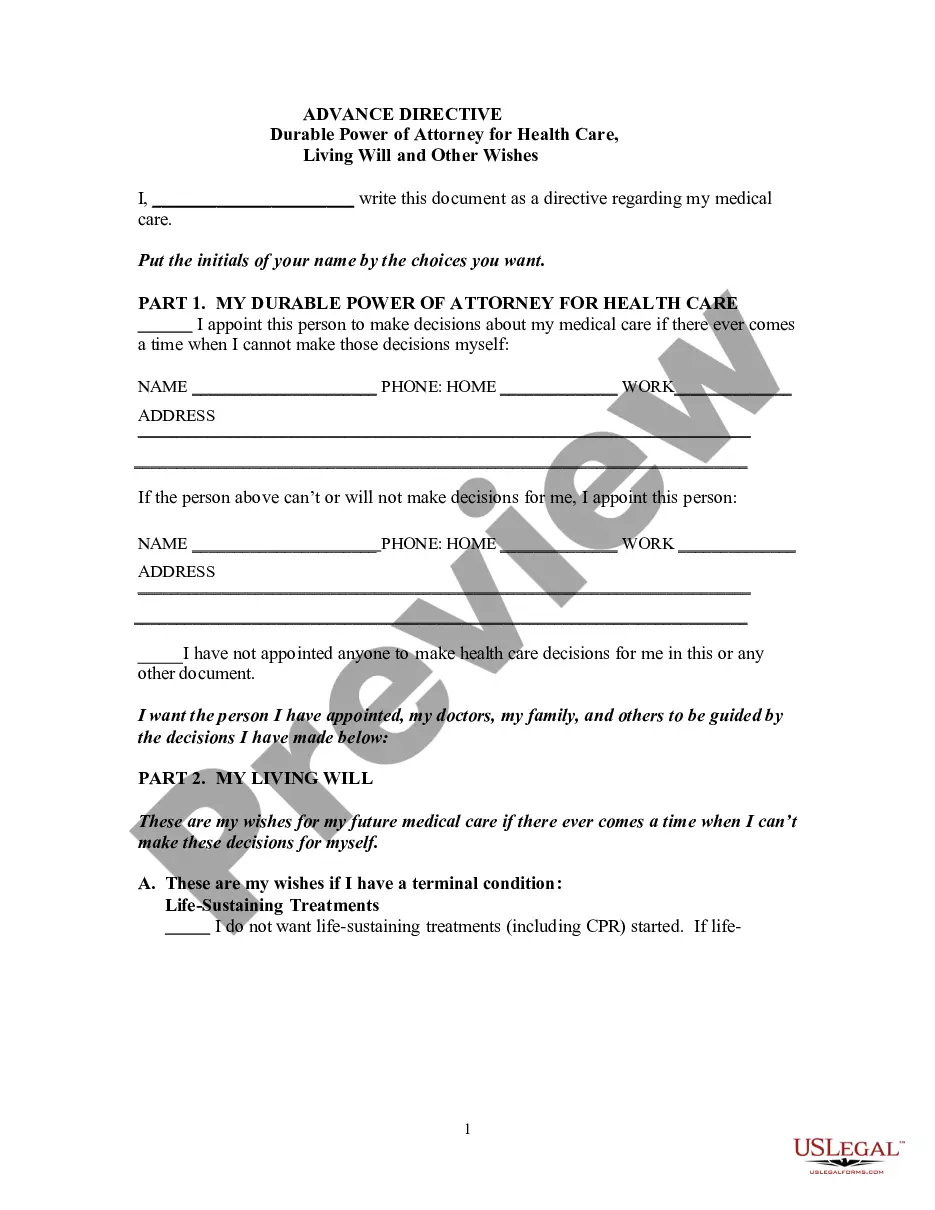
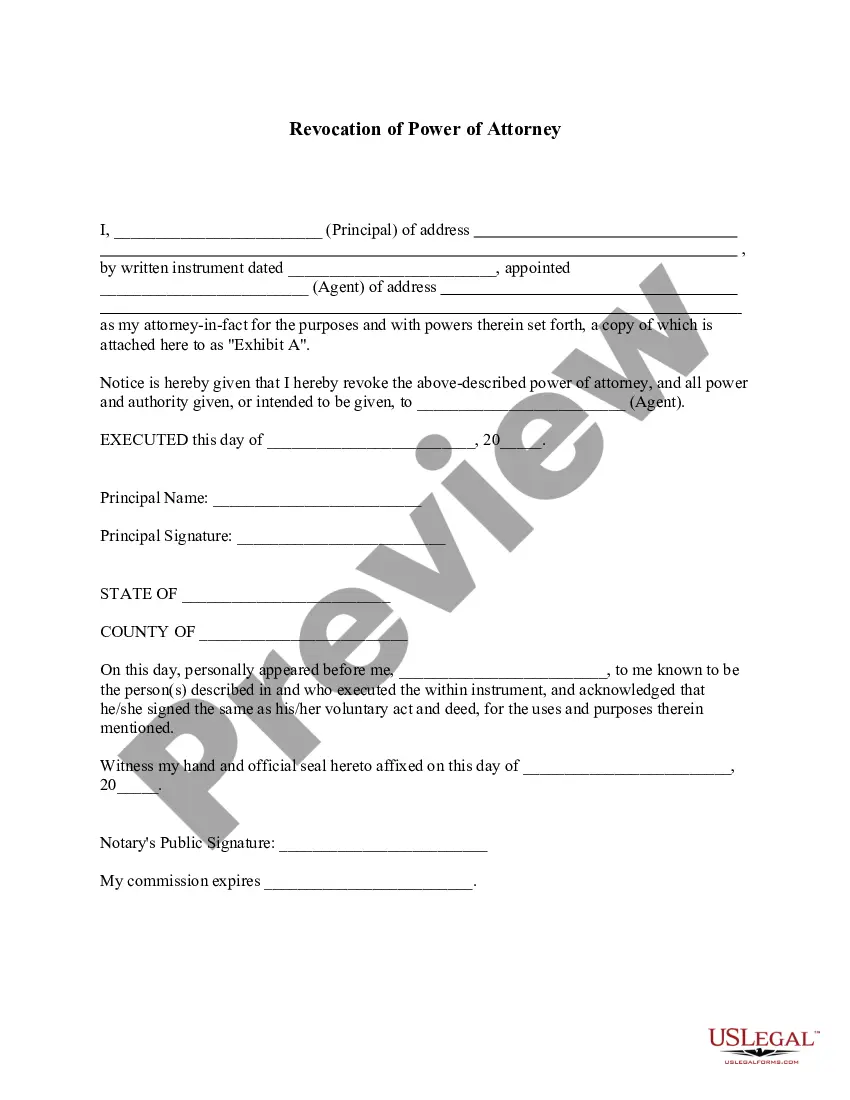
Get your form ready online
Our built-in tools help you complete, sign, share, and store your documents in one place.
Built-in online Word editor
Make edits, fill in missing information, and update formatting in US Legal Forms—just like you would in MS Word.
Export easily
Download a copy, print it, send it by email, or mail it via USPS—whatever works best for your next step.
E-sign your document
Sign and collect signatures with our SignNow integration. Send to multiple recipients, set reminders, and more. Go Premium to unlock E-Sign.
Notarize online 24/7
If this form requires notarization, complete it online through a secure video call—no need to meet a notary in person or wait for an appointment.
Store your document securely
We protect your documents and personal data by following strict security and privacy standards.

Make edits, fill in missing information, and update formatting in US Legal Forms—just like you would in MS Word.

Download a copy, print it, send it by email, or mail it via USPS—whatever works best for your next step.

Sign and collect signatures with our SignNow integration. Send to multiple recipients, set reminders, and more. Go Premium to unlock E-Sign.

If this form requires notarization, complete it online through a secure video call—no need to meet a notary in person or wait for an appointment.

We protect your documents and personal data by following strict security and privacy standards.
Looking for another form?



How to fill out Do Not Resuscitate Request - DNR?
It is feasible to spend hours online trying to locate the proper legal format that meets the federal and state criteria you need.
US Legal Forms offers thousands of legal documents that can be examined by professionals.
You can download or print the Oklahoma Do Not Resuscitate Request - DNR from their service.
If available, utilize the Review button to verify the format as well. To find an additional version of your form, use the Search box to locate the format that meets your needs and specifications. Once you have found the format you require, simply click Get now to proceed. Choose the pricing plan you need, enter your details, and create a free account on US Legal Forms. Complete the transaction. You can use your credit card or PayPal account to purchase the legal form. Select the format of your document and download it to your device. Make modifications to the document if necessary. You can complete, modify, and sign and print the Oklahoma Do Not Resuscitate Request - DNR. Download and print thousands of document templates using the US Legal Forms website, which provides the largest collection of legal forms. Utilize professional and state-specific templates to address your business or personal needs.
- If you already possess a US Legal Forms account, you can sign in and hit the Download button.
- Afterward, you can complete, modify, print, or sign the Oklahoma Do Not Resuscitate Request - DNR.
- Every legal format you acquire is yours indefinitely.
- To obtain another copy of the purchased form, navigate to the My documents section and click the appropriate button.
- If you are using the US Legal Forms website for the first time, follow the simple instructions listed below.
- First, ensure that you have selected the correct format for the area/city of your choice.
- Review the form description to confirm you have selected the correct one.
Form popularity
FAQ
To fill out an Oklahoma Do Not Resuscitate Request - DNR form, start by obtaining the official form from a reliable source, such as your healthcare provider or legal website. Next, clearly indicate your wishes regarding resuscitation by signing the document in the presence of a witness. It is crucial to ensure that both you and the witness sign the form to make it valid. Finally, keep the completed form in an accessible location and share copies with your healthcare team and family members to ensure your wishes are understood.
' In some cases, as with your grandad, doctors may decide that there should be no attempt to resuscitate a person if they have a cardiac arrest or stop breathing. This is called a DNACPR (do not attempt cardiopulmonary resuscitation) order, often shortened to a DNR or DNAR.
Can a Healthy Person Get a DNR? While do-not-resuscitate orders are commonly sought by aging and terminally ill patients, it is possible for a healthy person to get a DNR. In fact, many doctors have their own DNRs in place. But while most states will allow any adult to establish a DNR, it's not always a good idea.
The most important factor to bear in mind is that the law does not require a patient, or their family to consent to a DNR order. This means a doctor can issue a DNR order, even if you do not want one (see section on what to do if there is a disagreement).
What is a 'do not resuscitate order'? A DNR order is a medical order to withhold cardiopulmonary resuscitation (CPR). Such an order lets the healthcare team know that, in the event of a cardiac arrest, CPR must not be conducted. Instead, healthcare staff should promote comfort and prepare for end-of-life care.
notresuscitate order, or DNR order, is a medical order written by a doctor. It instructs health care providers not to do cardiopulmonary resuscitation (CPR) if a patient's breathing stops or if the patient's heart stops beating.
Free DNR consent forms are available and may be ordered from: OKDHS Supply Warehouse 217 N. E. 30th Street Oklahoma City, OK 73105 877-283-4113 FAX 405-528-4991 Give your name, address, phone number and quantity.
Witnesses must be individuals who are eighteen (18) years of age or older who are not legatees, devisees or heirs at law. D. It is the intention of the Legislature that the preferred, but not required, do-not-resuscitate form in Oklahoma shall be the form set out in subsection B of this section.
Do not resuscitate order A DNR is a request not to have CPR if your heart stops or if you stop breathing. You can use an advance directive form or tell your doctor that you don't want to be resuscitated. Your doctor will put the DNR order in your medical chart. Doctors and hospitals in all states accept DNR orders.
You decide deciding in advance to refuse CPR You can make it clear to your doctor or medical team that you do not want CPR if your heart or breathing stops. Your doctor may complete a DNACPR form to indicate this and put it in your medical records.