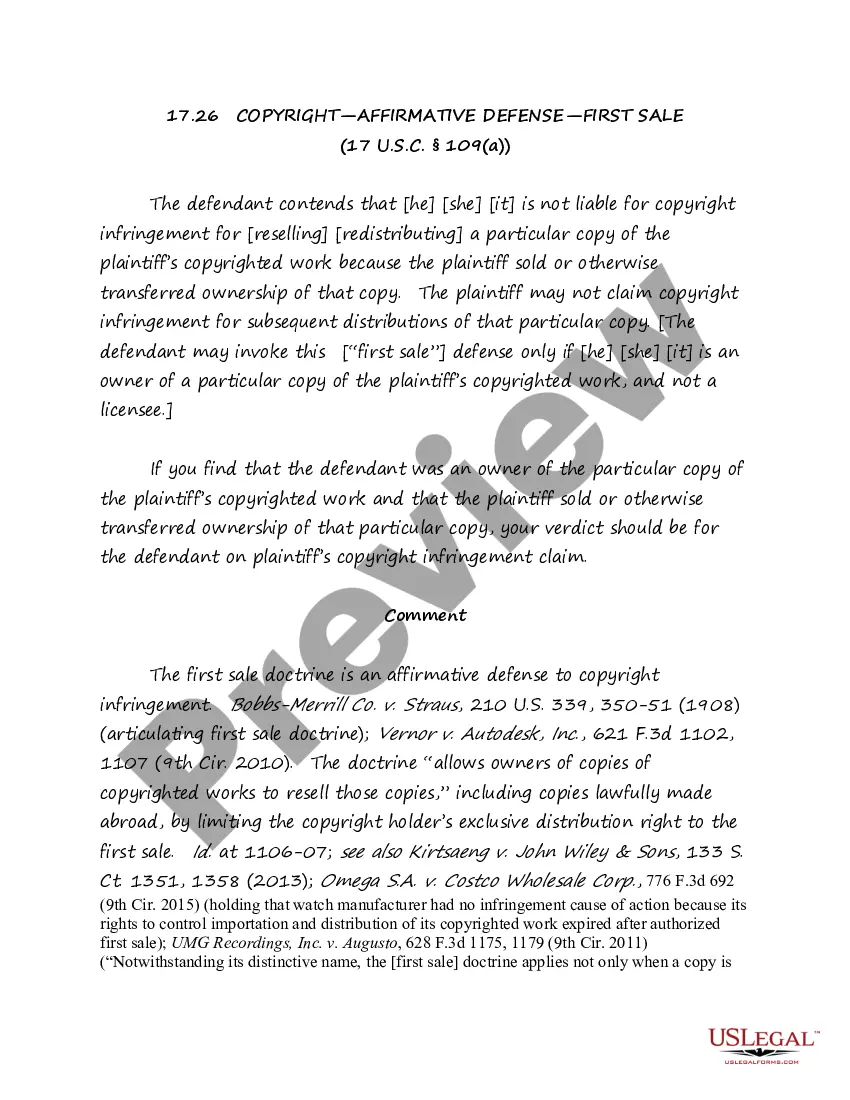
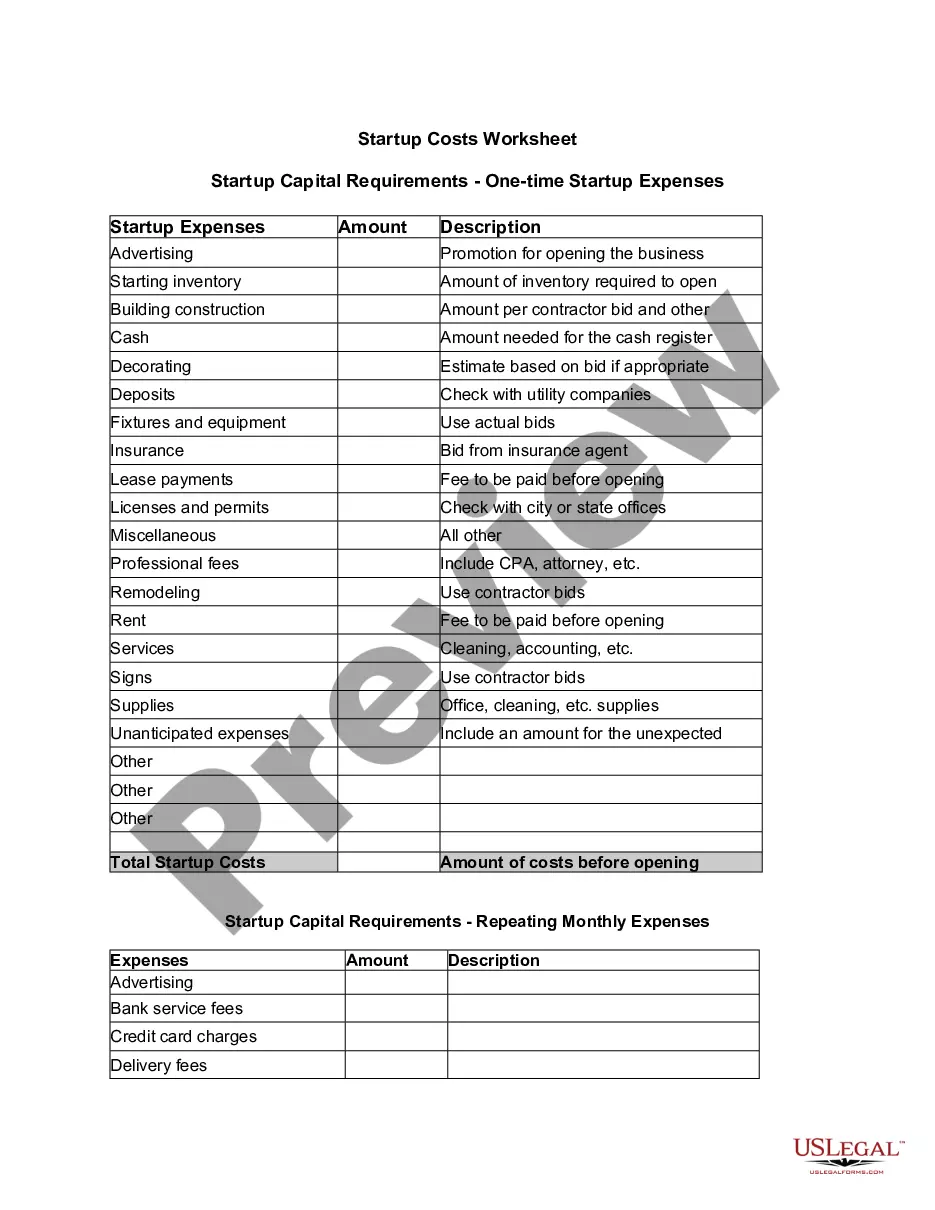
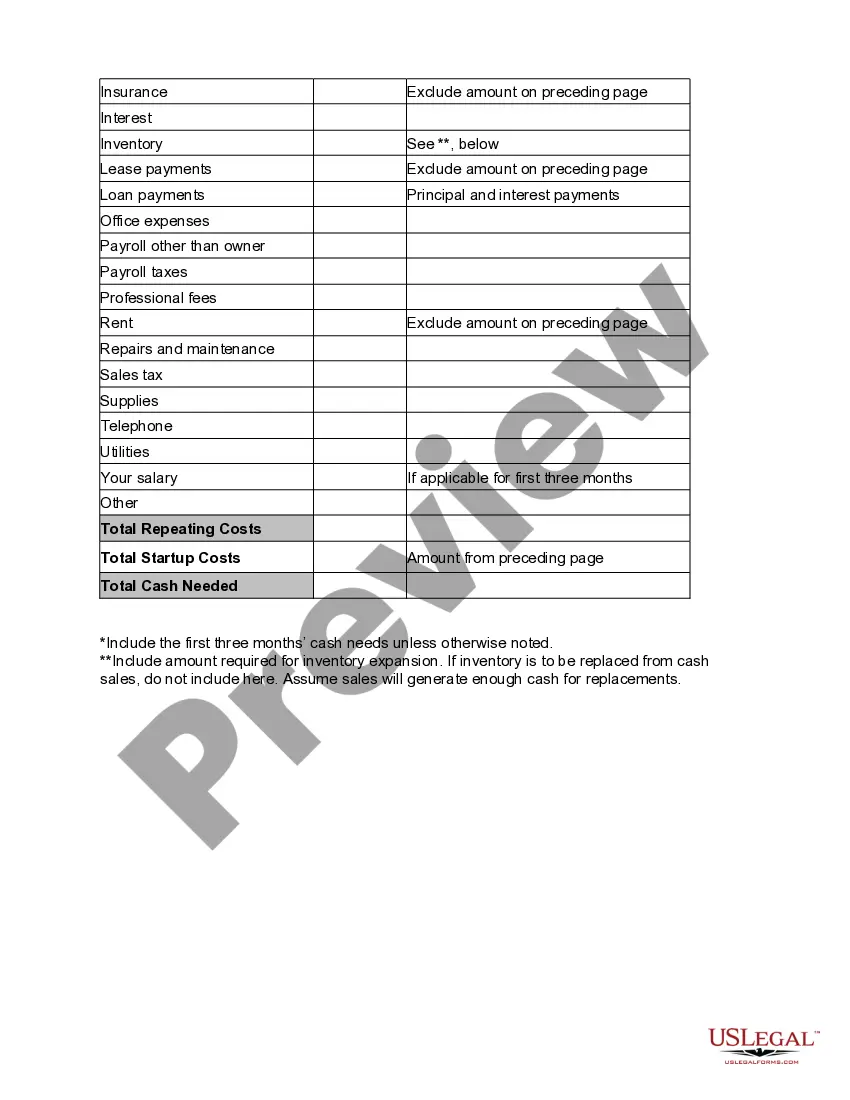
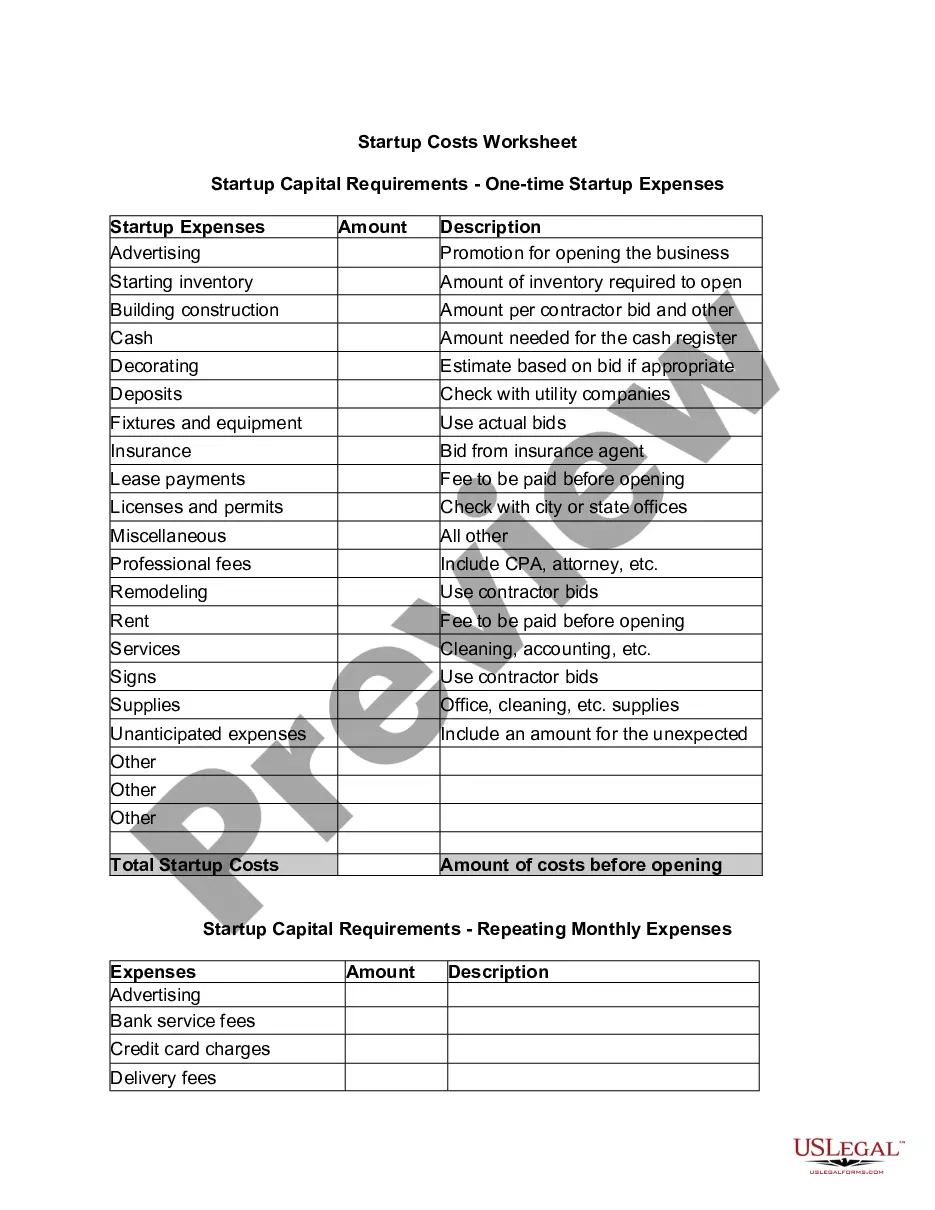
Oklahoma Startup Costs Worksheet
Description
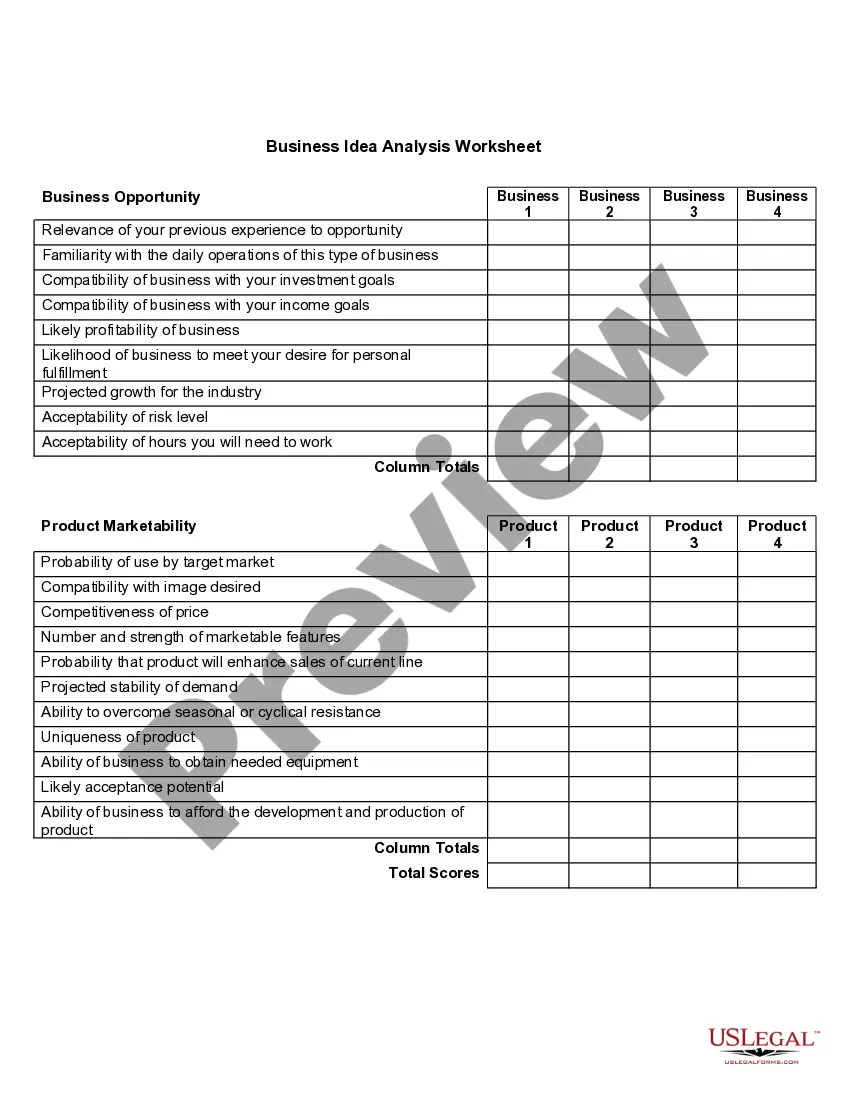
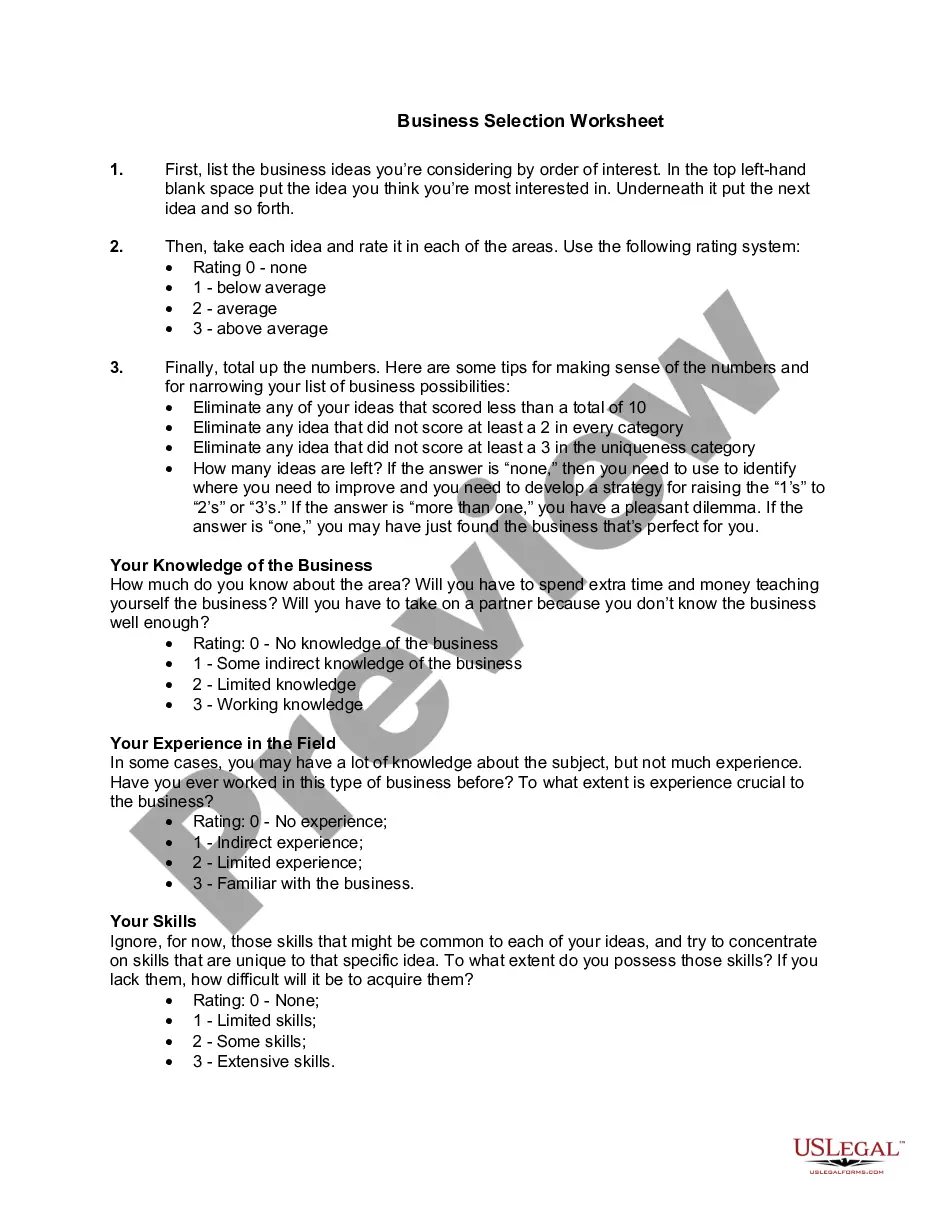
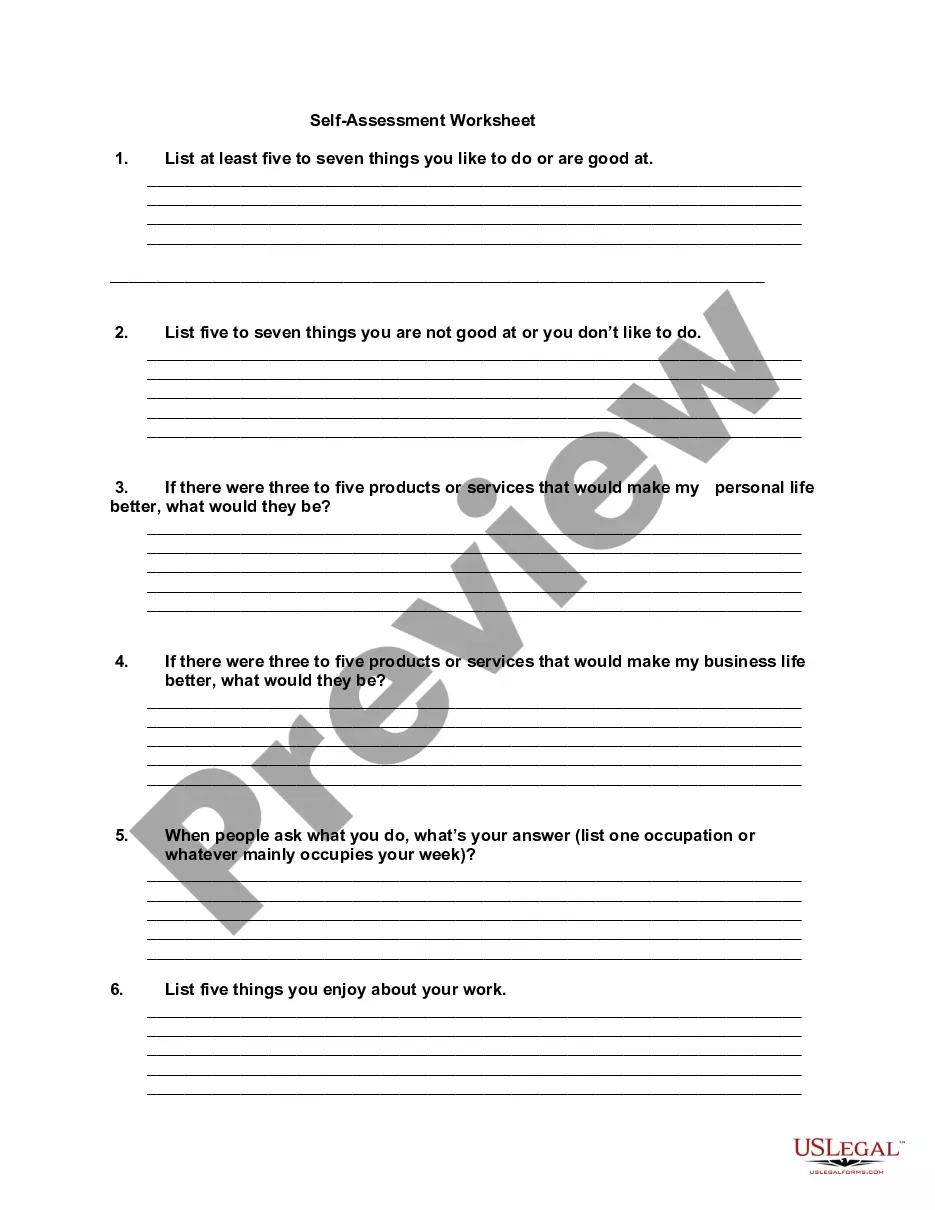
Get your form ready online
Our built-in tools help you complete, sign, share, and store your documents in one place.
Make edits, fill in missing information, and update formatting in US Legal Forms—just like you would in MS Word.
Download a copy, print it, send it by email, or mail it via USPS—whatever works best for your next step.
Sign and collect signatures with our SignNow integration. Send to multiple recipients, set reminders, and more. Go Premium to unlock E-Sign.
If this form requires notarization, complete it online through a secure video call—no need to meet a notary in person or wait for an appointment.
We protect your documents and personal data by following strict security and privacy standards.

Make edits, fill in missing information, and update formatting in US Legal Forms—just like you would in MS Word.

Download a copy, print it, send it by email, or mail it via USPS—whatever works best for your next step.

Sign and collect signatures with our SignNow integration. Send to multiple recipients, set reminders, and more. Go Premium to unlock E-Sign.

If this form requires notarization, complete it online through a secure video call—no need to meet a notary in person or wait for an appointment.

We protect your documents and personal data by following strict security and privacy standards.
Looking for another form?



How to fill out Startup Costs Worksheet?
You might spend numerous hours online trying to locate the official document template that meets the federal and state regulations you need.
US Legal Forms offers thousands of legal templates that can be reviewed by experts.
You can actually download or print the Oklahoma Startup Costs Worksheet from the services.
- If you already have a US Legal Forms account, you can sign in and click the Download button.
- Then, you can complete, edit, print, or sign the Oklahoma Startup Costs Worksheet.
- Every legal document template you obtain is yours permanently.
- To obtain another copy of any purchased form, go to the My documents tab and click the respective button.
- If you are using the US Legal Forms website for the first time, follow the simple instructions below.
- First, ensure that you have chosen the correct document template for your desired area/city.
Form popularity
FAQ
When calculating startup costs, two key elements to include are one-time expenses and ongoing operational costs. One-time expenses may cover equipment purchases and legal fees, while ongoing operational costs typically include rent and utilities. Utilizing the Oklahoma Startup Costs Worksheet allows you to categorize these expenses accurately, ensuring no crucial costs are overlooked. This comprehensive view helps you prepare for the financial demands of launching your business.
Federal tax laws allow LLCs to deduct initial startup costs, as long as the expenses occurred before it begins conducting business. A business is considered active the first time the company's services are offered to the public. The IRS sets a $5,000 deduction limit on startup and organizational costs.
How to calculate startup costsIdentify your expenses. Start by writing down the startup costs you've already incurred but don't stop there.Estimate your costs. Once you've developed a list of your business needs, note the average cost for each category.Do the math.Add a cushion.Put the numbers to work.
Startup costs will include equipment, incorporation fees, insurance, taxes, and payroll. Although startup costs will vary by your business type and industry an expense for one company may not apply to another.
What can be written off as business expenses? All basic expenses needed to run a business are tax deductible, including employee salaries, equipment and supplies, rent, utility costs, legal and accounting fees, business cards, subscriptions to business publications, and online services.
The IRS allows you to deduct $5,000 in business startup costs and $5,000 in organizational costs, but only if your total startup costs are $50,000 or less.
Start-up costs are amounts the business paid or incurred for creating an active trade or business, or investigating the creation or acquisition of an active trade or business.
Startup costs are the expenses incurred during the process of creating a new business. Pre-opening startup costs include a business plan, research expenses, borrowing costs, and expenses for technology. Post-opening startup costs include advertising, promotion, and employee expenses.
You can either deduct or amortize start-up expenses once your business begins rather than filing business taxes with no income. If you were actively engaged in your trade or business but didn't receive income, then you should file and claim your expenses.
Business expenses incurred during the startup phase are capped at a $5,000 deduction in the first year. This limit applies if your costs are $50,000 or less. 3fefffeff So if your startup expenses exceed $50,000, your first-year deduction is reduced by the amount over $50,000.