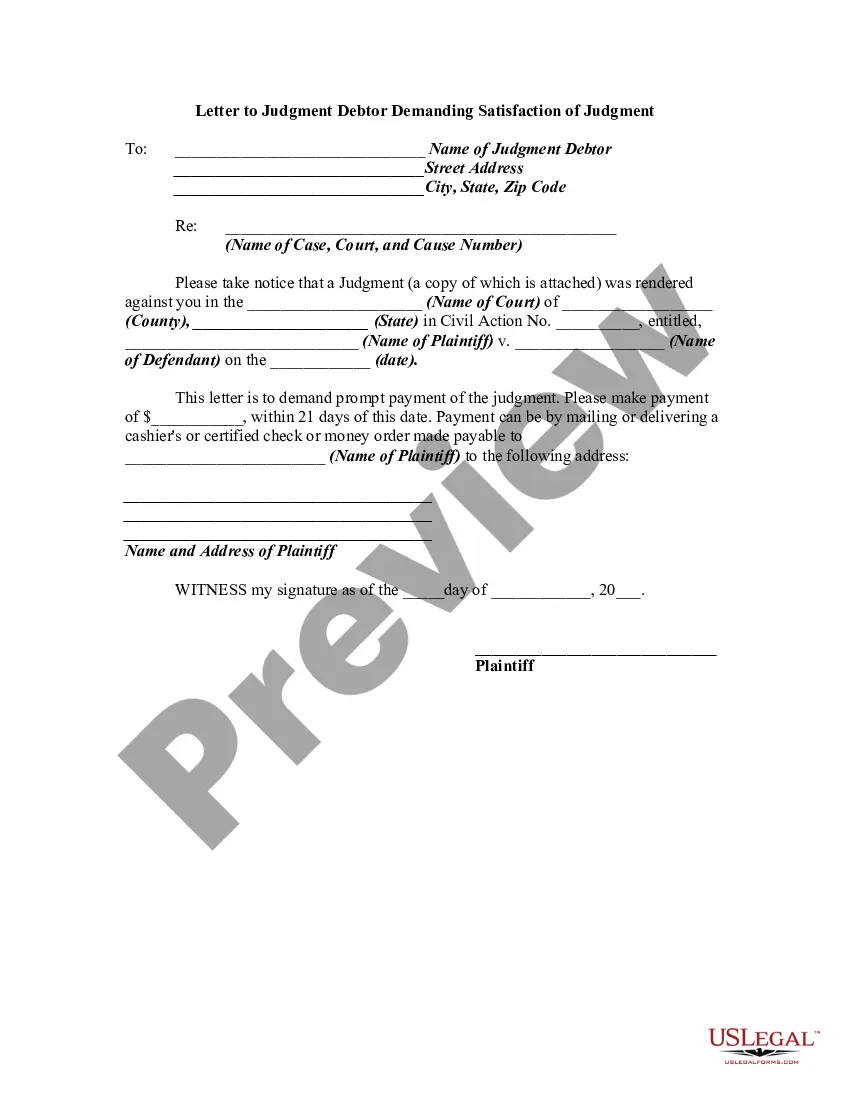
Pursuant to this form, a plaintiff who obtained a judgment against a defendant is demanding satisfaction of the judgment by payment of a sum of money sent to a specified address. If the parties are represented by an attorney, it would be preferable for the attorney representing the plaintiff to send such a letter to the attorney representing the defendant.
Oklahoma Letter to Judgment Debtor Demanding Satisfaction of Judgment
Category:
State:
Multi-State
Control #:
US-00760BG
Format:
Word;
Rich Text
Instant download
Description





How to fill out Letter To Judgment Debtor Demanding Satisfaction Of Judgment?
If you want to aggregate, retrieve, or produce sanctioned document templates, use US Legal Forms, the largest collection of legal forms available online.
Take advantage of the site's straightforward and user-friendly search to find the documents you require.
A range of templates for commercial and personal purposes are categorized by types and states, or keywords.
Once you have found the form you need, click the Purchase now button. Choose the pricing plan you prefer and enter your details to register for the account.
Complete the transaction. You may use your Visa or MasterCard or PayPal account to finalize the purchase. Step 6. Select the format of your legal form and download it to your device. Step 7. Fill out, edit, and print or sign the Oklahoma Letter to Judgment Debtor Demanding Satisfaction of Judgment.
- Utilize US Legal Forms to acquire the Oklahoma Letter to Judgment Debtor Demanding Satisfaction of Judgment in just a few clicks.
- If you are already a US Legal Forms user, Log Into your account and click the Download button to obtain the Oklahoma Letter to Judgment Debtor Demanding Satisfaction of Judgment.
- You can also access forms you previously saved in the My documents section of your account.
- If you are using US Legal Forms for the first time, follow the instructions below.
- Ensure you have selected the form for the correct city/state.
- Use the Review option to examine the form’s content. Remember to read the description.
- If you are dissatisfied with the form, use the Search field at the top of the screen to find other variations of the legal form template.
Form popularity
FAQ
In Oklahoma it is crucial to keep in mind the (5) year statute of limitation on your judgment. After that period, if the judgment is not renewed, it cannot legally be recognized in a court of law and can no longer be renewed if renewal period has passed.
Attachment is the process of seizing someone's property to collect on a judgment. ... Executing a Writ is a court order to the Sheriff to execute the judgment by confiscating the Judgment Debtor's personal property. ... Garnishments are a very efficient way to collect on a judgment.
It is very important to list your belongings in the Petition and claim them as Exempt. Guns, Horses, Cows, Furniture, Clothes, Wedding Rings, Electronics, Tools and Retirement Accounts if listed and claimed properly will be exempt and you can keep them!
Once a plaintiff has obtained a default judgment against a defendant, they can use it to collect a debt or damages in several ways. Collection efforts may include wage garnishments, property liens, seizure of assets held in bank accounts, and more.
A satisfaction of judgment may be filed to inform the court a judgment or order has been satisfied. This event should not be used in place of a Satisfaction of Claim.
If the defendant simply does not pay, you may execute on the defendant's property, you may have a garnishment issued against the defendant's assets or wages and you may compel the defendant to come to court for a Hearing on Assets to determine what assets are available.