Oklahoma Memorandum regarding Dispute Resolution Collections
Understanding this form
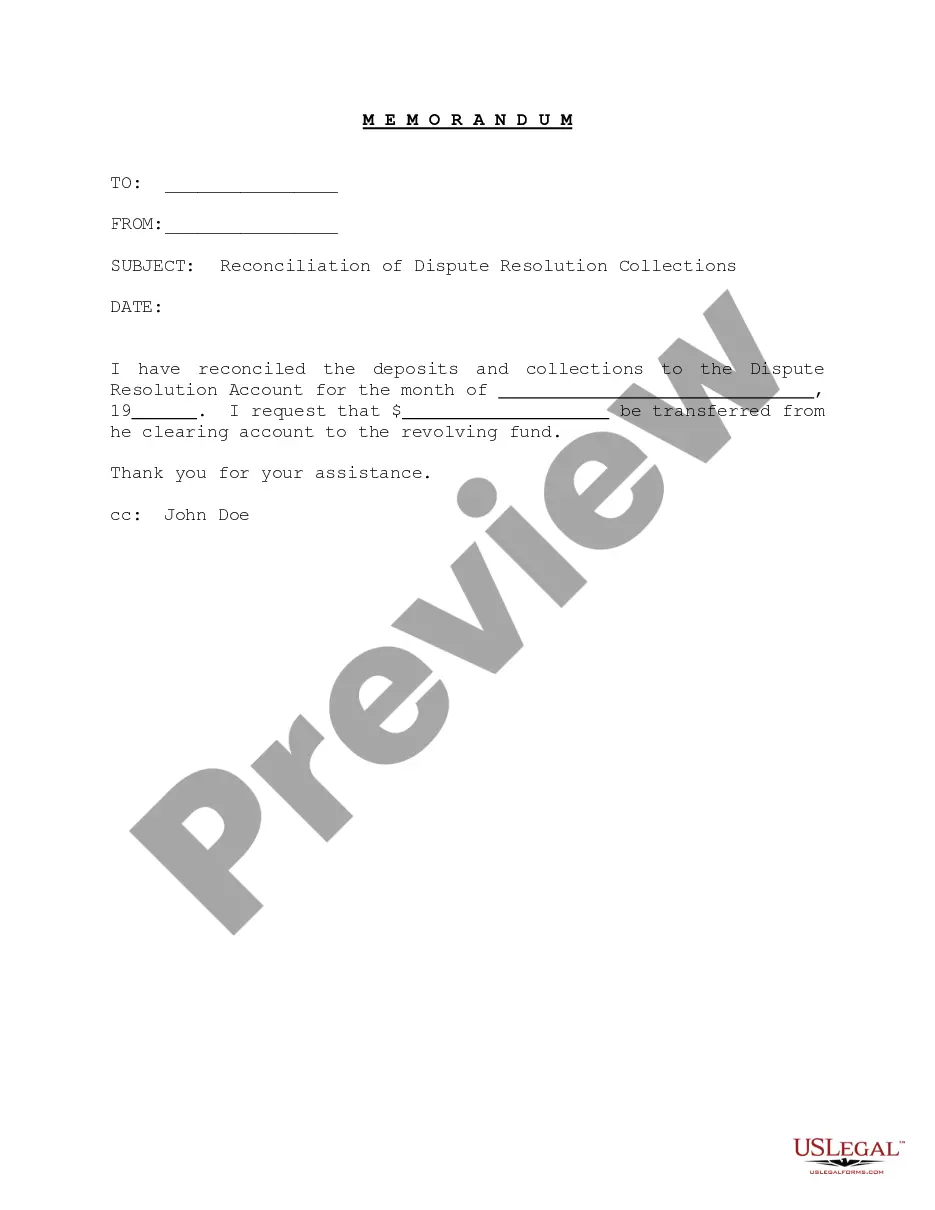
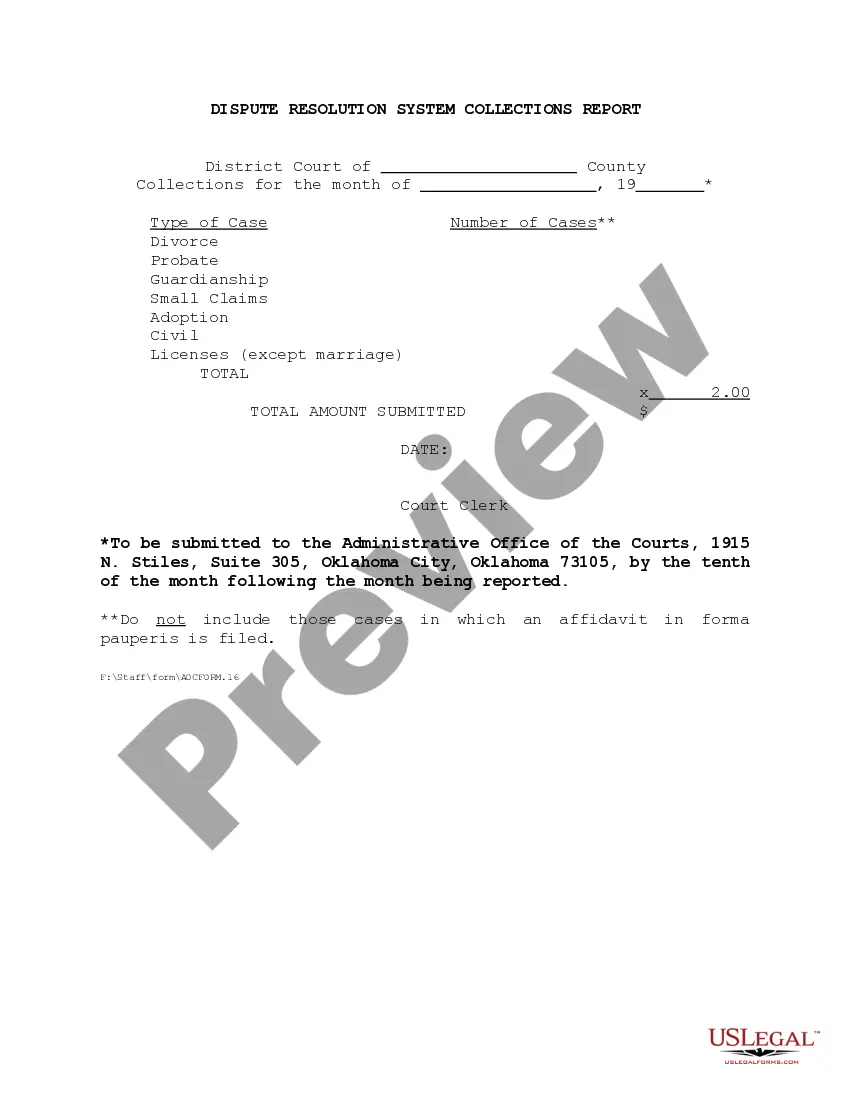
The Memorandum regarding Dispute Resolution Collections is an official document used to report and reconcile collections related to dispute resolution cases. This form serves as a request for transferring funds and provides a summary of collected amounts within specific case types. Unlike other financial memos, this form is tailored for collections reported by a court, ensuring that all necessary details regarding the dispute resolution account are accurately documented.
What’s included in this form
- Recipient and sender information sections to identify involved parties.
- Subject line specifying the form's purpose related to dispute resolution collections.
- A date field for documenting the reconciliation period.
- A detailed report section listing different case types and their respective collection amounts.
- A request for transferring funds from a clearing account to a revolving fund.
- Submission guidelines for sending the report to the appropriate court office.
Situations where this form applies
This form is necessary when reconciling monthly collections for dispute resolution cases handled by a court. It should be used whenever there is a need to summarize collections, request fund transfers, or report financial activity to relevant administrative offices. Particularly, it is applicable in cases such as divorce, probate, guardianship, small claims, and civil matters.
Who should use this form
This form is intended for use by:
- Court clerks responsible for financial reporting.
- Administrative staff within the court system managing dispute resolutions.
- Legal professionals overseeing cases requiring financial reconciliation.
- Accountants handling dispute resolution funds.
Completing this form step by step
- Identify and enter the name of the recipient and sender.
- Finalize the subject and date fields for the report.
- List case types and the number of cases, ensuring accurate counts and amounts.
- Specify the amount to be transferred and ensure it matches the stated collection totals.
- Include the name of the court clerk for verification before submission.
Notarization requirements for this form
This form does not typically require notarization unless specified by local law. Always verify local regulations to confirm notarization requirements.
Get your form ready online
Our built-in tools help you complete, sign, share, and store your documents in one place.
Make edits, fill in missing information, and update formatting in US Legal Forms—just like you would in MS Word.
Download a copy, print it, send it by email, or mail it via USPS—whatever works best for your next step.
Sign and collect signatures with our SignNow integration. Send to multiple recipients, set reminders, and more. Go Premium to unlock E-Sign.
If this form requires notarization, complete it online through a secure video call—no need to meet a notary in person or wait for an appointment.
We protect your documents and personal data by following strict security and privacy standards.

Make edits, fill in missing information, and update formatting in US Legal Forms—just like you would in MS Word.

Download a copy, print it, send it by email, or mail it via USPS—whatever works best for your next step.

Sign and collect signatures with our SignNow integration. Send to multiple recipients, set reminders, and more. Go Premium to unlock E-Sign.

If this form requires notarization, complete it online through a secure video call—no need to meet a notary in person or wait for an appointment.

We protect your documents and personal data by following strict security and privacy standards.
Avoid these common issues
- Failing to include all relevant case types in the collection report.
- Entering incorrect amount totals leading to discrepancies.
- Neglecting to sign the form or include necessary signatures.
- Missing submission deadlines, which can delay financial processes.
Why complete this form online
- Convenient access to templates crafted by legal professionals.
- Easy editing capabilities to ensure accuracy and compliance.
- Immediate download allows for quick submission.
- Reliable format that adheres to legal requirements, minimizing errors.
Legal use & context
- This form is legally recognized for the purpose of reconciling financial activities in dispute resolution cases.
- Filing this memorandum properly ensures that the collections are documented in compliance with court regulations.
- Failure to use this form correctly may lead to financial discrepancies and potential legal disputes.
Quick recap
- The Memorandum regarding Dispute Resolution Collections is vital for accurate financial reporting in district courts.
- Complete this form monthly to ensure timely fund transfers and compliance.
- Double-check details and calculations to avoid common mistakes.
Looking for another form?
Form popularity
FAQ
There are currently three principal methods of Alternative Dispute Resolution, mediation, collaboration, and arbitration.
There is no guaranteed resolution. With the exception of arbitration, alternative dispute resolution processes do not always lead to a resolution. Arbitration decisions are final. Limits on Arbitration Awards. Discovery limitations. Fee for the Neutral. May have no choice. Non-binding arbitration. Warning.
Avoiding the Conflict. Avoiding or withdrawing from a conflict requires no courage or consideration for the other party. Giving In. Giving in or accommodating the other party requires a lot of cooperation and little courage. Standing your Ground. Compromising. Collaborating.
Negotiation, mediation and arbitration - often called ADR or alternative dispute resolution- are the most well-known.
So when family members, neighbors or business partners have a dispute, mediation may be the best ADR procedure to use. Mediation is also effective when emotions may get in the way of a solution. A mediator can help the parties communicate in a non-threatening and effective manner.
Mediation is very popular today. Indeed, it is probably the fastest-growing segment of the ADR world. Some experts estimate that 80 to 90 percent of all disputes submitted to mediation are resolved through the process.
Dispute resolution processes fall into two major types: Adjudicative processes, such as litigation or arbitration, in which a judge, jury or arbitrator determines the outcome. Consensual processes, such as collaborative law, mediation, conciliation, or negotiation, in which the parties attempt to reach agreement.
The most common types of ADR for civil cases are mediation, settlement conferences, neutral evaluation, and arbitration. Read more about these ADR processes, when they may or may not be appropriate or watch a video demonstration.
The most common forms of ADR are arbitration, mediation, the rent-a-judge program, summary jury trial, and minitrial, although techniques can be combined to form hybrids suited to a particular dispute or legal jurisdiction.