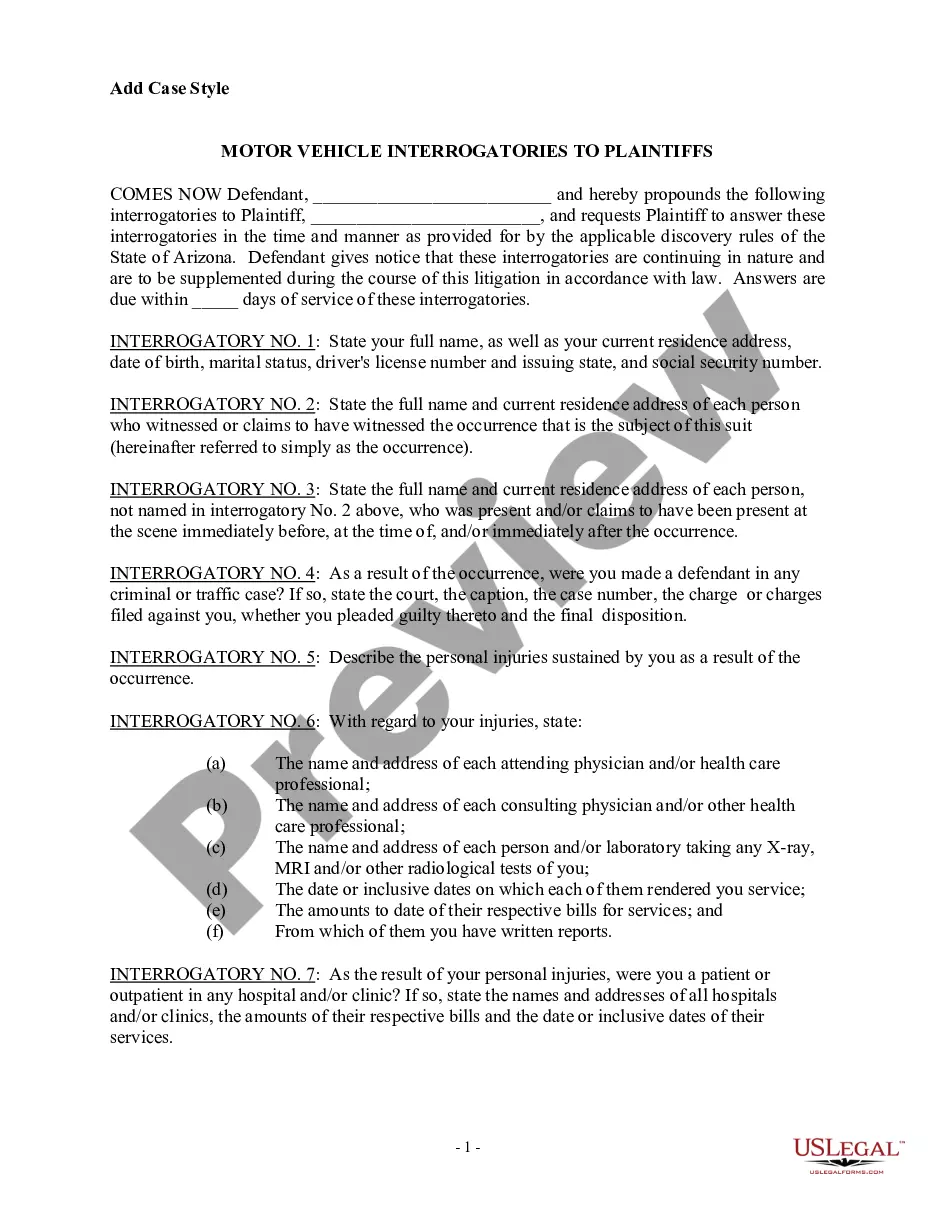
Rule 13.0 Mandatory Form to be Utilized in Criminal Cases in the State of Oklahoma - Official Order Allowing Defendant to Proceed Pro Se on Appeal to be submitted to judge with an application for defendant to represent themselves on appeal.
Oklahoma Form 13.7 Order Allowing Defendant to Proceed Pro Se on Appeal
Instant download
This website is not affiliated with any governmental entity
Public form
Description
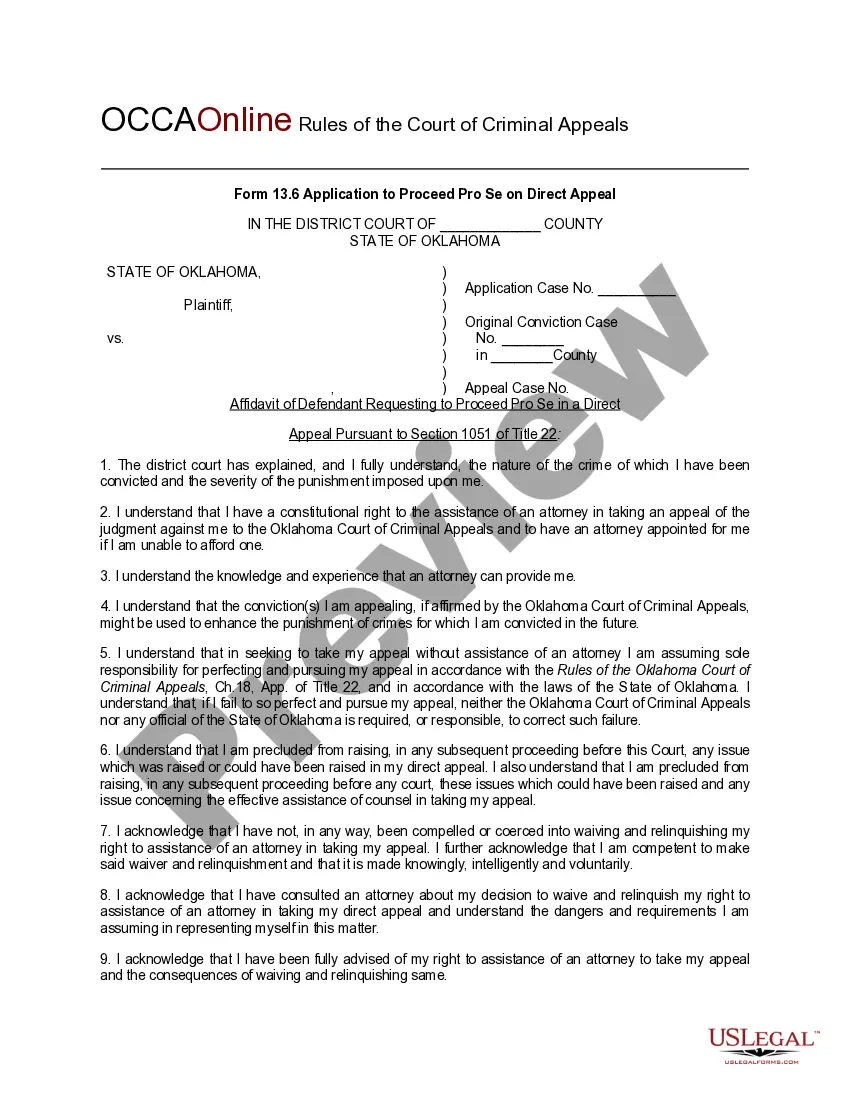
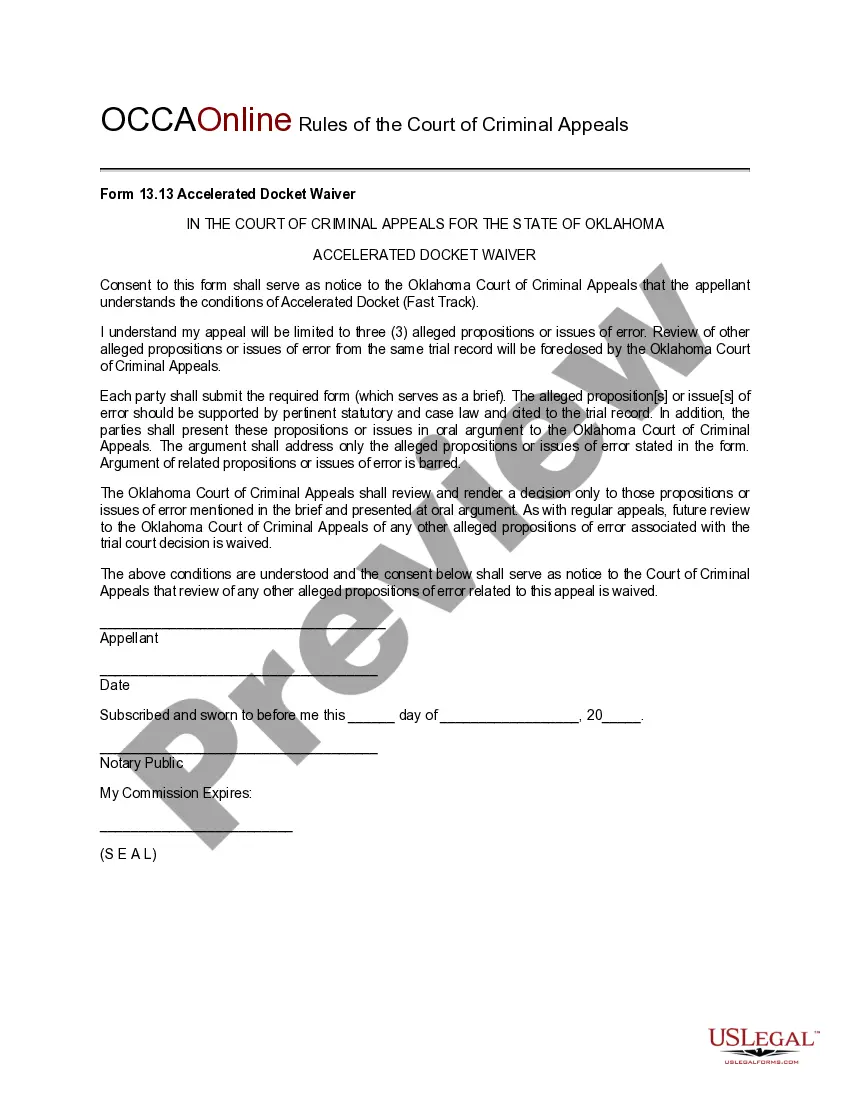
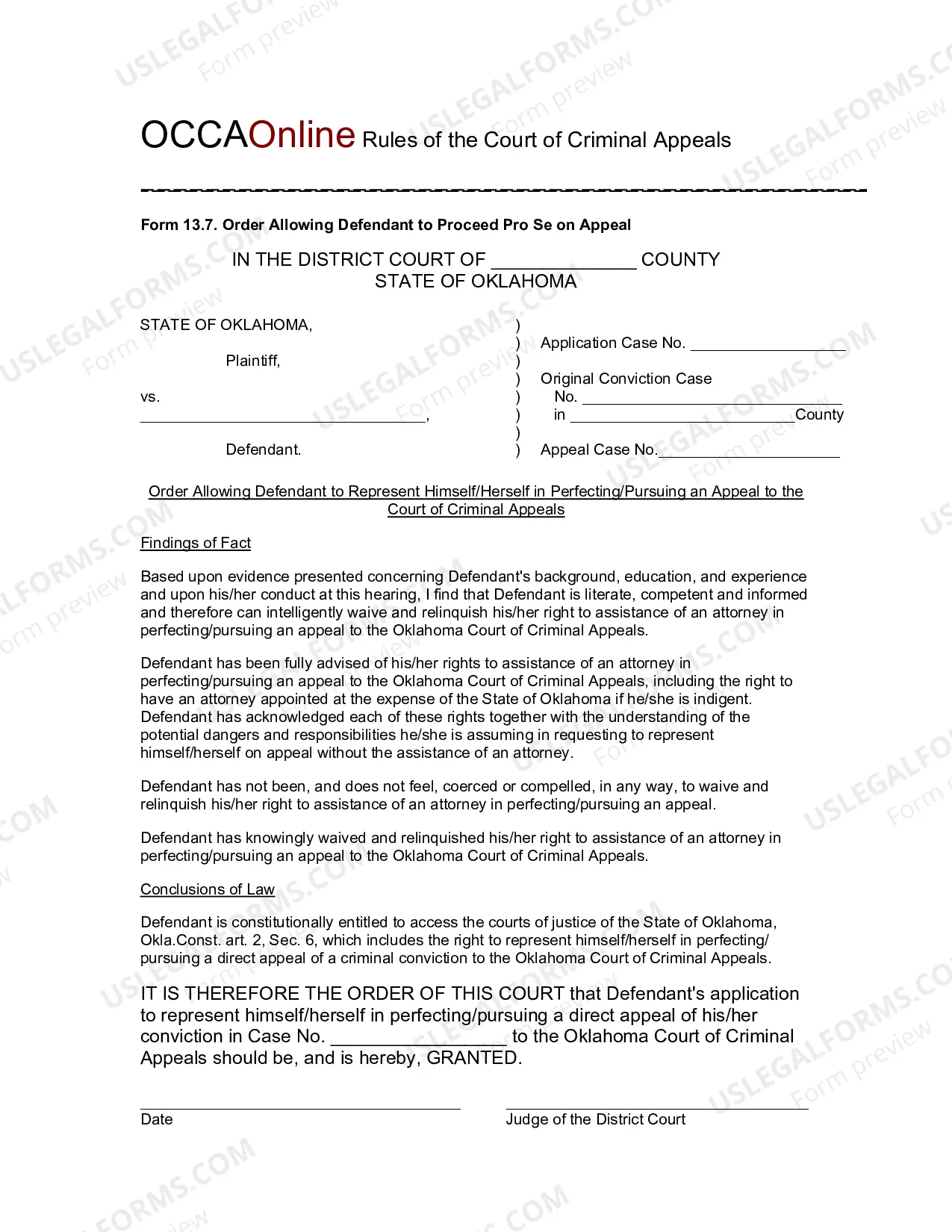
Get your form ready online
Our built-in tools help you complete, sign, share, and store your documents in one place.
Built-in online Word editor
Make edits, fill in missing information, and update formatting in US Legal Forms—just like you would in MS Word.
Export easily
Download a copy, print it, send it by email, or mail it via USPS—whatever works best for your next step.
E-sign your document
Sign and collect signatures with our SignNow integration. Send to multiple recipients, set reminders, and more. Go Premium to unlock E-Sign.
Notarize online 24/7
If this form requires notarization, complete it online through a secure video call—no need to meet a notary in person or wait for an appointment.
Store your document securely
We protect your documents and personal data by following strict security and privacy standards.

Make edits, fill in missing information, and update formatting in US Legal Forms—just like you would in MS Word.

Download a copy, print it, send it by email, or mail it via USPS—whatever works best for your next step.

Sign and collect signatures with our SignNow integration. Send to multiple recipients, set reminders, and more. Go Premium to unlock E-Sign.

If this form requires notarization, complete it online through a secure video call—no need to meet a notary in person or wait for an appointment.

We protect your documents and personal data by following strict security and privacy standards.
Looking for another form?
How to fill out Oklahoma Form 13.7 Order Allowing Defendant To Proceed Pro Se On Appeal?
When it comes to filling out Oklahoma Form 13.7 Order Allowing Defendant to Proceed Pro Se on Appeal, you probably think about an extensive procedure that requires getting a suitable form among numerous very similar ones and then needing to pay an attorney to fill it out for you. Generally, that’s a slow-moving and expensive choice. Use US Legal Forms and select the state-specific template in just clicks.
For those who have a subscription, just log in and click Download to have the Oklahoma Form 13.7 Order Allowing Defendant to Proceed Pro Se on Appeal sample.
In the event you don’t have an account yet but want one, follow the step-by-step manual listed below:
- Be sure the file you’re downloading applies in your state (or the state it’s required in).
- Do this by looking at the form’s description and also by clicking on the Preview option (if accessible) to view the form’s information.
- Click on Buy Now button.
- Find the appropriate plan for your budget.
- Sign up for an account and choose how you would like to pay out: by PayPal or by credit card.
- Download the document in .pdf or .docx file format.
- Get the record on the device or in your My Forms folder.
Skilled lawyers work on drawing up our samples so that after downloading, you don't have to worry about editing content outside of your personal details or your business’s info. Join US Legal Forms and get your Oklahoma Form 13.7 Order Allowing Defendant to Proceed Pro Se on Appeal document now.
Form popularity
FAQ
A term derived from the Latin "in propria persona," meaning "for one's self," used in some states to describe a person who handles his or her own case, without a lawyer.
A Pro Se divorce is a divorce where a spouse chooses to represent his/herself in court rather than hiring an attorney. The whole process of getting a divorce is the same but you are personally responsible for completing and filing legal forms yourself.
Judicial disqualification, also referred to as recusal, is the act of abstaining from participation in an official action such as a legal proceeding due to a conflict of interest of the presiding court official or administrative officer.
Litigants or parties representing themselves in court without the assistance of an attorney are known as pro se litigants. Pro se is Latin for in one's own behalf. The right to appear pro se in a civil case in federal court is defined by statute 28 U.S.C. § 1654.
A person who is acting In Pro Per is called a Pro Per. The terms Pro Per and Pro Se are equivalent in court. Pro-Se refers to representing yourself in any type of legal matter without the benefit of legal counsel. A petitioner in pro per is a person who appears before a Court without a legal representative or lawyer.
If the judge is showing what you believe to be unfair bias against you in pretrial motions or hearings, speak to your attorney at length about how you two can make an excellent record at trial that can overturn any negative decisions on appeal.
The courts tend to give no leeway to pro se litigants. This is also the area where the judges seem to most actively dislike the pro se litigants, likely because they cause so many problems with discovery and the procedural process of the case through lack of knowledge.
Estimates of the pro se rate of family law overall averaged 67% in California, 73% in Florida's large counties, and 70% in some Wisconsin counties.