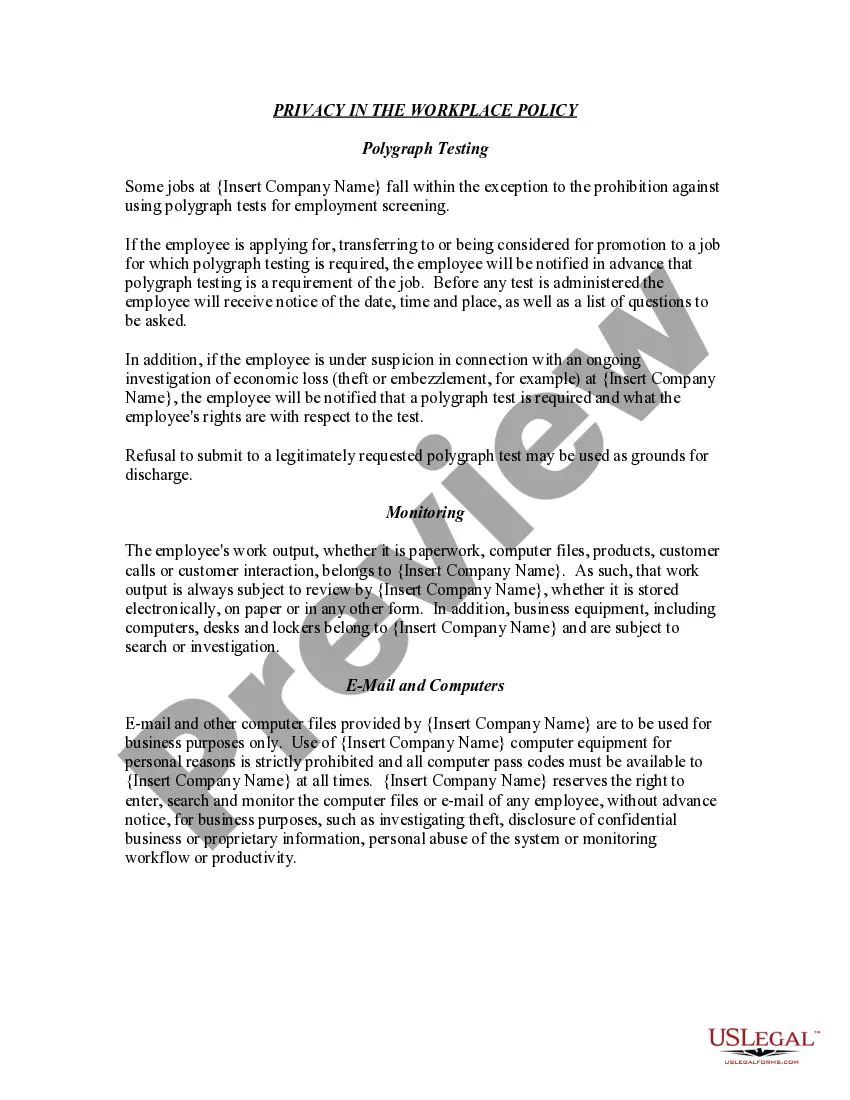
Ohio Privacy in the Workplace Policy
Description

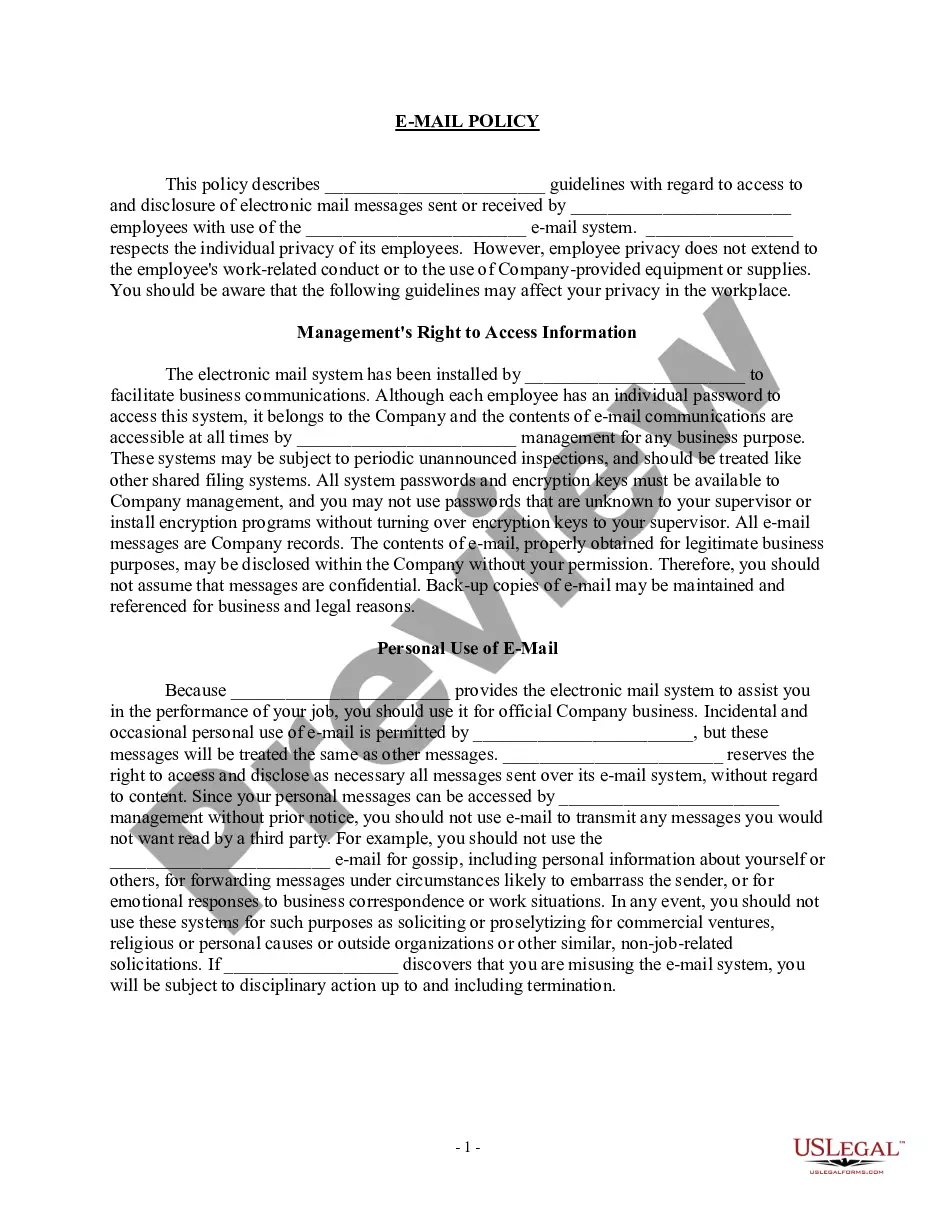
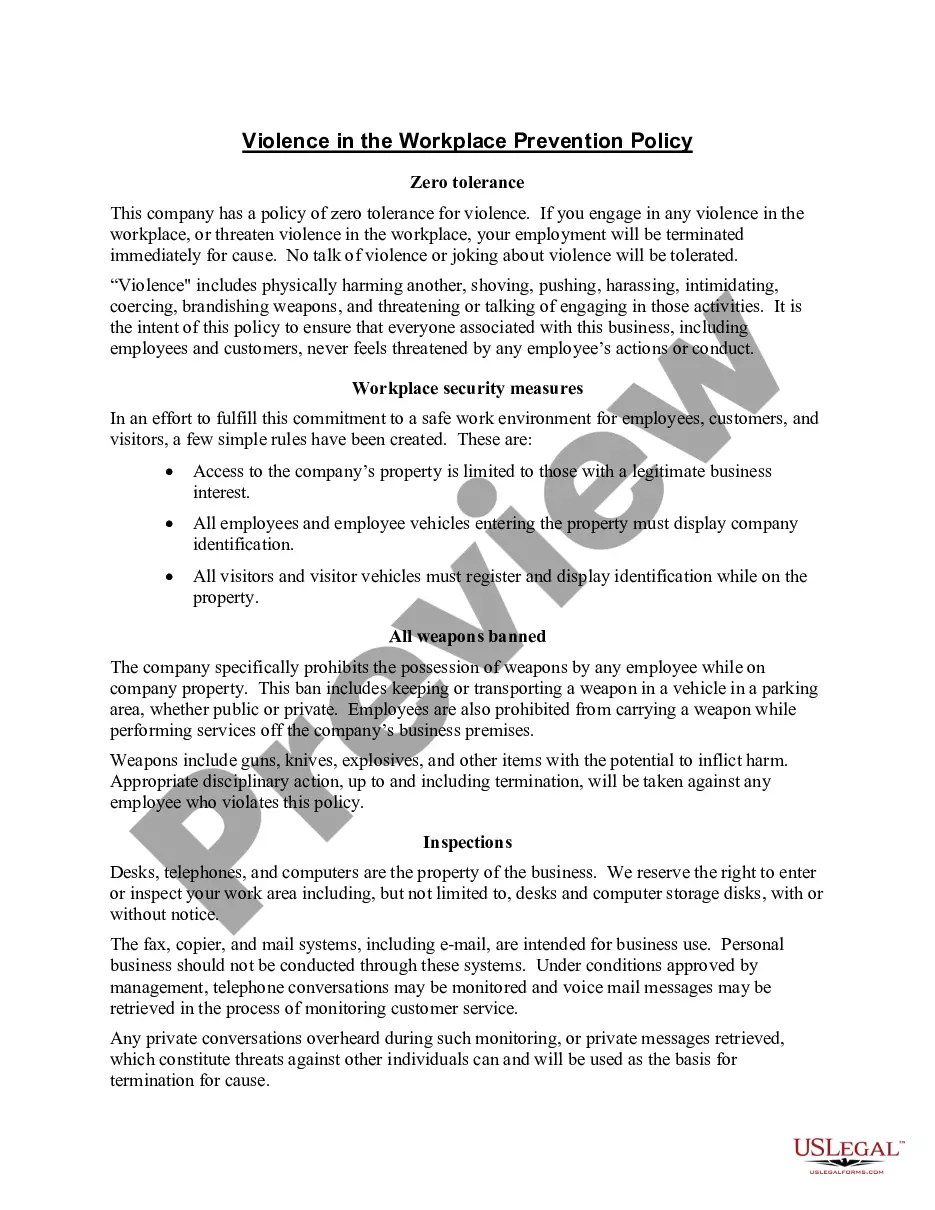
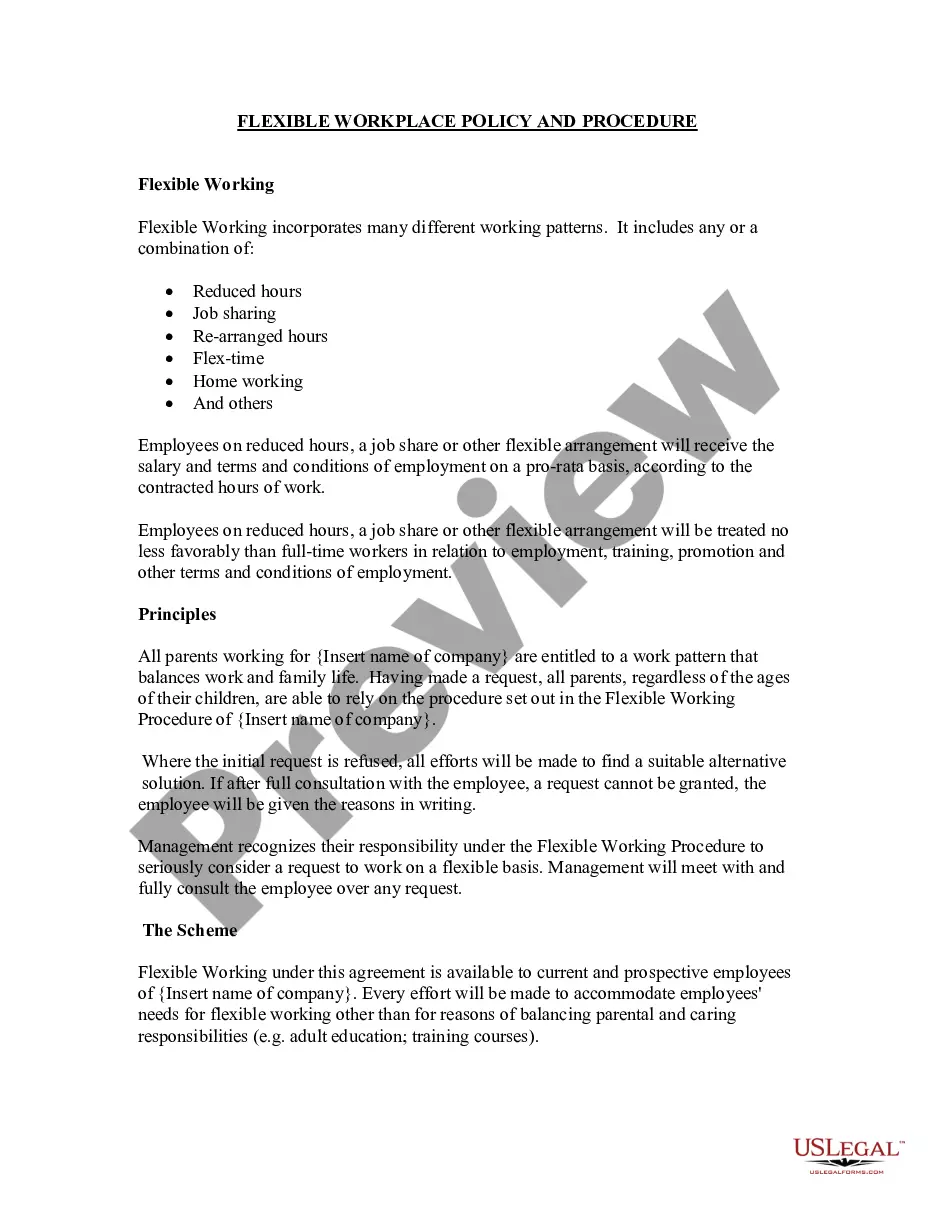
Get your form ready online
Our built-in tools help you complete, sign, share, and store your documents in one place.
Make edits, fill in missing information, and update formatting in US Legal Forms—just like you would in MS Word.
Download a copy, print it, send it by email, or mail it via USPS—whatever works best for your next step.
Sign and collect signatures with our SignNow integration. Send to multiple recipients, set reminders, and more. Go Premium to unlock E-Sign.
If this form requires notarization, complete it online through a secure video call—no need to meet a notary in person or wait for an appointment.
We protect your documents and personal data by following strict security and privacy standards.

Make edits, fill in missing information, and update formatting in US Legal Forms—just like you would in MS Word.

Download a copy, print it, send it by email, or mail it via USPS—whatever works best for your next step.

Sign and collect signatures with our SignNow integration. Send to multiple recipients, set reminders, and more. Go Premium to unlock E-Sign.

If this form requires notarization, complete it online through a secure video call—no need to meet a notary in person or wait for an appointment.

We protect your documents and personal data by following strict security and privacy standards.
Looking for another form?

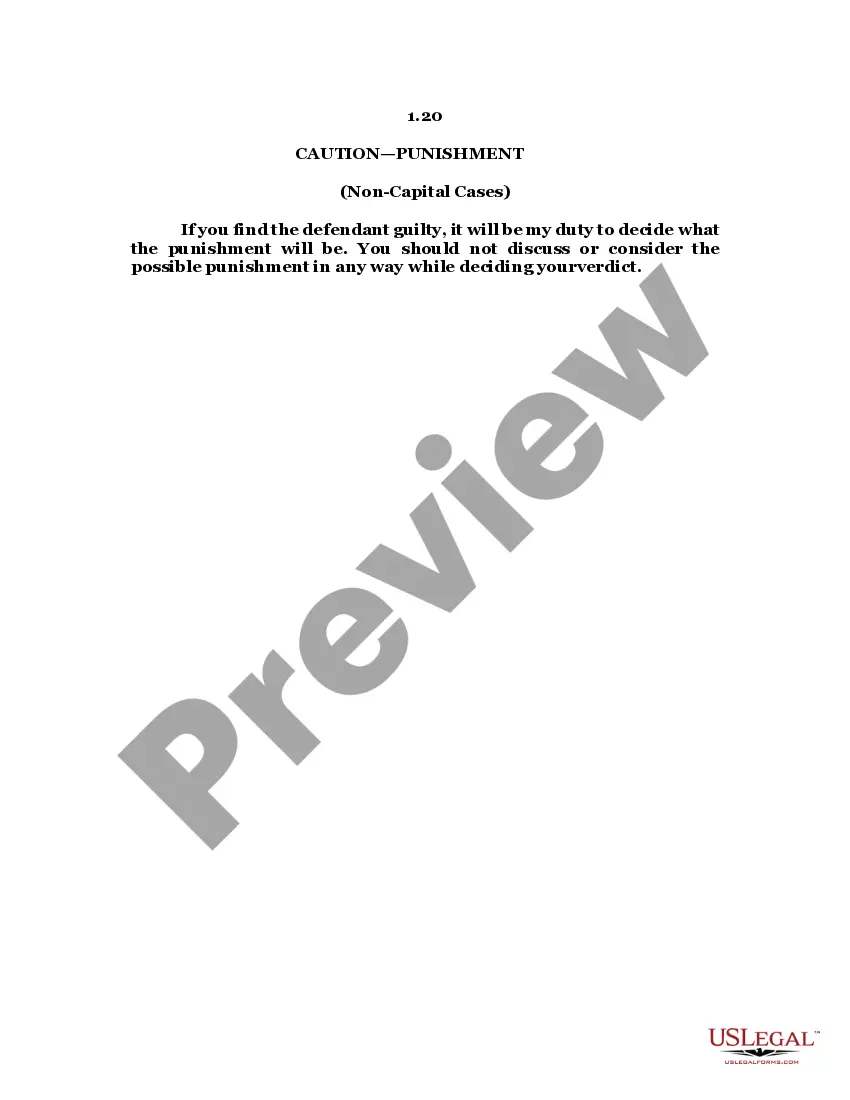

How to fill out Privacy In The Workplace Policy?
If you desire to summarize, acquire, or create legal document templates, utilize US Legal Forms, the premier collection of legal documents, accessible online.
Utilize the site’s straightforward and convenient search to find the paperwork you require. Diverse templates for business and personal applications are organized by categories and states, or keywords.
Use US Legal Forms to access the Ohio Privacy in the Workplace Policy in just a few clicks.
Every legal document format you purchase is yours permanently. You have access to every document you downloaded in your account. Click the My documents section and select a document to print or download again.
Compete and acquire, and print the Ohio Privacy in the Workplace Policy using US Legal Forms. There are numerous professional and state-specific forms available for your business or personal needs.
- If you are currently a US Legal Forms member, Log In to your account and select the Download option to obtain the Ohio Privacy in the Workplace Policy.
- You can also access forms you have previously downloaded from the My documents tab of your account.
- If you are using US Legal Forms for the first time, follow the instructions below.
- Step 1. Ensure you have selected the form for the appropriate city/state.
- Step 2. Use the Review option to examine the form’s content. Remember to read the description.
- Step 3. If you are dissatisfied with the form, use the Search area at the top of the screen to find other versions of your legal form template.
- Step 4. Once you have found the form you need, click the Buy now option. Choose the payment plan you prefer and provide your details to register for an account.
- Step 5. Complete the transaction. You may use your credit card or PayPal account to finalize the transaction.
- Step 6. Choose the format of your legal document and download it to your device.
- Step 7. Fill out, modify, and print or sign the Ohio Privacy in the Workplace Policy.
Form popularity
FAQ
Employee privacy rights are the rules that limit how extensively an employer can search an employee's possessions or person; monitor their actions, speech, or correspondence; and know about their personal lives, especially but not exclusively in the workplace.
Employees have the right to keep private facts about themselves confidential and the right to some degree of personal space. An employer that discloses private facts or lies about an employee may be held accountable in a civil action for invasion of privacy or defamation.
Reasonable expectation of privacy in the workplace can be best defined as a fair treatment of employees by a company where their personal details are kept a secret and their personal lives or possessions are not intruded upon and that they would not be asked to compromise on any of these unless there is a grave need.
In Ohio, as in most other states, employment is at will. That means that under Ohio law, an employee is generally free to quit his or her job for any reason. Similarly, an employer may generally terminate an employee for any reasonor even for no reasonas long as the reason doesn't violate the law.
The State shall protect labor, promote full employment, provide equal work opportunity regardless of gender, race, or creed; and regulate employee-employer relations.
You have a right to be free from illegal discrimination in the workplace, generally based on your race, sex, age, disability, religion, and your sexual orientation. This right applies while you are an employee at a company as well as while you are going through the hiring process.
Protecting Your Right to Privacy in the Workplace. The California Constitution protects employee privacy rights and prohibits intrusion into private matters. The use of employee monitoring is a balancing act that weighs the business interests against the threat to employee privacy rights.
Workers' Rights Law in Ohio: An OverviewUnlawful Termination.Evidence of unlawful termination.Medical Leave and Accommodations.Minimum Wage & Overtime Requirements.Harassment/Hostile-Work Environment.
The right to be consulted about safety in the workplace. the right to workers compensation. the right to a fair and just workplace. the right to fair pay and conditions.
1. Intrusion into an individual's private solitude or seclusion. An employee may allege this form of privacy invasion when an employer unreasonably searches (e.g., a locker or desk drawer) or conducts surveillance in areas in which an employee has a legitimate expectation of privacy (e.g., dressing rooms).