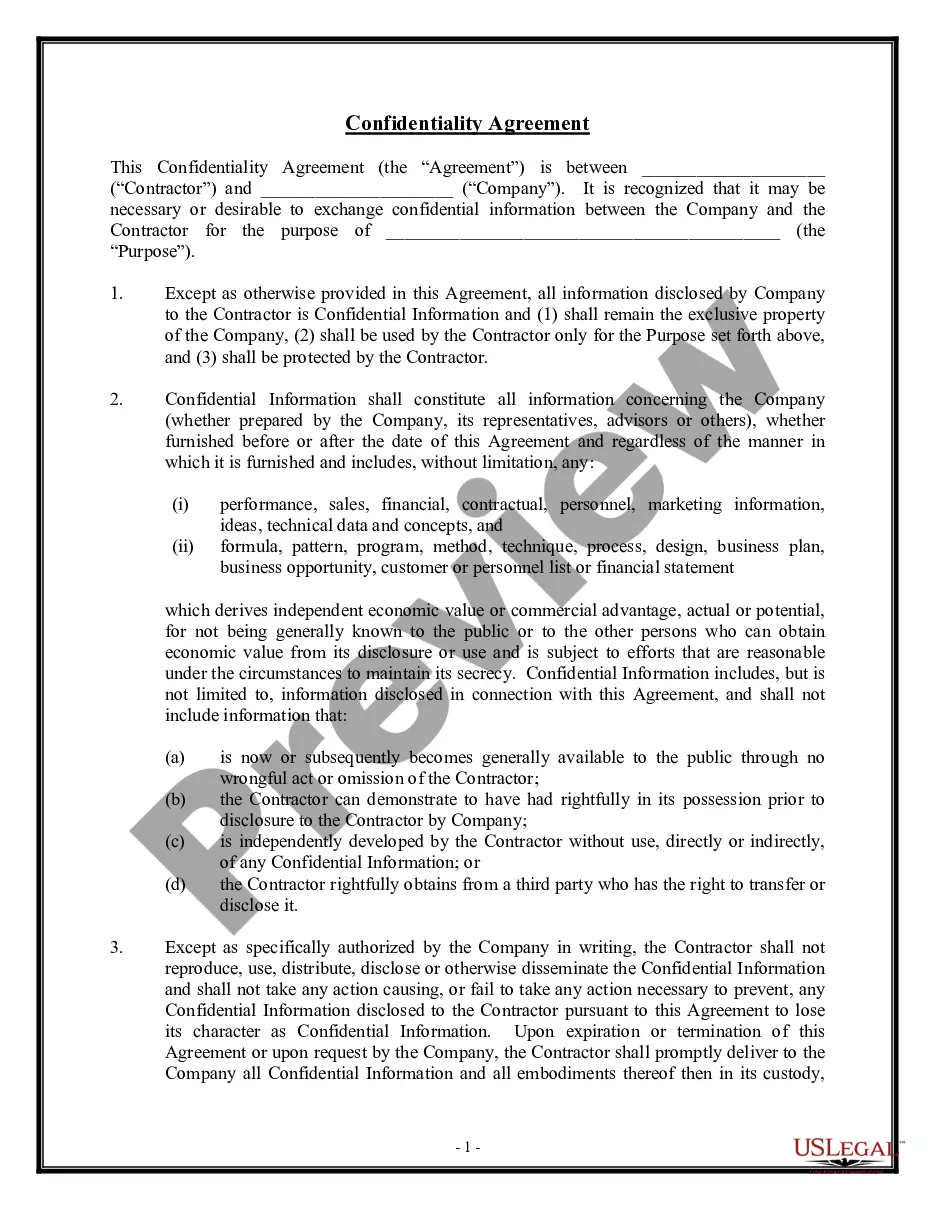
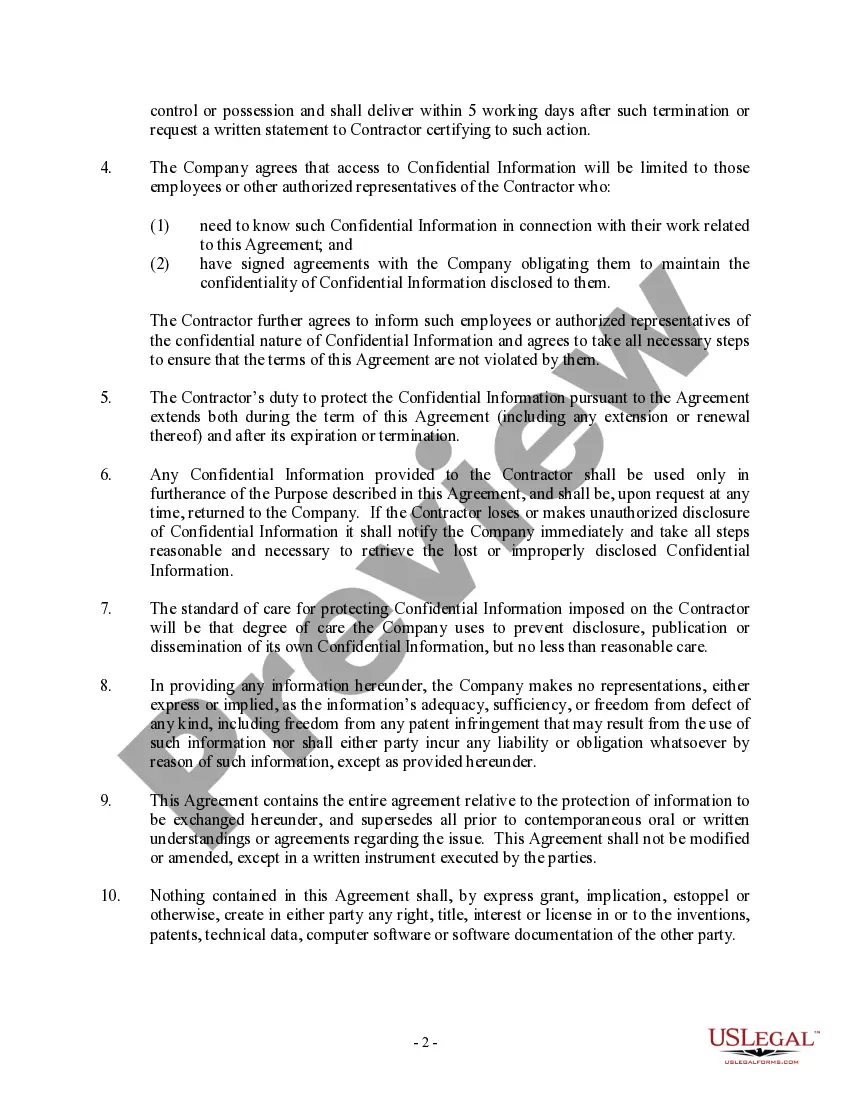
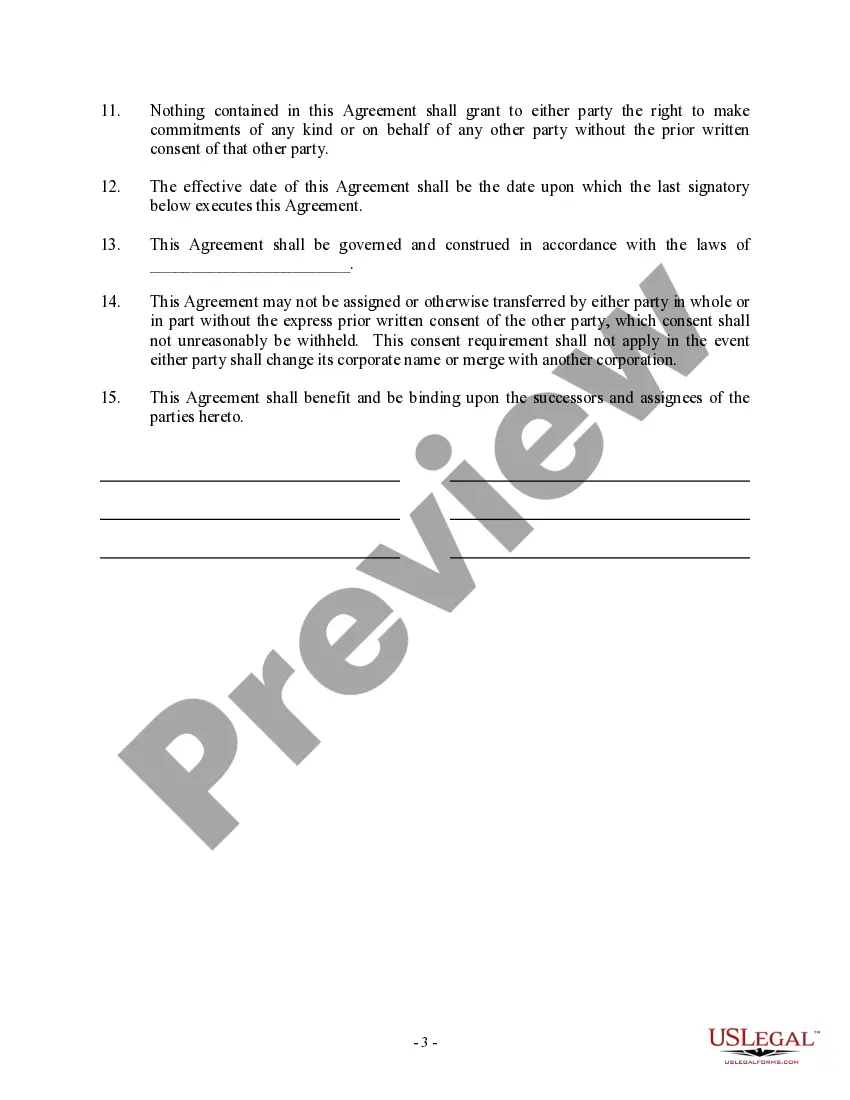
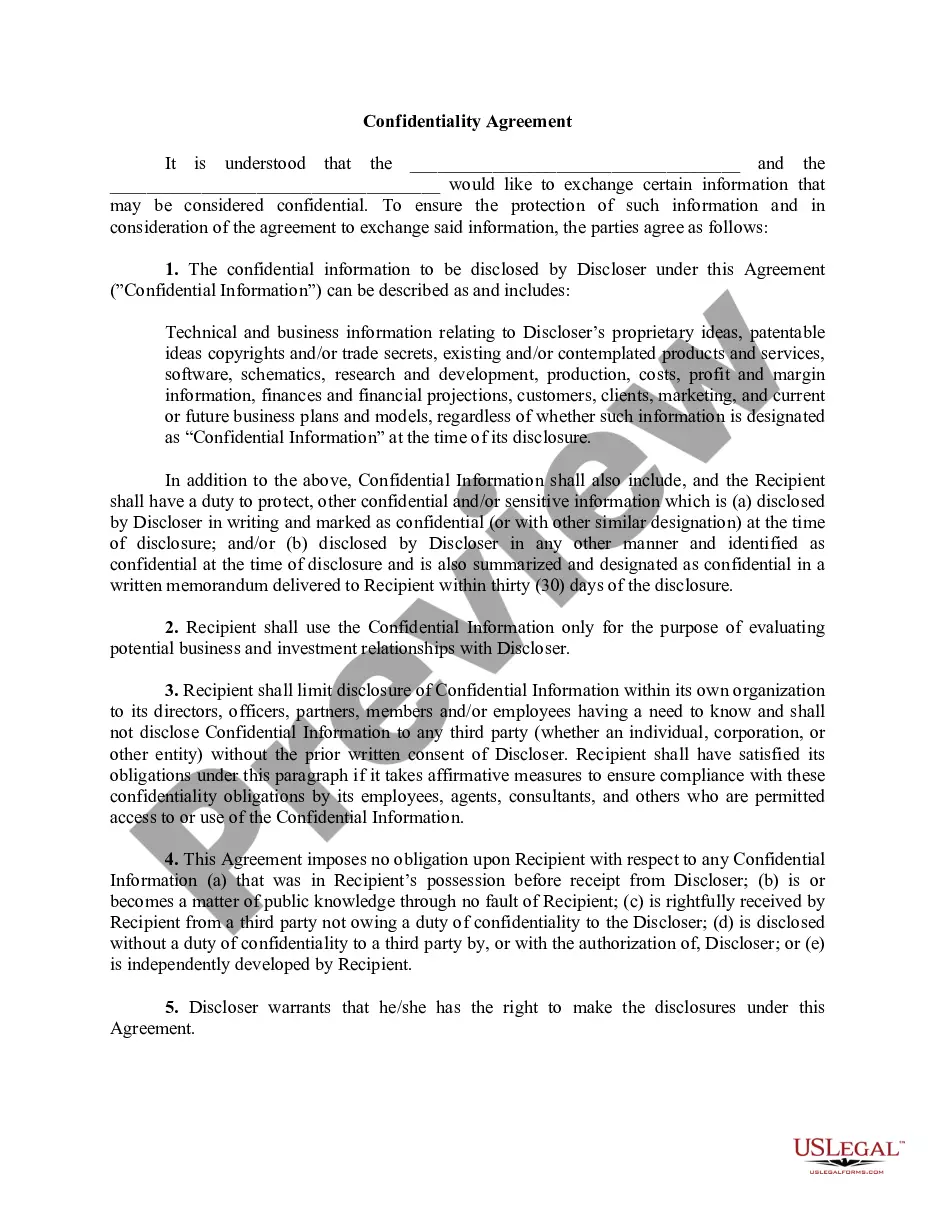
The parties desire to exchange confidential information for the purpose described in the agreement. Except as otherwise provided in the agreement, all information disclosed by the parties will remain confidential. Also, nothing contained in the agreement will grant to either party the right to make commitments of any kind or on behalf of any other party without the prior written consent of that other party.
Ohio Confidentiality and Nondisclosure Agreement - General
State:
Multi-State
Control #:
US-01760
Format:
Word;
Rich Text
1,173 downloads
Description
Free preview
Get your form ready online
Our built-in tools help you complete, sign, share, and store your documents in one place.
Built-in online Word editor
Make edits, fill in missing information, and update formatting in US Legal Forms—just like you would in MS Word.
Export easily
Download a copy, print it, send it by email, or mail it via USPS—whatever works best for your next step.
E-sign your document
Sign and collect signatures with our SignNow integration. Send to multiple recipients, set reminders, and more. Go Premium to unlock E-Sign.
Notarize online 24/7
If this form requires notarization, complete it online through a secure video call—no need to meet a notary in person or wait for an appointment.
Store your document securely
We protect your documents and personal data by following strict security and privacy standards.

Make edits, fill in missing information, and update formatting in US Legal Forms—just like you would in MS Word.

Download a copy, print it, send it by email, or mail it via USPS—whatever works best for your next step.

Sign and collect signatures with our SignNow integration. Send to multiple recipients, set reminders, and more. Go Premium to unlock E-Sign.

If this form requires notarization, complete it online through a secure video call—no need to meet a notary in person or wait for an appointment.

We protect your documents and personal data by following strict security and privacy standards.
Looking for another form?
How to fill out Confidentiality And Nondisclosure Agreement - General?
If you require to gather, retrieve, or produce official document templates, utilize US Legal Forms, the largest selection of legal documents, which are available online.
Take advantage of the site's straightforward and convenient search to find the files you require. Numerous templates for corporate and personal use are organized by categories and states, or keywords.
Utilize US Legal Forms to obtain the Ohio Confidentiality and Nondisclosure Agreement - General with just a few clicks.
Every legal document template you acquire belongs to you permanently. You have access to every document you've downloaded within your account. Click on the My documents section and select a document to print or download again.
Complete and download, then print the Ohio Confidentiality and Nondisclosure Agreement - General through US Legal Forms. There are many professional and state-specific documents available for your business or personal needs.
- If you are already a US Legal Forms user, sign in to your account and click the Download button to get the Ohio Confidentiality and Nondisclosure Agreement - General.
- You can also access documents you previously downloaded in the My documents section of your account.
- If this is your first time using US Legal Forms, follow the steps outlined below.
- Step 1. Confirm you have selected the form for the correct jurisdiction.
- Step 2. Utilize the Preview option to review the form's details. Be sure to read the description.
- Step 3. If you are dissatisfied with the form, use the Search field at the top of the page to find other versions of the legal document format.
- Step 4. Once you have found the form you need, click the Buy Now button. Choose the payment plan you prefer and enter your details to create an account.
- Step 5. Complete the purchase. You can use your credit card or PayPal account to finish the transaction.
- Step 6. Choose the format of the legal document and download it to your device.
- Step 7. Complete, modify, and print or sign the Ohio Confidentiality and Nondisclosure Agreement - General.
Form popularity
FAQ
To write a simple confidentiality agreement, begin by stating the purpose of the agreement. Include sections that specify the information to be kept confidential, the duration of confidentiality, and the consequences of breach. This approach aligns with the principles found in an Ohio Confidentiality and Nondisclosure Agreement - General, ensuring protection for all involved parties.
Writing a basic confidentiality agreement involves outlining the parties, defining what constitutes confidential information, and stating the obligations of both parties regarding that information. It's essential to maintain clarity and precision in your wording to create an effective Ohio Confidentiality and Nondisclosure Agreement - General. Online resources, including those provided by uslegalforms, can guide you through the process.
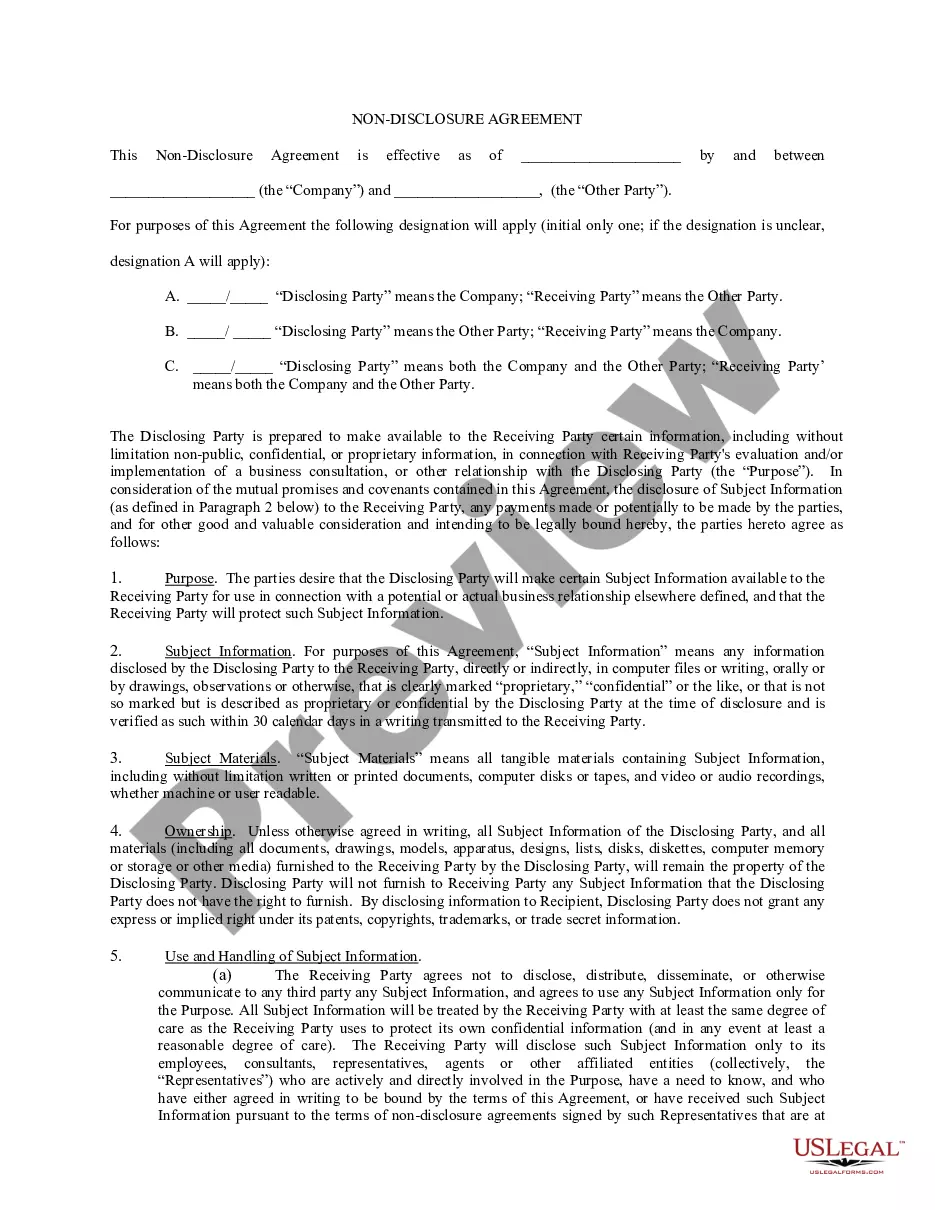
To fill out a non-disclosure agreement template, start by adding the names of the parties involved. Next, clearly define the confidential information and specify the obligations regarding its protection. Completing these steps within the framework of a well-structured Ohio Confidentiality and Nondisclosure Agreement - General will ensure you cover all necessary bases.
Yes, you can create your own confidentiality agreement tailored to your specific needs. Having a custom Ohio Confidentiality and Nondisclosure Agreement - General can help you address unique circumstances and safeguard sensitive information effectively. Online platforms like uslegalforms offer templates to simplify this process.
A confidentiality statement often includes language such as, 'The information shared in this meeting is confidential and must not be disclosed to any outside parties.' This type of statement forms the foundation of any Ohio Confidentiality and Nondisclosure Agreement - General, emphasizing the importance of keeping shared information secure.
A typical confidentiality agreement is structured into several key sections: purpose, definitions, obligations of the parties, term, and termination. Each section serves to outline the expectations and responsibilities of all parties involved, ensuring clarity in the Ohio Confidentiality and Nondisclosure Agreement - General. Understanding this structure helps you create an effective agreement that protects both parties.
An example of a statement of confidentiality can be a simple sentence like, 'The undersigned agrees to maintain the confidentiality of any proprietary or sensitive information shared during our discussions.' This statement clearly communicates the intent to protect private information, which is essential for any Ohio Confidentiality and Nondisclosure Agreement - General.
An NDA, or Non-Disclosure Agreement, and a confidentiality agreement serve similar purposes but are not identical. Both documents protect sensitive information, but an NDA typically includes stricter legal obligations. In a business context, the Ohio Confidentiality and Nondisclosure Agreement - General ensures that sensitive data remains confidential and prohibits sharing it without permission. If you need a reliable way to set these protections in place, consider using US Legal Forms to draft your Ohio Confidentiality and Nondisclosure Agreement - General.
A confidentiality agreement is legally enforceable if it adheres to state laws and includes essential elements like consideration and specific terms. Your Ohio Confidentiality and Nondisclosure Agreement - General should clearly outline the obligations and rights of each party. To avoid common pitfalls and ensure legal validity, using a trusted platform like UsLegalForms can provide you with reliable templates and guidance tailored to your needs.
Confidentiality agreements can indeed hold up in court, especially when they are well-drafted and specific about what information is protected. The enforceability of your Ohio Confidentiality and Nondisclosure Agreement - General largely depends on how clearly it defines confidential information and the obligations of the parties involved. Courts look for reasonableness and fairness in these agreements, so having a solid foundation is key.