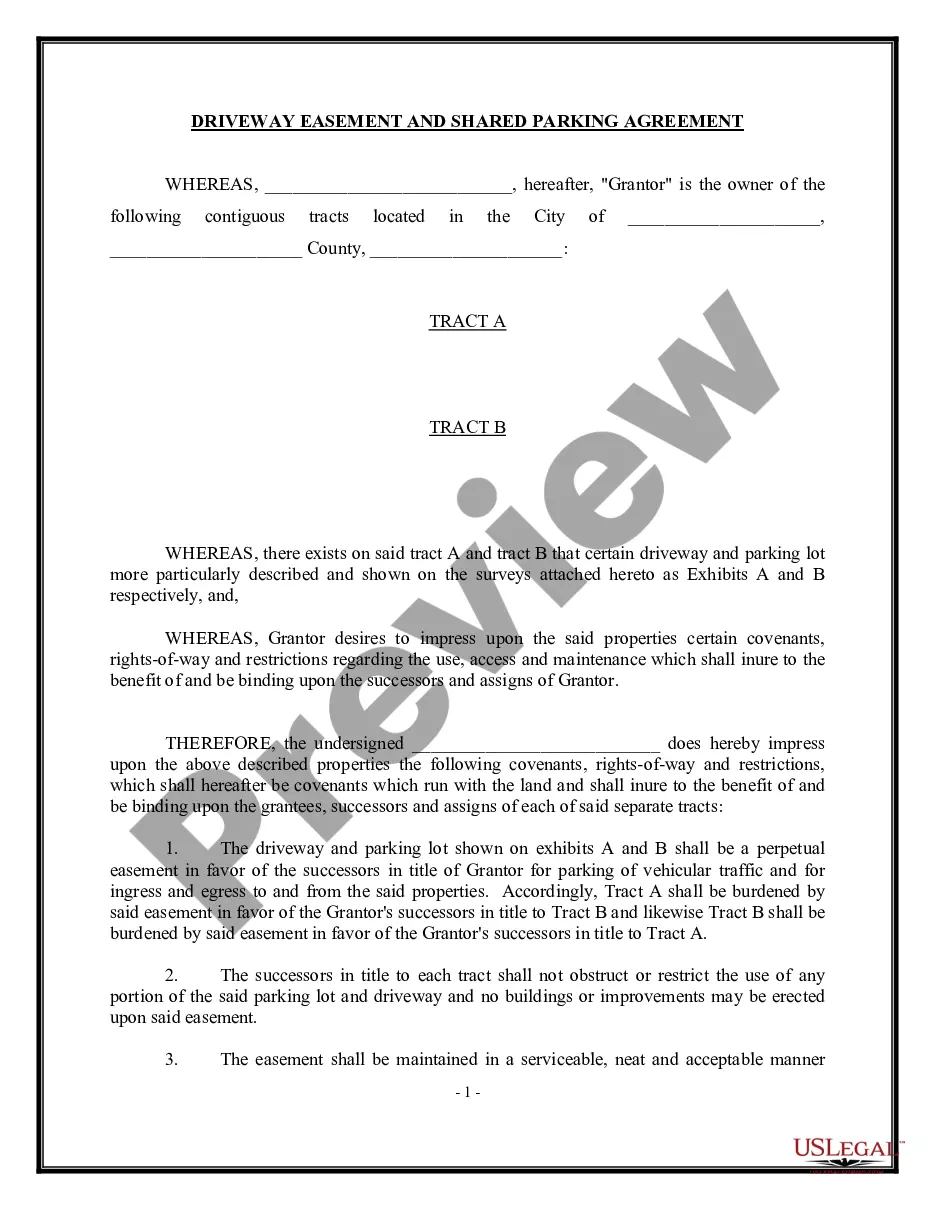
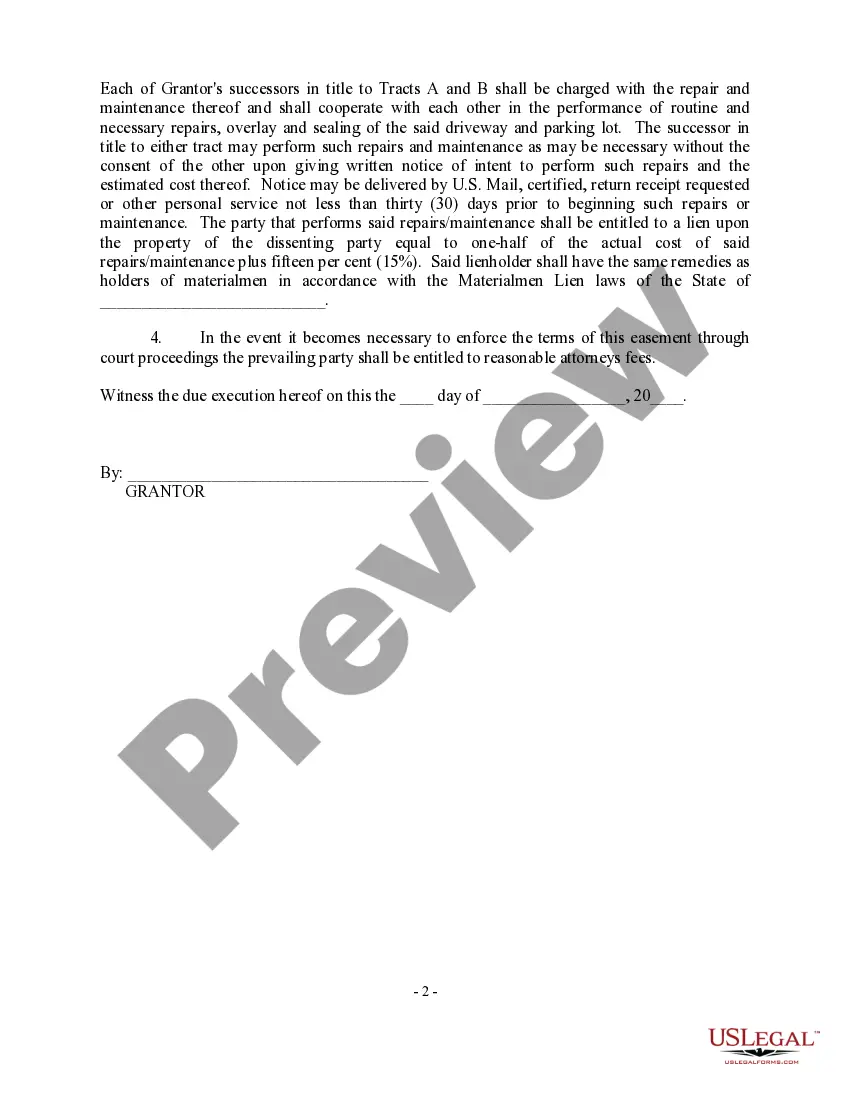
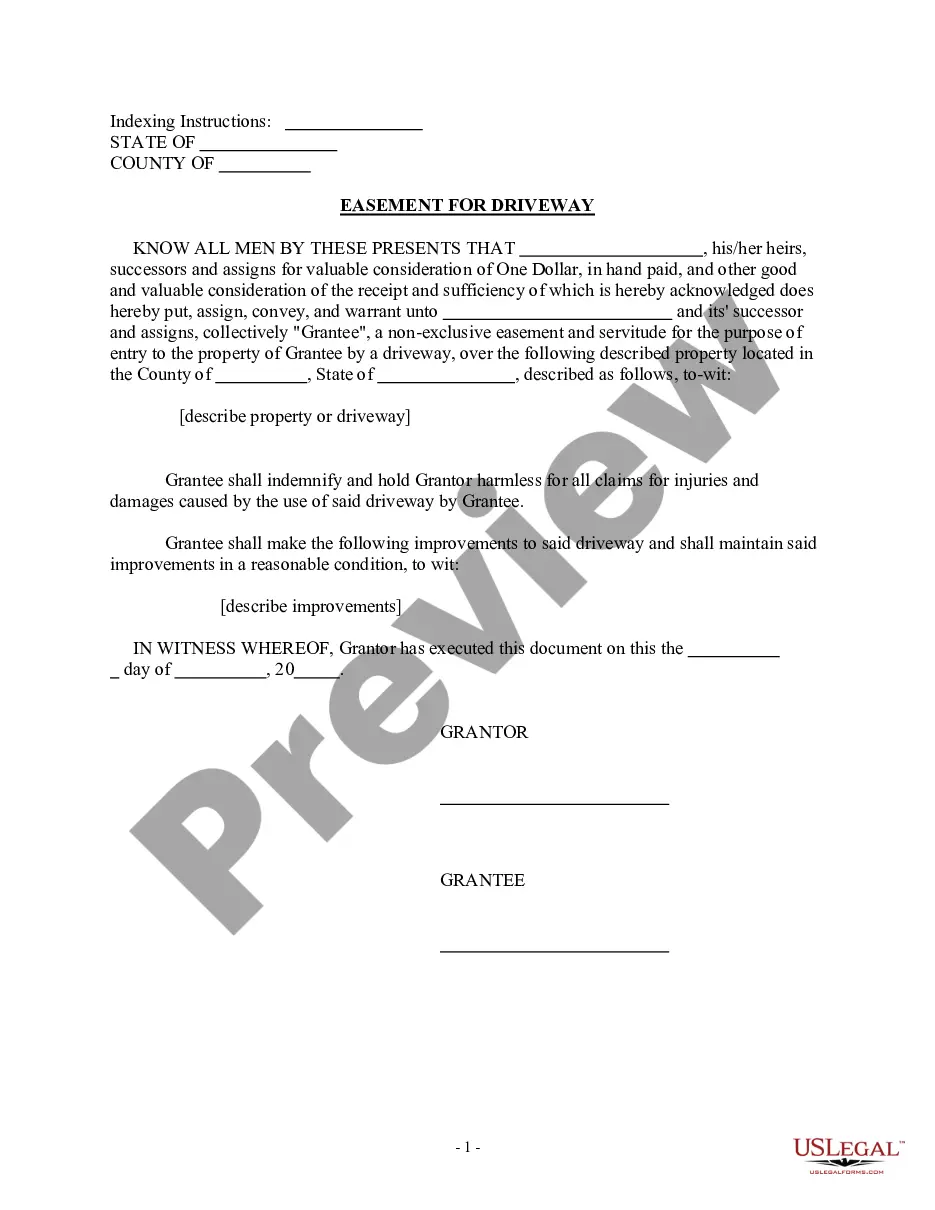
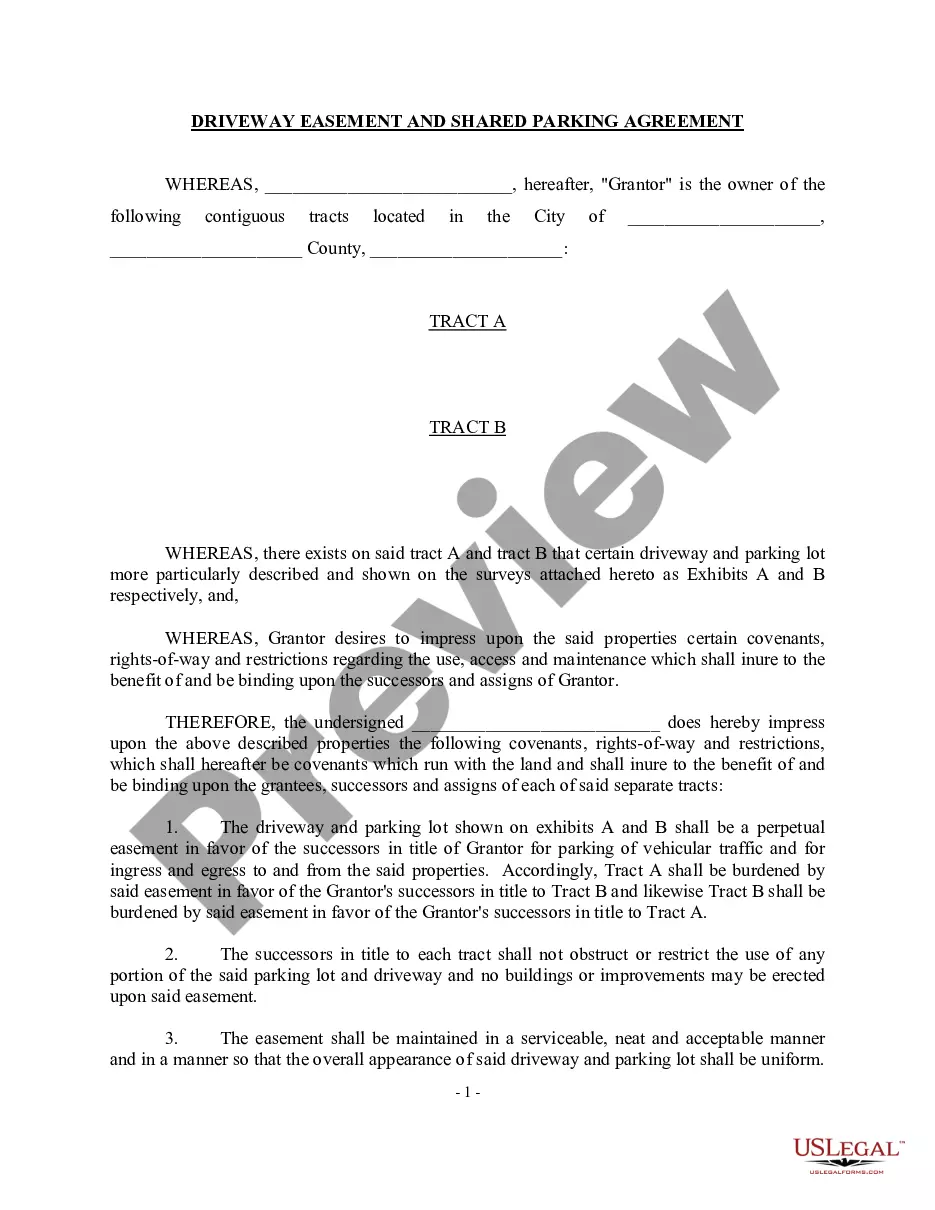
This form is a Driveway Easement and Shared Parking Agreement. The grantor conveys to the grantee certain covenants, rights-of-way, and restrictions regarding the use of a driveway and parking lot.
Ohio Easement - Shared Parking
State:
Multi-State
Control #:
US-00498
Format:
Word;
Rich Text
Instant download
Description
Free preview
Get your form ready online
Our built-in tools help you complete, sign, share, and store your documents in one place.
Built-in online Word editor
Make edits, fill in missing information, and update formatting in US Legal Forms—just like you would in MS Word.
Export easily
Download a copy, print it, send it by email, or mail it via USPS—whatever works best for your next step.
E-sign your document
Sign and collect signatures with our SignNow integration. Send to multiple recipients, set reminders, and more. Go Premium to unlock E-Sign.
Notarize online 24/7
If this form requires notarization, complete it online through a secure video call—no need to meet a notary in person or wait for an appointment.
Store your document securely
We protect your documents and personal data by following strict security and privacy standards.

Make edits, fill in missing information, and update formatting in US Legal Forms—just like you would in MS Word.

Download a copy, print it, send it by email, or mail it via USPS—whatever works best for your next step.

Sign and collect signatures with our SignNow integration. Send to multiple recipients, set reminders, and more. Go Premium to unlock E-Sign.

If this form requires notarization, complete it online through a secure video call—no need to meet a notary in person or wait for an appointment.

We protect your documents and personal data by following strict security and privacy standards.
Looking for another form?
How to fill out Easement - Shared Parking?
You can spend countless hours online looking for the legal document template that satisfies the federal and state requirements you need. US Legal Forms provides a wide array of legal documents that are evaluated by experts.
You can easily download or print the Ohio Easement - Shared Parking from my assistance.
If you already possess a US Legal Forms account, you can sign in and then click the Obtain button. After that, you can fill out, modify, print, or sign the Ohio Easement - Shared Parking. Every legal document template you purchase is yours forever.
Complete the purchase. You can use your credit card or PayPal account to buy the legal form. Choose the format of the document and download it to your device. Make changes to your document if necessary. You can fill out, modify, sign, and print the Ohio Easement - Shared Parking. Access and print numerous document templates using the US Legal Forms website, which offers the largest collection of legal forms. Utilize professional and state-specific templates to address your business or personal needs.
- To get another copy of any purchased form, visit the My documents tab and click the corresponding button.
- If you are using the US Legal Forms website for the first time, follow the simple instructions below.
- First, ensure that you have selected the correct document template for the state/region that you choose. Review the form outline to confirm you have selected the right form.
- If available, use the Preview button to look through the document template as well.
- If you wish to obtain another version of the form, use the Search field to find the template that meets your needs and requirements.
- Once you have found the template you need, click on Buy now to proceed.
- Select the pricing plan you want, enter your information, and create your account on US Legal Forms.
Form popularity
FAQ
Another doctrine, prescription (also called a prescriptive easement), allows you to use or access another's property without obtaining actual ownership. In considering the differences between these doctrines, it is important to determine whether you seek ownership of use/access to a certain property.
For example, Johnny bought property that did not have access to a public road, but he used the private gravel road of his neighbor to reach a public road for ten years. A court may grant him a prescriptive easement if the owner of the other property did not ask him to stop using the private road.
Under Ohio law, the party seeking a prescriptive easement has the ?burden of proof? and must establish in Court that they have been using a neighbor's property in a manner that is (1) open; (2) notorious; (3) adverse to the neighbor's property rights; (4) continuous; and (5) at least 21 years in duration.
In order to acquire an easement by prescription, the court requires the claimant to demonstrate clear and convincing evidence of 1) open, 2) notorious, 3) adverse, and 4) continuous use by it or its predecessor of an easement over property owned by another for a period of 21 years or more.
A party claiming land by adverse possession must prove that he or his predecessors had exclusive, continuous possession of the disputed land for at least 21 years and that the possession was open, notorious and adverse to the legal title holder.
Generally, the owner of any easement has a duty to maintain the easement. If the easement is owned by more than one person, or is attached parcels of land under different ownership, each owner must share in the cost of maintaining the easement pursuant to their agreement.