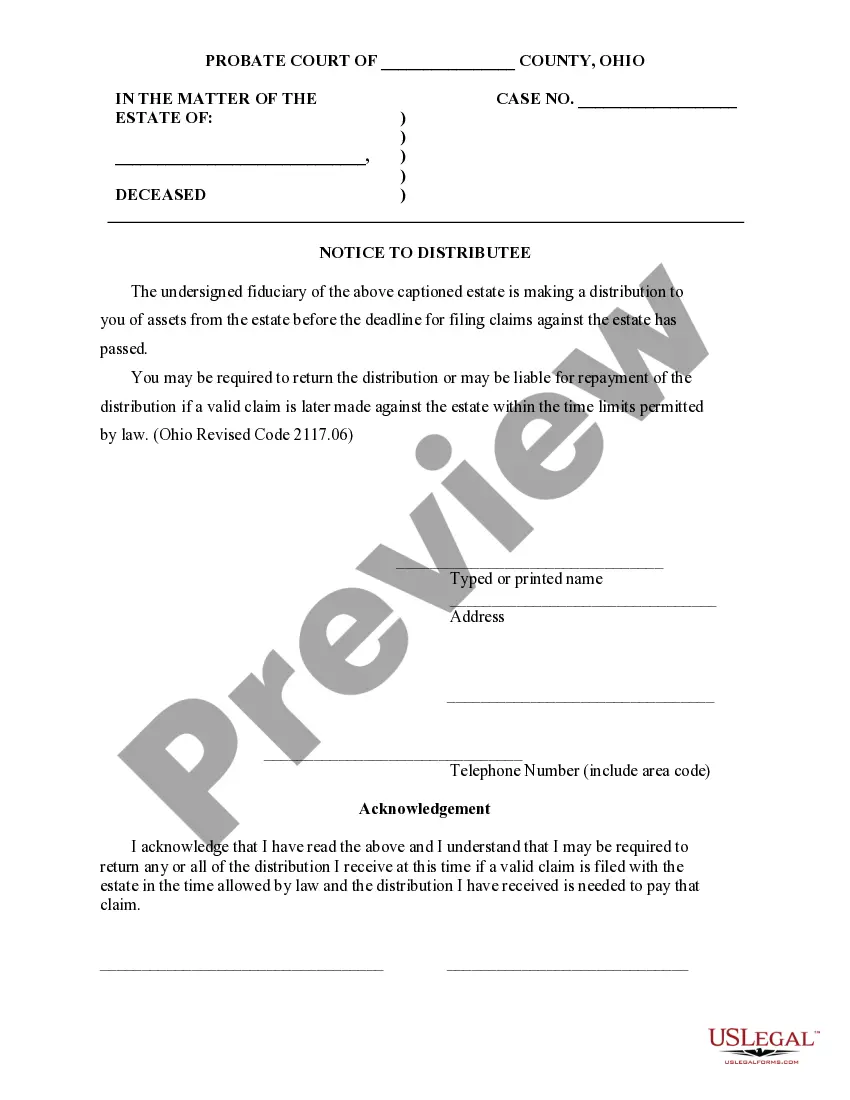
Ohio Notice to Distributee
Overview of this form
The Notice to Distributee is a legal document used in the administration of a deceased person's estate in Ohio. This form serves to inform distributees about the distribution of assets from the estate before the deadline for filing claims has expired. It protects the fiduciary by providing a warning that the distributee may need to return the assets if valid claims against the estate are made later. This form differs from other estate-related forms by focusing specifically on the distribution of assets and the associated legal obligations of the distributee.
Main sections of this form
- Case number section to identify the estate.
- Fiduciary's name and contact information.
- Clear statement regarding the distribution of estate assets.
- Disclaimer about the potential need to return distributions if claims arise.
- Distributee's acknowledgment and signature section.
- Date field to record when the form is completed.


When this form is needed
This form should be used when a fiduciary, such as an executor or administrator of an estate, is making distributions to beneficiaries while the estate is still open. It's particularly important in situations where claims against the estate could still be filed. Using this form ensures all parties are aware of their rights and responsibilities concerning the assets they receive.
Intended users of this form
This form is intended for:
- Fiduciaries managing a decedent's estate in Ohio.
- Beneficiaries (distributees) who are receiving assets from the estate.
- Legal professionals assisting with estate administration.
Steps to complete this form
- Fill in the name of the deceased in the designated space.
- Enter the estate's case number to ensure proper identification.
- Provide the fiduciary's name and contact details, including an address and telephone number.
- Indicate the date on which the distribution is being acknowledged.
- Have the distributee review the form and sign it to confirm their understanding of the conditions of the distribution.
Does this form need to be notarized?
This form does not typically require notarization unless specified by local law. However, it is important to check local regulations to ensure compliance with any specific notarization requirements that may apply in Ohio.
Get your form ready online
Our built-in tools help you complete, sign, share, and store your documents in one place.
Make edits, fill in missing information, and update formatting in US Legal Forms—just like you would in MS Word.
Download a copy, print it, send it by email, or mail it via USPS—whatever works best for your next step.
Sign and collect signatures with our SignNow integration. Send to multiple recipients, set reminders, and more. Go Premium to unlock E-Sign.
If this form requires notarization, complete it online through a secure video call—no need to meet a notary in person or wait for an appointment.
We protect your documents and personal data by following strict security and privacy standards.

Make edits, fill in missing information, and update formatting in US Legal Forms—just like you would in MS Word.

Download a copy, print it, send it by email, or mail it via USPS—whatever works best for your next step.

Sign and collect signatures with our SignNow integration. Send to multiple recipients, set reminders, and more. Go Premium to unlock E-Sign.

If this form requires notarization, complete it online through a secure video call—no need to meet a notary in person or wait for an appointment.

We protect your documents and personal data by following strict security and privacy standards.
Avoid these common issues
- Not including the case number, which can delay processing.
- Forgetting to sign the form, which renders it invalid.
- Failing to provide complete contact information for the fiduciary.
- Neglecting to explain the conditions of the distribution clearly to the distributee.
Benefits of using this form online
- Convenient downloading options across multiple formats, including Word and ASCII.
- Easy editing to fit specific circumstances related to the estate.
- Access to forms drafted by licensed attorneys, ensuring legal compliance.
Main things to remember
- The Notice to Distributee informs beneficiaries of asset distributions and potential future claims.
- Fiduciaries must be clear about the legal implications of the distribution.
- Properly completing and signing this form can help prevent future legal issues.
Looking for another form?

Form popularity
FAQ
Executor Fees: Executors can be compensated for the responsibility taken and the time and effort they put in to complete the estate process. Executor fees in Ohio are set by statute.: 4% of the first $100,000 of probate assets; 3% of the next $300,000; and 2% of the assets above $400,000.
The Ohio small estate affidavit, or the 'Application to Relieve Estate from Administration,' is used to ask the probate court to be relieved of the formal probate process in Ohio. There are certain requirements that must be met before this form of estate administration can be used.
Generally, only assets that the deceased person owned in his or her name alone go through probate. Everything else can probably be transferred to its new owner without probate court approval.
Q: How Long Does an Executor Have to Distribute Assets From a Will? A: Dear Waiting: In most states, a will must be executed within three years of a person's death.
How Long Does Formal Probate Take? Most straightforward probate cases can be wrapped up within about nine months after the executor or administrator is appointed. Creditors have six months to file a claim, so probate must last at least that long.
Generally, an executor has 12 months from the date of death to distribute the estate. This is known as 'the executor's year'. However, for various reasons the executor may have been delayed and has not distributed the estate within this time frame.
An Ohio estate qualifies as a small estate if the value of the probate estate is: $35,000 or less; OR. $100,000 or less and the entire estate goes to the decedent's surviving spouse whether under a valid will or under intestacy.
Summary Release from Administration Avoids probate entirely if either: The estate's worth less than $45,000 and the surviving spouse is the sole heir. The estate's worth less than $5,000 and/or the decedent's final expenses total no more than $5,000.