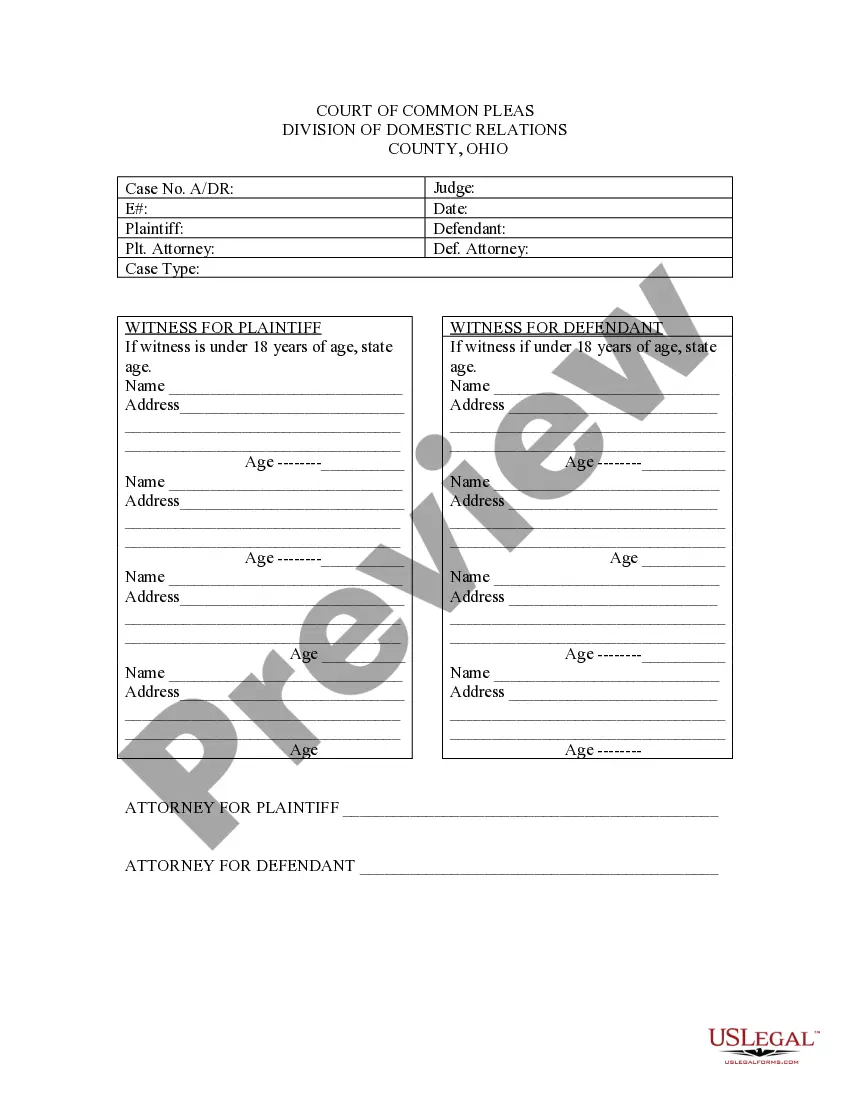
Ohio Witness List
About this form
The Witness List is a legal document used to identify and outline individuals expected to testify in a legal proceeding. This form serves as an essential tool for both parties involved, ensuring that all relevant witnesses are accounted for and their information is accessible. Unlike other legal forms, the Witness List focuses specifically on documentation of witnesses rather than evidence or other case materials.
Key components of this form
- Names of witnesses for both parties involved in the case.
- Contact information, including the addresses of all listed witnesses.
- Identification of the attorneys representing each party.
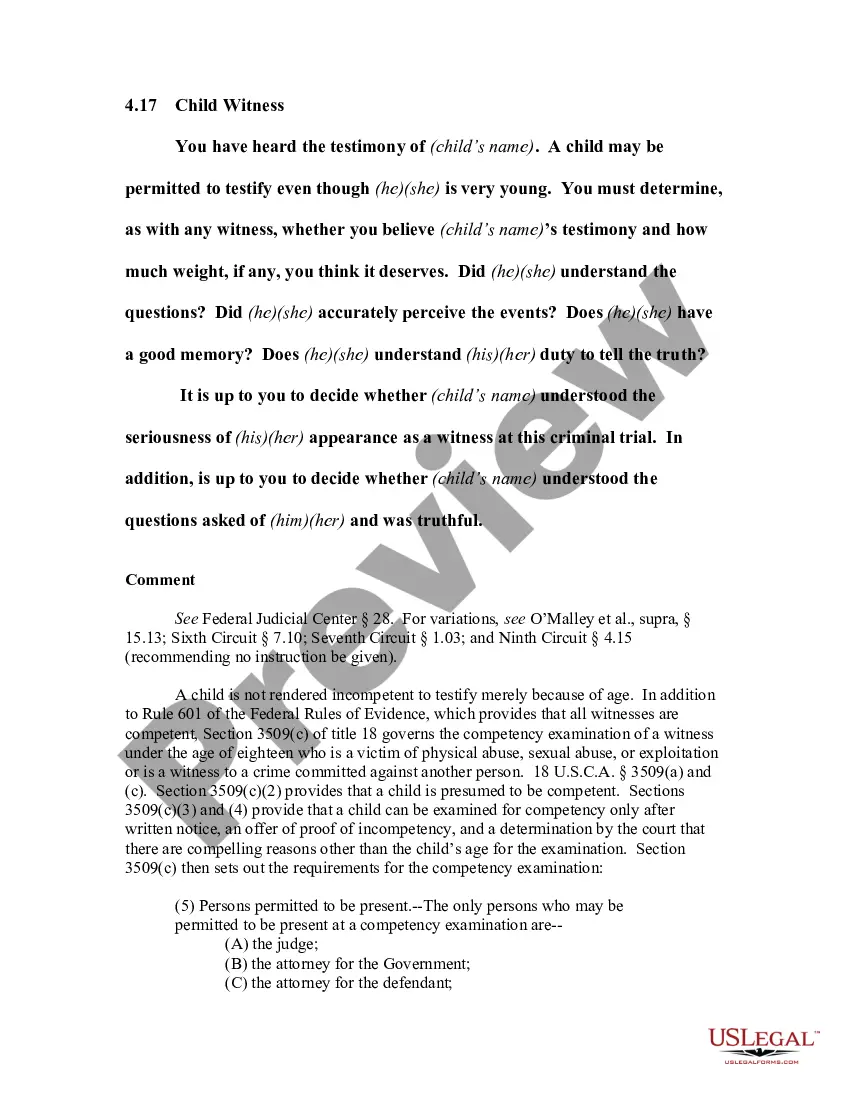
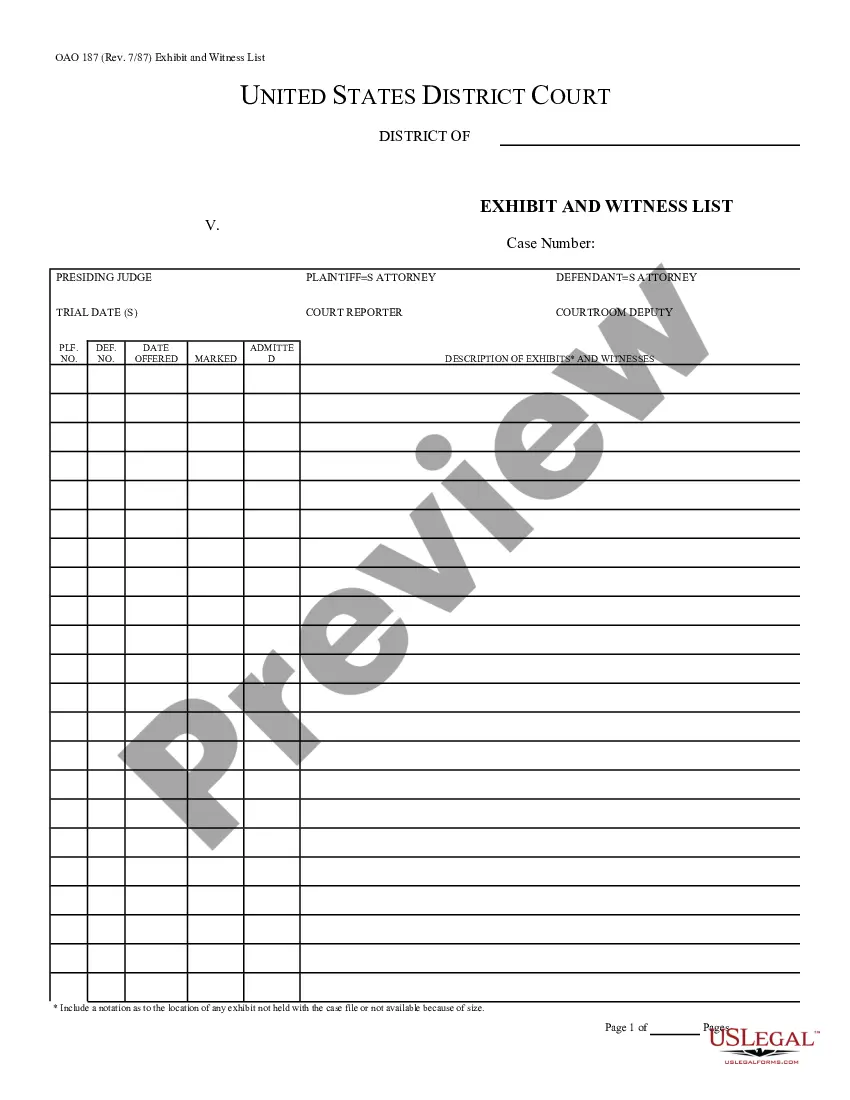


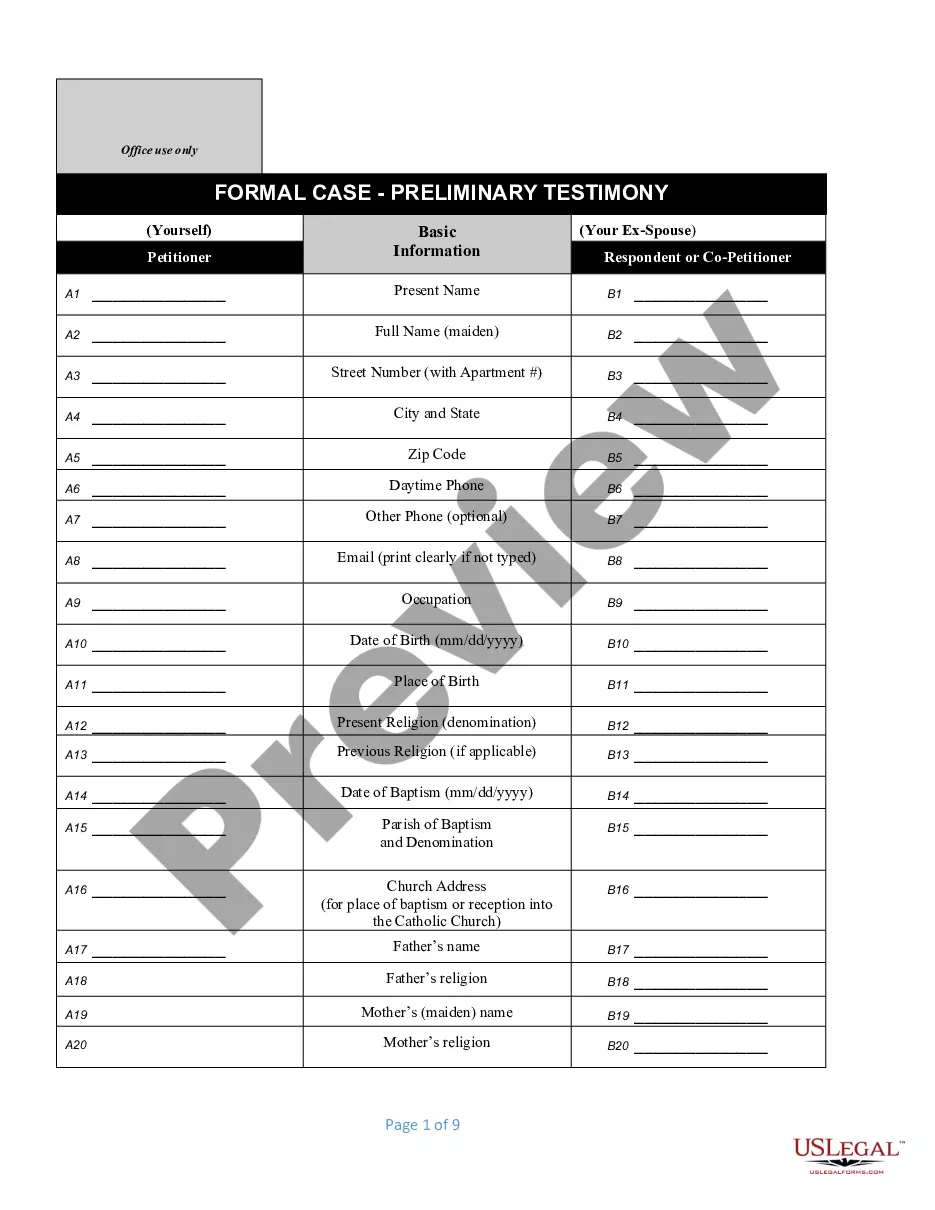
When to use this document
This form should be used when preparing for a trial, hearing, or deposition to ensure that all witnesses are formally recognized and documented. It is particularly useful in legal proceedings where multiple witnesses are involved, allowing parties to organize their testimony and streamline the courtroom process.
Who should use this form
- Attorneys representing plaintiffs or defendants in legal cases.
- Individuals involved in civil or criminal litigation who need to list witnesses.
- Legal assistants or paralegals assisting with courtroom preparations.
Steps to complete this form
- Identify the parties involved in the case, including their attorneys.
- List the names of all witnesses expected to testify.
- Provide the contact information, including mailing addresses, for each witness.
- Ensure the document is signed and dated by the appropriate parties.
Notarization requirements for this form
Notarization is not commonly needed for this form. However, certain documents or local rules may make it necessary. Our notarization service, powered by Notarize, allows you to finalize it securely online anytime, day or night.
Get your form ready online
Our built-in tools help you complete, sign, share, and store your documents in one place.
Make edits, fill in missing information, and update formatting in US Legal Forms—just like you would in MS Word.
Download a copy, print it, send it by email, or mail it via USPS—whatever works best for your next step.
Sign and collect signatures with our SignNow integration. Send to multiple recipients, set reminders, and more. Go Premium to unlock E-Sign.
If this form requires notarization, complete it online through a secure video call—no need to meet a notary in person or wait for an appointment.
We protect your documents and personal data by following strict security and privacy standards.

Make edits, fill in missing information, and update formatting in US Legal Forms—just like you would in MS Word.

Download a copy, print it, send it by email, or mail it via USPS—whatever works best for your next step.

Sign and collect signatures with our SignNow integration. Send to multiple recipients, set reminders, and more. Go Premium to unlock E-Sign.

If this form requires notarization, complete it online through a secure video call—no need to meet a notary in person or wait for an appointment.

We protect your documents and personal data by following strict security and privacy standards.
Mistakes to watch out for
- Failing to include complete contact information for each witness.
- Omitting witnesses who may have crucial testimony.
- Incorrectly identifying the parties or their attorneys, leading to confusion in the proceedings.
Benefits of using this form online
- Easy access to editable legal templates that can be tailored to specific cases.
- Instant download options in Word and fillable PDF formats.
- Convenient way to organize witness information efficiently.
Looking for another form?
Form popularity
FAQ
There is no formula for the calculation of spousal support (formerly known as alimony) in Ohio. Spousal support is determined on a case-by-case basis after a consideration of several factors set forth in Ohio Revised Code Section 3105.18.
The court presumes that the spouses contribute equally to all the marital property they acquire during the marriage. At divorce, the court divides the marital property equally between the spouses unless an unbalanced result is more equitable. The court can include either spouse's separate property, too. (Ohio Rev.
There's no such things as "alimony" in Ohio anymore. It has been replaced by "spousal support," which refers to payments from one spouse to another during or after a divorce. Either spouse can be ordered to pay support to the otherit's based on income and resources, not gender.
The fault-based grounds for divorce in Ohio include: adultery, fraudulent inducement to marry, extreme cruelty, gross neglect, habitual drunkenness, imprisonment, and willful absence for more than one year, Should I file for a fault-based divorce or a no-fault divorce?
The duration of payments is determined by a judge in Ohio family court. Alimony length is usually based on length of marriage - one commonly used standard for alimony duration is that 1 year of alimony is paid every three years of marriage (however, this is not always the case in every state or with every judge).